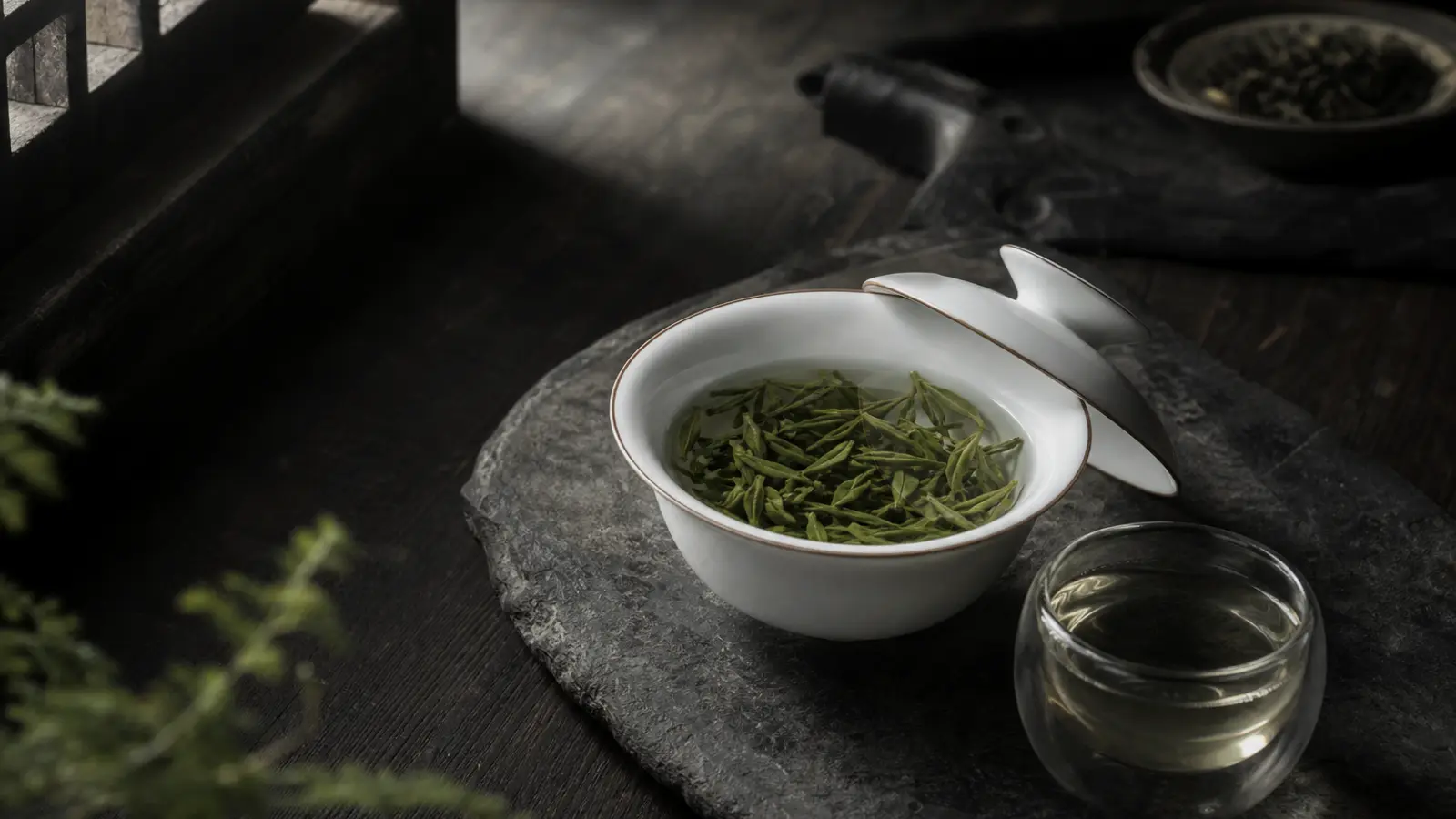

The relationship between tea and dementia is one of the most well-documented associations in nutritional epidemiology. A meta-analysis pooling seven prospective cohort studies and 410,951 participants found that tea drinkers had 29% lower risk of all-cause dementia than non-tea drinkers — a relative risk of 0.71. That is not a small signal buried in noise. It is a consistent finding across hundreds of thousands of person-years of follow-up.
This article explains what that number means, what drives it mechanistically, where the evidence has real limits, and how to use it practically.
What the 410,000-Person Meta-Analysis Actually Found
The headline figure — 29% lower dementia risk — comes from a meta-analysis of seven prospective cohort studies. Prospective cohorts follow people forward in time, recording their habits and tracking health outcomes. They sit one level below randomized controlled trials in the evidence hierarchy, but they are far more feasible for a condition like dementia, which develops over decades.
Breaking the 29% figure down by dementia subtype reveals something important:
| Dementia Type | Risk Reduction | Relative Risk |
|---|---|---|
| All-cause dementia | 29% | 0.71 |
| Alzheimer’s disease | 12% | 0.88 |
| Vascular dementia | 25% | 0.75 |
The larger reduction for vascular dementia than Alzheimer’s is biologically plausible. Vascular dementia results from reduced blood flow to the brain, and tea’s established cardiovascular benefits — lower blood pressure, improved endothelial function — map directly onto that pathway. Alzheimer’s disease has a more complex and less vascular pathology, which likely explains the smaller effect size.
This is Tier 2 evidence with Grade A data quality: the best observational evidence available, supported by plausible biological mechanisms, but not yet confirmed by large-scale clinical trials.
The Mechanisms: What Tea Does to the Brain

Epidemiology shows association. Mechanism explains why that association might be causal. For tea and brain health, the mechanistic case is unusually strong.
EGCG and Amyloid-Beta
EGCG (epigallocatechin gallate, 表沒食子兒茶素沒食子酸酯) is the primary catechin in green tea and the most-studied polyphenol in neuroprotection research. In laboratory and animal studies, EGCG inhibits the formation of amyloid-beta (Aβ) plaques — the protein aggregates that accumulate in the brains of people with Alzheimer’s disease and are considered a central feature of its pathology.
EGCG appears to work by binding to amyloid-beta peptides and preventing them from aggregating into the toxic oligomeric forms that damage neurons. It also appears to promote the clearance of existing aggregates through autophagy pathways. These findings come from in vitro and animal studies; direct demonstration in living human brains remains an active area of research.
EGCG and Tau Protein
The second major pathological feature of Alzheimer’s is tau hyperphosphorylation — the formation of neurofibrillary tangles inside neurons. EGCG inhibits several of the kinases responsible for abnormal tau phosphorylation. Again, this evidence base is primarily preclinical, but the dual action on both hallmarks of Alzheimer’s pathology makes EGCG a genuinely interesting molecule.
L-Theanine and Alpha Brain Waves
L-theanine (茶氨酸) is an amino acid found almost exclusively in Camellia sinensis. It crosses the blood-brain barrier and promotes alpha brain wave activity — the oscillation pattern associated with relaxed alertness, focus without anxiety, and creative cognition. Some research suggests L-theanine may also support neuroplasticity, the brain’s capacity to form and reorganize synaptic connections.
Matcha (抹茶) and gyokuro (玉露), both shade-grown Japanese teas, accumulate significantly more L-theanine than field-grown teas because shade stress increases amino acid synthesis in the leaf. If the alpha-wave pathway matters — and the evidence suggests it does — these are the teas best positioned to deliver it. Uji and Shizuoka are the two regions most associated with high-grade shade-grown production.
Caffeine as a Neuroprotectant
Caffeine’s relationship with the brain extends well beyond alertness. Multiple independent studies have found inverse associations between moderate caffeine consumption and Parkinson’s disease risk, and several have found similar patterns for Alzheimer’s. The proposed mechanisms include adenosine receptor antagonism — caffeine blocks adenosine A2A receptors in the brain, which may reduce neuroinflammation and beta-amyloid production.
Tea delivers caffeine at moderate, sustained doses rather than the sharp peaks of espresso. That pharmacokinetic profile — especially when combined with L-theanine, which smooths the caffeine curve — may matter for neuroprotection.
The Critical Caveat: What This Evidence Cannot Prove
Epidemiology has irreducible limitations, and intellectual honesty requires stating them clearly.
Confounding is real. Tea drinkers differ from non-tea drinkers in ways beyond tea consumption. In many of the study populations, particularly East Asian cohorts, tea drinking correlates with higher education, better diet quality, higher socioeconomic status, and non-smoking — all factors that independently protect against dementia. Researchers use statistical adjustment to control for these variables, but confounding can never be fully eliminated in observational data.
Causation is not proven. The 29% risk reduction shows a strong, consistent association. The mechanistic evidence provides a biologically plausible causal pathway. But a large randomized controlled trial — giving some people tea and others a placebo for 20 years and measuring dementia outcomes — has not been done. Without that, “association” is the accurate word.
Dose matters, and more is not better. UK Biobank data using Mendelian randomization — a method that partially mimics random assignment by using genetic variants as proxies — identified a possible association between very high tea consumption (above roughly 13 cups per day) and reduced brain grey matter volume. This suggests an inverted U-shaped dose-response curve: moderate consumption appears protective, but excessive consumption may not be. For a full discussion of safe daily limits across health outcomes, see how much tea is too much.
The practical implication: 2–5 cups per day, or 1–2 gongfu sessions using adequate leaf weight and water, sits in the range where the evidence points toward benefit.
Which Tea Has the Strongest Evidence for Brain Health?

The honest answer is that the evidence base is strongest for green tea, because most studies specifically measured green tea consumption and most mechanistic research has focused on EGCG, which is far more concentrated in unoxidized leaves.
That said, all Camellia sinensis teas contain relevant compounds:
- Green tea (綠茶): Highest EGCG content; most studied; strongest direct evidence
- Matcha (抹茶) and gyokuro (玉露): Highest L-theanine concentrations; potentially additive benefit via alpha-wave pathway
- Oolong (烏龍茶): Partially oxidized; lower EGCG than green, higher than black; moderate polyphenol content
- Black tea (紅茶): EGCG converted to theaflavins and thearubigins during oxidation; some neuroprotective activity in these compounds; weaker direct evidence
- Pu-erh (普洱茶): Complex secondary metabolites from microbial fermentation; limited specific dementia research, but cardiovascular benefits are documented
If I were choosing a tea specifically for the cognitive evidence base, I would lean toward a quality Japanese green tea — sencha (煎茶), gyokuro, or matcha — brewed at 70–80°C to preserve catechins and amino acids. But drinking a high-quality black tea you enjoy consistently is almost certainly better than drinking a green tea you find unpleasant and will eventually stop drinking.
Practical Application: How to Use This Evidence
The dementia risk reduction appears to accumulate over years and decades of consistent consumption, not from occasional drinking. That reframes the practical question from “what do I drink today?” to “what can I maintain as a daily practice?”
For daily consumption:
- 2–5 cups of green, oolong, or black tea covers the range associated with the signal in the data
- 1–2 gongfu sessions using 5–8g of leaf in a 100–150ml gaiwan (蓋碗) provides concentrated exposure to active compounds
- Brewing temperature matters: catechins in green tea degrade at high temperatures; brew at 70–80°C rather than boiling to maximize EGCG extraction — see the complete temperature reference for specifics
What to avoid:
- Adding large amounts of milk may reduce polyphenol bioavailability, though the effect size in humans is debated
- Exceeding 13 cups per day offers no additional benefit and may carry risk
- Relying on tea as a substitute for established dementia risk-reduction behaviors — physical exercise, sleep quality, blood pressure management, social engagement — which have stronger causal evidence
Situating This Evidence Honestly
The 29% reduction in dementia risk associated with tea consumption is one of the largest single-factor associations in the epidemiology of this disease. The mechanistic evidence — particularly EGCG’s dual action on amyloid-beta and tau phosphorylation — makes a causal relationship biologically credible. The dose-response data suggests moderation is key.
What this evidence does not provide: proof that drinking tea will prevent any individual from developing dementia, and certainly no claim that tea reverses cognitive decline already underway.
What it does provide: a strong, consistent signal across nearly half a million people that regular tea consumption is associated with meaningful protection against one of the most feared conditions of aging — and a plausible mechanism for why.
Drinking 3 cups of green tea daily is not a medical intervention. It is a low-cost, low-risk habit with centuries of cultural practice behind it and increasingly credible science pointing in the same direction. That combination is worth taking seriously.