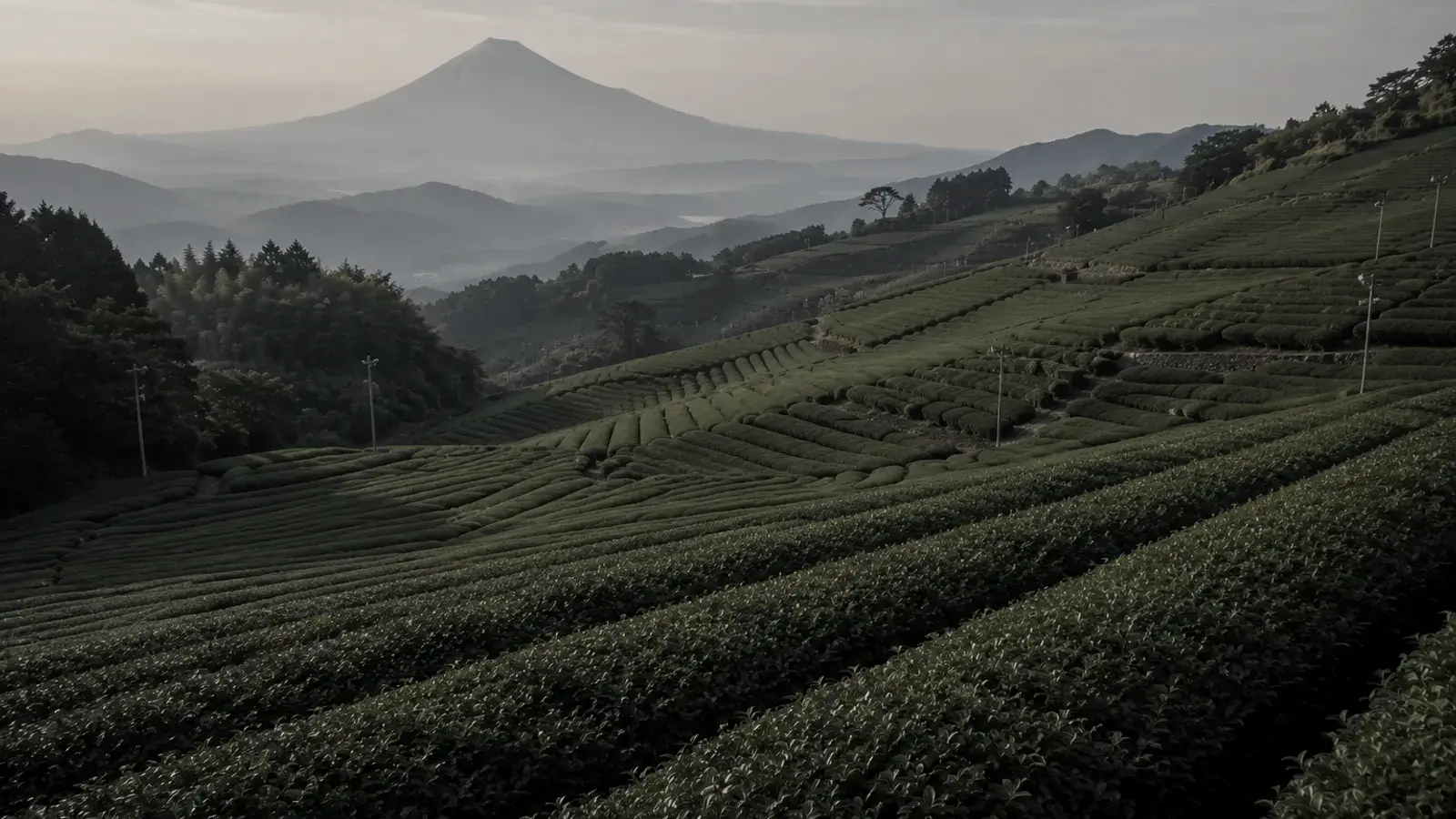
Shizuoka (静岡) is where Japanese tea gets made. Not in the romantic, ceremonial sense that Uji commands — in the literal, industrial sense that keeps a nation of 125 million people supplied with green tea. Approximately 40% of Japan’s total tea production comes from this prefecture on the central Pacific coast of Honshu, making Shizuoka not merely important but foundational to understanding what Japanese tea is.
That scale creates a reflex among serious tea drinkers to look past Shizuoka toward more storied regions. This is a mistake. The Shizuoka story is not a story of compromise — it’s a story of range. The same prefecture that produces bulk green tea destined for vending machines and ペットボトル茶 (petbotoru-cha, bottled tea drinks) also grows competition-winning single-cultivar sencha from mountain valleys with the complexity to hold its own against Japan’s finest. Understanding Shizuoka means understanding how both things can be true simultaneously.
Geography & Location
Shizuoka prefecture sits at approximately 35.0°N, 138.4°E, occupying the central stretch of Japan’s Pacific coast between the Izu Peninsula and the Enshūnada Sea. The prefecture is defined by the tension between two geographic forces: the Pacific Ocean to the south and east, and the steep ridgeline of the Southern Alps — the Akaishi Mountains (赤石山脈) — rising sharply to the north.
Tea grows in the transition zone between these two forces, on hillsides, plateaus, and river valleys between 100m and 600m elevation. This is not high-altitude tea country by global standards — Darjeeling gardens run to 2000m, and top-tier Taiwanese oolongs sit above 1500m — but elevation is not the only lever for quality. In Shizuoka, the combination of maritime moisture, volcanic soils, and river valley fog creates a different kind of growing advantage.
The terrain is carved by three major river systems flowing south from the mountains to the sea: the Abe (安倍川), the Oi (大井川), and the Tenryu (天竜川). These rivers shape the most important tea sub-zones, depositing alluvial soils on their banks and creating the valley microclimates that distinguish one Shizuoka tea from another.
Mount Fuji (富士山) stands at the northeastern edge of the prefecture, visible from tea gardens across the eastern growing areas. Its presence is more than symbolic — Fuji’s periodic volcanic activity over millennia has deposited ash across the region’s soils, with direct consequences for terroir.
Sub-Regions at a Glance
Shizuoka is not monolithic. The prefecture contains distinct growing zones with meaningfully different characters:
Makinohara (牧之原) occupies the largest tea-growing plateau in Japan, a broad highland between the Oi River and the coast. This is the commercial engine — flat enough to mechanize, large enough to produce at scale. Fukamushi sencha is the dominant product, and Makinohara’s teas are the definition of mainstream Japanese green tea: reliable, accessible, and often excellent value when sourced carefully.
Kawane (川根) follows the Oi River valley into the mountains, with gardens climbing steep hillsides at elevations approaching 500m. The mountain valley setting creates more temperature fluctuation between day and night, longer cool seasons, and a more delicate, aromatic sencha character. Kawane teas are lighter-bodied than Makinohara’s, with more obvious floral and fresh grass notes.
Hon Yama (本山) sits in the Abe River valley directly north of Shizuoka city, at the highest elevations in the prefecture. Hon Yama producers favor asamushi (浅蒸し, light-steam) processing, which preserves the tea’s natural aroma at the cost of some body. The result is Shizuoka’s most aromatically expressive sencha — a style that rewards careful brewing attention.
Tenryu (天竜) occupies the remote northern reaches of the prefecture along the Tenryu River. Lower population density, steeper terrain, and a culture of organic production have made this area a home for non-Yabukita cultivars and wild-style farming. Tenryu teas are harder to find outside Japan but represent some of Shizuoka’s most distinctive character.
Climate & Elevation
The climate of Shizuoka tea country is warm temperate with a pronounced Pacific maritime influence. Annual rainfall runs between 2,000 and 2,500mm — placing Shizuoka among the wettest tea-growing regions on earth, comparable to Darjeeling’s wettest zones but spread more evenly across the calendar.
This rainfall is not accidental — it is why tea growing concentrated here in the first place. Tea plants are water-intensive and prefer acidic, moist soils. Shizuoka’s mountains intercept Pacific moisture systems, creating consistent fog and cloud cover that reduces direct sun stress on leaves. Fog functions similarly to the shade used in gyokuro production, slowing leaf development and concentrating amino acid content, particularly L-theanine (テアニン), which drives the umami character Japanese green tea is known for.
Winters are mild by Japanese standards. The Pacific acts as a thermal buffer, keeping temperatures above the threshold at which frost damages tea plants. The occasional cold snap causes concern in the lower elevation gardens, but most of Shizuoka’s growing areas experience fewer than 10 frost days per year — far fewer than inland regions at comparable latitudes.
Summers are warm and humid. The first flush (一番茶, ichibancha) arrives in late April to early May, when the accumulated amino acids of winter storage express themselves in the new season’s leaves. This timing gives Shizuoka’s tea its characteristic balance of sweetness and savory depth.
Elevation variation across the prefecture creates meaningful microclimatic differences. Lower gardens on the Makinohara plateau (150–250m) experience warmer temperatures and faster leaf development, producing the dense, full-leafed crops that make fukamushi processing appropriate. Higher valley gardens in Kawane and Hon Yama (400–600m) experience cooler temperatures, slower growth, and the kind of complex amino acid accumulation that produces more nuanced flavor profiles.
Soil & Terroir
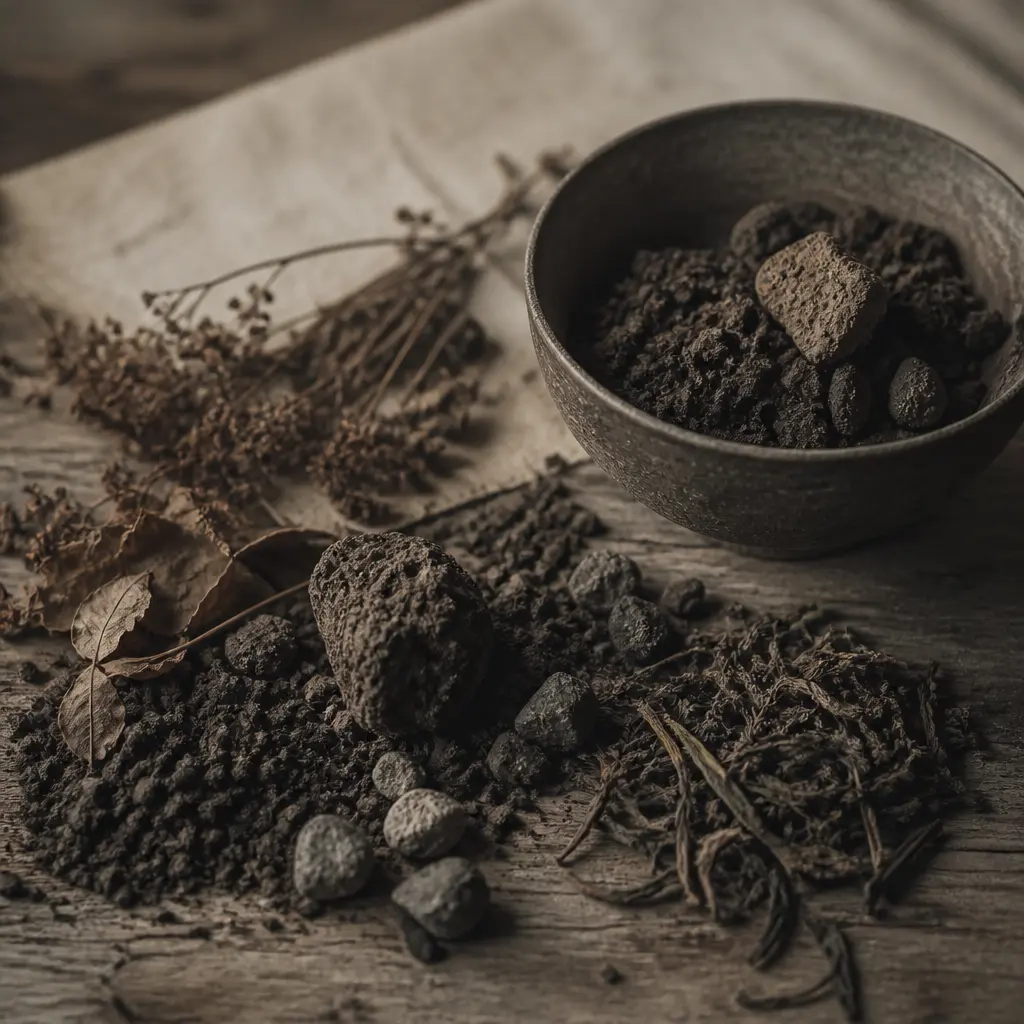
Two soil types define Shizuoka’s agricultural character, and their interaction creates a growing medium that tea plants find genuinely favorable.
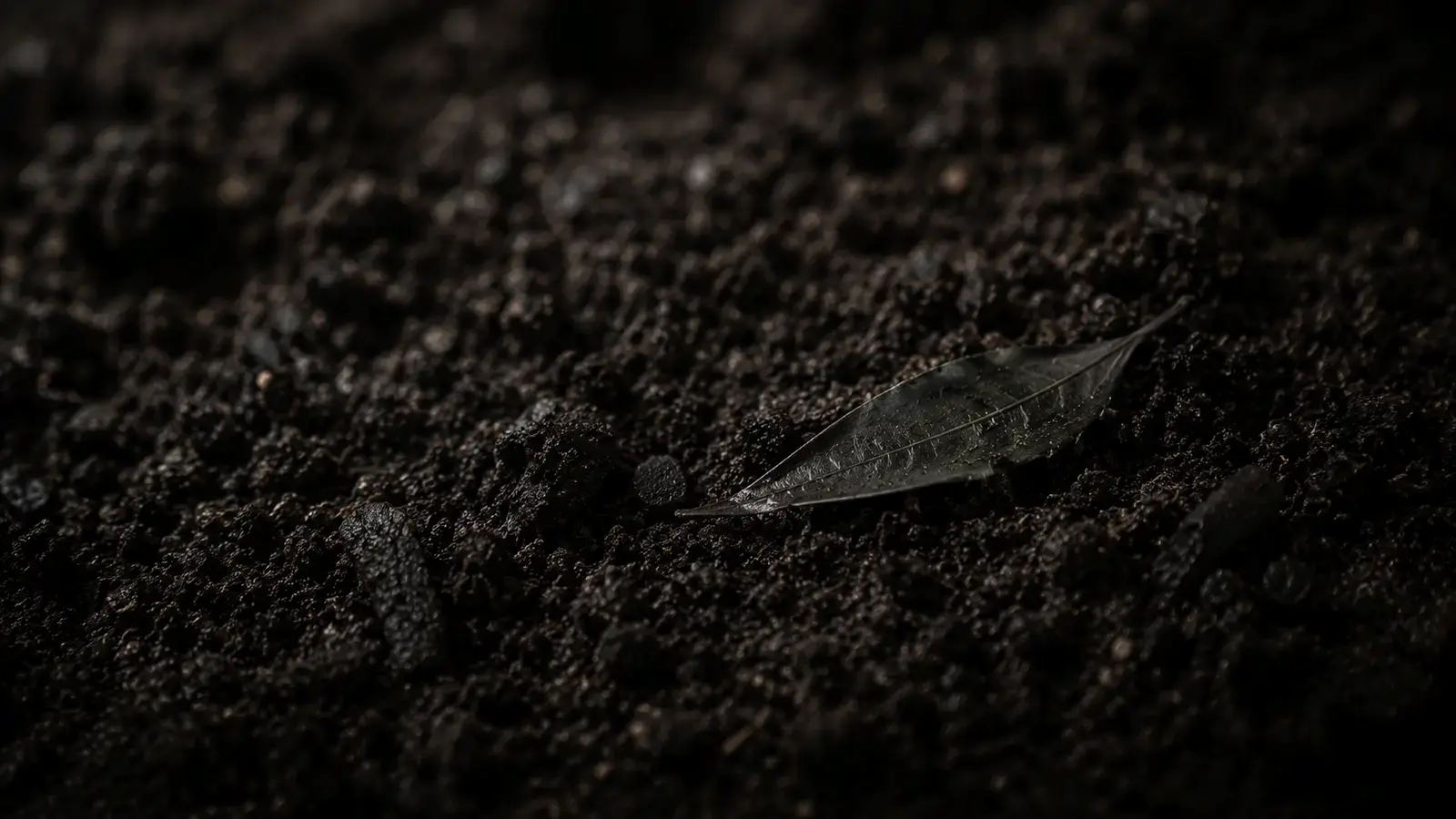
Volcanic ash deposits from Mount Fuji and ancient volcanic activity across the region have created a soil profile rich in silica and minerals, with excellent drainage and a slightly acidic pH (approximately 4.5–5.5) that tea plants prefer. Volcanic soils tend toward low organic matter content on their own, which limits their fertility — but Shizuoka’s combination of volcanic parent material and alluvial deposits from the three major river systems creates a more balanced profile.
Alluvial soils along the river valleys — particularly in Kawane and Hon Yama — are deeper, richer in organic matter, and more moisture-retentive than the plateau soils of Makinohara. This distinction matters: valley soils encourage the kind of slow, steady root development that builds complexity in the finished tea.
The Makinohara plateau sits on a different soil profile — well-drained, moderately fertile, and well-suited to mechanized cultivation. These soils produce reliable, high-yield crops. They are not the soils of grand crus, but they are excellent farming soils, which explains why Makinohara became the commercial backbone of Japanese tea production.
Multiple sources note that Shizuoka’s soils benefit from what Japanese agronomists describe as 赤土 (akatsuchi, red clay soil) deposits in some areas — iron-rich, slightly acidic, and excellent for tea root development. This soil type appears in several of Japan’s finest green tea regions and likely contributes to the umami intensity that characterizes good Shizuoka sencha.
Key Cultivars & Tea Types
The Yabukita Question
No discussion of Shizuoka cultivars avoids Yabukita (やぶきた). This cultivar was selected in Shizuoka by breeder Sugiyama Hikosaburo (杉山彦三郎) in the early 20th century and released for widespread cultivation in the 1950s. Its combination of frost resistance, reliable yield, and balanced flavor — clean sweetness, moderate umami, fresh vegetal notes — made it the obvious choice for post-war agricultural expansion.
Today, approximately 75% of all Japanese tea comes from Yabukita. In Shizuoka specifically, the proportion may be higher in commercial growing areas. Yabukita is, by any measure, a success story of agricultural breeding.
It is also, by now, a ceiling. Yabukita’s dominance has produced remarkable consistency across the Japanese market, but consistency comes at the cost of variety. This is why Shizuoka’s cultivar diversity movement matters.
Single-Cultivar Alternatives
Shizuoka is where Japan’s cultivar experimentation happens at meaningful scale. The prefecture’s size and infrastructure make it the natural testing ground for new varieties, and producers here are increasingly committing to single-cultivar lots that express distinct flavor signatures.
Okumidori (おくみどり) is a late-season cultivar with notably high amino acid content, producing a rich, deep umami flavor and a dense green liquor. It is late-budding — a hedge against late frost risk — and produces well in Shizuoka’s conditions.
Saemidori (さえみどり) was developed as a cross between Yabukita and Asatsuyu, inheriting the latter’s high L-theanine content. The result is a tea with bright, almost sweet umami — closer to gyokuro character than standard sencha — with a pale green liquor and delicate aromatics.
Tsuyuhikari (つゆひかり) has earned a following for its aromatic distinctiveness. The name translates roughly as “morning dew sparkle,” and the tea delivers on this — more floral and perfumed than standard Yabukita, with a sweetness that sits on the front of the palate.
Sofu (そうふう) is an aromatic cultivar with a slightly unusual profile for Japanese green tea — a pronounced floral character with hints of what some describe as muscatel, making it an interesting bridge for wine drinkers entering Japanese tea.
Benifuuki (べにふうき) stands apart from the others. Originally developed for black tea production (its name reflects red tea heritage), it has attracted attention for its methyl catechin content, which research suggests may help reduce allergic responses — a significant marketing point in Japan’s allergy-conscious culture. As a green tea, Benifuuki produces a more astringent, assertive cup than the amino-acid-forward cultivars above. As a black tea, Shizuoka-grown Benifuuki occupies an interesting niche — one of Japan’s few domestically produced black teas with real character.
Processing Traditions
The Standard: Sencha (煎茶)
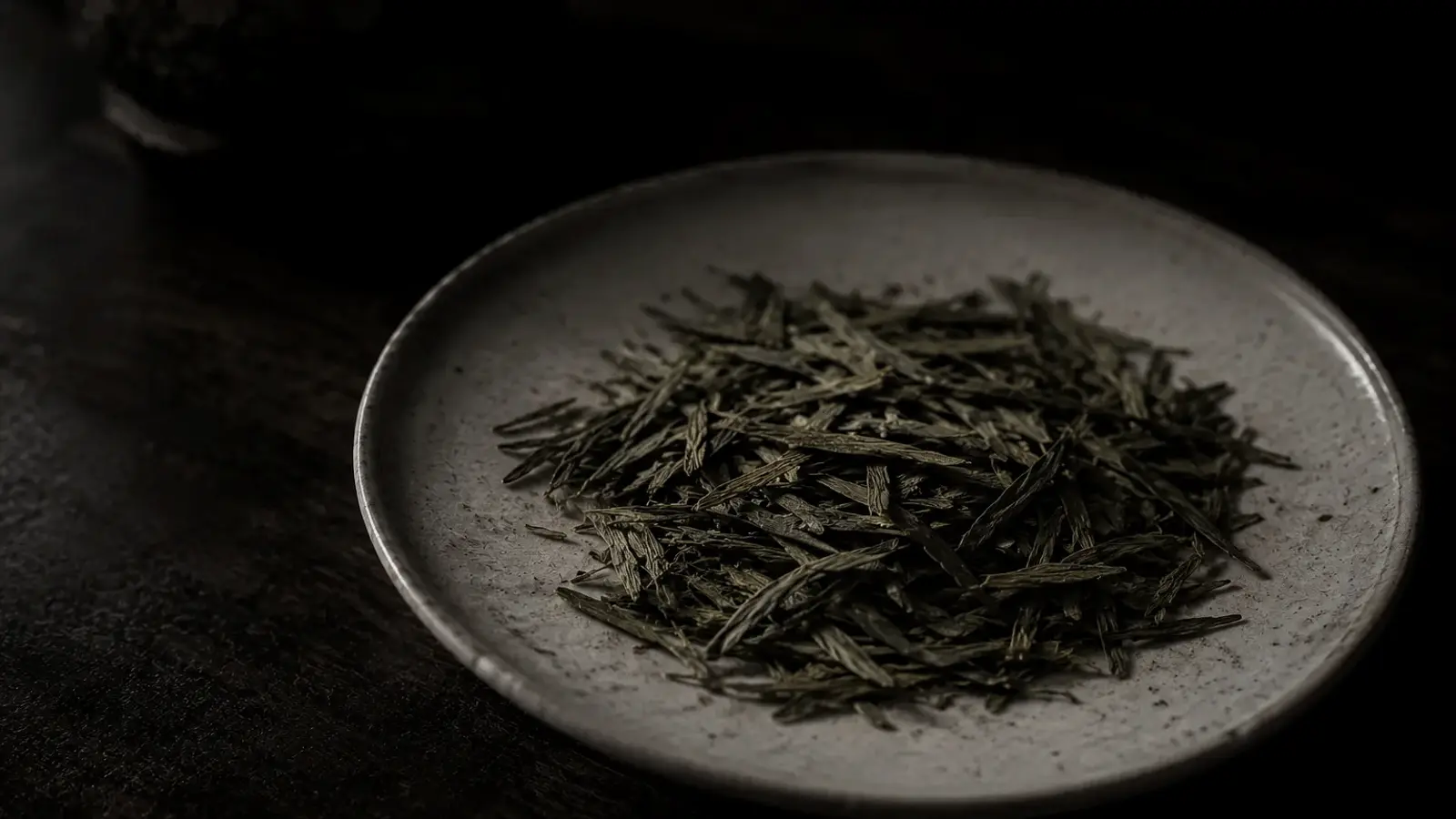
Shizuoka’s processing tradition is built on the standard Japanese steam-kill-green method used for sencha production. Fresh leaves are steamed immediately after harvest to halt oxidation, then rolled and dried into the needle-shaped leaves that define Japanese green tea’s visual identity.
The steaming step is where Shizuoka made its most significant contribution to Japanese tea processing.
Fukamushi: Shizuoka’s Innovation
Fukamushi sencha (深蒸し茶, deep-steamed tea) was developed in Shizuoka in the 1960s as a response to a specific problem: the region’s nutrient-dense, thick-leafed crops produced sencha that could be overly vegetal or bitter with standard steaming times of 30–45 seconds.
Fukamushi extends steaming to 90–120 seconds. The longer exposure to heat breaks down cell walls more completely, softening the leaf structure and fundamentally changing how the finished tea brews. The results are distinctive:
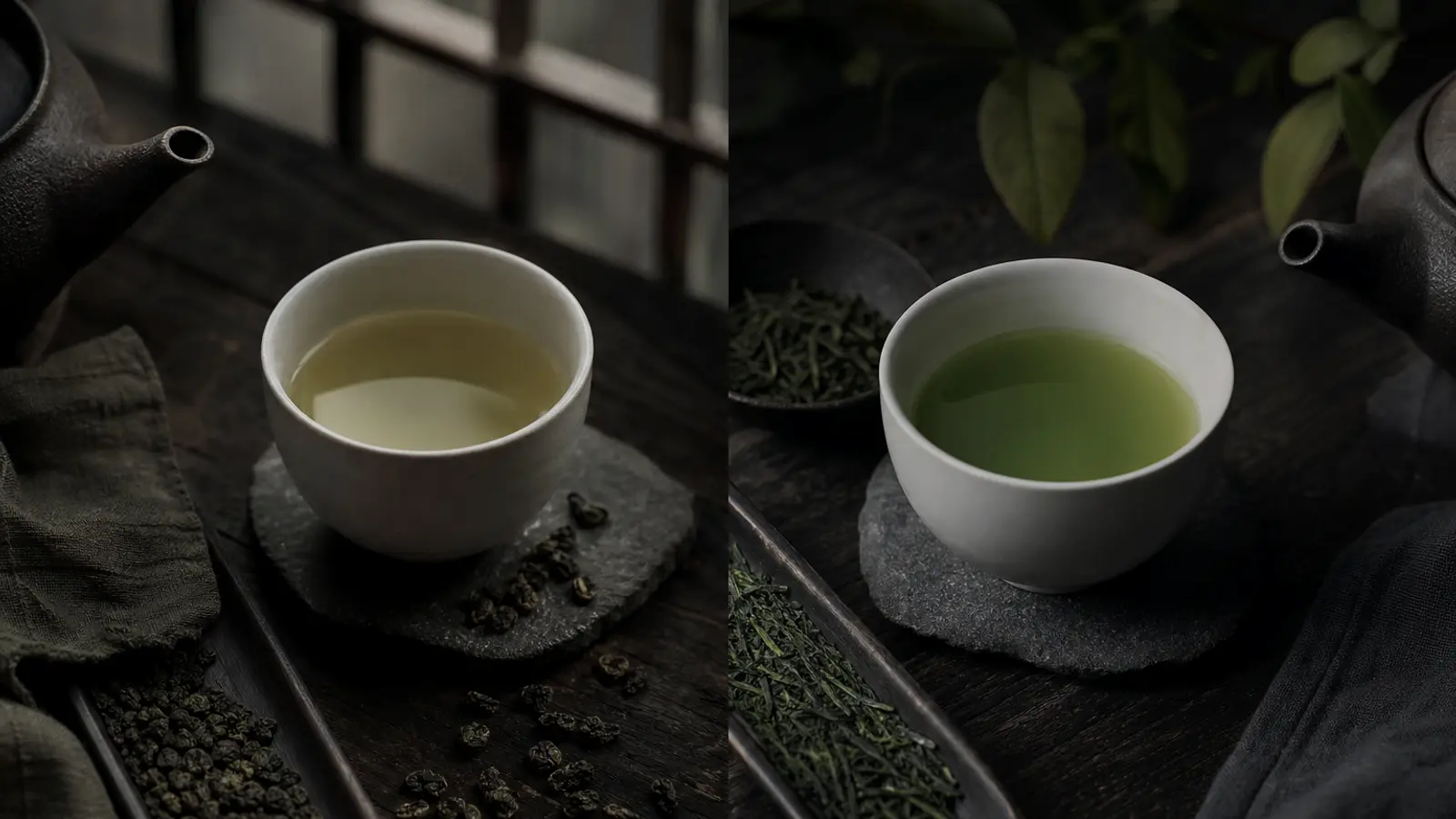
- Color: Fukamushi sencha produces a deep, opaque green liquor — almost jade — with significant fine particles that cloud the cup
- Flavor: More immediate, full-bodied, and rounded than asamushi sencha; lower bitterness despite the dense leaf material
- Brewing: The broken-down leaf particles pass more easily through strainers, and the tea infuses quickly — shorter steep times and lower temperatures work well
Fukamushi now dominates the Japanese domestic market. When Japanese consumers drink sencha — in convenience stores, at home, in restaurants — they are overwhelmingly drinking fukamushi-style tea, most of it from Shizuoka. This is Shizuoka’s most lasting contribution to Japanese tea culture.
Asamushi and the Hon Yama Style
Hon Yama producers take the opposite approach. Asamushi (浅蒸し, light-steam) sencha uses steaming times of 20–40 seconds, leaving the leaf structure more intact and producing a clearer, more golden-green liquor. The tradeoff: asamushi is more aromatic but more demanding to brew. The shorter steaming preserves volatile aromatics that fukamushi destroys, and Hon Yama’s elevation-influenced leaf material has the amino acid content to make this style shine.
Asamushi requires more careful brewing — water temperature matters more, steep time is more sensitive, and the leaf grade needs to be consistent. But when it works, asamushi sencha from Hon Yama delivers a cup with aromatic complexity that fukamushi cannot match.
Characteristic Flavor Signatures
Generalizing across Shizuoka’s sub-regions risks misleading — but some patterns hold across the prefecture’s better production.
The Shizuoka baseline — good commercial fukamushi from Makinohara — shows a deep green, slightly cloudy liquor with immediate vegetal sweetness, moderate umami, low bitterness, and a clean finish. This is the flavor of Japanese green tea as most of the world knows it: accessible, satisfying, without sharp edges.
Kawane sencha shifts the profile toward greater delicacy. The mountain valley environment produces leaves with a slightly higher aromatic compound content, and the flavor profile reflects this: fresh grass, young leaves, a lighter sweetness, and a longer, more fragrant finish than Makinohara teas at comparable prices.
Hon Yama asamushi is the most aromatic expression in the prefecture — when brewed with attention. The liquor is clearer and lighter in color, the attack is more floral and herbaceous, and the umami is present but woven into a more complex aromatic structure rather than sitting front-and-center as it does in fukamushi styles.
Single-cultivar lots from any sub-region introduce additional variables. Saemidori shows a pronounced sweet umami that can feel almost syrupy on the palate. Tsuyuhikari adds floral and fruity notes that are genuinely unusual for Japanese green tea. Okumidori brings depth and richness. These distinctions are real and worth seeking out.
One note for wine drinkers learning to taste Japanese green tea: the framework for evaluating Shizuoka sencha runs parallel to tasting cool-climate white wines. Look for the interplay between sweetness (amino acids, primarily L-theanine), bitterness (catechins, managed by steaming and temperature), aromatics (volatile compounds preserved or amplified by processing), and finish (the lingering savory quality the Japanese call huigan-adjacent — though the Japanese equivalent, 余韻, yoin, or “aftertaste echo,” is the more precise term in this context).
Quality Indicators & Authentication
What Separates Commodity from Craft
Shizuoka’s range from industrial to artisan is genuine, and the quality signals between them are legible once you know what to look for.
Leaf appearance matters in asamushi styles — intact, evenly-sized needles indicate careful processing and good leaf material. Fukamushi is less informative visually because the extended steaming naturally breaks down leaf structure — here, color (deep, uniform green rather than brownish or yellow-tinged) is the primary visual indicator.
Liquor color in fukamushi should be deep jade-green and slightly opaque. Yellowing suggests old tea or improper storage. In asamushi styles, clarity and a bright yellow-green color indicate freshness.
Aroma in dry leaf should be fresh and grassy-sweet, with no mustiness or staleness. Shizuoka’s high-quality sencha will show an immediate release of vegetal sweetness when you open the package — if the first smell is flat or papery, quality is already compromised.
Harvest date is increasingly prominent on premium Shizuoka packaging. First flush (ichibancha, 一番茶) commands the highest prices and delivers the best amino acid to catechin balance. Second flush (nibancha, 二番茶) is more affordable but slightly more astringent. New tea season (新茶, shincha) designations on ichibancha lots indicate the freshest possible production.
Sub-Region Identification
The Japanese tea market is not tightly regulated by geographic indication in the way European wine appellations are. “Shizuoka” on a package guarantees prefecture-of-origin but does not restrict blending within that origin. Sub-region designations like “Kawane” or “Hon Yama” are generally trustworthy on premium products but are sometimes used loosely on commercial teas. Single-estate and single-garden designations (茶園, chaen) provide the most specific provenance information.
Competition results provide a useful verification mechanism. The Shizuoka Prefecture Tea Competition (静岡県茶品評会) and the National Tea Competition (全国茶品評会) both publish results annually, and winning lots command premium prices that are generally justified by quality.
Shizuoka and Uji: The Comparison Worth Making
The Shizuoka-Uji comparison is Japanese tea’s version of a debate that exists in every beverage category: the prestigious historic region versus the large, versatile producer. The parallel I find most useful is Languedoc-Roussillon versus Burgundy in French wine.
Burgundy (Uji) commands the cultural prestige. The imperial connections, the ceremonial history, the gyokuro tradition — all of it anchors Uji’s reputation as the prestige leader. This reputation is earned. Uji’s best gyokuro and matcha are benchmarks by which other Japanese teas are measured, and that position is not marketing.
But the wine drinker who dismisses all of Languedoc because it isn’t Burgundy misses extraordinary value and genuine quality. The same logic applies to Shizuoka.
At equivalent price points, Shizuoka competes directly with Uji and frequently wins on value. A $20/100g Kawane or Hon Yama sencha from a careful producer delivers Japanese tea character that exceeds what a similar budget buys in Uji, where production costs, prestige premiums, and smaller scale all push prices higher.
The relevant question is not “is Shizuoka as good as Uji?” — the two regions specialize in different things. Uji’s strength is gyokuro and ceremonial matcha, where its shade-growing tradition and accumulated expertise are genuine competitive advantages. Shizuoka’s strength is sencha — particularly fukamushi sencha, which it invented — and increasingly single-cultivar lots that express specific flavor signatures unavailable in the more Yabukita-uniform Uji production.
For the Western tea drinker beginning to explore Japanese tea, Shizuoka is the correct entry point. The value is better, the availability is higher (Shizuoka teas are more likely to be in stock at international retailers simply because production volume is larger), and the style variety is greater.
Price Ranges
Shizuoka sencha spans a wider price range than almost any other Japanese tea region, reflecting the gulf between industrial and artisan production within the same prefecture.
| Tier | Price per 100g | Description |
|---|---|---|
| Everyday commercial | $5–$15 | Blended Makinohara fukamushi, reliable quality, excellent value |
| Premium single-origin | $15–$35 | Kawane or Hon Yama sencha, single sub-region, often asamushi |
| Single-cultivar artisan | $30–$50 | Named cultivar lots, small producers, competition-adjacent quality |
| Competition-grade | $60–$100+ | Award-winning lots, limited production, rare outside Japan |
For context, comparable Uji sencha typically runs 20–40% higher at each tier, with the gap widening at the premium end where Uji’s prestige premium adds the most cost without necessarily adding proportional flavor value.
The most practical buying guidance for international drinkers: the $15–$35 range in Shizuoka represents exceptional quality-to-price. This is where single-origin sencha from named sub-regions appears at prices that still feel like good value against equivalent green tea from other origins. Going above $50 for Shizuoka sencha requires specific justification — a named competition result, a specific cultivar you want to study — because the everyday premium tier already delivers excellent quality.
Domestic Japanese pricing is generally 20–30% lower than international export pricing for equivalent teas, reflecting the efficiency of direct domestic retail channels versus the logistics of international specialty retail.
Brewing Shizuoka Sencha Well
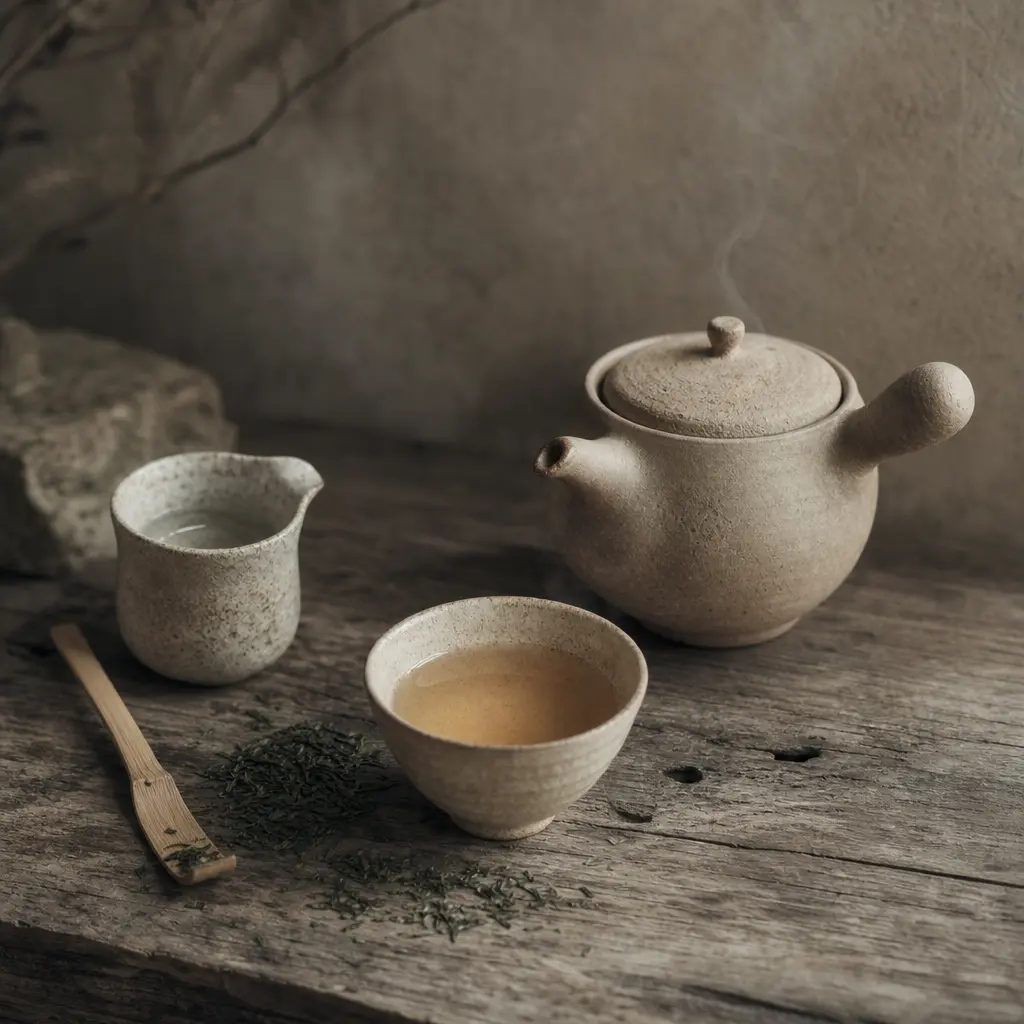
Shizuoka sencha rewards attention to water temperature and steep time more than almost any other tea style. The parameters differ meaningfully by processing style:
Fukamushi sencha is forgiving. The broken-down leaf structure means flavor extracts quickly and evenly. Water at 70–75°C, 4–5g leaf per 150ml water, 40–60 seconds — this produces a balanced cup. Pushing temperature above 80°C risks bitterness from accelerated catechin extraction; the tea’s character is built on sweetness and depth, not astringency.
Asamushi sencha (Hon Yama style) needs slightly higher temperature — 75–80°C — to open the more intact leaf structure, but the timing is more critical. At 60 seconds it is balanced; at 90 seconds it tips toward bitterness. The reward for precision is a more aromatically complex cup with more obvious finish.
Multiple infusions are appropriate for both styles. Shizuoka sencha typically gives three to four good infusions, with the second often showing a different character than the first — slightly more astringent, more mineral, sometimes more interesting.
A gaiwan works well for Shizuoka sencha if you want maximum control, but a standard kyusu (急須, Japanese side-handle teapot) with a fine-mesh strainer is the traditional vessel and produces excellent results. The goal is to capture the fine particles that fukamushi produces while preventing the leaf from over-steeping.
Shizuoka is Japanese tea at full scale — messy, diverse, commercially indispensable, and capable of genuine excellence at multiple price points. The region’s critics see only the industrial base; its advocates understand that any region producing 40% of a nation’s tea will contain multitudes. The cultivar experimentation happening in Tenryu, the mountain valley complexity of Kawane, the aromatic sencha of Hon Yama — none of this appears in the vending machine bottle. All of it is Shizuoka.