I collected wine for years. Not casually — the deep end. Terroir arguments about which slope of which hill in which vintage produced the better Pinot Noir. Cellaring bottles for a decade to see what happened. Tracking down specific producers because their winemaking philosophy aligned with how I thought about flavor. The whole architecture: varietal, vintage, appellation, style, aging curve, the ritual of opening something you’d been waiting for.
When a health protocol took the wine away — sleep issues, anxiety that alcohol was making worse instead of better, a body sending signals I couldn’t keep ignoring — the beverages disappeared overnight. The intellectual architecture didn’t. It was still there, fully built, looking for something to inhabit.
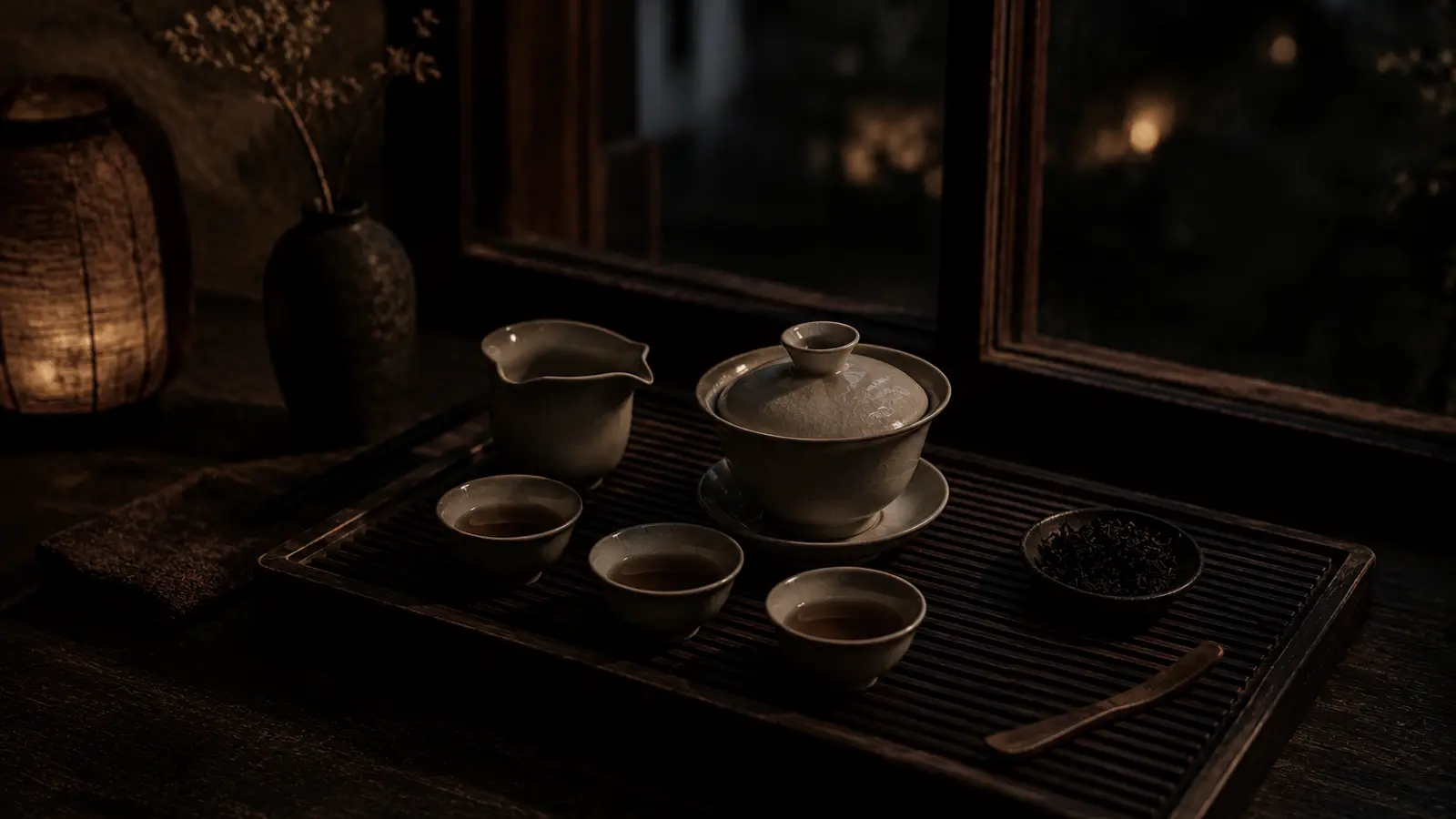
Tea turned out to be that something. Not herbal tea. Not the bag in a mug at the office. Gongfu-brewed Chinese tea — the kind where the terroir arguments are as fierce as Burgundy’s, the aging debates are as obsessive as Bordeaux’s, and the counterfeiting is as rampant as anywhere in the wine world. The kind where you sit down with 7 grams of leaves from a specific mountain and watch the flavor change across fifteen steeps — the tea equivalent of watching a great wine open in the glass, except you get fifteen discrete snapshots instead of one gradual evolution.
This guide maps the translation. If you think in wine, you already have the framework to understand tea at a level that takes most tea drinkers years to develop. The vocabulary transfers. The palate transfers. The instincts transfer. What changes is the medium, the cost structure, and the fact that the ritual stays but the damage leaves.
What Transfers Directly
Terroir → Terroir
The concept is identical. A pu-erh from Yiwu and a pu-erh from Laobanzhang — same species, same processing, same year — taste as different as a Margaux and a Pauillac. The mountain wrote the tea. Elevation, soil composition, microclimate, and the age of the trees determine the raw character of the leaf exactly the way slope, drainage, and rootstock determine the character of the grape.
The parallels are specific enough to navigate by:
| Wine Region/Style | Tea Equivalent | Why the Parallel Works |
|---|---|---|
| Margaux (elegance, silk) | Yiwu pu-erh | Soft entry, refined structure, legendary aging |
| Pauillac (power, tannin) | Bulang/Laobanzhang pu-erh | Intense structure, rewards patience, built for decades |
| Burgundy (Pinot Noir, terroir sensitivity) | Yiwu aged sheng | Highest ceiling, most terroir-expressive, expensive |
| Barolo (Nebbiolo, austere youth) | Lao Man’e pu-erh | Extreme bitterness that converts to depth with time |
| Mosel Riesling (crystalline, mineral) | Taiwanese high-mountain oolong | Delicate, mineral-driven, elevation is the story |
| Condrieu (Viognier, aromatic, floral) | Jingmai pu-erh | Floral, perfumed, immediately captivating |
| Pomerol (Merlot, velvet) | Shou pu-erh | Smooth, dark, thick body, immediate comfort |
| Châteauneuf-du-Pape (warm, generous) | Wuyi Da Hong Pao | Warm climate power, mineral terroir, roasted depth |
| Old-vine Grenache (natural wine) | Gushu ancient-tree sheng | Wild energy, terroir purity, minimal intervention |
| Sancerre (Sauvignon Blanc, crisp) | Longjing green tea | Light, clean, bright, defined by freshness |
You already know more about tea than you think. Your palate calibration from years of wine maps onto tea’s terroir landscape almost directly. The terroir guide covers the five variables (elevation, soil, climate, cultivar, human tradition) in full.
Varietal → Cultivar
In wine, varietal determines the raw material: Pinot Noir, Cabernet Sauvignon, Riesling. In tea, cultivar does the same: Da Hong Pao, Rou Gui, Tieguanyin, the large-leaf var. assamica used for pu-erh versus the smaller-leaf var. sinensis used for green tea and oolong.
The relationship between cultivar and terroir in tea mirrors wine exactly. A Da Hong Pao cultivar from Wuyi’s volcanic rock expresses differently than the same cultivar grown elsewhere — just as Pinot Noir from Gevrey-Chambertin expresses differently from Oregon Willamette Valley. The cultivar sets the boundaries. The terroir writes within them.
Where it gets wilder than wine: Phoenix Mountain dancong oolongs are single-bush cultivars — each tree in the garden produces a unique aromatic signature. One bush smells like gardenias. The next smells like almonds. A third smells like ginger flowers. There is no wine equivalent to this. It’s as if each vine in a vineyard produced a different varietal, and the winemaker’s job was to vinify each one separately.
Vintage → Year
In wine, vintage matters because annual weather variation changes the grape. In tea, vintage matters for the same reason: a spring harvest during a dry year produces different leaf chemistry than a spring harvest during a wet year.
For pu-erh specifically, vintage carries a second layer of meaning: how old the tea is. A 2005 pu-erh cake is both a vintage (produced from 2005 leaf) and an aged product (21 years of storage transformation). This is closer to how vintage works in Champagne or Port — the year of production and the years of aging both contribute to what you taste.
The pu-erh market has vintage obsession that rivals Bordeaux. Specific years from specific producers command collector premiums. A Menghai Tea Factory 7542 from 2003 and from 2006 are materially different cakes, even though the recipe number is identical — because the leaf allocation, the weather that year, and the two decades of different storage conditions have created divergent outcomes.
Cellaring → Storage
Wine people understand that storage conditions shape the final product. Too warm and the wine ages too fast. Too cold and it doesn’t develop. Humidity matters for the cork. Temperature stability matters more than absolute temperature.
Pu-erh storage follows identical principles with different parameters. High humidity (Hong Kong traditional storage, 80-90% RH) accelerates microbial aging — the tea transforms faster but risks mold if uncontrolled. Low humidity (Kunming dry storage, 50-65% RH) produces slower, cleaner aging over decades. The debate between wet and dry storage partisans is as heated as the Burgundy cellar-temperature debates — and as consequential.
If you’ve managed a wine cellar, you already understand why storage matters for tea. The medium is different (tea cakes instead of bottles) but the principle is identical: the vessel contains a living product undergoing slow biochemical transformation, and the storage environment determines which transformation pathways dominate.
Tasting Framework → Tasting Protocol
Wine tasting uses systematic evaluation: appearance, nose, palate (fruit, acid, tannin, body, finish), and overall quality assessment. The Steep Atlas Tasting Protocol does the same thing with ten dimensions calibrated for tea:
- Aroma ↔ Nose (intensity and complexity)
- Body ↔ Body/weight (light to full)
- Astringency ↔ Tannin (grip and drying)
- Acidity ↔ Acidity (brightness and liveliness)
- Huigan ↔ No direct equivalent — returning sweetness is unique to tea
- Finish Length ↔ Finish (persistence after swallowing)
- Mineral ↔ Minerality (stony, flinty character)
- Cha Qi ↔ No direct equivalent — body sensation beyond flavor
If you’ve used the WSET Systematic Approach to Tasting or the UC Davis wine scorecard, the Steep Atlas protocol will feel familiar in structure. Two dimensions — huigan and cha qi — have no wine equivalent. These are the new things you’ll learn. Everything else maps.
What Doesn’t Transfer
Alcohol’s Immediate Effect
Wine hits the brain in minutes. The first glass produces a neurological shift — GABA activation, dopamine release, a warm loosening that most wine drinkers associate with “relaxing.” Tea doesn’t do this. Tea’s L-theanine produces alpha brain waves associated with calm focus, and its caffeine provides alertness, but neither compound creates the instant, potent neurological shift that alcohol does.
This is the transition that trips up most wine-to-tea converts in the first weeks. You sit down for an evening session expecting the feeling and the feeling doesn’t arrive — at least not in the same form. What arrives instead is subtler: a sustained calm from the L-theanine, a warmth from the hot liquid, and a focused presence from the ritual’s structured attention. It takes 2-3 weeks for this subtler effect to register as satisfying on its own terms rather than as a diminished version of what wine provided.
I’ll be direct: the first two weeks without the evening glass were harder than I expected. Not because of the alcohol. Because of the absence of the immediate shift. The gongfu session provided the ritual — the hands-busy, brain-occupied hour — but the neurological shortcut was gone. By week three, the L-theanine calm started registering as its own thing rather than as not-wine. By month two, I preferred it. The mornings were the evidence. Everything was clearer.
Social Drinking
Wine is social. A bottle opens and a table shares it. Tea can be social — Chinese gongfu cha is traditionally communal, Korean darye is practiced in groups, and hosting a tea session for friends is one of the most satisfying things in the practice. But the deepest tea practice is solitary. The evening session where you sit with one tea across fifteen steeps and track the flavor’s evolution — that is a solo practice. It doesn’t translate to a dinner party or a bar.
If the social dimension of wine is what you miss most, tea won’t fully replace it. If the solitary ritual — the hour alone with something worth paying attention to — is what you miss, tea replaces it completely.
Price Signals
In wine, price broadly correlates with quality within a category. A $50 Burgundy is usually better than a $15 Burgundy. The correlation is imperfect but directional.
In tea, price signals are less reliable because counterfeiting and mislabeling are more pervasive than in regulated wine markets. A $200 pu-erh cake labeled “Laobanzhang gushu” might be excellent or might be $20 worth of plantation tea with a fraudulent wrapper. The label is not proof. Your palate, combined with trusted sourcing, is the only reliable guide.
The good news: tea’s cost-per-experience ratio is dramatically better than wine’s. A 357g pu-erh cake that costs $50-100 provides 50+ gongfu sessions — $1-2 per session of complex, multi-steep tea from ancient trees. The wine equivalent of that experience level starts at $30-50 per bottle, consumed in one sitting. If you’re a value-oriented drinker (and what wine collector isn’t?), tea’s economics are startling.
Where to Start: Wine Preference → Tea Recommendation
| If You Drink… | Start With… | Why |
|---|---|---|
| Bold reds (Barolo, Cab Sauv, Syrah) | Shou pu-erh, then aged sheng | Body, density, dark flavors, structure |
| Burgundy (Pinot Noir, terroir-focused) | Yiwu sheng pu-erh, Wuyi yan cha | Terroir expression, elegance, complexity |
| Rhône (Grenache, Mourvèdre) | Bulang/Meng Song sheng pu-erh | Power, warmth, generosity |
| Riesling (mineral, precise, aromatic) | Taiwanese high-mountain oolong | Crystalline, floral, mineral, elevation-driven |
| Natural wine (funky, terroir-first) | Gushu ancient-tree sheng | Wild character, minimal processing, terroir purity |
| Champagne (bright, structured, celebratory) | Longjing green tea, dancong oolong | Bright, precise, aromatic, delicate |
| Port/Sauternes (sweet, rich, aged) | Aged shou pu-erh, aged Liu Bao | Depth, sweetness, decades of transformation |
| Rosé (light, easy, uncomplicated) | Light oolong (Tieguanyin, Korean hwangcha) | Floral, gentle, low astringency, approachable |
The pattern: if your wine preference leans toward structure, body, and density — start with pu-erh (shou for comfort, sheng for challenge). If your preference leans toward aromatics and delicacy — start with oolong. If you value terroir expression above all — start with Wuyi yan cha or single-origin sheng.
My own path: I was a Barolo drinker, not a Moscato drinker. Structure over sweetness. Density over delicacy. Shou pu-erh was my entry point — the dark chocolate body and velvet mouthfeel felt familiar from the first session. Aged sheng became the long-term obsession — the camphor and complexity of a 30-year cake is the closest analog to opening a cellar-aged Grand Cru that exists outside of wine.
The Ritual That Stays
What wine gave me — and what I initially thought I’d lost — was the evening hour. The deliberate practice of paying attention to something worth paying attention to. The sensory precision. The collecting instinct. The terroir arguments. The satisfaction of knowing that what you’re drinking came from somewhere specific and someone specific and means something beyond the liquid itself.
Gongfu brewing gave all of that back. The small vessel, the measured leaf, the temperature precision, the steep-by-steep progression. The practice demands enough attention that there’s no room for the noise. For thirty to sixty minutes, the hands are busy, the senses are engaged, and the mind has somewhere specific to be.
I have anxiety. The gongfu session is the most effective grounding practice I’ve found — more effective than any technique a therapist has suggested. Not because tea is medicine. Because the ritual is structured enough to hold my attention and gentle enough to not overwhelm it. Wine provided a chemical shortcut to calm. Tea provides a procedural path to presence. The path is slower. The result is cleaner. The mornings are better.
If you’re here because you stopped drinking and you’re looking for the thing that fills the gap — not the health gap, the ritual gap — the full guide to building an evening tea practice covers the practical details. If you’re here because the gap is deeper than ritual — the anxiety, the panic, the nights when the noise doesn’t stop — the Journal is where I write about that.
The wine knowledge you already have is not wasted. It’s a head start. The map is the same. The territory is new. Start exploring.
Frequently Asked Questions
Can tea really replace wine as an evening ritual?
The ritual — yes, completely. The sensory engagement, the terroir arguments, the collecting, the connoisseur’s attention to detail — all of it transfers directly to gongfu tea practice. The neurological effect of alcohol does not transfer. Tea provides L-theanine calm and caffeine alertness, not GABA sedation and dopamine release. If you’re replacing the ritual, tea works. If you’re replacing the intoxication, it doesn’t — and that’s the point.
What tea should a wine drinker try first?
Shou pu-erh is the safest first step for red wine drinkers — dark, smooth, full-bodied, and immediately satisfying with no bitterness to overcome. For white wine or Riesling drinkers: a lightly oxidized Taiwanese high-mountain oolong. For Burgundy drinkers specifically: a Wuyi Da Hong Pao, where the mineral terroir expression will feel immediately familiar. For natural wine enthusiasts: a gushu (ancient tree) sheng pu-erh.
Is tea as complex as wine?
In terms of aromatic compound diversity, yes — specialty tea has roughly 750+ identified aroma compounds, comparable to wine’s approximately 800. In terms of tasting experience, gongfu tea may offer more data points per session: 15 steeps from one tea give you 15 distinct snapshots of evolving flavor, versus one continuous evolution from a glass of wine. In terms of terroir expression, the best tea regions (Wuyi, Yiwu, Laobanzhang) produce origin-specific character as distinctive as any wine appellation.
How much does it cost to switch from wine to tea?
Equipment: under $50 for a complete gongfu setup (gaiwan, pitcher, cups, scale). Tea: a quality shou pu-erh cake ($15-30) provides 50+ sessions at approximately $0.50-1.00 per session. Compare to wine at $15-50 per bottle for a single evening. A wine drinker spending $100/month on wine can fund a tea practice that is arguably more complex and more varied for $30-50/month. The economics are dramatically favorable.
Do I need to stop drinking wine to enjoy tea?
No. Many people practice both. Wine and tea are not competing categories — they’re complementary sensory practices that happen to share a vocabulary. The “from wine to tea” framing of this article reflects my personal path (I stopped drinking alcohol for health reasons), but tea practice does not require abstinence. Some of the best tea drinkers I’ve encountered are active wine collectors. The palate benefits from both.