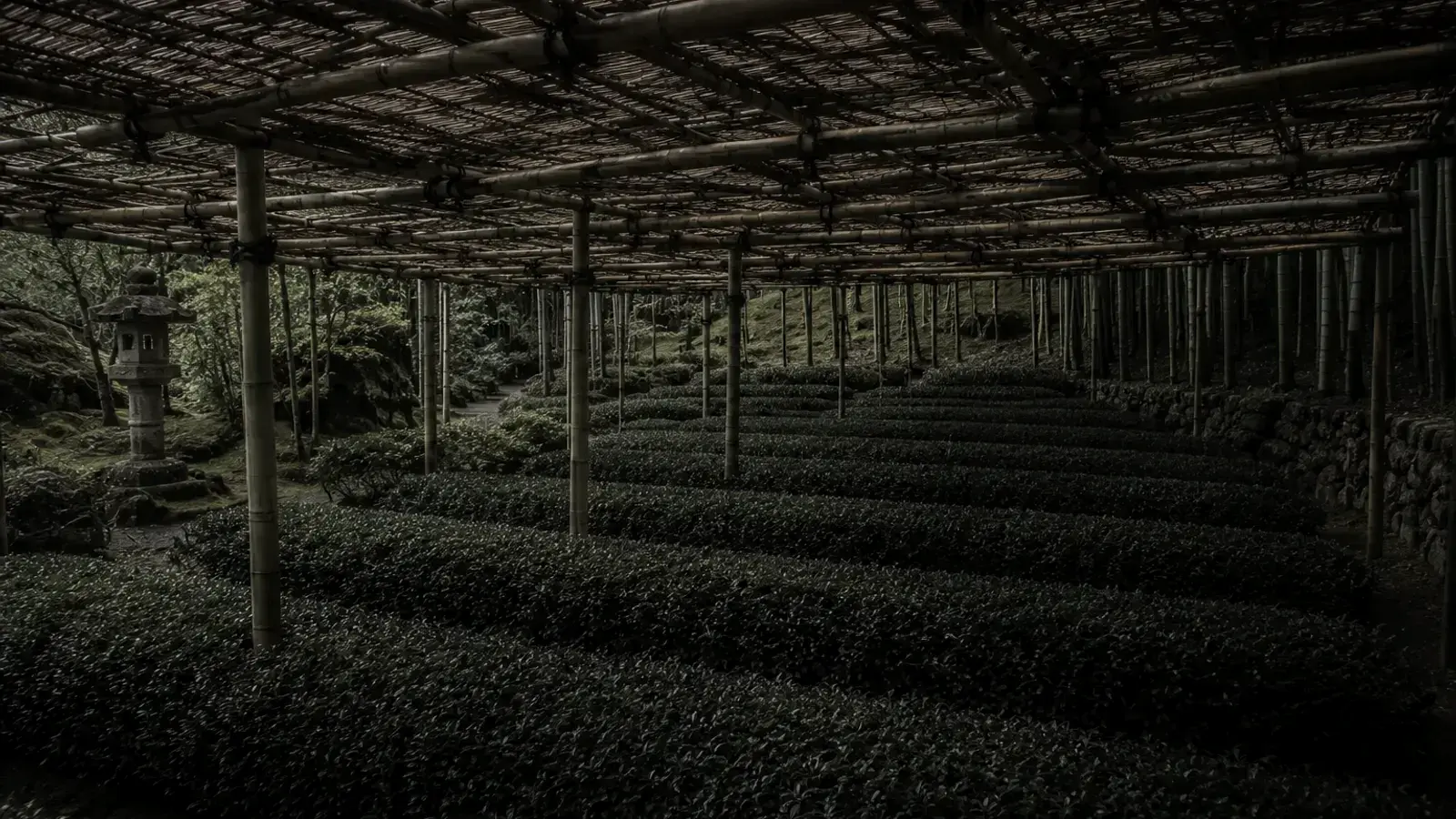
Uji sits approximately 10 kilometers south of central Kyoto, at 34.9°N, 135.8°E. Its elevation ranges from around 50 meters along the Uji River (宇治川) flood plain to roughly 400 meters on surrounding hillsides. In global terms, it is a small region. In the history of tea, it is enormous.
The wine parallel that keeps returning: Uji is the Burgundy of tea. Not because the comparison is flattering—though it is—but because it describes the same specific phenomenon. A region of modest size, historically specific, terroir-obsessed, producing small volumes at high prices that define a category. A region where the name carries weight that sometimes exceeds what the cup delivers, but where the genuine article—when you find it—justifies everything.
Geography & Location
Uji occupies the confluence of two forces: the Uji River valley and the rising hillsides of the Yamashiro Basin. The river moderates temperature, increases morning humidity, and creates the persistent mist that tea farmers here have cultivated around for centuries. The hillsides provide the drainage that tea requires—standing water kills Camellia sinensis roots—while orienting south-facing slopes toward the sun during the critical spring growing season.
The tea-growing area is not a single flat expanse. It is fragmented: terraced hillside plots, valley-floor gardens, small parcels held by families who have worked the same land for generations. This fragmentation is partly geographical and partly the result of inheritance patterns over centuries. The result looks, again, like Burgundy—a patchwork of small parcels where neighboring plots can produce meaningfully different tea.
The Uji River itself has practical and symbolic importance. Practically, it supplies irrigation and moderates the local microclimate. Symbolically, it is central to the region’s visual identity—the image of mist rising from the river over tea fields in early spring is inseparable from Uji’s cultural reputation. Kyoto’s influence pervades the region: the proximity to Japan’s ancient imperial capital meant Uji’s tea was always consumed by, and cultivated for, the highest levels of Japanese society.
Climate & Elevation
The climate is warm temperate with oceanic influence, shaped by the Seto Inland Sea weather patterns that moderate Kyoto Prefecture. Annual rainfall runs 1,400–1,600mm, distributed across the year but with a pronounced wet season in June and July following the spring harvest. Four distinct seasons matter here: winter cold hardens the plants, spring mist and cool temperatures slow leaf growth and concentrate flavor compounds, summer heat accelerates the second and third flushes, and autumn brings a cooler senescence.
The spring conditions are the critical variable. First-flush harvest (一番茶, ichibancha) typically runs late April through mid-May. During this period, cool nights—temperatures dropping to 8–12°C—combine with warming days and persistent morning fog from the river to create what tea growers describe as ideal conditions: slow leaf development, high accumulation of amino acids, and deep green chlorophyll production. The mist itself is functional. It diffuses direct sunlight, extending the effective shade period and mimicking, at low intensity, the effects of the deliberate shading that defines Uji’s most prestigious teas.
Elevation within the region creates meaningful variation. Valley-floor gardens at 50–100 meters experience greater humidity and more moderate temperatures—conditions that favor sencha (煎茶) and tencha (碾茶) production. Higher hillside plots at 200–400 meters have better drainage, more diurnal temperature variation, and slightly lower yields, producing leaves with more concentrated flavor. The best gyokuro (玉露) plots are frequently on these elevated slopes, where morning fog still reaches but afternoon sun creates the stress conditions that push quality.
Soil & Terroir
Two soil types define Uji’s growing areas. Along the river and lower valley: alluvial deposits, river-borne sediments laid down over millennia, well-drained despite their proximity to water, slightly acidic (pH 5.5–6.0), mineral-rich from upstream geology. On the hillsides: decomposed granite mixed with clay subsoil, requiring careful terracing to prevent erosion, excellent drainage, and a mineral profile that multiple sources associate with the particular sharpness and definition in Uji’s shade-grown teas.
Both soil types share the slightly acidic pH that Camellia sinensis prefers. Both are relatively low in nitrogen—a condition that, counterintuitively, pushes tea plants to produce more amino acids as they compete for nutrients, contributing to the umami depth that Uji teas are known for. The decomposed granite on hillsides introduces silica and trace minerals in ways that parallel how granite soils in Burgundy’s Côte de Nuits contribute to Pinot Noir’s mineral signature. The analogy is imperfect, but the mechanism—mineral-rich parent rock, slow decomposition, uptake through root systems—is genuinely similar.
What Uji’s terroir cannot fully explain on its own is the gap between genuine Uji tea and nominally equivalent teas from other regions. Soil and climate account for some of it. Cultivar selection accounts for more. And the accumulated knowledge of production—refined over 800 years by families who have done nothing else—accounts for a portion that resists quantification.
Key Cultivars & Tea Types
Uji does not run on a single cultivar. The region uses several, selected for specific teas and quality tiers.
Uji Hikari (宇治光) and Uji no Shiro (宇治の白) are traditional cultivars developed specifically for the Uji region, prized for their high L-theanine content and vivid color when shade-grown. These appear in high-end ceremonial matcha and premium gyokuro.
Okumidori (おくみどり) is a later-budding cultivar popular across several Japanese regions, including Uji, valued for its resistance to late frosts and its deep green color after steaming. It produces matcha with characteristic sweetness.
Samidori (さみどり) is frequently cited as the cultivar most associated with premium Uji matcha. Multiple sources report that Samidori shade-grown in Uji produces a particularly vivid emerald liquor and a complex layered umami. It is finicky—lower yields, sensitive to temperature extremes—which partly explains its association with high-end production.
Yabukita (やぶきた) is Japan’s dominant cultivar nationally, planted across Shizuoka, Kagoshima, and elsewhere for its reliable yield and consistent quality. It is present in Uji, particularly for sencha production, though the region’s premium teas tend toward the heritage and regionally-specific cultivars above.
The Three Pinnacle Teas
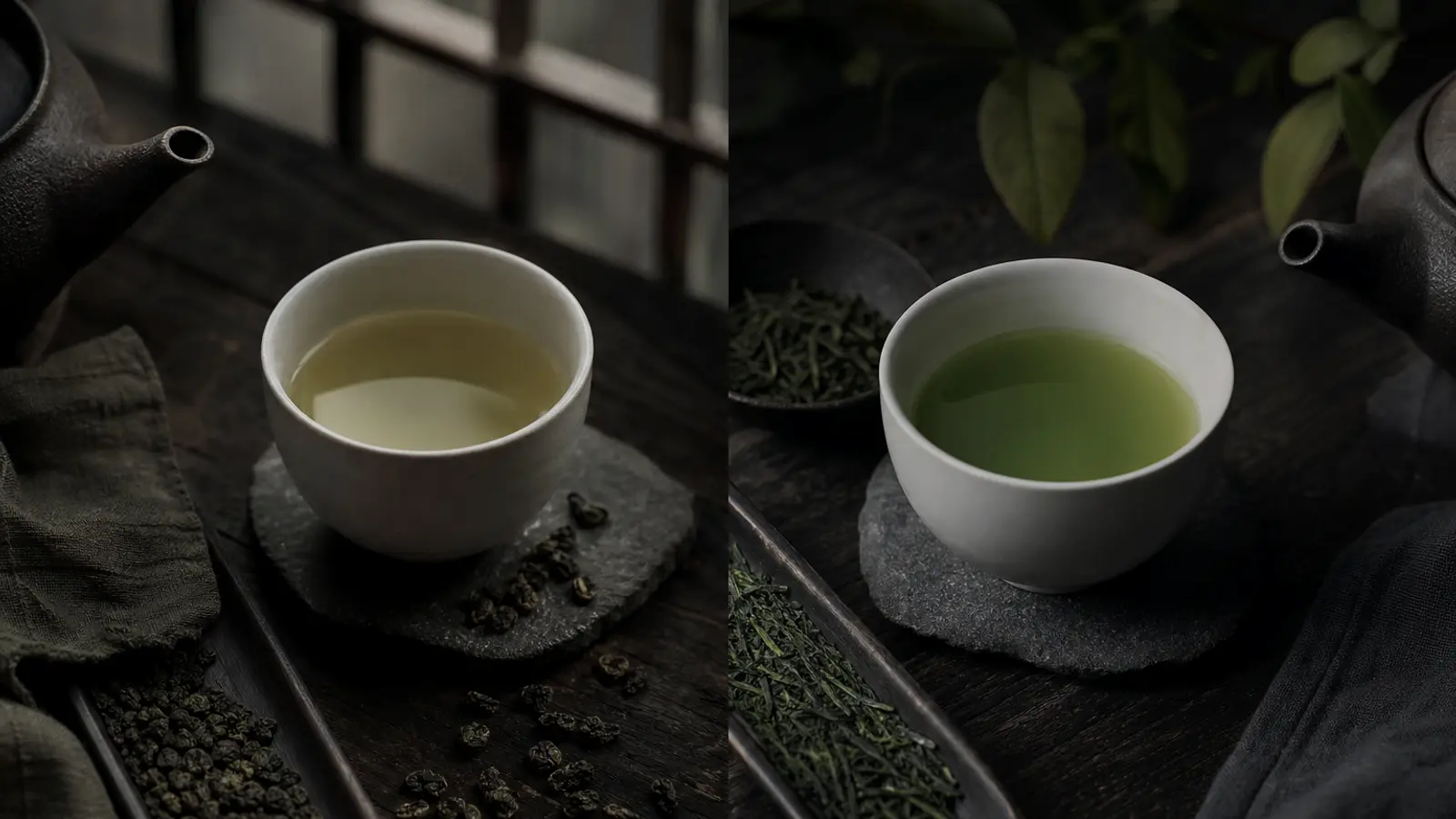
Matcha (抹茶) is what most people associate with Uji, and the association is historically precise. Ceremonial-grade Uji matcha begins as tencha (碾茶)—a shade-grown, steamed, dried leaf with veins and stems removed, leaving flat, matte leaf fragments. These fragments are stone-ground (石臼, ishiusu) at low speed to generate minimal heat, preserving volatile aromatics and producing a fine powder with particle size around 5–10 microns. The shading period—20 to 30 days before harvest—is what separates tencha from standard green tea. Under shade, the plant redirects energy from catechin production (astringency, bitterness) toward L-theanine production (umami, sweetness, calm focus) and chlorophyll synthesis (vivid green color). The result, when ground, is a powder that produces a vivid emerald bowl, rich in umami, with bitterness so reduced it reads as sweetness.
Gyokuro (玉露) shares the shading technique with tencha but diverges at processing. Rather than being destemmed and dried flat for grinding, gyokuro leaves are steamed, rolled, and dried as a whole-leaf tea. Brewing gyokuro is its own discipline: low water temperature (50–60°C), small volumes, short steeps. The resulting liquor is thick, brothy, almost savory—marine umami that occupies more of the palate than any other tea style I’m aware of from research. Uji gyokuro is produced in limited quantities by specialist farms. The category name translates roughly as “jade dew” (玉 = jade/gem, 露 = dew), and the visual and textural qualities of the brew justify the name.
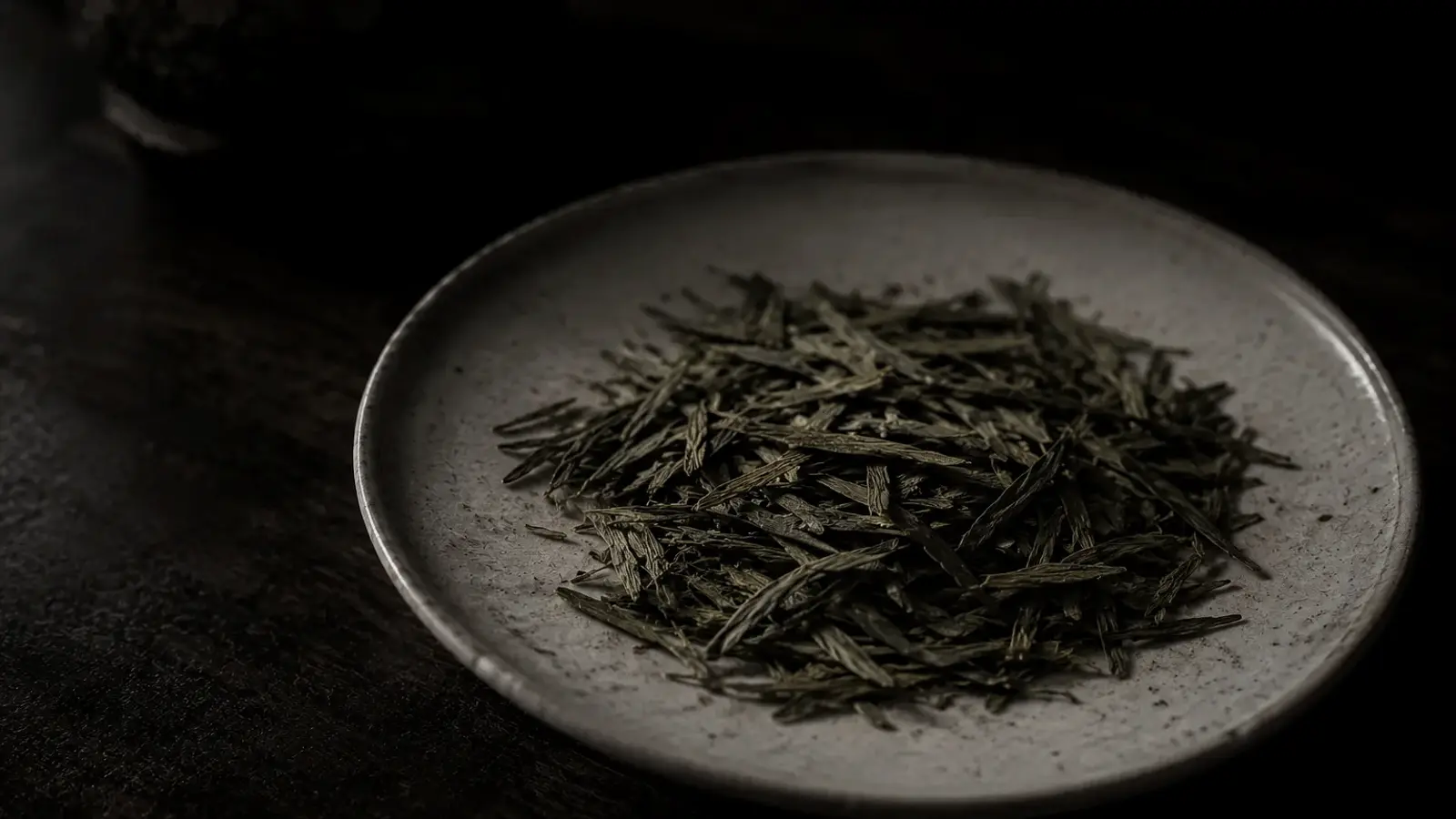
Sencha (煎茶) is Japan’s everyday tea, and Uji’s version of it set the qualitative standard for the category. While Shizuoka (静岡) produces the majority of Japan’s sencha by volume, Uji sencha is considered the reference point for flavor—grassy, umami-forward, with more aromatic complexity than most mass-market sencha. The region produces both asamushi (浅蒸し, light steam) and fukamushi (深蒸し, deep steam) sencha, with traditional producers tending toward asamushi and the lighter, more defined flavor it produces.
Processing Traditions
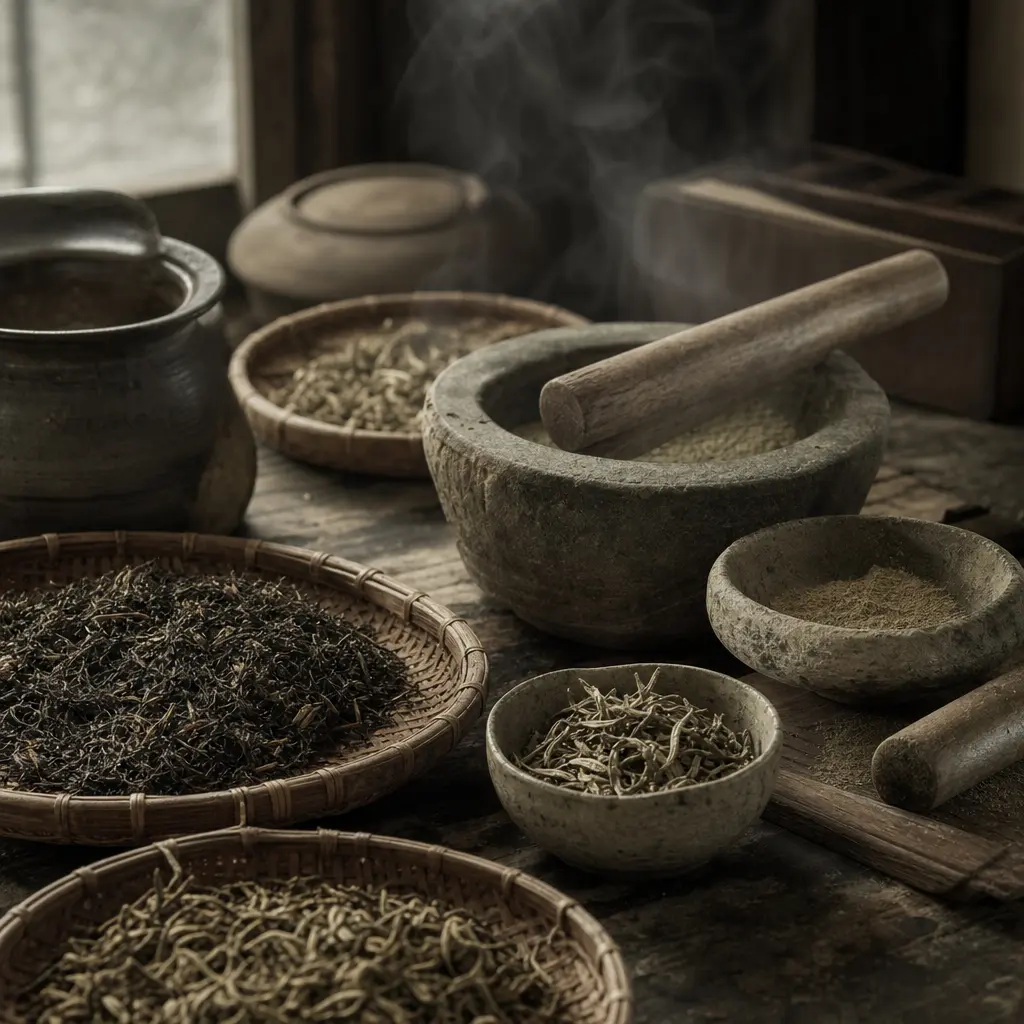
Japanese tea processing diverges from Chinese at the most fundamental step: kill-green. Where Chinese green teas use pan-firing (殺青, shaqing) in a dry wok to halt oxidation, Japanese teas use steam (蒸し, mushi). This difference is not cosmetic. Steam deactivates oxidative enzymes quickly and evenly without the Maillard reactions that pan-firing introduces. The result is a fundamentally different flavor profile: no toasty, nutty, or roasted notes, but instead a characteristic vegetal-marine-umami character that is immediately identifiable as Japanese green tea.
Within steaming, timing creates subcategories:
- Asamushi (浅蒸し): light steam, 30–60 seconds. The traditional method. Leaves emerge with more intact cell structure, producing a clearer liquor with more defined, lighter flavor. Associated with traditional Uji production and premium sencha.
- Fukamushi (深蒸し): deep steam, 60–120 seconds. A 20th-century development, now Japan’s dominant sencha style. Longer steaming breaks down leaf cells more thoroughly, producing a more opaque, intensely colored liquor with fuller, less differentiated flavor. More robust and forgiving to brew.
After steaming, leaves are rolled and dried in multiple stages that determine the final leaf shape and aroma development. For tencha—the matcha precursor—rolling is omitted. The steamed leaf is simply dried flat, preserving the flat, matte surface that grinds efficiently under stone.
The Shading Technique: Uji’s Defining Innovation
The practice called ooishita saibai (覆い下栽培)—literally “cultivation under cover”—is the technical foundation of Uji’s most prestigious teas. Farmers install shade structures over tea plants 2–3 weeks before the spring harvest. Traditional materials were reed screens (よしず, yoshizu) or rice straw; modern farms often use synthetic shading cloth rated to block 70–90% of sunlight.
The biochemistry is specific. Under shade:
- The plant cannot photosynthesize efficiently, so it cannot convert L-theanine (テアニン) into catechins as readily. L-theanine accumulates.
- Chlorophyll production increases as the plant attempts to capture available light. Leaves become more intensely green.
- Catechin levels—the primary source of astringency and bitterness in tea—decrease by 30–50% relative to sun-grown leaves.
- L-theanine content in shade-grown leaves can reach 4–5 times that of sun-grown equivalents.
The practical result: less bitterness, more umami, more vivid color, more of the amino acid most associated with the calm alertness that distinguishes a bowl of ceremonial matcha from a cup of coffee. The L-theanine connection is real and measurable, which is why shade-grown teas occupy a central place in discussions of tea for anxiety—it’s the same amino acid, just at much higher concentration.
This technique likely originated in Uji. Multiple historical sources attribute its development to Uji farmers in the 15th or 16th century, though the exact origin remains debated. What is clear is that Uji refined and systematized ooishita saibai before any other region, and that this systematization is part of why Uji teas occupy their particular position.
Characteristic Flavor Signatures
Describing Uji teas without having brewed them myself requires appropriate care. What follows reflects published accounts, technical literature, and the consistent descriptions across multiple sources I consider credible.
Uji ceremonial matcha is described consistently as: vivid emerald green in both powder and bowl; intensely sweet on first contact; umami that builds through the swallow and lingers; a characteristic “oceanic” quality—marine, mineral, occasionally described as reminiscent of sea vegetable (kombu, in particular); low bitterness that registers instead as a gentle astringency in the finish; and a long, sweet aftertaste (回甘, huigan) that extends well past the bowl.
Uji gyokuro pushes these characteristics further: the liquor is thicker, the marine character more pronounced, the sweetness more dense. Multiple accounts describe it as broth-like—closer to dashi than to what most people would expect from tea. Brewing temperature matters enormously; at 60°C, the catechins remain largely undissolved and the amino acids dominate. At 80°C, the same tea tastes harsh by comparison.
Uji sencha is lighter but maintains the regional signature: grassy and fresh on entry, with umami depth that differentiates it from Shizuoka equivalents, and a clean finish without the oceanic intensity of the shade-grown teas.
The unifying thread is L-theanine expression. Uji’s shade-grown teas contain measurably more of it, and that amino acid is responsible not just for umami flavor but for the quality of alert calm that experienced drinkers describe as the tea’s effect—different in character from caffeine stimulation, softer, more sustained.
Quality Indicators & Authentication
Protected Geographical Indication (地理的表示, GI): Japan’s GI system for tea includes Uji tea (宇治茶), which legally requires that the tea be grown and processed in Kyoto, Nara, Shiga, or Mie prefectures—a broader area than the city of Uji itself. This is a politically negotiated definition, and purists in the tea world often note that GI-certified “Uji tea” does not necessarily mean tea grown within Uji’s traditional cultivation areas.
The “Uji blend” problem is real. Matcha and sencha labeled with Uji branding are sold worldwide, many containing only a small percentage of Uji-origin leaf blended with less expensive tea from Kagoshima (鹿児島) or elsewhere. This is not fraud in a legal sense when labeled accurately as a blend, but it dilutes the geographic signal considerably. The Japanese Tea Instructors Association and various Uji producer cooperatives have pushed for stricter labeling, with limited success in international markets.
Color as an indicator: Genuine high-grade Uji ceremonial matcha should be a vivid, saturated emerald green—not yellowed, not gray-green, not khaki. Color degrades with oxidation (oxygen exposure, heat, light), so fresh matcha should be stored in a sealed, opaque container away from heat. A yellowed matcha is either old, improperly stored, or low-grade from the outset.
Texture: Stone-ground tencha produces a finer, silkier powder than industrially ground (ball-mill or pin-mill) matcha. Running a small amount between thumb and forefinger—a practice sometimes called the finger test—reveals this. Genuine stone-ground Uji matcha feels almost frictionless. Industrial matcha feels gritty by comparison.
Flavor honesty test: A ceremonial-grade Uji matcha prepared as usucha (薄茶, thin tea) with 1.5–2g of matcha in 60–70ml of water at 70–75°C should be sweet and umami-forward with minimal bitterness. If the dominant note is bitterness or grassiness without sweetness, the tea is either lower grade, improperly brewed, or not genuinely from the premium Uji production tier. For a structured approach to evaluating what’s in your bowl, the Steep Atlas tasting protocol offers a useful framework.
Provenance documentation: Serious producers in Uji—particularly those working with tea ceremony schools and high-end distributors—provide documentation of harvest date, cultivar, shading period, and stone-ground batch information. This level of traceability is becoming a quality signal in itself, analogous to vintage documentation in wine.
Price Ranges
Uji teas occupy the top of the Japanese tea price spectrum, with ceremonial-grade matcha reaching levels that require explanation for anyone unfamiliar with the category.
Ceremonial-grade Uji matcha: $30–$100+ per 30g. At the lower end of this range, you find teas from GI-certified Uji blends or lower-tier single-origin material. The $60–100+ range represents named-cultivar, single-harvest, stone-ground matcha from established Uji houses with documented provenance. International export pricing typically runs 20–30% higher than what the same tea costs in Japanese domestic markets.
Uji gyokuro: $30–$80 per 100g. Premium examples from named cultivars and specific hillside plots can exceed $100/100g. Domestic Japanese pricing for top Uji gyokuro can reach ¥15,000–25,000 per 100g (approximately $100–170 at current exchange rates), though international export often, counterintuitively, runs lower for the same tier due to how export-focused distributors price for market accessibility.
Uji sencha: $15–$40 per 100g for quality single-origin material. Competitive pricing exists at the lower end from Shizuoka equivalents, but premium Uji sencha commands a consistent premium for its profile and provenance.
For comparison: equivalent-grade sencha from Shizuoka runs $8–20/100g, and high-quality matcha from Nishio (西尾) or Kagoshima runs $15–40 per 30g. The Uji premium is real and persistent. Whether it is always justified by the cup rather than the name is a question each drinker has to answer personally—which is, again, exactly what Burgundy asks of wine drinkers.
Historical Depth: Why Uji Occupies This Position
The history is inseparable from the terroir profile, because Uji’s prestige is not purely biochemical.
The monk Eisai (栄西, 1141–1215) is credited with introducing tea cultivation to Japan from Song Dynasty China, returning with seeds and the practice of drinking powdered tea (抹茶) in a Buddhist ceremonial context. He planted seeds in Kyushu and later in the Uji region, and the Uji cultivation took hold more permanently than any other site. The climate was right. The proximity to Kyoto—political and cultural capital—was decisive. Uji tea became the tea of imperial court, of Buddhist ritual, of the emerging samurai culture that sought refined practices to distinguish itself.
The Muromachi period (室町時代, 1336–1573) saw Uji tea become the currency of cultural sophistication. Tea competitions (闘茶, tōcha) where participants identified teas by region were fashionable among the elite, and Uji teas consistently set the standard against which others were judged.
Sen no Rikyū (千利休, 1522–1591) is the central figure in formalized Japanese tea ceremony (茶道, chado or sado). His aesthetic philosophy—wabi-cha (侘茶), the beauty of restraint and imperfection—transformed tea from elite entertainment into something approaching a spiritual practice. Rikyū’s tea was Uji tea. The equipment he designed, the ceremonies he formalized, and the aesthetic principles he articulated all assumed Uji as the tea of reference. The three tea ceremony schools that descend from his lineage—Urasenke (裏千家), Omotesenke (表千家), and Mushanokōjisenke (武者小路千家)—all maintain close relationships with Uji producers.
This historical depth is part of what you pay for when you buy ceremonial-grade Uji matcha. The tea is good. But you are also participating in a practice that connects, unbroken, to these eight centuries of cultivation and ceremony. That is not nothing, and it is not merely marketing.
Uji is where Japan decided what tea meant. The biochemistry backs the reputation: the shading techniques, the cultivars, the steam-kill processing, the stone-grinding—all of it produces teas that, at their best, cannot be replicated by geography alone. But the historical context amplifies everything. When you prepare a bowl of Uji matcha using gongfu brewing principles—precise ratios, temperature control, attentive multiple infusions—you are not just dissolving powder in hot water. You are engaging with a practice that shaped Japanese aesthetics, Buddhist ritual, and the concept of hospitality (おもてなし, omotenashi) for nearly a millennium.
The terroir is real. The tradition is real. The premium is real. The only question worth asking is whether the tea in your bowl is actually from Uji—and that, unfortunately, requires more attention than the label alone will give you.