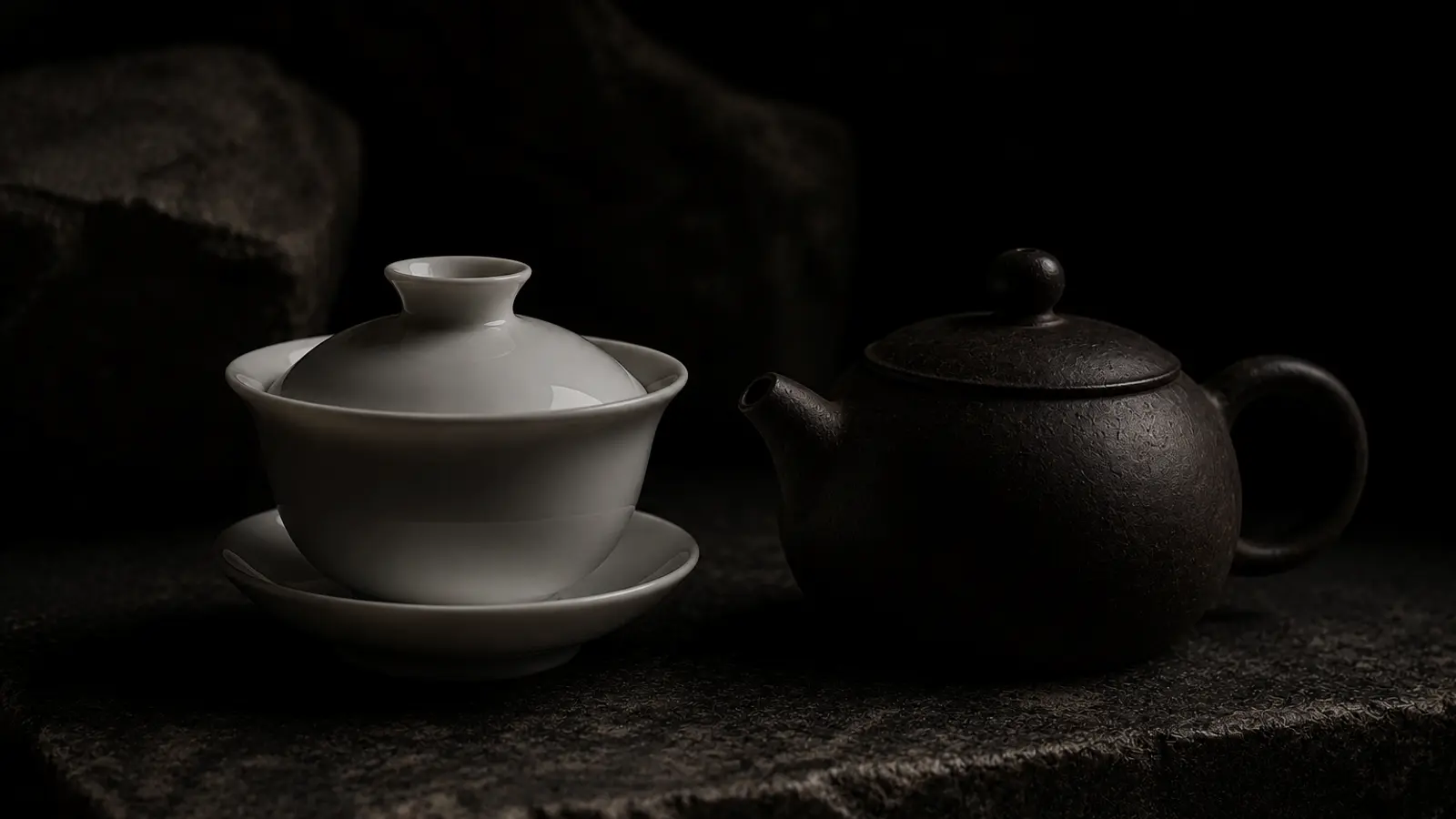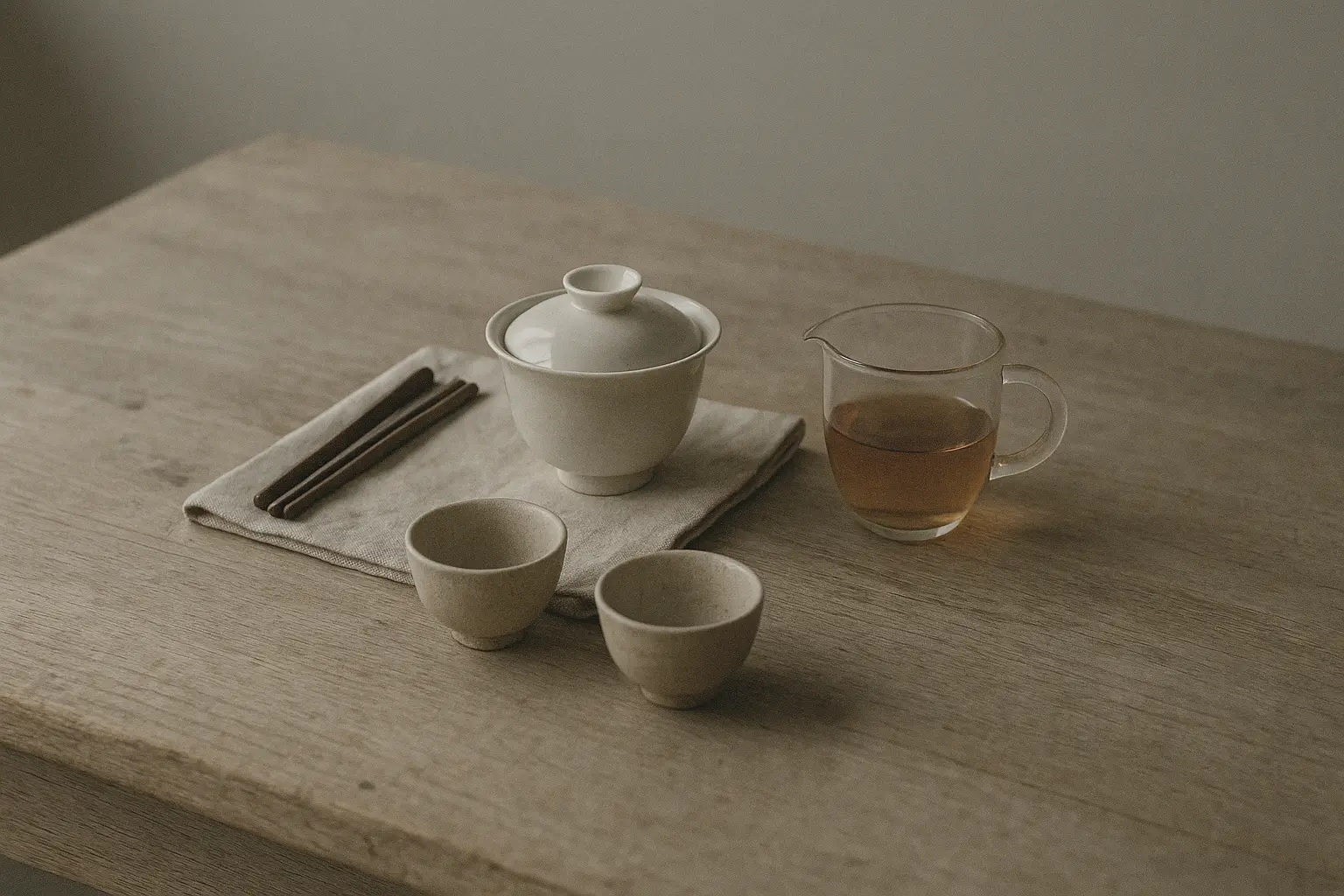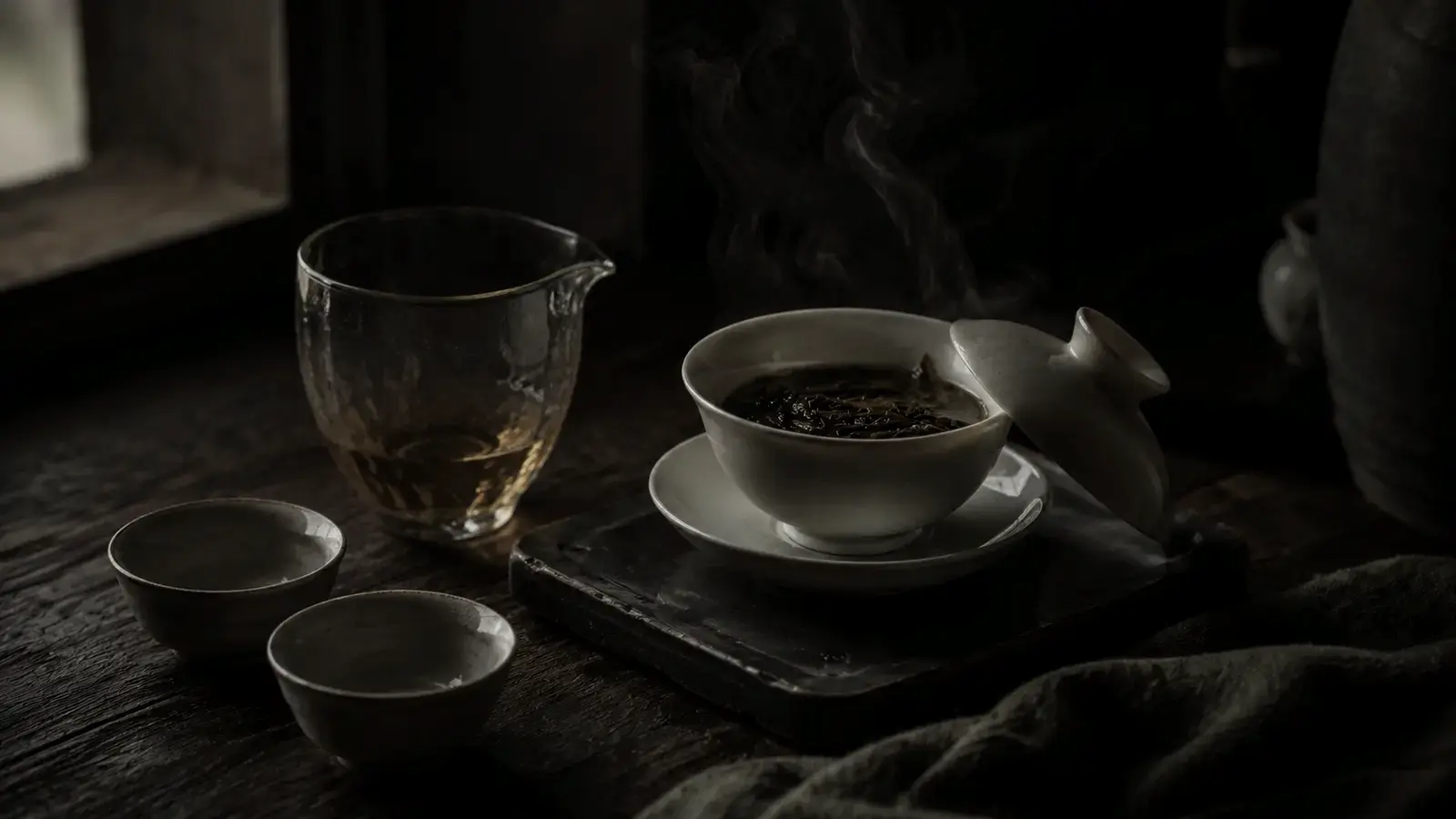
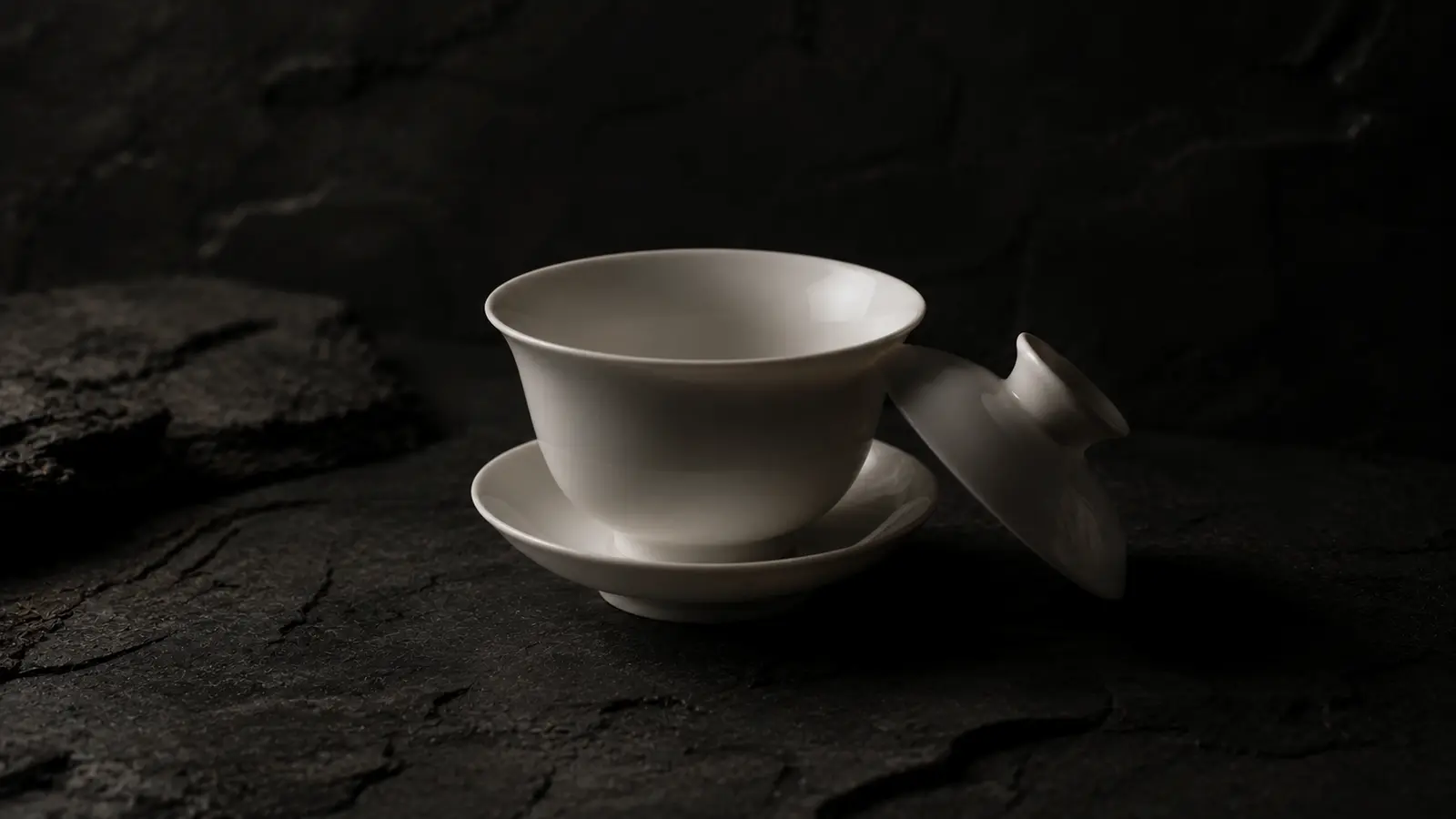
If you brew tea with any seriousness, you will eventually own a gaiwan (蓋碗). The only question is whether you buy one now or waste time and money cycling through inferior alternatives first. This gaiwan guide is designed to skip that detour entirely.
A gaiwan is the single most useful piece of teaware you can own. It is cheap, versatile, easy to clean, and gives you direct access to the tea — its aroma, its leaf, its color — in a way no teapot does. Every tea I taste seriously, I taste in a white porcelain gaiwan first. That practice is not an affectation; it is the fastest path to understanding what a tea actually is.
Here is everything you need to choose, buy, and start using your first gaiwan.
What Is a Gaiwan?
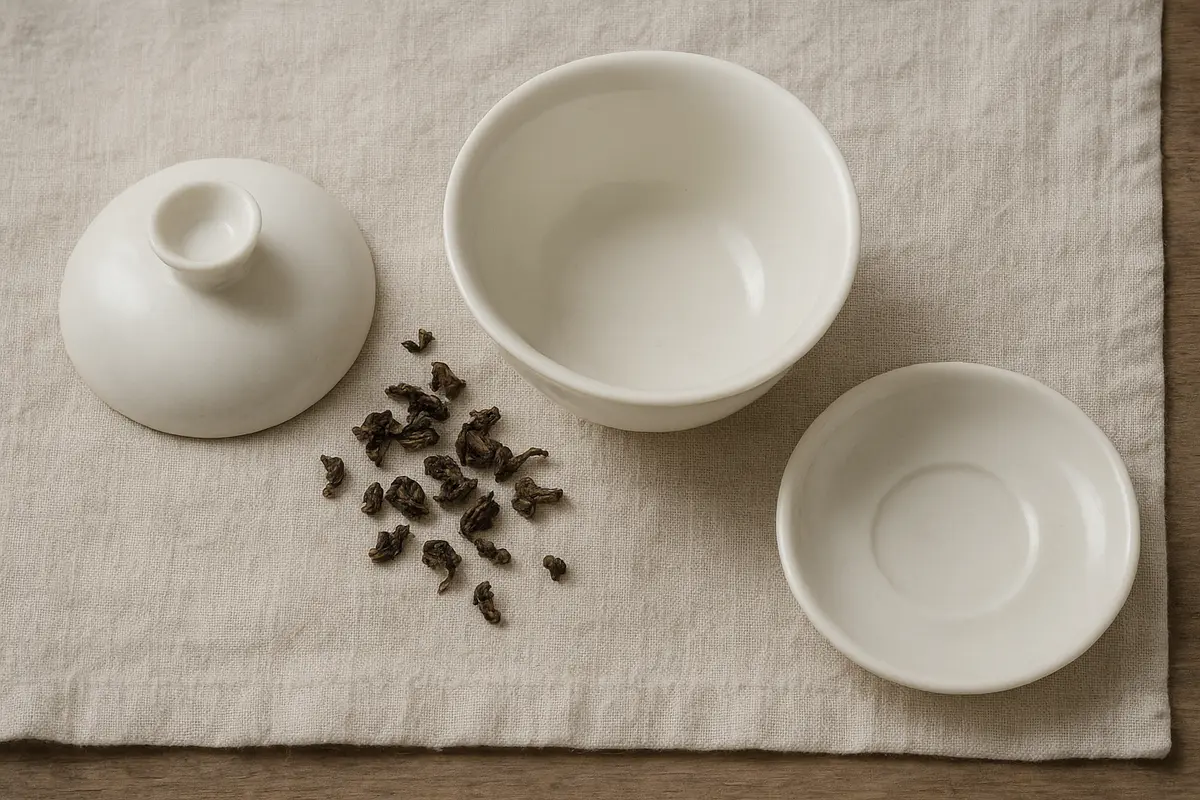
A gaiwan is a three-piece lidded bowl used for brewing tea. The three pieces are:
- The lid (蓋, gài) — tilted slightly during the pour to hold back leaves
- The bowl (碗, wǎn) — the brewing chamber itself
- The saucer (托, tuō) — protects the table and provides a secondary grip point
The word translates directly as “lidded bowl.” That simplicity is the point. There are no moving parts, no filters to clog, no porous walls absorbing flavor compounds. You add leaves, add water, wait a short time, and pour. The whole system can be rinsed in ten seconds.
Gaiwans have been used in China since at least the Ming dynasty, where they were used for brewing and drinking directly. In gongfu cha (工夫茶) practice — the style of short, repeated steepings that produces the most nuanced results from good tea — the gaiwan replaced the small Yixing teapot as the preferred vessel for tasting and comparison. When you want to evaluate a tea without variables, you reach for a porcelain gaiwan.
Why a Gaiwan Over a Teapot for Beginners
This is the question I get most often from people setting up their first gongfu brewing station. The honest answer is that a gaiwan is better than a teapot for beginners on almost every practical axis.
Flavor neutrality. White porcelain does not absorb flavor. Every infusion you pour tastes like the tea, not the accumulated ghost of every tea you have ever brewed. A teapot — especially a clay one — builds up a seasoning over time. For a beginner still learning to distinguish tea characteristics, that seasoning is noise, not signal.
Versatility. One gaiwan handles green tea, white tea, yellow tea, oolong, red tea (紅茶, hóng chá), and pu-erh (普洱茶). Each category has specific temperature requirements, but none require a dedicated vessel. A Yixing teapot is ideally suited to a single tea type. A gaiwan suits all of them.
Visibility. You can see the leaves. You can watch them unfurl, check their color and texture, assess hydration level between steepings. This is not a minor point for someone learning. The visual information in a gaiwan is part of the education.
Speed of pour. A gaiwan poured correctly empties in about three seconds. This is faster than most small teapots and gives you precise control over steeping time — crucial when you are working with delicate teas where an extra ten seconds changes the cup.
Price. A functional gaiwan costs $8–15. A functional small teapot from a reputable source costs $30–80. The gaiwan is not a compromise; it is the better tool at a fraction of the price.
Ease of cleaning. Remove the lid, rinse with hot water, done. No spout to worry about, no interior curves that trap leaf fragments.
The only genuine argument for starting with a teapot is if you are brewing almost exclusively one tea type and want the accumulated seasoning effect from day one. That is a reasonable preference but a specialized one. For most beginners, the gaiwan wins.
How to Choose a Gaiwan: The Four Decisions
1. Size: 100–120ml Is the Standard
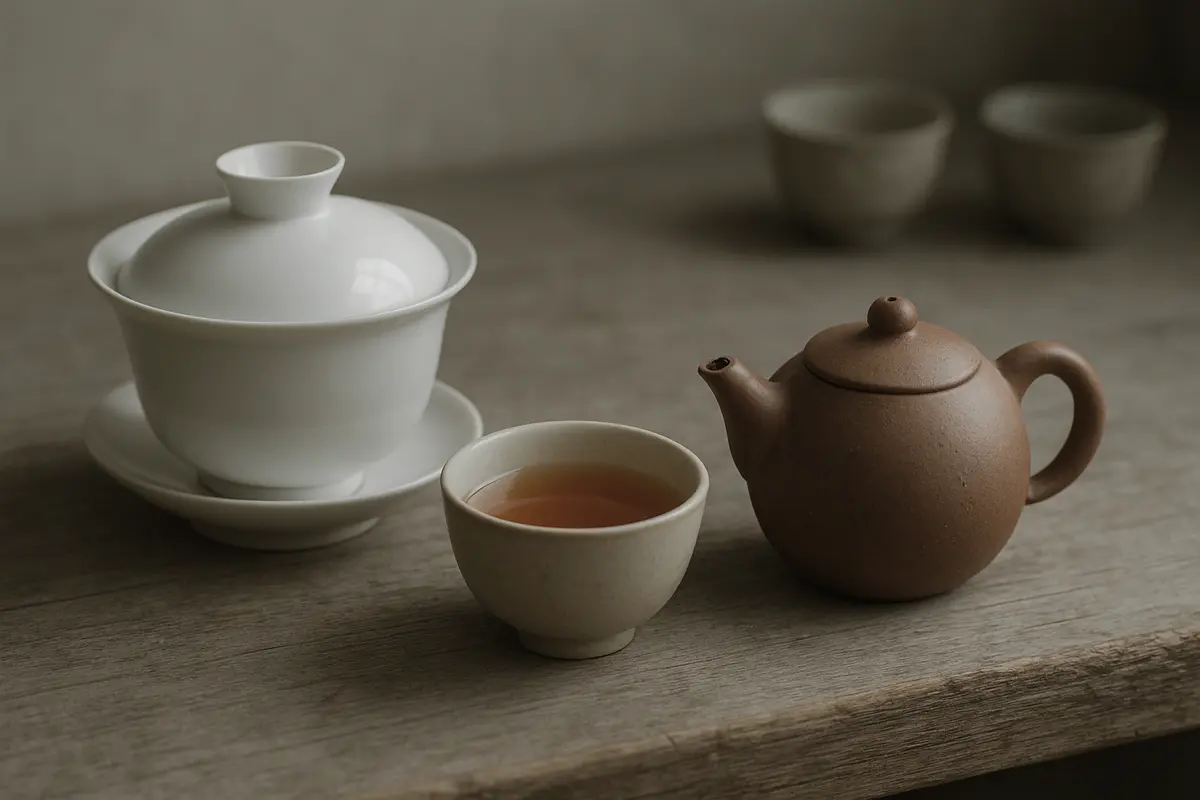
Gaiwan size refers to the volume of the bowl, typically measured in milliliters. The standard for solo gongfu brewing is 100–120ml.
At 100–120ml, you are working with 5–8 grams of leaf depending on tea type, producing enough liquid per infusion to fill two or three small cups. This ratio gives you control. The leaf-to-water ratio stays consistent, steep times are short enough to be precise, and the pour is manageable.
Go up to 150ml if you routinely brew for two or three people. A 150ml gaiwan is still a single-session vessel, but it produces enough liquid per pour to serve a small group without a second steep.
Avoid going smaller than 90ml until you have built up technique. The physics work against you: a very small gaiwan heats up fast, pours awkwardly, and leaves less room for error in timing.
Avoid going larger than 150ml for gongfu work. At 200ml or above you lose the fast, controlled pour that defines the brewing style. That size is better suited to grandpa-style brewing (直泡, zhí pào) — long single steeps with leaves floating free — which is a different method entirely.
My daily driver is a 100ml white porcelain gaiwan. It has been that way for years. When I brew for guests, I use a 120ml gaiwan and adjust leaf weight accordingly. I have rarely had reason to go outside that range.
2. Material: White Porcelain First, Everything Else Later
White porcelain is the correct material for a first gaiwan, and for most sessions it remains the correct material indefinitely.
Here is why:
- Thermally responsive: thin porcelain walls heat quickly and, critically, cool quickly between steepings. This matters because temperature affects flavor extraction. A material that stays hot too long will over-extract delicate teas.
- Color-neutral: white walls let you read the true color of the liquor. Pale gold, amber, dark ruby — color is information about oxidation level, steep time, and tea age. You lose that information in clay or glazed vessels.
- Flavor-neutral: no absorption, no seasoning effect, no interference with the tea.
- Widely available at low price points.
Clay gaiwans — most commonly made from Jian Shui clay (建水紫陶) in Yunnan or Yixing clay (宜興紫砂) in Jiangsu — are specialist items. Clay is porous. Over dozens or hundreds of sessions, the clay absorbs flavor compounds and develops what collectors call “seasoning.” For someone who drinks the same puerh or the same style of oolong every day and wants the vessel to become calibrated to that tea, a clay gaiwan is a meaningful upgrade. For someone still exploring tea types, it is a disadvantage. You are tasting the vessel’s history as much as the tea in your hand.
Glass gaiwans look beautiful. The view of unfurling leaves through clear glass is genuinely appealing. The problem is thermal conductivity: glass holds heat and transfers it to your fingers immediately. Glass gaiwans burn hands at a rate that interrupts the brewing process. Some people adapt with practice; most find them frustrating. I do not recommend them as a first vessel.
Celadon and other glazed gaiwans vary widely. If the interior is white or near-white, they function like porcelain for our purposes. Heavily colored interiors obscure liquor color. Treat them as aesthetic choices rather than functional upgrades.
3. Shape: The Flared Rim Is Non-Negotiable
Shape matters more than most buying guides acknowledge. The single most important feature of a gaiwan is a flared rim.
A flared rim — where the top edge curves outward away from the bowl — does two things:
- It creates a natural channel for the pour, allowing the lid to rest at an angle that controls flow without your fingers contacting the hot side of the bowl.
- It keeps your fingertips clear of the hottest part of the vessel.
A straight-sided gaiwan, or one with a rim that curves inward, forces your grip into contact with the hot body of the bowl. You will burn yourself consistently and the pour will be imprecise.
What to look for:
- Visible outward flare at the rim
- Thin walls (under 3mm ideally) — thick walls hold heat and make the pour feel clumsy
- A lid knob large enough to pinch comfortably — avoid tiny, decorative knobs
- A saucer deep enough to catch drips without the bowl sliding
What to avoid:
- Straight or inward-curving rims
- Thick walls marketed as “durable” or “robust” (they are harder to use, not better)
- Decorative designs with heavy embossing or painted patterns on the rim surface, which create uneven contact points
4. Price: Set Your Ceiling at $15
A gaiwan that costs $8–15 from a reputable source is a good gaiwan. A gaiwan that costs $40 because it has hand-painted blue-and-white decoration is a decorative object with less functional value for daily brewing.
The price ceiling for a standard 100–120ml white porcelain gaiwan is $15. Above that, you are paying for aesthetics, not brewing performance. There are beautiful gaiwans worth more than $15 that I own and enjoy using. But for your first purchase, stay at $8–15, confirm the shape and wall thickness are right, and put the money you save into better tea.
Where to Buy Your First Gaiwan
Online tea vendors are the most reliable source. Vendors who specialize in Chinese tea almost always carry functional white porcelain gaiwans alongside their inventory, and they know their own products. Any reputable specialist Chinese tea vendor is a good place to start. Prices for their basic porcelain gaiwans typically run $8–15.
General online retailers work, with caveats. Search specifically for “white porcelain gaiwan” and filter by size. Read reviews for mentions of thin walls and flared rims. Avoid results dominated by thick decorative pieces with vague sizing. The price range overlaps with dedicated vendors, but quality control varies more.
Local Asian grocery stores and tea shops occasionally carry gaiwans. If you can handle the piece before buying, check the rim flare and wall thickness directly. That tactile check is worth the trip.
What to avoid: “premium” beginner sets marketed with elaborate packaging and vague claims about hand-craftsmanship. At $30–50 for what is still a basic porcelain gaiwan, you are funding marketing, not quality. The $10 gaiwan and the $45 gaiwan often come from the same region of China.
How to Hold and Pour a Gaiwan
Technique is where most beginners struggle, and the struggle is temporary. Everyone burns their fingers the first few sessions. By the end of the first week, the grip is automatic.
The grip:
- Place the gaiwan on the saucer in front of you.
- Bring your dominant hand to the vessel.
- Place your index finger on top of the lid knob, applying light downward pressure — you are not gripping the knob, just stabilizing it.
- Place your thumb under the edge of the rim on the far side of the lid (not on the body of the bowl).
- Place your middle finger on the flared rim of the bowl, on the near side.
- Lift the gaiwan from the saucer using this three-point grip. Your palm does not contact the body of the bowl.
The pour:
- Tilt the gaiwan toward your fairness pitcher (公道杯, gōngdào bēi) at roughly a 45–60 degree angle.
- Use the lid, held slightly ajar (about 2–3mm gap), to hold back the leaves while the liquid flows through.
- Aim for a pour time of 2–4 seconds for a complete empty.
- Set the gaiwan upright on the saucer. Open the lid slightly to let steam escape between steepings.
Why fingers burn: The most common mistake is allowing the body of the bowl to contact the palm or the inside of the fingers. The bowl is 90–95°C during the first steep. Brief contact at the rim (where the flare protects you) is fine. Sustained contact with the body is not. Keep your grip points at the rim, lid, and saucer only.
With a thin-walled, flared-rim gaiwan and correct grip, the pour is genuinely comfortable after a few sessions. With a thick-walled, straight-sided gaiwan, it remains uncomfortable indefinitely. This is the strongest functional argument for buying the right shape from the start.
What Else You Need: Building a Complete Gongfu Setup
A gaiwan alone produces excellent tea. Adding three more items creates a full gongfu station. For a broader look at what a complete setup involves, see The Complete Guide to Gongfu Tea Equipment.
Fairness Pitcher (公道杯, Gōngdào Bēi)
Also called a sharing pitcher or chahai (茶海). The gaiwan pours into this vessel first, equalizing the concentration across the full volume before distributing to cups. Without it, the first cup is weaker and the last cup is stronger.
- Price: $5–10 for glass; $10–20 for porcelain
- Material: Glass is the practical choice — you can see the liquor color, it is flavor-neutral, and cheap glass pitchers are genuinely good.
- Size: 150–200ml is appropriate for a 100–120ml gaiwan
Small Cups (品茗杯, Pǐn Míng Bēi)
Tasting cups for gongfu service. Small — typically 30–50ml — because you are tasting in repeated infusions, not gulping a single large serving.
- Price: $3–8 for a set of four
- Material: White porcelain shows liquor color clearly and is neutral. Thin-walled is preferable.
- Quantity: Four cups handles solo through small-group sessions
Temperature-Controlled Kettle
Different teas require different temperatures. Green tea brews best at 70–80°C; oolong at 85–95°C; pu-erh and black tea at 95–100°C. A kettle that holds a set temperature removes guesswork and prevents the single most common beginner error: scorching green or white tea with boiling water. See the full tea brewing water temperature reference for a complete breakdown by tea type.
- Price: $20–40 for a functional variable-temperature kettle
- Features needed: Temperature setting in Celsius or Fahrenheit, hold-temperature function
Total Cost
| Item | Low | High |
|---|---|---|
| White porcelain gaiwan (100–120ml) | $8 | $15 |
| Glass fairness pitcher | $5 | $10 |
| Small cups (set of 4) | $3 | $8 |
| Temperature-controlled kettle | $20 | $40 |
| Total | $36 | $73 |
A complete, functional gongfu setup for under $50 is realistic if you shop deliberately. The kettle is where cost varies most. If you already own a variable-temperature kettle, your entry cost is closer to $20.
Common Mistakes to Avoid
Buying a thick-walled gaiwan because it looks substantial. Thickness is a liability, not a feature. It traps heat, makes the pour awkward, and slows your temperature read between steepings.
Choosing an oversized gaiwan to “grow into.” A 200ml gaiwan does not teach you gongfu brewing any more than a larger pan teaches you knife skills. The 100–120ml size is standard for a reason.
Buying a clay gaiwan before you know what tea you drink most. Clay seasoning is irreversible. If you spend $40 on a Yixing gaiwan and then discover you prefer white tea over puerh, the investment works against you.
Skipping the fairness pitcher. Pouring directly from gaiwan to individual cups creates uneven concentration. The fairness pitcher is a $5–8 item that makes every cup better.
Using water that is too hot for the tea. This is not a gaiwan problem, but it is the most common error that beginners attribute to equipment. If your green tea tastes bitter and astringent, try dropping the water temperature to 75°C before changing your gaiwan.
The Short Version
If you want to start brewing gongfu tea and want to know the minimum viable path, here it is:
- Buy a 100–120ml white porcelain gaiwan with a flared rim, $8–15
- Buy a glass fairness pitcher, $5–10
- Buy four small porcelain cups, $3–8
- Buy a variable-temperature kettle, $20–40
- Learn the three-point grip described above
- Accept that you will burn your fingers two or three times and continue anyway
Within a week, the mechanics will feel natural. Within a month, you will wonder why you waited.