This article is for informational purposes only and does not constitute medical advice. If you are managing diabetes or a related condition, consult your physician before making changes to your diet or routine.
The relationship between tea and blood sugar is one of the better-supported claims in tea and health research — and one of the most frequently overstated. I want to give you the honest version: what the evidence actually shows, what it doesn’t show, and how to translate it into a practical daily habit.
The short answer is that green tea has a real, measurable effect on insulin resistance and blood glucose markers. The effect is modest. It does not replace diet and exercise. But if you are already drinking green tea regularly, you are getting a meaningful physiological benefit on top of the sensory experience.
What the Evidence Shows on Tea and Blood Sugar
A meta-analysis pooling data from 15 randomized controlled trials (RCTs) — with 722 participants total — found that green tea consumption produced statistically significant improvements across three key diabetes-related markers:
- Fasting blood glucose: lower average glucose levels after an overnight fast
- HbA1c: a measure of long-term blood sugar control, averaged over roughly three months
- HOMA-IR: the Homeostatic Model Assessment of Insulin Resistance score, which quantifies how effectively the body is responding to insulin
For context on evidence quality: a meta-analysis of RCTs is the highest tier of evidence available in nutrition science. This is not a single observational study or a rodent trial. Fifteen independent randomized controlled trials all pointing in the same direction is a meaningful signal. I would classify this as Grade A evidence — strong Tier 2, sitting just below the kind of multi-decade mechanistic consensus we have on, say, smoking and lung disease.
The effect sizes are real but modest. Green tea is not a pharmaceutical intervention. A person drinking three cups of green tea per day while maintaining a diet of refined carbohydrates and processed foods will not see meaningful improvement in their metabolic health. Tea is additive to the primary interventions — diet quality, physical activity, sleep, and body composition — not a substitute for them.
The Active Compound: EGCG and How It Works

The primary driver of green tea’s effect on blood sugar is epigallocatechin gallate (EGCG, 表没食子儿茶素没食子酸酯), the most abundant and biologically active catechin in green tea.
EGCG operates through at least two well-documented pathways:
AMPK activation. AMPK (AMP-activated protein kinase) is sometimes called the body’s “energy sensor.” When EGCG activates AMPK, it triggers a cascade that improves insulin sensitivity at the cellular level — essentially making cells more responsive to the insulin signal to take up glucose from the bloodstream.
Glucose transporter regulation. EGCG influences the expression and activity of GLUT4, the glucose transporter responsible for moving glucose into muscle and fat cells in response to insulin. More efficient GLUT4 activity means better glucose clearance after meals.
There is also a simpler, more direct mechanism: EGCG inhibits certain digestive enzymes, including alpha-glucosidase and alpha-amylase, which are responsible for breaking down complex carbohydrates into absorbable sugars. Slower carbohydrate digestion means a slower, blunter glucose rise after eating — a reduced postprandial spike.
Dose, Timing, and Practical Application

How Much Green Tea for Blood Sugar Benefits?
Large-scale epidemiological data — including cohort studies from Japan tracking hundreds of thousands of participants — associates consumption of 3 or more cups per day with a meaningfully reduced risk of developing type 2 diabetes compared to non-drinkers or occasional drinkers.
Three cups is a threshold worth paying attention to, but the relationship is dose-responsive: more regular consumption is associated with greater benefit up to a point, after which the returns flatten.
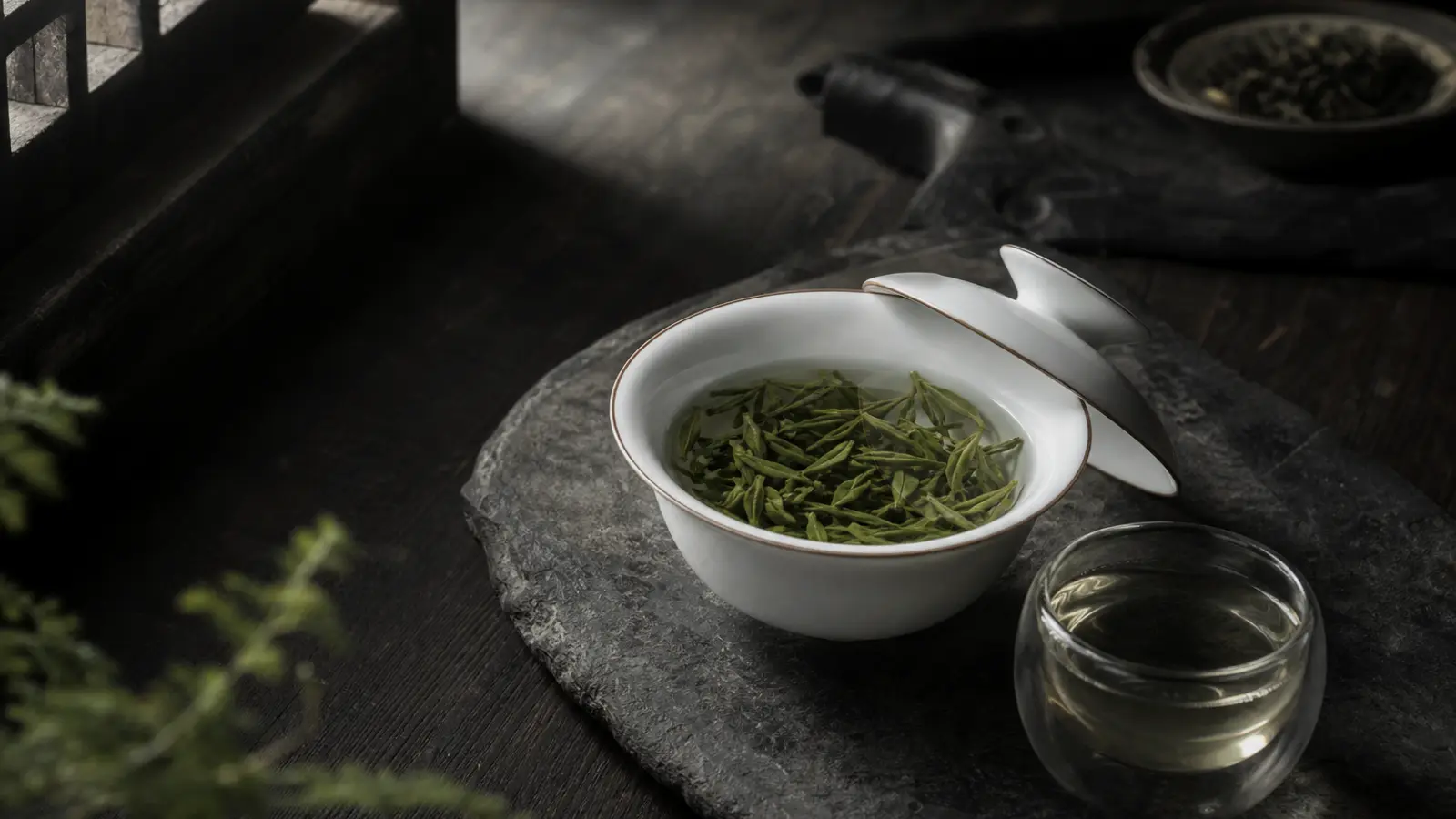
One practical note for gongfu (工夫) brewers: a standard gongfu session — using 5–7g of leaf in a 100ml gaiwan (蓋碗), brewed across 6–8 short steeps — delivers roughly the catechin equivalent of 2–3 UK standard cups. A morning gongfu session followed by a casual afternoon cup puts you comfortably in the effective range.
Timing: After Meals
If you are specifically interested in buffering postprandial glucose spikes, drinking green tea with or shortly after meals is the most strategically useful application of the evidence. This is when the enzyme-inhibiting effect of EGCG is most relevant — it slows the conversion of the carbohydrates you just ate into bloodstream glucose.
This is also the most natural fit for how green tea is traditionally consumed across East Asia: with food, or immediately following a meal.
No Added Sugar
This point is non-negotiable: do not add sugar to the tea you are drinking for metabolic benefit.
Added sugar directly opposes the mechanism you are relying on. Sweetened green tea raises postprandial blood glucose — the exact outcome you are trying to buffer. Even honey, which is sometimes positioned as a “healthier” sweetener, carries enough fructose and glucose to meaningfully blunt the effect.
Drink it plain. If you find plain green tea unpleasant, that is often a brewing problem — water too hot, leaf steeped too long — rather than an inherent bitterness. Most quality green teas brewed correctly at 70–80°C with a 30–60 second steep time are clean and sweet without any added sweetener. For a detailed breakdown of temperature by tea type, the tea brewing water temperature guide covers this precisely.
Green Tea vs. Other Teas for Blood Sugar
Green tea has by far the most clinical evidence in this space because it is the most-studied tea type in East Asian epidemiological cohorts. But it is worth noting:
- Black tea contains theaflavins and thearubigins, oxidized polyphenols with some evidence for glucose modulation, but the research base is smaller and less consistent than green tea
- Oolong tea (烏龍茶) sits between green and black in oxidation; limited but suggestive evidence for insulin sensitivity improvement
- Pu-erh (普洱茶), particularly shou (ripe) pu-erh, has some animal-model and small human-trial evidence for lipid and glucose effects, but RCT evidence is not yet at the same level as green tea
If blood sugar management is a specific goal, green tea is where the evidence sits most solidly.
What Green Tea Cannot Do
I want to be direct about the limits here, because this topic attracts a lot of overstated claims.
Green tea will not reverse established type 2 diabetes. It will not produce clinically significant HbA1c reductions on its own in someone with poor dietary habits. It is not a substitute for metformin or other medications prescribed for blood sugar management. The improvements seen across those 15 RCTs are meaningful at the population level but modest at the individual level — the kind of effect that matters as part of a coherent health practice, not as a standalone intervention.
If you are managing diabetes, pre-diabetes, or insulin resistance, the primary levers remain: reducing refined carbohydrate intake, increasing physical activity, managing body weight, and working with your physician on any required medication. Green tea is a useful, evidence-backed addition to that picture. It is not the picture itself.
Building the Habit
Three cups of green tea per day is achievable without any particular discipline once it becomes a structural part of your day. The pattern I find works:
- Morning session: a gongfu brew with breakfast or immediately after, contributing the equivalent of 2–3 cups
- Afternoon cup: a simpler Western-style steep or a second short gongfu session with lunch
- Skip the evening cup if you are caffeine-sensitive — green tea contains enough caffeine to affect sleep quality, which itself is an independent variable in insulin resistance
For the specifics of how to brew green tea well — leaf weight, temperature, steep time by cultivar — the Steep Atlas green tea guide covers this in detail. For gongfu session protocols, the gongfu brewing guide walks through the full method. If you are wondering how much tea to buy and keep on hand to maintain a 3-cup daily habit, the how much tea per day article has the practical math.
The evidence on tea and blood sugar is honest: real, modest, and best understood as one component of a larger metabolic picture. That framing is less exciting than “green tea cures diabetes,” but it is what the data actually supports — and a genuine benefit is still worth having.