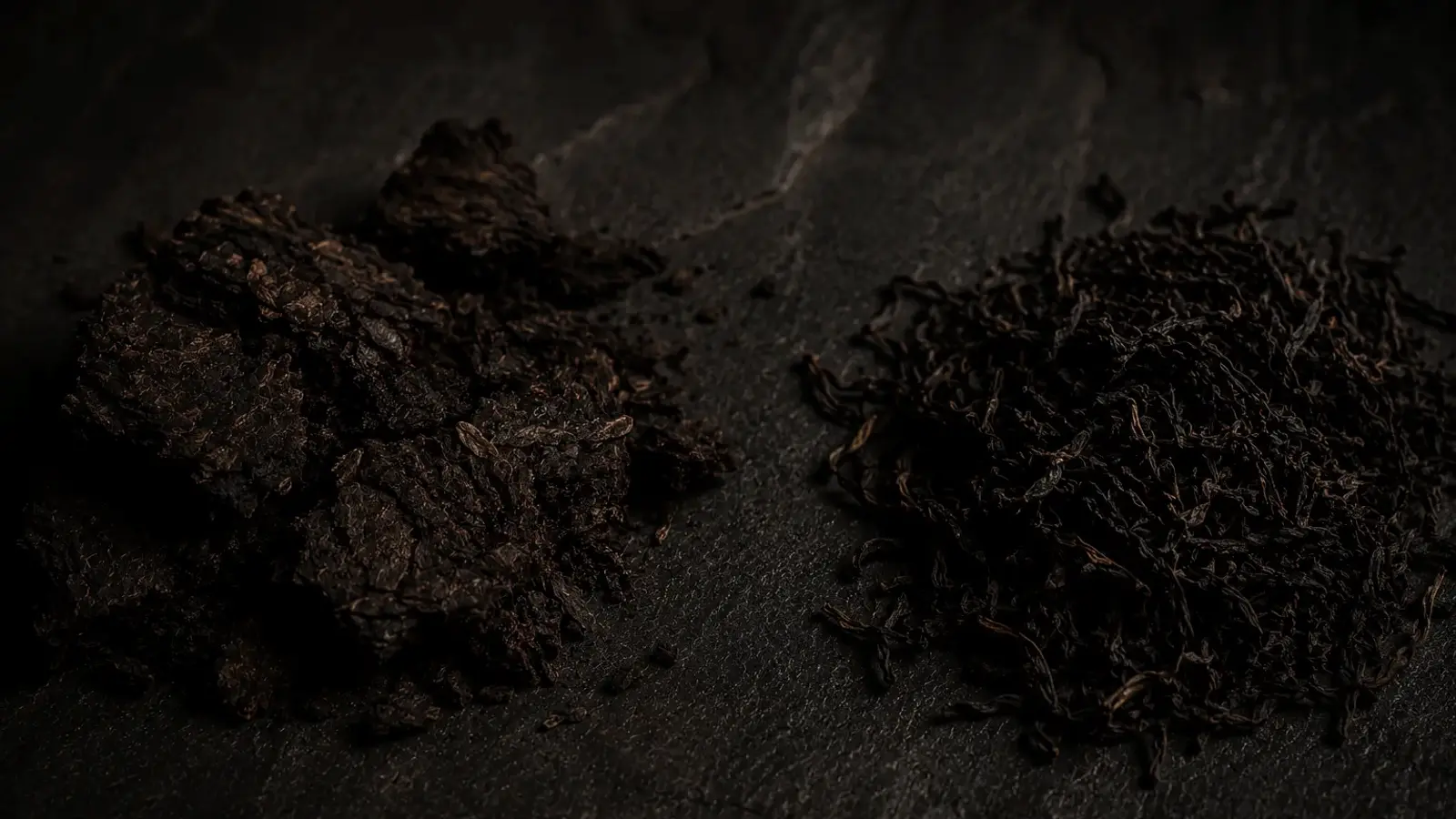
Most people encounter pu-erh for the first time and reach a reasonable but incorrect conclusion: this must be a black tea. The liquor is dark. The flavor is rich. The dry leaves often look like compressed brown material. The assumption is understandable — and almost entirely wrong.
Pu-erh vs black tea is one of the most common points of confusion in tea, and it persists partly because of a genuine translation problem baked into the English language. Once you understand what is actually happening in each tea’s production, the differences become obvious. They are not just different teas; they belong to different categories built on different biological foundations.
This guide covers everything: processing, flavor, aging potential, brewing method, caffeine, price, and the naming confusion that started the whole mess.
What Is the Difference Between Pu-erh and Black Tea?
Pu-erh is a fermented tea from Yunnan that ages and improves over years or decades. Black tea (red tea in Chinese, 红茶) is fully oxidized, sealed to prevent further change, and meant to be consumed within one to two years of production. Different processing, different microbiology, different timelines, different cups.
At a Glance:
| Dimension | Black Tea (Hong Cha 红茶) | Pu-erh (Hei Cha 黑茶) |
|---|---|---|
| Processing | Fully oxidized, then dried; process stops | Post-fermented; microbial activity continues |
| Flavor (typical) | Malty, brisk, astringent | Earthy/smooth (shou); green/evolving (sheng) |
| Aging potential | Degrades after 1–2 years | Improves over decades |
| Best brewing method | Western style (1 steep, 3–5 min) | Gongfu (multiple short steeps) |
| Caffeine delivery | Concentrated in single steep | Distributed across many steeps |
| High-end price | Moderate | Can reach thousands per cake |
The Naming Problem: Hong Cha vs Hei Cha
Before anything else, let’s fix the language.
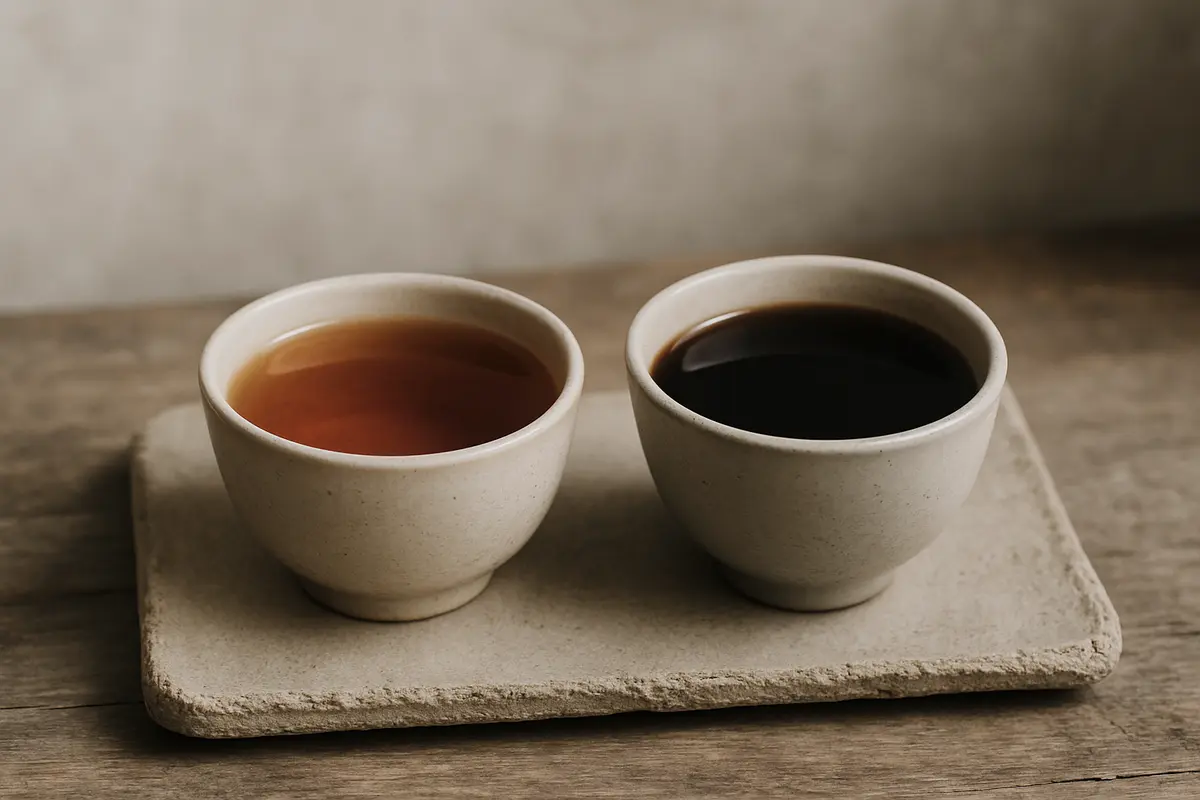
In Chinese, what Westerners call “black tea” is hong cha (红茶) — which translates literally as red tea. Look at a brewed cup of Darjeeling, Assam, or Keemun: the liquor is a warm amber-red, not black. Chinese speakers named the category accurately.
Hei cha (黑茶) means dark tea and is the category that contains pu-erh, along with other post-fermented teas from Hunan, Guangxi, and Sichuan. The dry leaves and brewed liquor of aged or ripe pu-erh are genuinely dark — nearly black. If you want to explore what else falls under this umbrella, what is hei cha covers the full dark tea category beyond pu-erh.
When Western traders encountered Chinese teas, they labeled hong cha as “black tea” (perhaps because the dry leaves are dark), and the distinction between hong cha and hei cha collapsed. The result: in English, “black tea” points at the wrong category from a Chinese perspective, and hei cha — the actual dark tea — has no clean English name at all.
This is the seed of the confusion. Pu-erh looks like what an English speaker would call a black tea. But it belongs to a different category with different biology, different flavor potential, and a fundamentally different relationship with time.
How Each Tea Is Made: The Fundamental Difference
Understanding pu-erh vs black tea starts with processing. The difference is not cosmetic — it is biological.
How Black Tea Is Produced
Black tea production follows a defined sequence: wither, roll, oxidize, dry. The oxidation step — where enzymes in the leaf react with oxygen — transforms the fresh green leaf into the dark, malty material we recognize. Heat drying at the end arrests that enzymatic activity. The tea is finished. It will not change in any meaningful way after production; in fact, it will slowly degrade.
The process is closed. Once dried, the tea is a static product.
How Pu-erh Is Produced
Pu-erh starts from a different base material: mao cha (毛茶), a sun-dried green tea made from the large-leaf Camellia sinensis var. assamica trees of Yunnan province, many of them old-growth. This base material retains live enzymes and microbial populations that heat-kill processing would destroy.
From mao cha, pu-erh takes two paths:
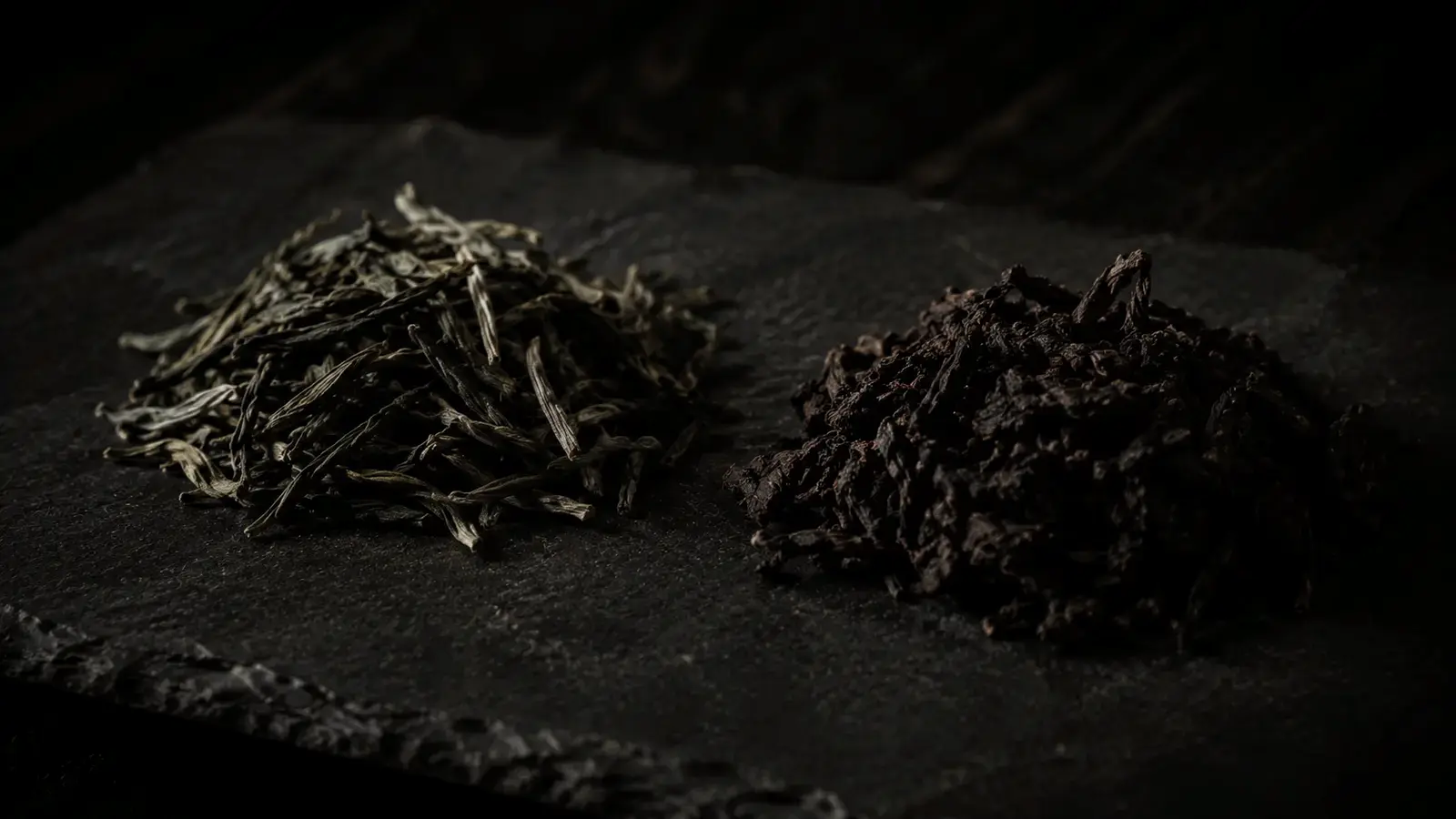
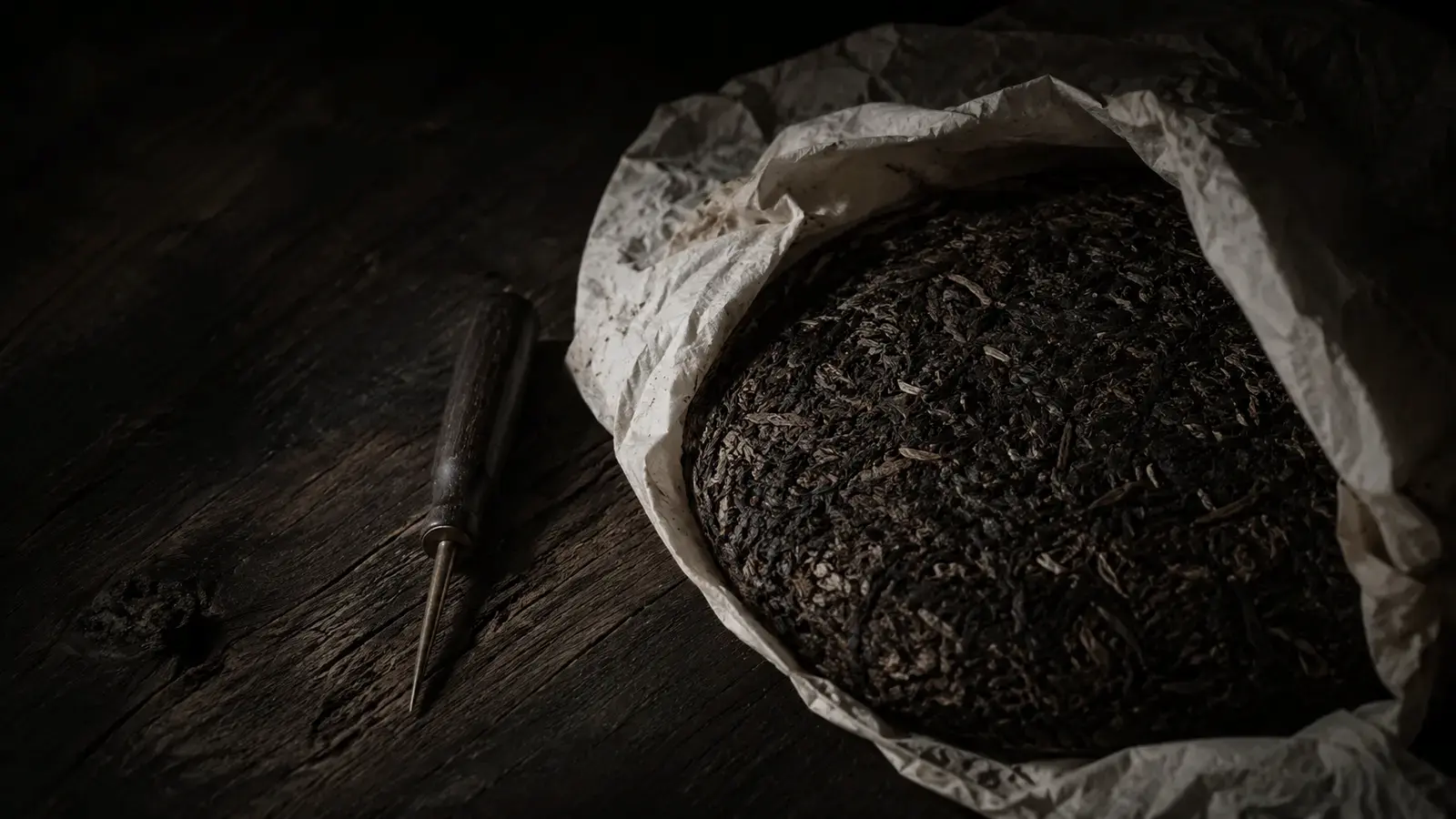
Sheng (生) pu-erh, also called raw pu-erh, is pressed into cakes and aged. The transformation happens slowly through ongoing enzymatic activity and microbial fermentation over years or decades. A young sheng is green and astringent; a 20-year-old sheng is smooth, complex, and utterly different from what it was.
Shou (熟) pu-erh, also called ripe pu-erh, uses an accelerated process called wo dui (渥堆) — a controlled microbial pile fermentation developed in the 1970s in Yunnan. Dampened mao cha is piled, covered, and allowed to ferment for 45 to 60 days. The result approximates the character of aged sheng in a fraction of the time. For a deeper look at how these two types compare, sheng vs shou pu-erh covers the real differences in detail.
The critical point: pu-erh is a living product. Microbial activity does not stop when the tea is pressed or dried. It continues in storage. A black tea’s story ends at the factory; pu-erh’s story is still being written.
Flavor: What Each Tea Actually Tastes Like
This is where the gap between pu-erh and black tea is most immediately obvious to anyone who drinks both.
Black Tea Flavor
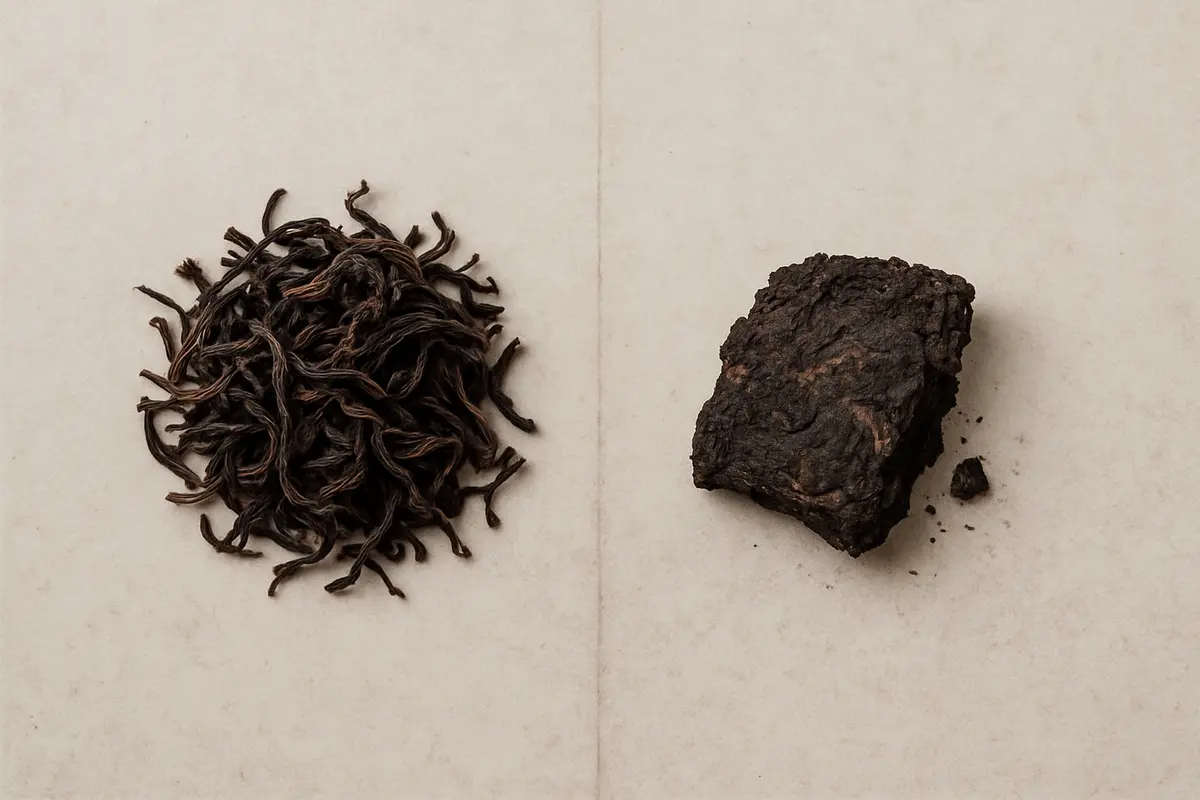
Black tea — hong cha — is malty, brisk, and often astringent. Depending on origin and processing, you get the muscatel of a second-flush Darjeeling, the bold tannin structure of an Assam, the smoky depth of a Lapsang Souchong, or the honey-cocoa notes of a well-made Dian Hong (Yunnan black tea, confusingly). The flavor profile is front-loaded: it hits your palate immediately with brightness and structure.
Black tea’s astringency comes from theaflavins and thearubigins — polyphenols created during oxidation. These give black tea its characteristic bite and the satisfying dryness after swallowing.
Shou Pu-erh Flavor
Shou pu-erh sits at the opposite end of the flavor spectrum. It is earthy, smooth, and deep — with notes that range from dark soil, forest floor, and dried jujube to mushroom, dark chocolate, and sometimes a clean mineral finish. The astringency is minimal. The texture is often thick, almost coating.
Where black tea is brisk, shou is contemplative. It does not demand attention — it rewards it. The huigan (回甘), or returning sweetness, that develops in the throat minutes after swallowing is a signature of quality shou pu-erh and has no real parallel in black tea.
Sheng Pu-erh Flavor
Young sheng is the wildcard. To a first-time drinker, it tastes nothing like either black tea or shou pu-erh. It is closer to a full-bodied, high-astringency green tea: grassy, floral, sometimes bitter, with a strong huigan. With 10 to 15 years of storage behind it, that same sheng transforms into something with dried apricot, camphor, tobacco, and a silky texture that took years to develop. A 30-year-old sheng from a good storage environment is one of the most complex beverages in the world.
Aging: Time Changes Everything
This single dimension separates pu-erh from every other tea category.
Black tea does not improve with age. Most black teas are best consumed within 12 to 24 months of production. A well-stored Assam from two years ago is fine; a five-year-old Assam has almost certainly lost its brightness and become flat. There are narrow exceptions — some heavily oxidized or smoked black teas can hold well — but aging black tea as a deliberate practice makes no sense.
Pu-erh is defined by aging. Collectors store sheng cakes for 10, 20, 40 years. Factories in Yunnan have aged inventories stretching back to the 1950s and 1960s. The price of pu-erh scales with age in ways that parallel aged wine or whiskey. A well-stored 1990s sheng cake that sold for a few dollars when pressed now commands hundreds or thousands per cake.
Even shou pu-erh, already fermented, benefits from a few years of rest after production to let the rough wo dui character settle into something smoother.
This relationship with time is fundamental to pu-erh culture. People buy young sheng with the explicit intention of not drinking most of it for years. That concept simply does not exist in black tea. If you want to understand how pu-erh tea ages across different time horizons, the changes at 5, 10, and 20 years are genuinely distinct.
Brewing: Gongfu vs Western Style
Black tea arrived in the West with an entire infrastructure built around it: teapots, tea caddies, milk jugs, timed steeping. The standard Western brew — one teaspoon per cup, 212°F (100°C) water, 3 to 5 minutes — was optimized for black tea’s single, bold extraction.
Pu-erh rewards the gongfu (功夫) method: a small brewing vessel (typically a gaiwan or a Yixing clay teapot), a high leaf-to-water ratio, and many short steeps of 10 to 30 seconds each. A quality shou or aged sheng can sustain 10 to 15 infusions, and the flavor profile shifts meaningfully from steep to steep.
You can brew pu-erh Western-style. It will produce a drinkable cup. But you will be collapsing a dynamic, multi-act experience into a single scene. The gongfu approach lets you watch the tea open up, soften, shift in register — and then gracefully fade. That arc is part of what you are paying for with quality pu-erh material.
Temperature note: Shou pu-erh and aged sheng both handle full-boil water (212°F / 100°C) well; the compressed leaves need heat to open. Young sheng is sometimes brewed slightly cooler — around 195°F (90°C) — to manage bitterness, though preferences vary.
Caffeine: Similar Levels, Different Delivery
Pu-erh and black tea have roughly comparable caffeine content per gram of dry leaf — typically in the 30 to 70 mg per serving range depending on leaf grade, brewing parameters, and harvest time. I would not cite a precise figure here because the variance within each category is large enough that averages mislead.
What differs is delivery. Black tea brewed Western-style releases most of its caffeine in a single steep. Gongfu-brewed pu-erh spreads that release across many infusions. Drinkers who find black tea gives them a sharp caffeine spike followed by a crash often report that pu-erh — consumed across 8 to 10 steeps over an hour — produces a steadier, longer-duration alertness. Whether this is the caffeine delivery, the presence of L-theanine, or simply the ritual slowing the drinking down, I cannot say definitively.
Price: Different Markets Entirely
Daily-quality black tea is among the most accessible beverages on earth. A decent CTC Assam for morning milk tea costs almost nothing. Even good loose-leaf Darjeeling or Dian Hong runs $10 to $30 per 100g for reliable material.
Pu-erh spans an enormous price range. Factory shou pu-erh for everyday drinking costs comparably to decent black tea — $15 to $30 for a 357g cake works out to a few dollars per session. But the upper end of the pu-erh market has no equivalent in black tea. Aged sheng from reputable factories — 1990s Menghai productions, for example — trades between collectors for hundreds or thousands of dollars per cake. Single-tree mao cha from famous old-growth gardens in Yunnan can cost $50 to $150+ per 100g even as young material.
This price range reflects something black tea simply does not have: the combination of terroir-specific sourcing, decades of storage, and genuine scarcity. A 30-year-old Keemun is just old. A 30-year-old sheng from a known storage and reputable source is a different object entirely.
Head-to-Head Comparison Table
| Dimension | Black Tea (Hong Cha 红茶) | Pu-erh (Hei Cha 黑茶) |
|---|---|---|
| Chinese name | Hong cha (red tea) | Hei cha (dark tea); pu-erh is a subset |
| Processing | Fully oxidized, then dried; process stops | Post-fermented; microbial activity continues |
| Base material | Various Camellia sinensis cultivars | Primarily Yunnan large-leaf assamica |
| Flavor (typical) | Malty, brisk, astringent | Earthy/smooth (shou); green/evolving (sheng) |
| Astringency | Moderate to high | Low (shou); high when young, dropping with age (sheng) |
| Aging potential | Degrades after 1–2 years | Improves over decades |
| Best brewing method | Western style (1 steep, 3–5 min) | Gongfu (multiple short steeps) |
| Caffeine delivery | Concentrated in single steep | Distributed across many steeps |
| Entry-level price | Very affordable | Affordable to mid-range |
| High-end price | Moderate | Can reach thousands per cake |
| Color of liquor | Amber to dark red | Dark brown to near-black (shou); golden to amber (young sheng) |
Which Should You Choose?
This is the wrong question if you are new to both. They serve different roles.
If you want a reliable morning cup, something that works with milk, something brewed in under five minutes with no learning curve — black tea is the answer. It is not lesser for being what it is. A well-made Dian Hong or a proper Darjeeling second flush is a genuinely excellent beverage.
If you are curious about complexity, about teas that change across multiple steeps, about the possibility of aging a tea like you would age a wine — pu-erh is worth your time. Start with a factory shou pu-erh; they are forgiving, inexpensive, and give you a clear first impression of what post-fermented tea tastes like. Then try a young sheng and see how different two teas from the same category and same province can be.
The two are not competitors. Plenty of serious tea drinkers drink both — black tea in the morning for its directness and energy, pu-erh in the afternoon or evening for its depth and ritual. If the evening ritual angle interests you, tea instead of wine is worth reading for how shou pu-erh fits that kind of slow, deliberate session.