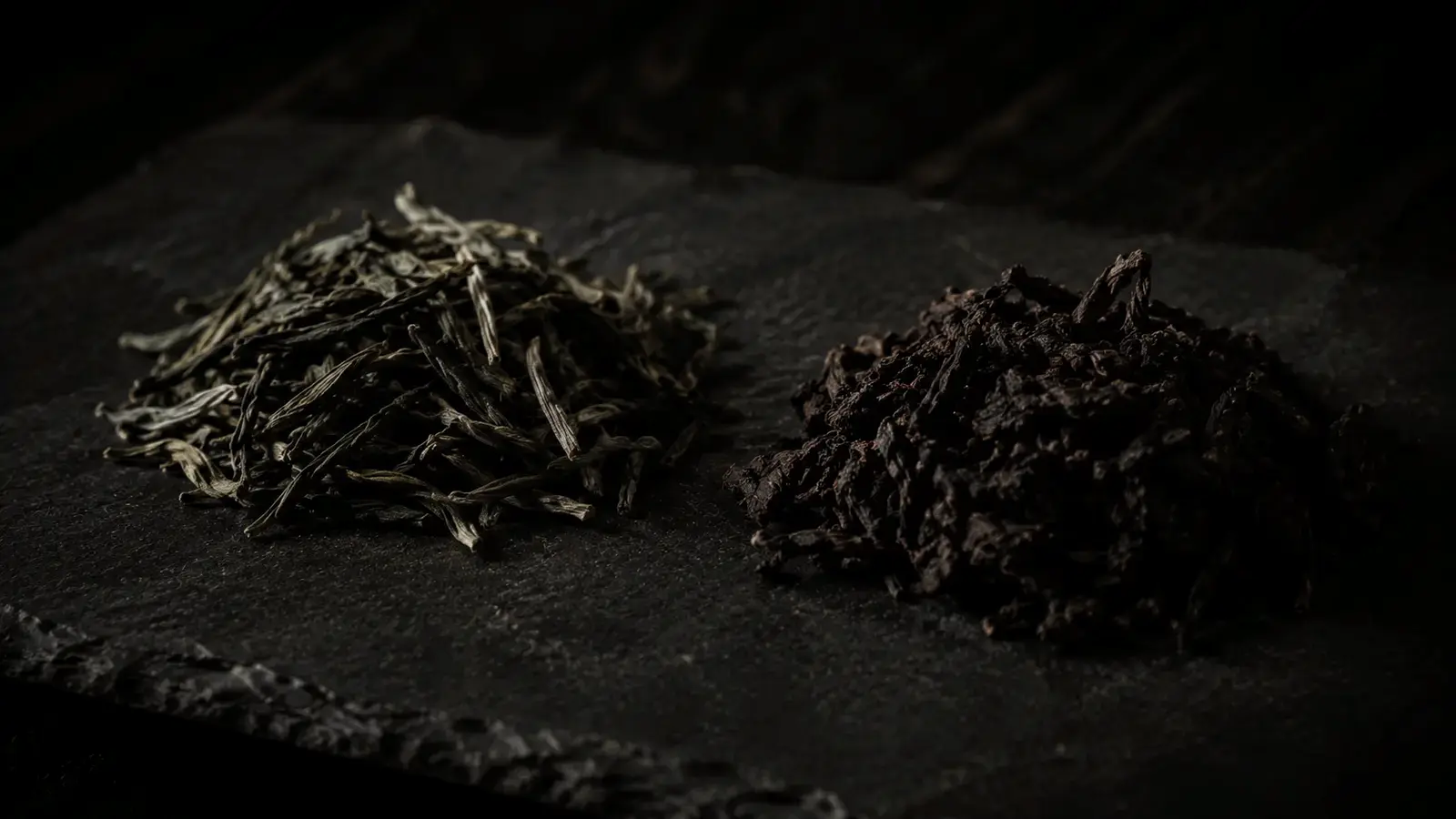
The Comparison at a Glance
| Dimension | Sheng (Raw) | Shou (Ripe) |
|---|---|---|
| Processing | Sun-dried maocha, pressed into cakes | Maocha undergoes wo dui (wet pile fermentation) for 45-60 days, then pressed |
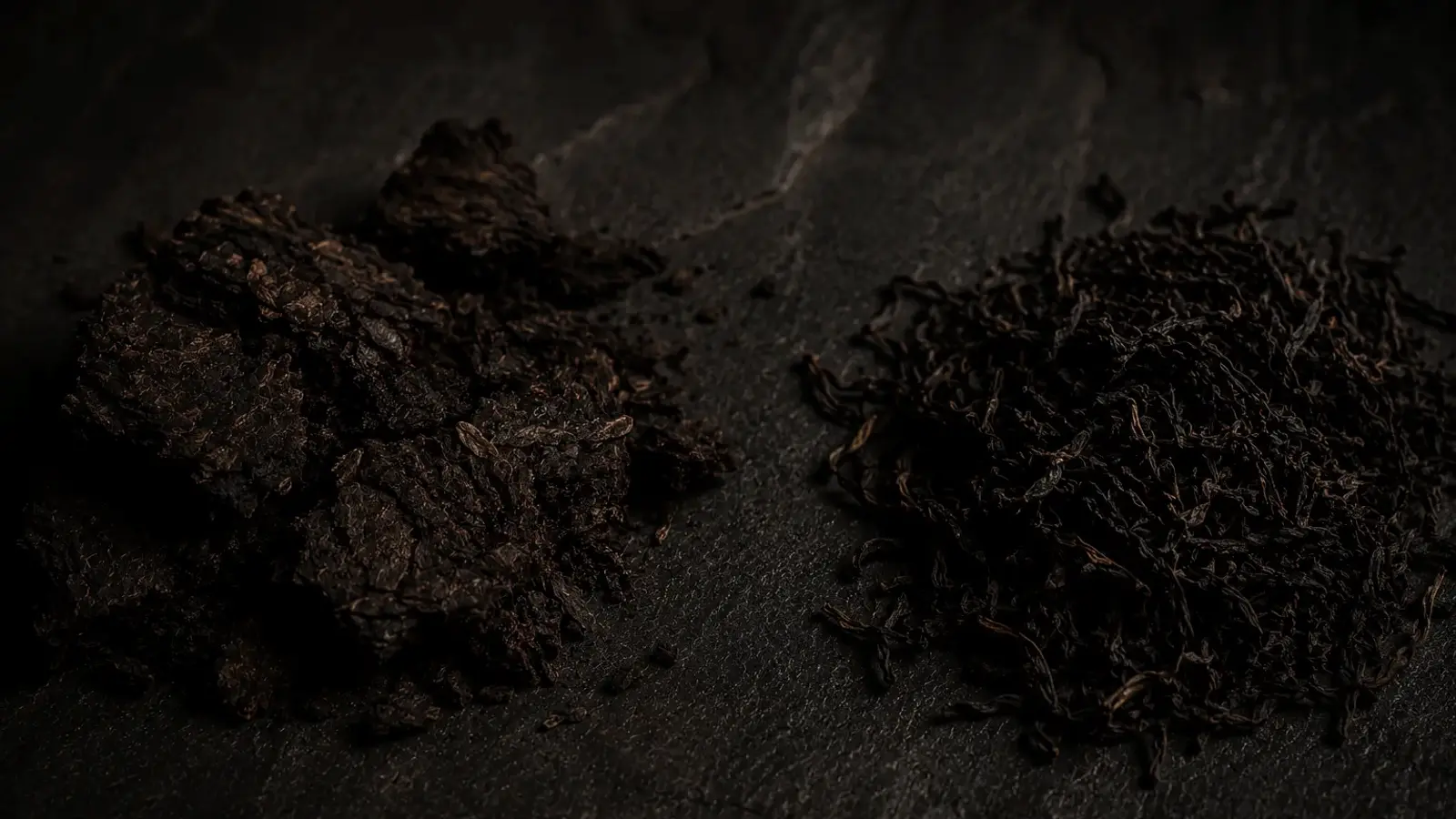
| Flavor (young) | Bright, bitter, floral, vegetal, astringent | Earthy, smooth, chocolate, wood, minimal bitterness |
| Flavor (aged) | Camphor, dried fruit, medicinal herbs, honey | Deepens to cleaner earth, wood, dried dates |
| Color | Pale gold → amber → deep reddish-brown over decades | Deep reddish-brown to opaque black from production |
| Body | Light to medium when young, thickening with age | Thick and coating from production |
| Huigan | Can be intense — bitterness converts to powerful sweetness | Present but gentle — sweetness is upfront, not earned through bitterness |
| Aging potential | Decades. The entire point. 15-30 years is the sweet spot | Benefits from 1-5 years of resting. Limited transformation beyond that |
| Caffeine | Higher, especially young material | Lower — fermentation degrades some caffeine |
| Price (entry) | $15-40 per 357g cake | $10-30 per 357g cake |
| Price (premium) | $100-5,000+ for gushu and aged material | $30-200 for quality aged or gushu-based shou |
| Best time to drink | Morning and afternoon | Anytime, especially evening |
| Who starts here | Experienced tea drinkers, collectors, those who enjoy bitterness | Beginners, evening drinkers, those who prefer comfort |
Every pu-erh tea is one of two things: sheng (生, raw) or shou (熟, ripe). They come from the same plant, the same mountains, often the same trees. But the processing fork between them creates two teas that taste, age, brew, and cost differently enough that they might as well be different categories.
Understanding this split is the first real decision any pu-erh drinker makes. It determines what you buy, how you store it, how you brew it, and what you expect from it over time.
The short version: sheng is the original form — unfinished tea designed to transform over decades of storage. Shou is the accelerated form — fermented at production to deliver aged character immediately. Sheng is the Barolo: structured, tannic, built for patience. Shou is the ready-to-drink Merlot: smooth, dark, comforting from day one.
The long version follows.
What Is the Difference Between Sheng and Shou Pu-erh?
Sheng (raw) pu-erh is naturally sun-dried and ages slowly over years or decades, developing complexity through microbial and enzymatic transformation. Shou (ripe) pu-erh undergoes accelerated fermentation (wo dui) over 45–60 days to simulate the characteristics of aged sheng. Sheng is brighter, more astringent, and evolves with storage; shou is darker, smoother, and ready to drink immediately.
How Sheng Is Made
Sheng pu-erh follows a production path that is deliberately incomplete.
Fresh leaves from Camellia sinensis var. assamica trees are withered to reduce moisture, then pan-fired in a large wok — the kill-green step (sha qing, 杀青) that halts oxidation. But unlike green tea production, where kill-green is aggressive and thorough, pu-erh’s kill-green is lighter and shorter. The goal is to stop oxidation while preserving the enzymatic activity and microbial potential that will drive aging.
After kill-green, the leaves are rolled to break cell walls and release juices that facilitate future fermentation, then spread outdoors for sun-drying (shai qing, 晒青). This sun-drying step is what separates pu-erh from every other tea: the ultraviolet exposure activates microbial communities while keeping biological systems alive. Oven-dried tea is shelf-stable but biologically dead. Sun-dried pu-erh is alive.
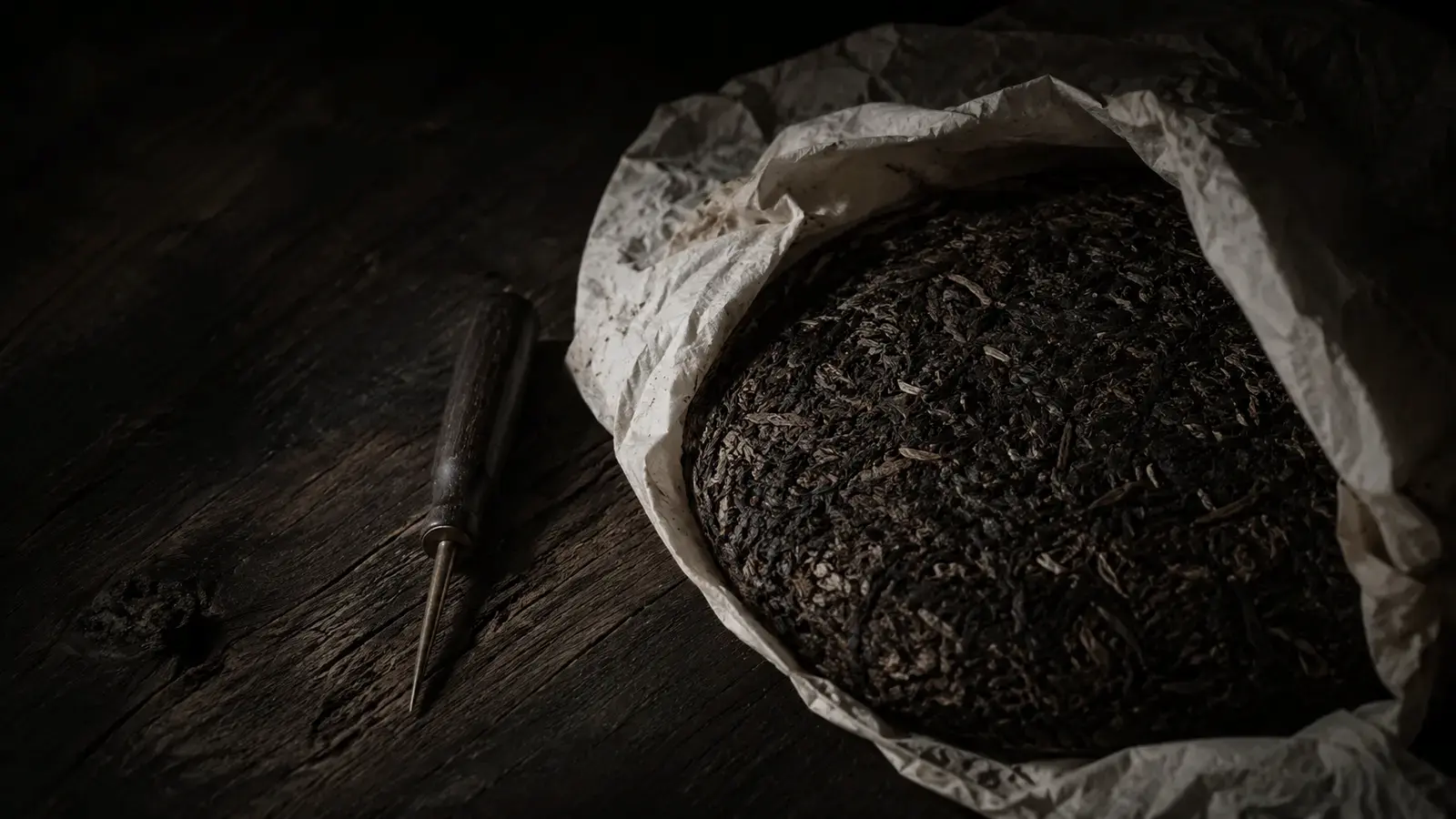
The resulting loose tea — maocha (毛茶, rough tea) — is then steamed briefly to soften it and pressed into cakes, bricks, or other shapes. The standard cake (bing, 饼) weighs 357 grams.
That’s the entire process. The tea enters the world unfinished. What happens next — over years and decades of storage — is the whole proposition.
How Shou Is Made
Shou pu-erh adds one massive intervention between maocha production and pressing: wo dui (渥堆, wet pile fermentation).
The technique was standardized in 1973 at Menghai Tea Factory to meet Hong Kong market demand for aged-character pu-erh without the decades of waiting. Large piles of maocha — sometimes several tons — are moistened to 30-40% water content and covered with thermal blankets. Microbial communities (primarily Aspergillus niger and related species) colonize the pile. Their metabolic activity generates heat, pushing core temperatures to 50-65°C.
Over 45-60 days, the fermentation master monitors the pile daily, turning it every 5-7 days to redistribute moisture and prevent scorching. The microbial activity transforms the tea’s chemistry: catechins convert to theabrownins (the dark, smooth compounds unique to fermented tea), chlorophyll degrades, and new aromatic compounds form — the earthy, woody, chocolate character that defines shou.
The result is immediate drinkability. Where young sheng demands years of patience, shou is ready at production — though it benefits from 1-3 years of rest to let the pile taste (dui wei, 堆味 — a composty or fishy note from fresh fermentation) dissipate.
The quality of shou depends on variables that are invisible to the consumer: the quality of the maocha going in (gushu material produces better shou than plantation material — the raw complexity shows through even after fermentation), the pile size and management skill, the water source, and the fermentation master’s judgment about when to turn and when to stop. Great shou and mediocre shou come from the same process. The difference is the hands managing it.
Sheng vs Shou: Taste Difference
Sheng: Bright, Then Patient
Young sheng pu-erh is not what most people expect from “pu-erh.” It’s closer to a potent, assertive green tea than to the dark, earthy beverage the name suggests. The first steeps of a quality young sheng hit with vegetal brightness, floral aromatics, and a bitterness that can be genuinely intense — mouth-coating, jaw-tightening bitterness that announces itself without apology.
That bitterness is not a flaw. In quality sheng, it converts. The huigan (回甘, returning sweetness) that follows is the defining quality marker of the category: within seconds of the bitter peak, a wave of sweetness rises in the throat and lingers for minutes. The speed, intensity, and duration of this conversion tells you more about the raw material than any other single indicator. The most famous pu-erh villages — Laobanzhang, Lao Man’e — are prized precisely because their huigan conversion is the most dramatic in Yunnan.
I’ll be honest: young sheng is not my comfort zone. I’m a structure-and-body drinker — I reach for density over delicacy, darkness over brightness. My palate profile maps more naturally to aged sheng and shou. But I respect what young sheng does, and the teas I’ve brewed from Southeast Asian ancient trees have taught me to appreciate the berry and stone fruit aromatics that quality sheng offers when given patient attention and proper dosing.
As sheng ages, the transformation is the reward. The bitterness mellows. The astringency softens. New compounds develop — camphor, dried fruit, medicinal herbs, aged wood, honey. A properly stored sheng at 15-20 years is a fundamentally different tea from what it was when pressed. The brightness becomes depth. The aggression becomes authority. A 38-year aged sheng I tasted from Southeast Asian ancient tree stock produced a camphor-cypress aroma so intense I described it in my notes as “smelling time itself.” The cha qi (茶气, body sensation) from that session caused cha zui (茶醉, tea drunkenness) — a lightheaded, body-warming sensation that left me sitting quietly for twenty minutes after the last steep.
That transformation potential is what drives the sheng collector market and the prices that make wine collectors feel at home.
Shou: Dark, Immediate, Forgiving
Shou is the pu-erh that meets you where you are.
The first steep of a well-made shou is dark chocolate in a cup. Literally — the liquor is opaque reddish-black, the aroma is cocoa and wet wood, and the mouthfeel coats the tongue with a velvety thickness that no other tea type replicates. There is no bitterness to overcome. No astringency to tolerate. No learning curve to navigate. You pour the water, you wait fifteen seconds, you drink something that tastes like comfort distilled into liquid.
My most-brewed tea across every session I’ve documented is a shou from ancient trees in Southeast Asia — dark chocolate, dates, velvet body, no edges. It became the benchmark against which I evaluate every other shou. It’s the tea I reach for at the end of the day when the purpose of the session is not evaluation but arrival. The gongfu parameters forgive imprecision — even a clumsy brew produces a smooth, warm, dark cup.
Shou’s simplicity is deceptive. Within the category, there is range. A factory shou from a major producer is clean and consistent but one-dimensional — earth and wood, session over in six steeps. A gushu-based shou from a skilled fermentation master has layers: chocolate gives way to dried fruit, then teak, then a late sweetness that the early steeps’ density concealed. The best shou I’ve brewed produced a qi that arrived as a slow, warming calm — not the dramatic punch of aged sheng but a sustained grounding that I associate now with evening practice.
Sheng vs Shou: Caffeine Comparison
Both sheng and shou contain caffeine, but young sheng typically has more per steep than shou. The fermentation process in wo dui production degrades a portion of the caffeine in shou, producing a lower-stimulation cup. In gongfu brewing, both distribute caffeine across many short steeps rather than concentrating it in a single extraction — the per-steep intake for either is lower than a standard cup of coffee.
Aging: The Core Divergence
This is where sheng and shou fundamentally part ways.
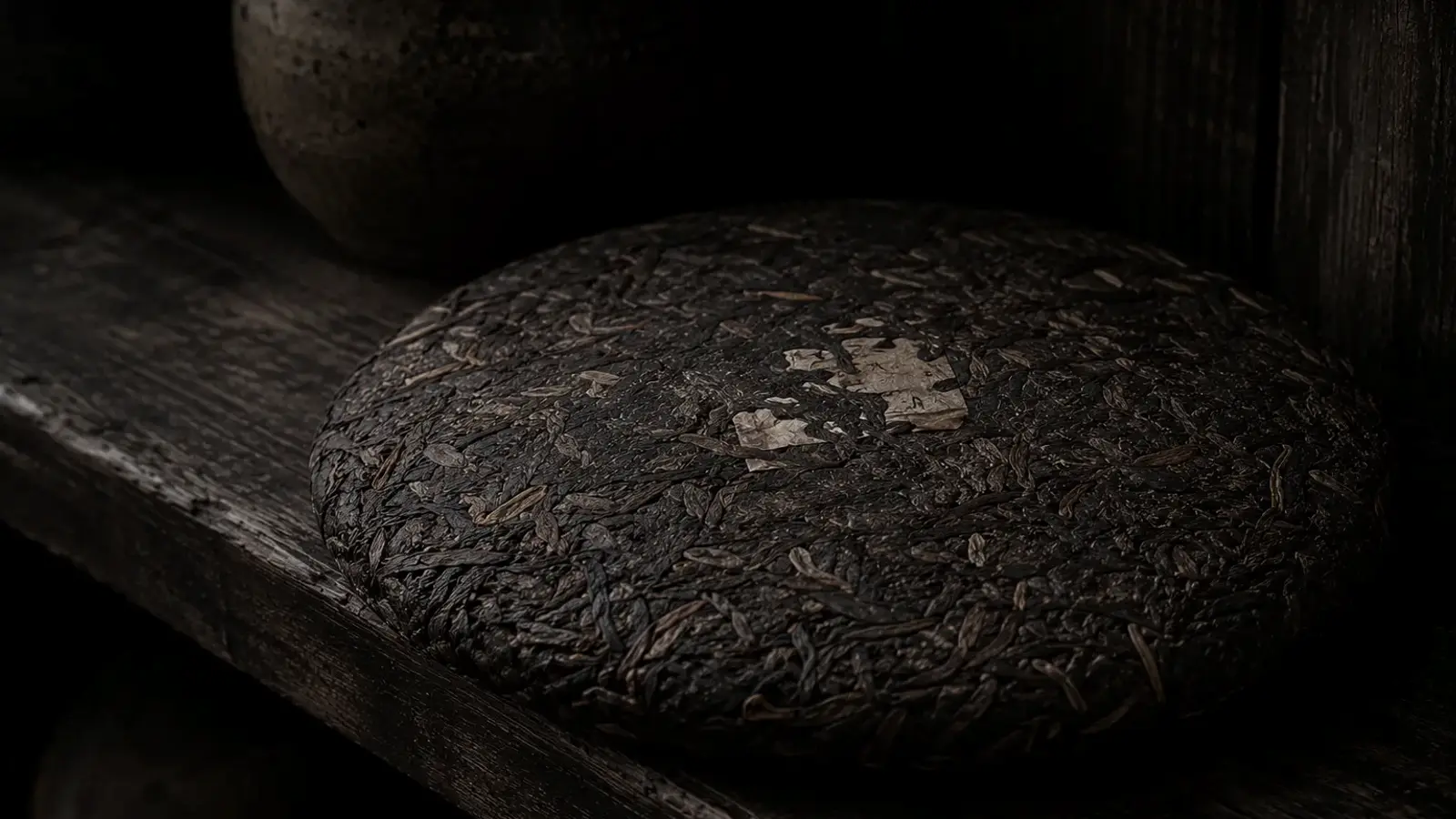
Sheng ages. This is its purpose. The biological activity preserved through sun-drying drives slow microbial transformation over decades. The flavor evolution is dramatic and directional: bright becomes dark, bitter becomes sweet, aggressive becomes refined. The aging trajectory varies by terroir and storage — Yiwu develops elegant honey-camphor integration, Bulang develops deep medicinal authority — but the direction is consistent. Time adds complexity.
The practical sweet spot for most drinkers is 10-25 years. Below 5 years, sheng is still mostly raw — bright, bitter, not yet transformed. Between 5 and 10, it enters an awkward middle period where the brightness is fading but the aged character hasn’t arrived. After 10, the transformation becomes real. After 20, properly stored sheng from quality material becomes something extraordinary. After 30-40, you’re in collector and auction territory.
Storage conditions determine the speed and character of aging. High humidity (Hong Kong traditional storage, 80-95% RH) accelerates the process — 10-15 years can produce significant transformation. Low humidity (Kunming dry storage, 50-65% RH) slows everything — 25-30 years for equivalent depth. My own storage in tropical Southeast Asia (70-85% RH) sits between these extremes. For the full aging timeline: How Pu-erh Tea Ages: What Happens at 5, 10, and 20 Years.
Shou has limited aging trajectory. The wo dui fermentation front-loaded the transformation that sheng spreads across decades. Shou does benefit from 1-3 years of rest post-production — the pile taste dissipates and the flavors integrate. Some quality shou continues to develop complexity over 5-10 years. But the dramatic arc of aged sheng — the 20-year metamorphosis — doesn’t happen with shou. It was already transformed at production. There’s less distance left to travel.
This is not a criticism. Shou’s proposition is different: immediate gratification with consistency. Sheng’s proposition is delayed gratification with potential. Different purposes, different timelines, different audiences.
Price: What Drives the Gap
Shou is almost always cheaper than sheng of equivalent raw material, and the reason is simple: shou’s value is in what it is today. Sheng’s value includes what it might become.
Entry shou (factory production, plantation material): $10-30 per 357g cake. Consistent, clean, daily-drinking quality. The most accessible point in all of pu-erh.
Entry sheng (small producer, identified region): $15-50 per 357g cake. More variable than entry shou. Can range from unpleasant (poor processing) to surprisingly good (quality material from a lesser-known mountain).
Premium shou (gushu-based, quality fermentation): $30-200 per 357g cake. The ceiling is lower than premium sheng because shou doesn’t carry the same aging premium.
Premium sheng (single-village gushu, aging potential): $100-5,000+ per 357g cake. The ceiling is effectively unlimited. Verified aged cakes from the 1990s and earlier trade at $1,000-50,000+. Current-year gushu from celebrity villages commands hundreds of dollars per 357g cake at production.
The pricing dynamics mirror wine: a current-release classified-growth Bordeaux costs more than a current-release négociant bottling, and a 20-year-old classified growth with provenance costs more still. The raw material quality, the processing skill, the storage history, and the reputation of the name all compound into the final price.
For someone starting: a $15-25 shou cake and a $30-50 sheng cake together provide months of daily brewing and a direct comparison that teaches more than any article can.
Brewing Differences
Both reward gongfu brewing, but the parameters differ.
| Parameter | Sheng | Shou |
|---|---|---|
| Leaf amount | 6-7g per 100ml | 7-8g per 100ml |
| Water temperature | 90-95°C (young), 95-100°C (aged) | 95-100°C |
| First steep | 8-10 seconds | 10-15 seconds |
| Rinse | 1 rinse (young), 2 rinses (aged/compressed) | 2 rinses |
| Expected steeps | 10-15+ | 8-12 |
| Tolerance for imprecision | Low — oversteeping young sheng punishes | High — even careless brewing produces a drinkable cup |
The dose difference matters. Shou at 7-8g per 100ml produces the thick, coating body that defines the category. At 5-6g, shou becomes sweet but structureless — pleasant enough but missing the density that makes it satisfying. Sheng at 6-7g balances extraction intensity with bitterness management — more leaf makes young sheng aggressive enough to overwhelm the huigan.
Sheng vs Shou: Which Should a Beginner Buy?
If you’re new to pu-erh: start with shou. It’s the gentler entry point, the more forgiving brew, and the faster path to understanding what pu-erh offers as a category. You can explore sheng later with a calibrated palate and the tolerance for bitterness that comes from experience.
If you came from wine: your palate will predict your preference. If you drink Bordeaux, Barolo, or structured reds — sheng’s bitterness-to-sweetness arc will feel familiar. If you drink Pomerol, aged Rioja, or velvety Pinot — shou’s immediate smoothness will appeal. Most wine-to-tea converts land on shou first and discover sheng when they’re ready for more challenge.
If you have anxiety or sleep concerns: shou for evenings, sheng for mornings. Shou’s lower caffeine and warming body make it the safe choice for late-day sessions. Young sheng’s caffeine can interfere with sleep and amplify anxiety — I restrict it to mornings on stable days and avoid it entirely during difficult periods.
If you want to collect and age: sheng is the only play. Shou doesn’t transform enough over time to justify cellaring. Buying young sheng today and storing it properly for 10-20 years is the pu-erh equivalent of buying wine futures.
If you want both: most committed pu-erh drinkers keep both. Sheng for analytical morning sessions. Shou for comfort evenings. They’re not competitors. They’re complements.
Frequently Asked Questions
Is sheng pu-erh better than shou?
Neither is better. They serve different purposes. Sheng has higher ceiling — the best aged sheng is among the most complex beverages on earth. Shou has higher floor — even mediocre shou is drinkable, while mediocre sheng can be unpleasant. The question is not which is better but which you need today.
Can beginners drink sheng pu-erh?
Yes, but be prepared for bitterness that exceeds anything you’ve encountered in other teas. In my experience, Southeast Asian ancient tree sheng tends to be smoother and less aggressive than Yunnan sheng. Use the correct dose (6-7g per 100ml) and keep early steeps short (8-10 seconds). If the bitterness is overwhelming, try an aged sheng (10+ years) where the bitterness has mellowed.
Does shou pu-erh age?
Minimally. Shou benefits from 1-3 years of rest after production to let the pile taste dissipate, and quality shou may continue to develop subtle complexity over 5-10 years. But the dramatic decades-long transformation that defines sheng does not occur in shou. If you’re buying shou to drink, drink it within a few years. If you want to age tea, buy sheng.
Why is aged sheng so expensive?
Scarcity compounds over time. A cake pressed in 2005 from a specific village exists in a fixed quantity that only decreases as people drink it. Twenty years of storage costs money (warehouse space, climate control, insurance against loss). Verified provenance — proof that the cake was stored properly and is what the label claims — adds further premium. And demand from collectors, particularly in the Chinese and Southeast Asian markets, drives prices at auction. The dynamics are identical to aged Burgundy or vintage Port.
Can I mix sheng and shou in one session?
You can, but most experienced drinkers don’t. The palate calibration is different — moving from shou’s thick smoothness to sheng’s bright bitterness (or vice versa) creates a jarring transition that makes it harder to evaluate either tea on its own terms. If you want to compare, brew them in separate sessions on the same day. Or use one for the morning and the other for the evening — which is what I do.