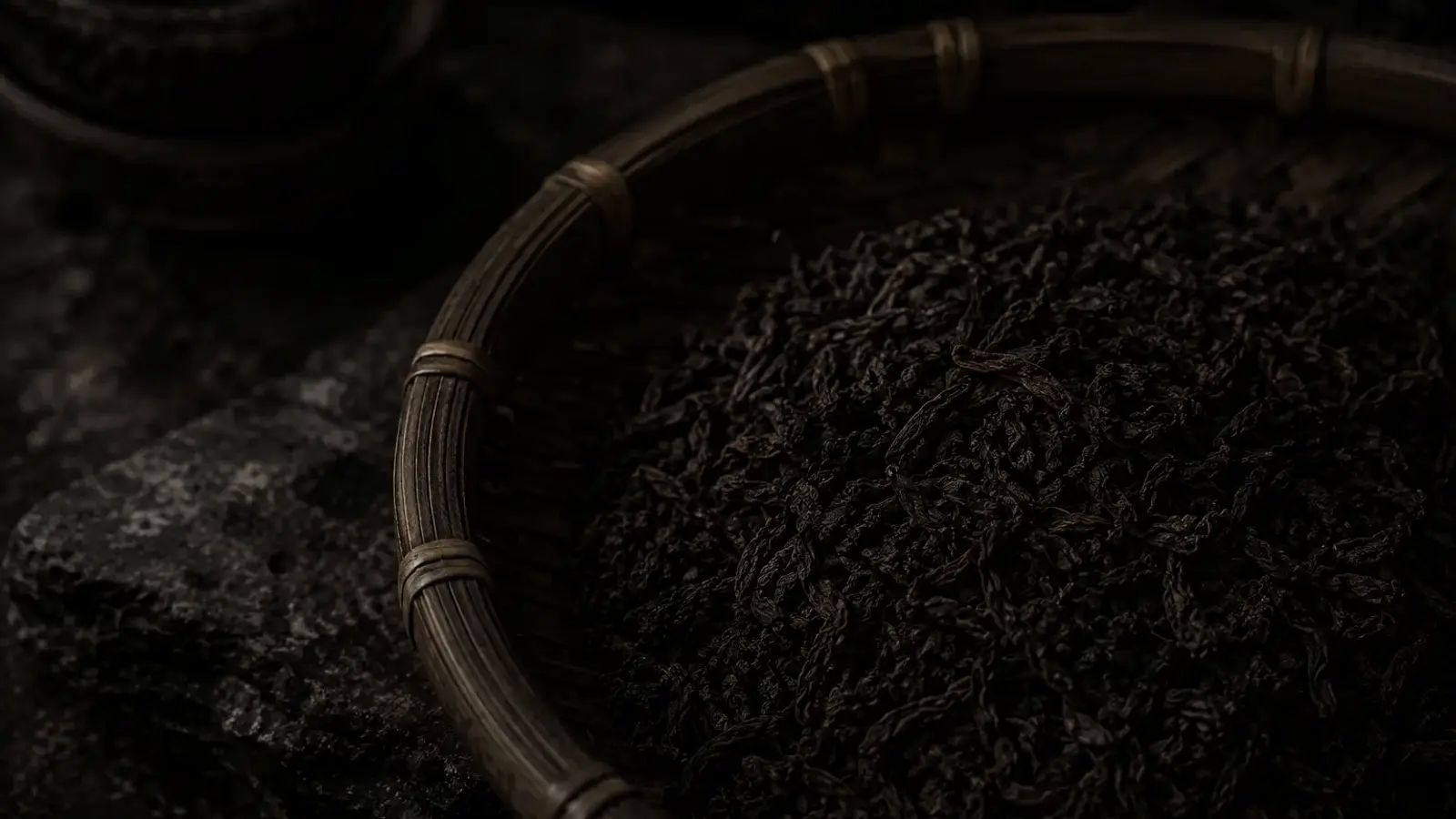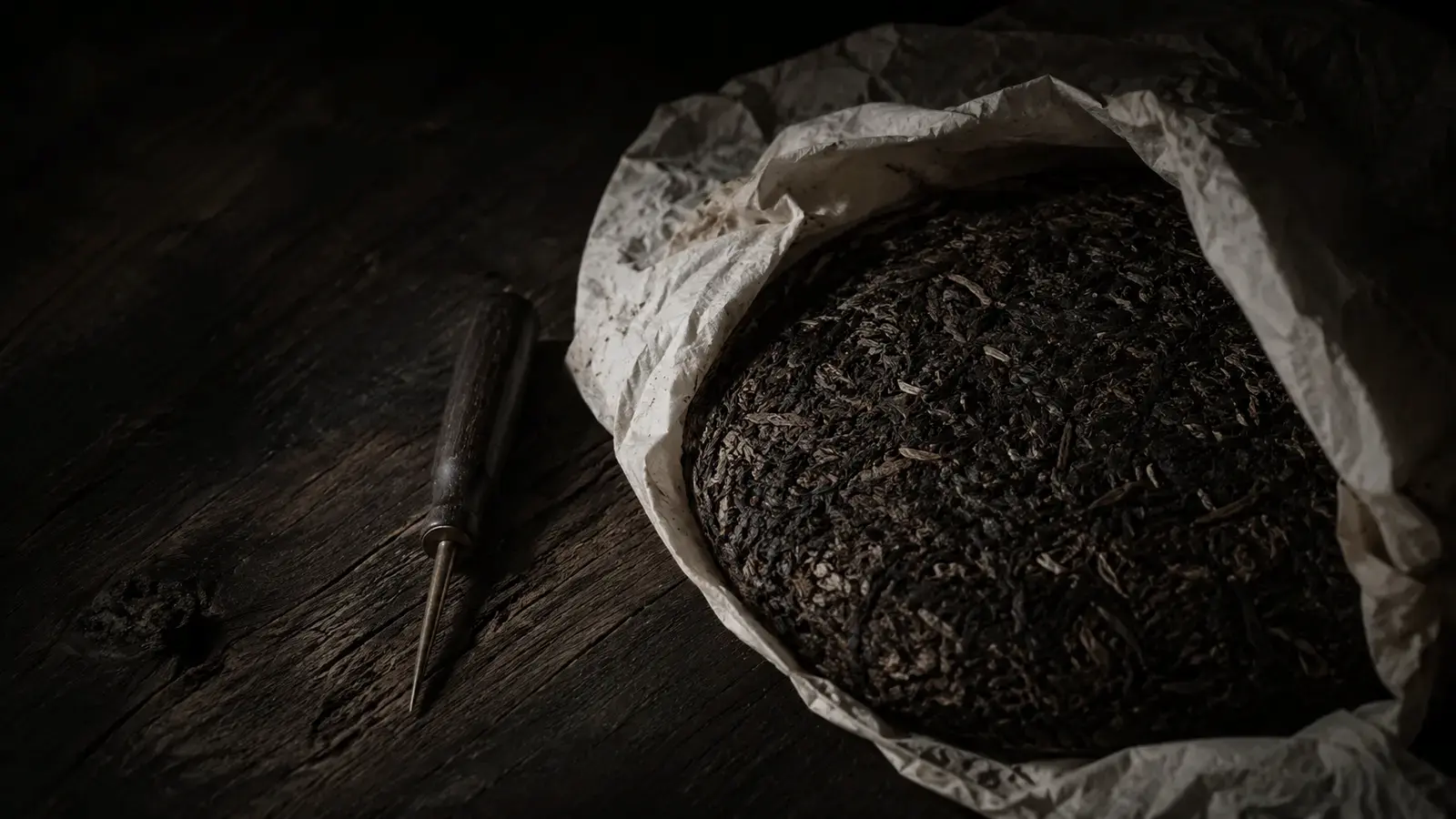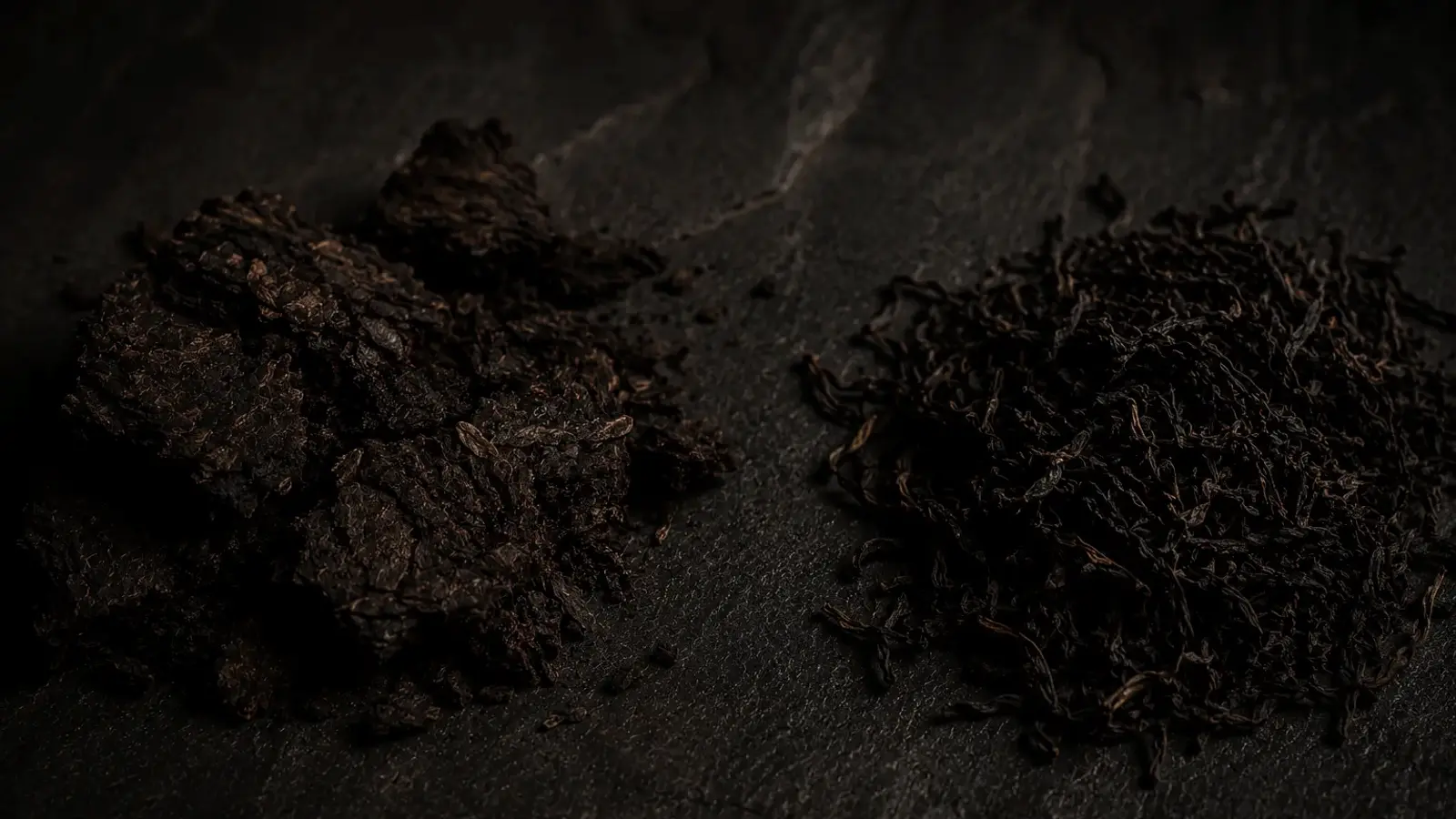
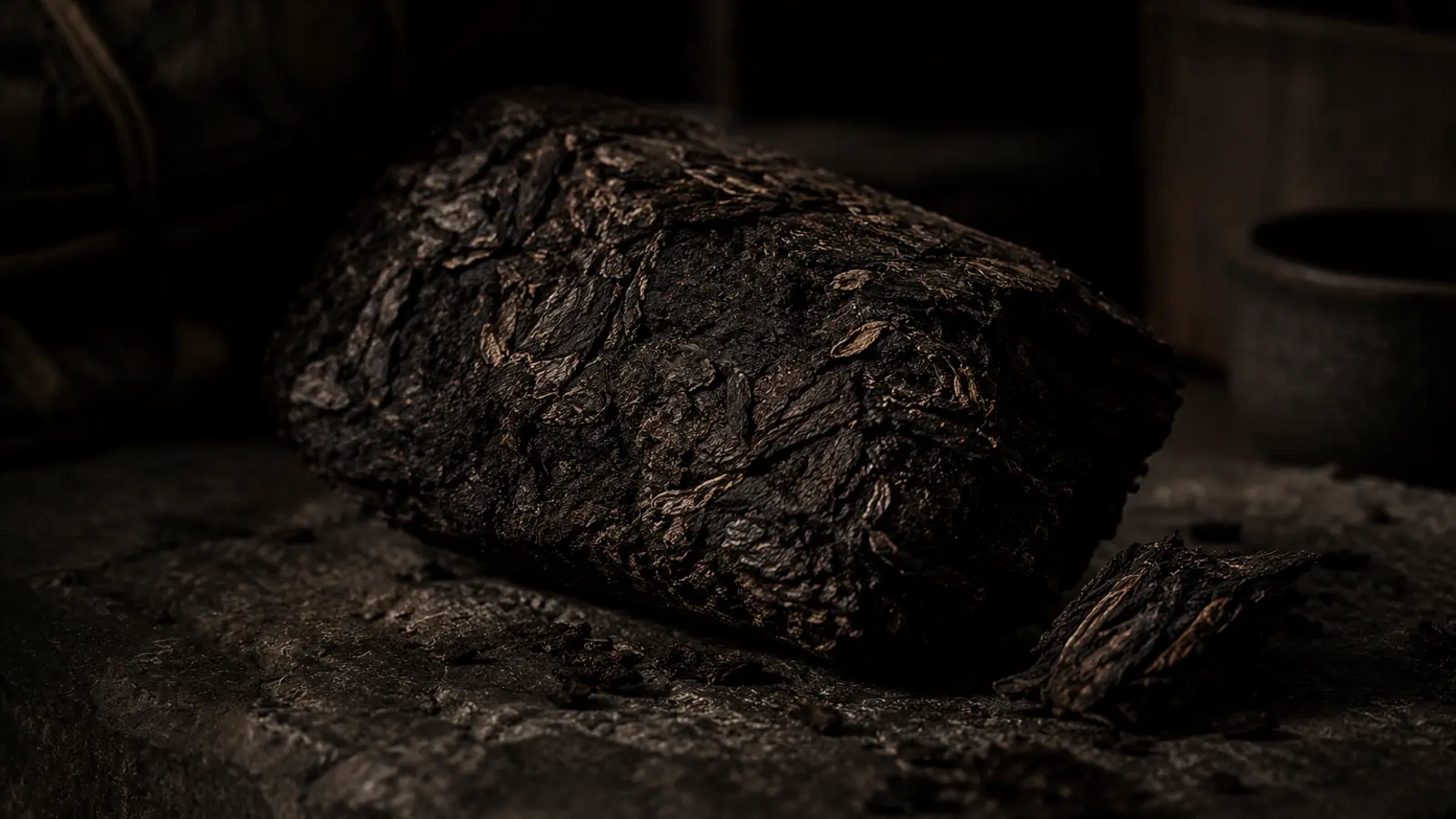
Hei cha tea (黑茶) is one of the six classical categories of Chinese tea, and almost nobody outside dedicated tea circles knows what it actually is. Ask most Western tea drinkers about dark tea and they’ll say “pu-erh”—full stop. That answer isn’t wrong. It’s just radically incomplete.
Pu-erh is one subcategory of hei cha. One. There are at least four others, each from a different province, each with its own processing logic, flavor signature, and aging tradition. Some of them are extraordinary. One—Liu Bao (六堡)—produced the most memorable tea I’ve encountered in years of serious collection. Yet Liu Bao gets perhaps one-tenth the coverage of a middling pu-erh factory cake.
This article maps the full territory of hei cha: what it is, how it’s made, and why the sub-categories beyond pu-erh deserve your attention.
Defining Hei Cha: Post-Fermented Tea
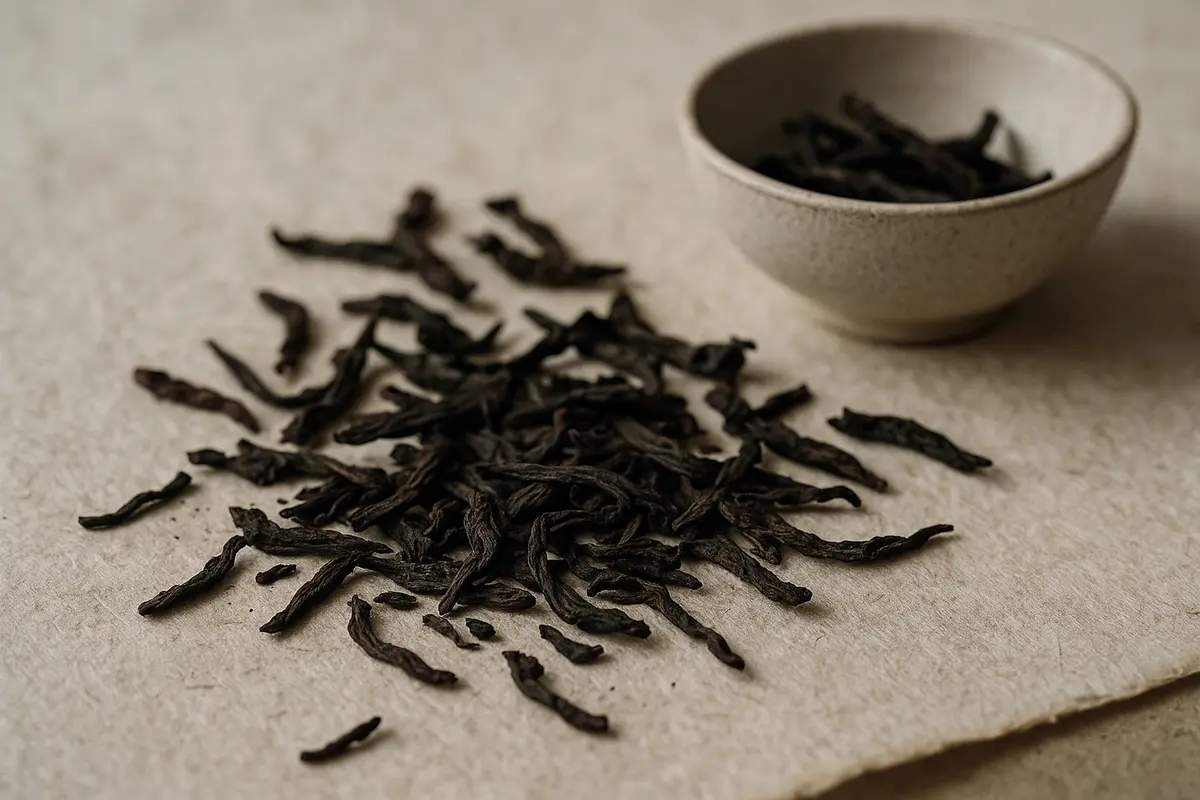
Hei cha literally means “black tea” in Mandarin—a translation that immediately causes confusion because what English speakers call “black tea” (Assam, Darjeeling, Ceylon) is called hóng chá (红茶, “red tea”) in Chinese.
The “dark” in hei cha refers to a processing category, not necessarily the color of the leaf or the liquor. The defining characteristic is post-fermentation: microbial and enzymatic activity that occurs after the initial tea processing steps (fixing, rolling, drying). This is fundamentally different from the oxidation that creates oolong or black tea, which happens to the fresh leaf before drying. In hei cha, dried or partially processed tea is exposed to conditions—moisture, heat, oxygen, specific microbes—that allow ongoing transformation.
The result is tea that can age productively for years or decades. Bitterness and astringency mellow. Complexity accumulates. The flavor moves toward earth, wood, spice, deep sweetness.
Think of it this way: if oxidation in black tea is a sprint—a fast, enzyme-driven transformation controlled by the processor—then post-fermentation in hei cha is a marathon, driven by microbial communities operating over months or years.
The Five Major Types of Hei Cha
The hei cha category is best understood regionally. Each major type comes from a specific province, uses local cultivars and microclimates, and has developed its own processing and storage conventions over centuries.
1. Pu-erh (普洱) — Yunnan Province
Pu-erh is the category most Western drinkers know, so I’ll address it first but not dwell on it—it deserves its own extensive treatment, and it gets plenty of English coverage elsewhere.
A few structural facts that matter for understanding hei cha broadly:
Sheng (生, raw) pu-erh is compressed tea that undergoes natural, slow post-fermentation through storage. Young sheng can be intensely bitter and astringent; aged sheng from quality material is among the most complex tea in the world.
Shou (熟, ripe) pu-erh uses wò duī (渥堆), an accelerated pile-fermentation process developed in the 1970s to mimic the taste of aged sheng in months rather than decades. Piles of moistened tea leaves are turned periodically while temperature and humidity are managed. The result is immediately smooth, earthy, and accessible.
Legally and by Chinese national standard, pu-erh must be produced from Camellia sinensis var. assamica material grown in Yunnan province. This geographic indication matters: calling a tea from Guangxi “pu-erh” is incorrect regardless of how it was processed.
2. Liu Bao (六堡) — Guangxi Province
This is the one I know firsthand, extensively.
Liu Bao comes from the Liu Bao area in Cangwu County, Guangxi. The tea has been produced commercially for at least several hundred years and was historically exported across Southeast Asia—particularly to Malaysian and overseas Chinese communities, where it was consumed by laborers working in tin mines and rubber plantations. This export history is why old Liu Bao is sometimes found in Malaysia, stored in traditional warehouse conditions that give older teas their distinctive humid, slightly camphor character.
The processing involves initial withering and fixing (like any tea), followed by pile fermentation and then extended aging, traditionally in humid warehouses, caves, or large ceramic jars. The basket format—leaves compressed into woven bamboo baskets of various sizes—is iconic and functional: the bamboo breathes, contributing subtle aromatics over time.
What Liu Bao tastes like: I’ll be direct about what I’ve experienced. A 1993 Liu Bao I spent serious time with was characterized by cinnamon warmth, chocolate, and hazelnut—not as discrete notes but interwoven into something cohesive and deep. The huigan (回甘, the returning sweetness at the back of the throat after swallowing) was extraordinary, arriving in waves and persisting well after the cup was empty. The body was full without being heavy. The qi—the physical sensation associated with the tea—was calming, almost sedating in the best sense. I’ve had sessions with aged Liu Bao that posed zero insomnia risk and left me in a state of sustained, quiet alertness that’s difficult to describe without sounding precious.
The 33-year example I’ve worked through was among the most remarkable teas in my entire collection experience. At prices that still, in 2025, trail comparable-age pu-erh by a significant margin.
Why it matters for the hei cha conversation: Liu Bao demonstrates that the post-fermentation logic of hei cha produces genuinely diverse outcomes depending on cultivar, climate, processing specifics, and storage. It doesn’t taste like pu-erh. It doesn’t taste like Fu Zhuan. It’s its own thing.
3. Fu Zhuan (茯磚) — Hunan Province
Fu Zhuan is compressed brick tea from Hunan, with the major production centered around Anhua County. Its defining characteristic—and what makes it instantly recognizable—is the presence of golden flowers (金花, jīn huā).
Golden flowers are the visible spores of Eurotium cristatum, a beneficial mold cultivated deliberately during a stage of brick production called fa hua (发花, “flower blooming”). After the tea is compressed into bricks, it’s held in warm, humid conditions that allow this specific fungal culture to proliferate. A good Fu Zhuan brick, when broken open, reveals these tiny yellow-orange clusters scattered through the interior.
This isn’t an accident or a defect—it’s a deliberate quality marker. Higher golden flower density has historically been associated with better quality bricks, and the fungal activity is understood to transform the tea’s chemical composition in ways that affect both flavor and reputed digestive effects. The Eurotium cristatum pathway produces a distinctive earthy, mushroom-like character with hints of floral or even slightly sweet complexity layered underneath.
Note: My experience with Fu Zhuan is research-based and limited to a handful of sessions—I’d consider this Tier 2 knowledge. The golden flower phenomenon is well-documented in Chinese tea literature and has been the subject of agricultural research, but my personal depth with the category doesn’t approach what I’ve accumulated with Liu Bao.
Fu Zhuan has a long history as a trade tea—compressed bricks were durable, portable, and stable. The Silk Road and the Ancient Tea Horse Road (茶马古道, Chámǎ Gǔdào) moved these kinds of compressed dark teas into Central Asia and Tibet for centuries.
4. Liu An (六安 Basket Tea) — Anhui Province
Liu An (sometimes written Luk On in Cantonese transliteration) is perhaps the least discussed hei cha in mainstream coverage—which is remarkable given its historical significance.
Produced in Anhui province, Liu An is traditionally packed into small bamboo baskets lined with bamboo leaves, typically around 500 grams per basket. The bamboo packaging contributes to both the aging environment and subtle flavor character—the leaves and basket breathe in ways that influence the tea stored inside.
Liu An has deep roots in Southeast Asian storage and consumption traditions, similar to Liu Bao. Old Liu An from Malaysian storage is prized among collectors, though it’s become increasingly rare and expensive as demand from mainland Chinese buyers has grown.
The flavor profile of Liu An trends toward clean earthiness with a distinctive woody character that long-time drinkers describe as “dried lotus leaf”—this comes partly from the bamboo leaf lining. Well-aged Liu An can be remarkably clear and pure in the cup despite its age.
This is Tier 2 knowledge for me—I have limited direct experience with Liu An and rely on documented sources and collector accounts.
5. Qing Zhuan (青磚) — Hubei Province
Qing Zhuan, or green brick tea, comes from Hubei province and is another compressed brick format with a long history as a trade and commodity tea. “Qing” (青) here refers to a blue-green color quality, though the processing places it firmly in the hei cha category.
Qing Zhuan was historically significant in trade with Mongolian and Tibetan communities, serving both as currency and as a practical, durable food source during travel. The tea was often boiled with milk and salt rather than steeped in the Gongfu manner.
Contemporary Qing Zhuan is generally considered an everyday, accessible dark tea rather than a collector’s item—though older examples from notable producers have appreciation potential. The flavor profile tends toward straightforward earthiness without the complexity markers of top-tier Liu Bao or Fu Zhuan.
Also Tier 2 knowledge—I document this for completeness rather than firsthand experience.
The Processing Logic That Unifies Them
Despite regional differences, all hei cha types share the post-fermentation step. Understanding this helps clarify why they occupy the same category.
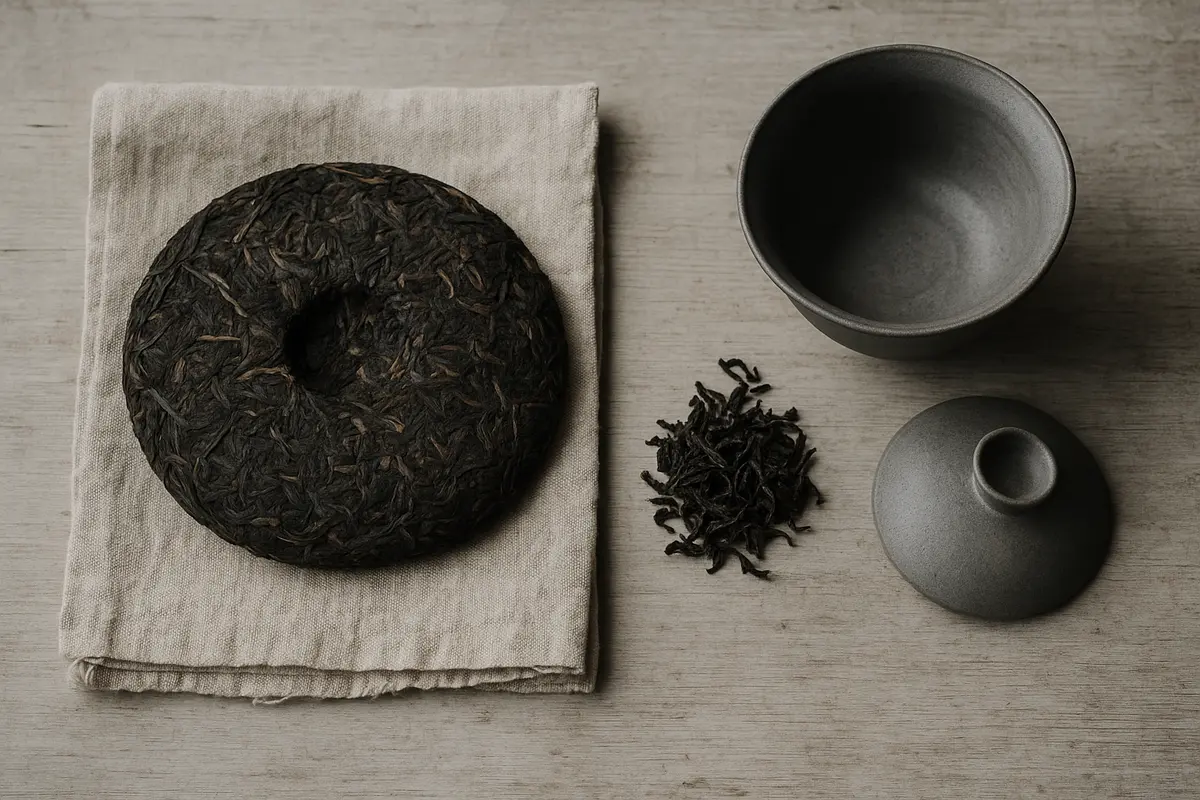
Standard tea processing moves from fresh leaf → fixing (kill-green / shā qīng, 杀青) → rolling → drying. This preserves the leaf and stops enzymatic activity.
Hei cha processing adds a critical step: after initial processing, the tea undergoes conditions that allow—or actively cultivate—microbial transformation. This step varies by type:
| Type | Post-Fermentation Method |
|---|---|
| Shou Pu-erh | Wò duī (渥堆): pile fermentation with controlled moisture and turning |
| Sheng Pu-erh | Slow natural fermentation through storage over years/decades |
| Liu Bao | Traditional pile fermentation + extended warehouse or cave aging |
| Fu Zhuan | Compressed brick held in warm humid conditions to cultivate Eurotium cristatum |
| Liu An | Basket packing + ambient aging, influenced by bamboo packaging |
| Qing Zhuan | Pile fermentation of raw material before compression |
The microbial communities involved differ by region, processing environment, and tea material—which is a major reason the flavor outcomes differ so dramatically across types.
Hei Cha and Aging: The Wine Appellation Parallel
If you come from a wine background, the hei cha category maps usefully onto the concept of appellations. The base concept—fermented agricultural product that rewards aging—is the same. The regional expressions are distinct. Burgundy and Barossa both produce wine; comparing them directly misses the point.
Liu Bao is not pu-erh stored in Guangxi. It’s a different tea from different material, processed differently, stored in ways specific to its region and tradition. The fact that both undergo post-fermentation is like noting that Burgundy and Barolo are both red wines—accurate, but the category label barely touches the actual difference.
Aging potential across hei cha types:
- Liu Bao: Traditionally aged for 3, 10, 20+ years. Decades-old Liu Bao is prized and, relative to pu-erh, undervalued. The humid cave and warehouse tradition in Guangxi produces a reliable pathway to fine aged tea.
- Shou pu-erh: Typically peaks within 10-15 years for most factory production; quality material continues longer.
- Sheng pu-erh: High-quality sheng can age productively for 30-50+ years under good storage conditions.
- Fu Zhuan: Bricks continue developing for decades; 10-20 year Fu Zhuan from reputable Anhua producers shows real complexity.
- Liu An: Old Malaysian-stored Liu An from the mid-20th century is collector territory; contemporary Liu An needs 10+ years to show its character.
The storage requirements share common principles: stable humidity (not too high, not too low—roughly 60-75% RH is a reasonable range for most types), darkness, adequate airflow, and zero odor contamination. Details vary by type and tradition.
Why Hei Cha Beyond Pu-erh Deserves Your Attention
The market distortion here is real. Pu-erh receives the vast majority of coverage, collector attention, and speculative pricing. A 20-year Liu Bao of comparable quality to a 20-year shou pu-erh will typically sell for less—sometimes significantly less—because Western buyers haven’t yet priced in what serious Asian collectors already know.
This creates practical opportunity. I’m not suggesting you treat tea as an investment vehicle—the joy is in drinking it. But when the 33-year Liu Bao in my collection costs a fraction of what a comparable-age pu-erh from a name producer commands, the value proposition is obvious.
Beyond price: the flavor diversity within hei cha is genuine. The cinnamon-chocolate signature of aged Liu Bao, the mushroom-floral complexity of Fu Zhuan with dense golden flowers, the clean woody precision of well-stored Liu An—these aren’t variations on a theme. They’re distinct destinations.
The qi question is worth addressing, though I hold it lightly as a category. Aged hei cha—Liu Bao in particular—has a reputation for producing calming, grounding physical effects distinct from the more stimulating energy of young sheng pu-erh or high-caffeine greens. My personal experience with aged Liu Bao aligns with this. The tea is known for being gentle on sleep—a practical consideration for evening sessions.
How to Approach Hei Cha as a Category
If you’re already a pu-erh drinker looking to expand:
-
Start with Liu Bao. It’s the clearest departure from pu-erh character while remaining approachable. Look for Liu Bao from established Guangxi producers; older examples (10+ years) show the character more clearly than fresh production.
-
Try Fu Zhuan from Anhua. Find a brick with visible, dense golden flowers. Brew at 100°C, rinse once, and use relatively short steeps (10-20 seconds in a small gaiwan (蓋碗) or teapot, adjusting to your taste).
-
Use your pu-erh brewing knowledge as a starting point, not a script. Most hei cha types respond well to gongfu (工夫) parameters: 100°C water, 5-8g per 100ml vessel, multiple short infusions. Liu Bao tends to be forgiving of longer steeps even at high temperatures—it rarely turns harsh.
-
If you encounter Liu An from reputable Malaysian storage, take it seriously. The category is underexplored and the best examples are genuinely special.
-
Document what you taste. The flavor vocabulary for hei cha beyond pu-erh is underdeveloped in English. Your notes contribute to a clearer map.
A Note on Sourcing and Authenticity
As with pu-erh, the hei cha market has authenticity issues, particularly for aged teas. A few practical points:
- Liu Bao with provenance documentation from established Guangxi factories or known Malaysian storage warehouses is more trustworthy than anonymous “aged” material.
- Fu Zhuan bricks should have visible golden flowers—this is a quality indicator you can verify yourself before purchase.
- Liu An basket tea from reputable Southeast Asian sources is documented; orphan baskets with no history warrant skepticism.
- Price can be a rough guide: genuine 20-30 year hei cha from quality producers is not cheap, even if it’s cheaper than comparable pu-erh. If the price seems implausible for the claimed age, trust that instinct.
The broader sourcing infrastructure for non-pu-erh hei cha is thinner than for pu-erh. This is changing as interest grows, but it means doing more homework and, where possible, buying from vendors who specialize in the specific type.
Summary: The Hei Cha Map
Hei cha (黑茶) is the Chinese category for post-fermented tea. It encompasses at least five distinct regional types:
| Type | Province | Key Character | Aging Tradition |
|---|---|---|---|
| Pu-erh (普洱) | Yunnan | Earthy, complex; wide range by age/type | Extensive; 5-50+ years |
| Liu Bao (六堡) | Guangxi | Cinnamon, chocolate, profound huigan | Cave/warehouse; 5-30+ years |
| Fu Zhuan (茯磚) | Hunan | Earthy-mushroom; golden flower florals | Brick aging; 5-20+ years |
| Liu An (六安) | Anhui | Clean earth, dried lotus leaf, woody | Basket aging; 10+ years |
| Qing Zhuan (青磚) | Hubei | Straightforward earth; commodity character | Limited collector aging |
Pu-erh is exceptional and deserves its reputation. But treating it as synonymous with hei cha misses most of the category—including some teas that, by any serious measure, belong in the same conversation.
The Liu Bao I’ve spent the most time with is proof enough. Thirty-three years in, it offers what the best aged teas always offer: evidence that time, when applied to good material, produces something that couldn’t have existed any other way.