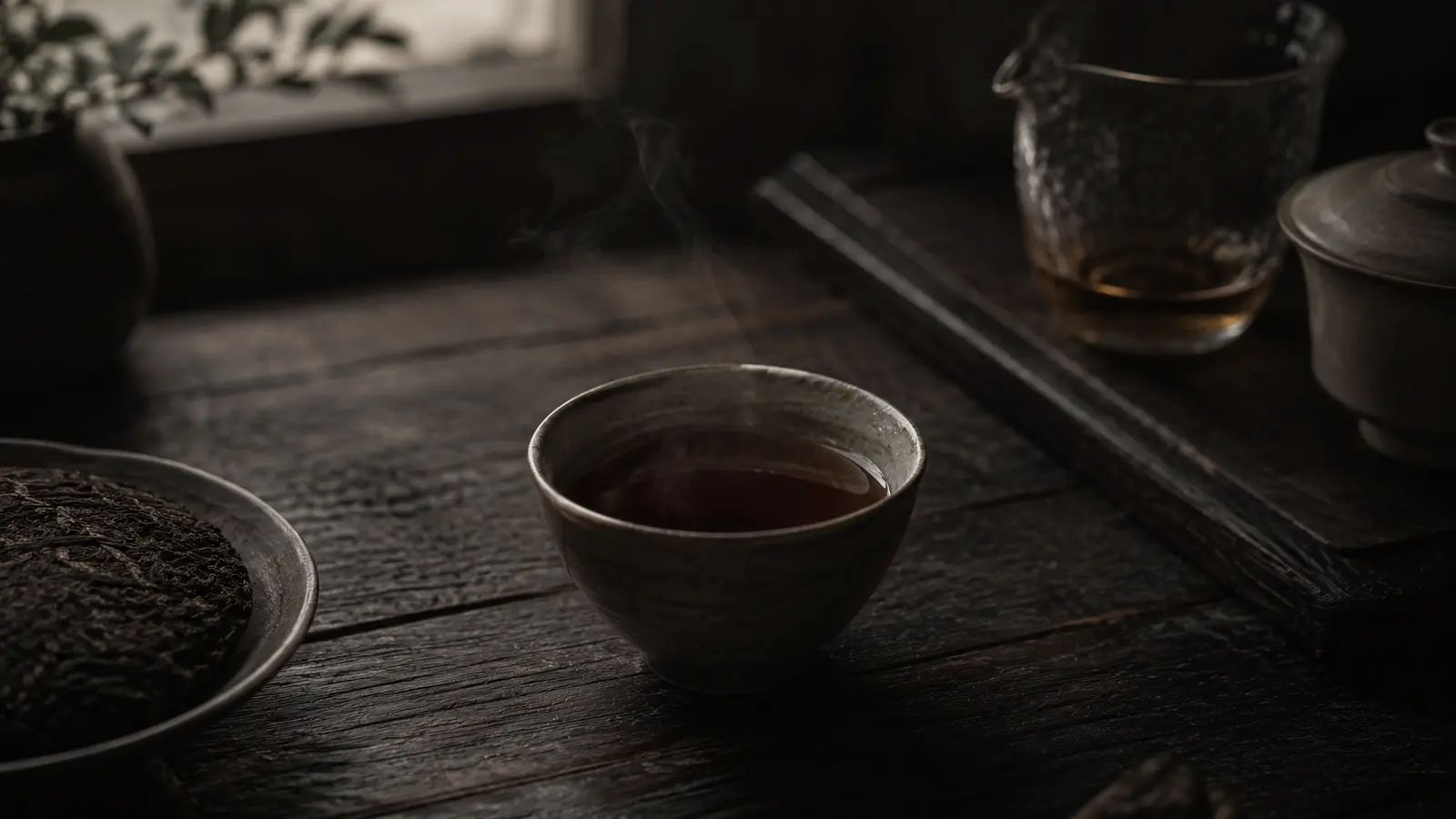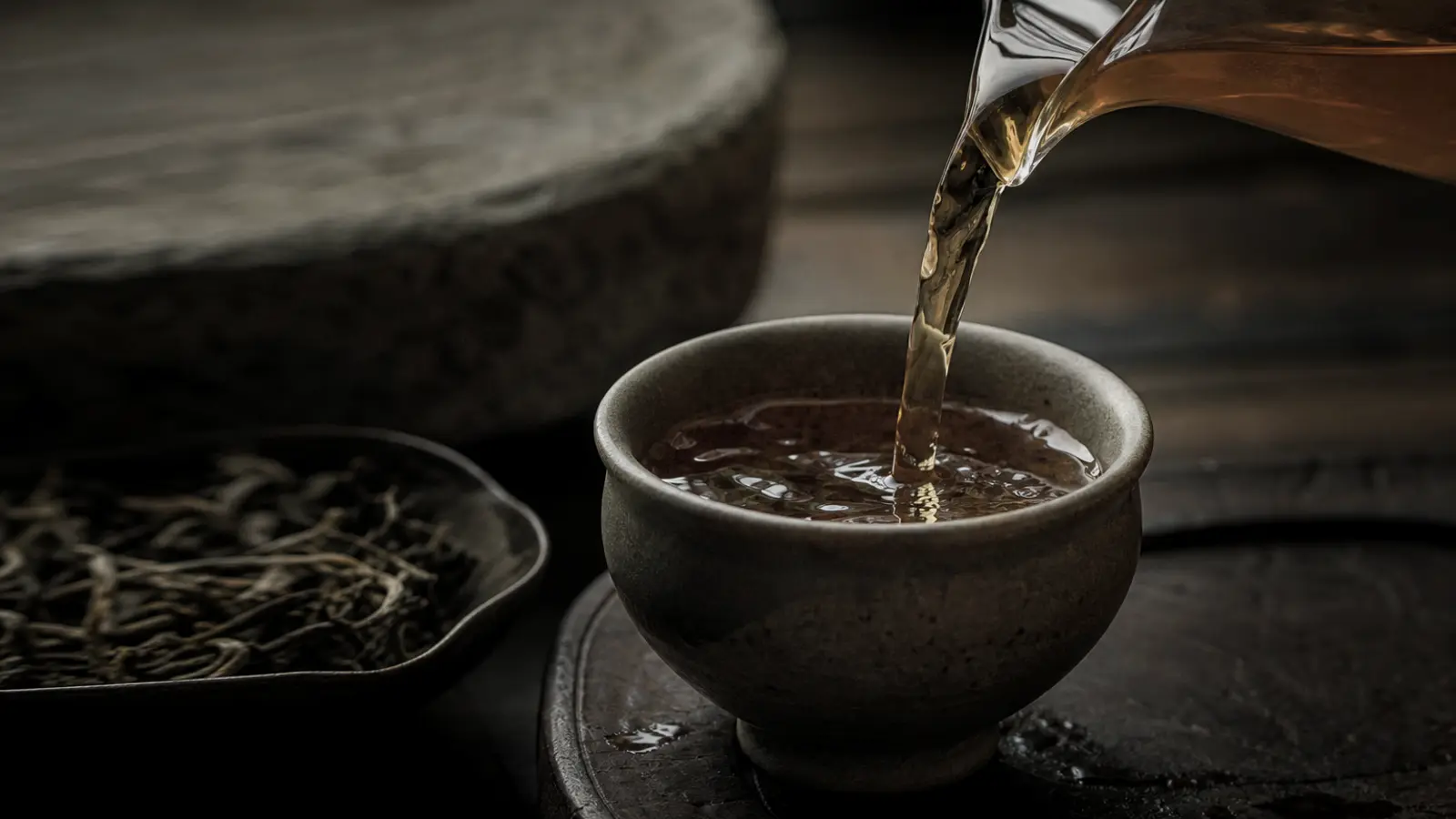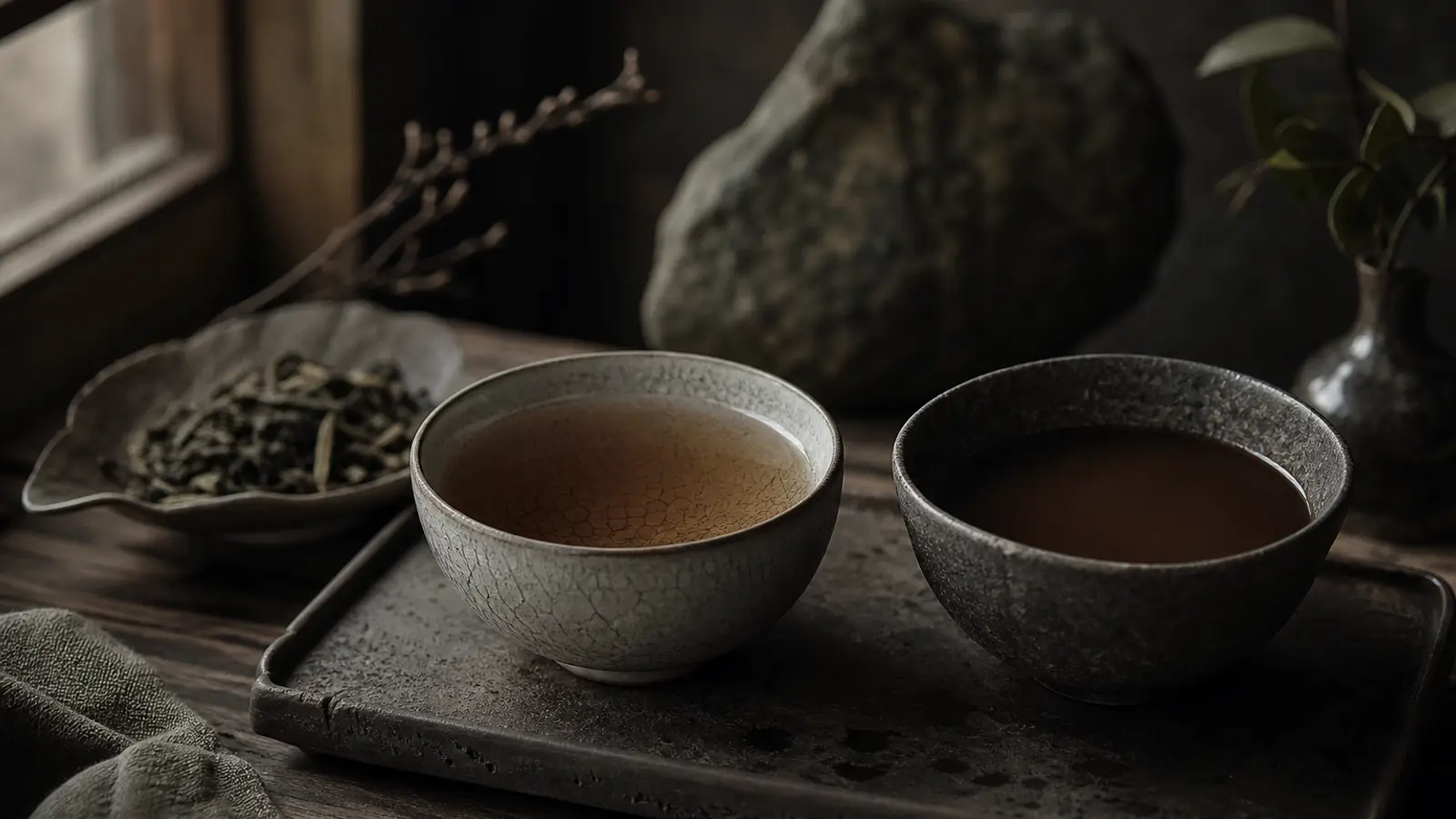
Huigan (回甘) is the sensation of sweetness that returns to the mouth after swallowing tea, particularly after an initial bitterness. It is one of the most valued characteristics in Chinese tea evaluation — a direct indicator of tea quality, terroir expression, and processing skill.
There is a moment that stops first-time pu-erh drinkers cold. They swallow a bitter, almost challenging mouthful, wait, and then — sweetness. Not in the cup. In their throat and mouth, arriving uninvited, building over ten or fifteen seconds until plain saliva tastes like diluted honey. That is huigan (回甘), and once you’ve felt it clearly, you understand immediately why serious tea drinkers treat it as the single most important quality indicator in Chinese tea.
Huigan tea is not a style or a category. It is a physiological experience — a retronasal and palate-level phenomenon — that a tea either produces or does not. This article explains what huigan is, what causes it, how it varies across tea types, how to train yourself to notice it, and what it tells you about the tea in your cup.
Defining Huigan: What “Returning Sweetness” Actually Means
Huigan (回甘) translates literally as “returning sweetness.” 回 (huí) means return or go back; 甘 (gān) means sweet, or more precisely, the pleasant sweetness associated with nourishing foods in classical Chinese. The compound has been used in Chinese tea writing for centuries to describe a specific post-swallow sensation distinct from in-cup flavor.
The definition matters: huigan is not sweetness present in the tea liquid. It is sweetness that appears in the mouth and throat after swallowing, usually following an initial bitter or astringent phase. This is the critical distinction. A tea can taste bitter — genuinely, challengingly bitter — and still produce tremendous huigan. In fact, the most dramatic huigan almost always comes from teas with significant upfront bitterness. The relationship between bitterness and returning sweetness is not coincidental. It is causal.
Huigan is also distinct from what Chinese tasters call tián (甜), simple sweetness. Tián is a flavor quality in the liquid. You taste it while it’s in your mouth. Huigan arrives after. Some teas have both. Many teas have one without the other. The evaluation of fine Chinese tea — especially sheng pu-erh (生普洱) — treats huigan as the more significant indicator of quality, because it reflects the tea’s chemical complexity in a way that simple sweetness does not.
The Chemistry: Why Bitter Becomes Sweet
I want to be honest about the knowledge tier here. The mechanism of huigan is an area of active research, and a complete picture doesn’t exist yet. What follows is the best current understanding, but it is Tier 2 knowledge — research-based, not something I can observe directly.
Tea contains several classes of bitter compounds. The primary ones relevant to huigan are:
Catechins and other polyphenols. These are the major source of bitterness and astringency in unoxidized and lightly oxidized teas. Epigallocatechin gallate (EGCG) is the most abundant and the most bitter. They bind to bitter taste receptors (T2Rs) on the tongue and palate.
Caffeine. Contributes a clean, sharp bitterness distinct from polyphenol astringency. Caffeine is present in higher concentrations in young sheng pu-erh and first-flush material.
Saponins. These are triterpenoid glycosides found in tea that contribute a unique quality: they are bitter and stimulating, but they also appear to modulate taste receptor response over time. Some researchers point to saponins as particularly important in the huigan mechanism.
The working hypothesis for how bitterness converts to perceived sweetness runs roughly as follows: bitter compounds bind to taste receptors and trigger the familiar bitter signal. As those compounds leave the palate and dilute into saliva and the mucous membranes of the throat, the receptors desensitize — a standard neurological process called receptor adaptation. That desensitization produces a rebound effect. The nervous system, having been told “bitter” at high intensity, recalibrates, and the absence of the bitter signal gets interpreted as its opposite. Meanwhile, theanine (L-茶氨酸), the dominant amino acid in quality tea, may amplify the pleasant aspects of this rebound. Trace levels of naturally occurring sugars reinforce the sweetness perception once the bitter compounds clear.
What makes this interesting from a tea evaluation standpoint is that the strength and speed of huigan reflect the concentration and quality of the polyphenol-saponin profile in the tea. Teas from old arbor trees (古树, gǔshù) tend to have more complex polyphenol profiles than plantation material, and they tend to produce stronger, faster huigan. This is not just correlation — the chemistry connecting leaf quality to huigan response is real, even if the precise mechanism isn’t fully mapped.
Speed and duration are the two dimensions that matter most.
A fast huigan — sweetness returning within 5 to 10 seconds of swallowing — is a marker of quality. Slow huigan, taking 30 seconds or more, or huigan that only appears faintly, suggests either lower-grade leaf material or improper brewing that hasn’t extracted the relevant compounds cleanly. Duration tells you about intensity and complexity: a huigan that fades in 20 seconds is pleasant; one that sustains for two or three minutes, transforming every sip of plain water into something sweet, is remarkable.
How Huigan Varies by Tea Type
Not all teas produce huigan equally. The bitterness-to-sweetness arc plays out differently depending on oxidation level, processing method, age, and terroir.
Sheng Pu-erh: The Most Dramatic Arc
Young sheng pu-erh (生普洱, raw pu-erh) is where huigan shows its most dramatic range. The best young sheng from high-altitude, old-tree material can be genuinely difficult to drink on steep 1 and steep 2 — bitter enough to make your molars ache — and then produce a wave of sweetness so complete that it transforms the experience entirely by steep 3 or 4.
I had a berryish, lightly smoky sheng where this arc was textbook: steeps 1 and 2 were challenging, bitter in a way that coated the whole palate, and then steep 3 arrived and the bitterness converted cleanly. The huigan came fast — under ten seconds — and lasted well past a minute. By steep 5, the tea had almost no bitterness at all and the sweetness was the primary sensation both in the cup and in the return.
This conversion arc is what pu-erh drinkers are actually tracking when they say a tea “opens up.” The tea hasn’t changed. Your taste receptors are adapting, the early harsh compounds are softening as the session progresses, and the huigan is becoming more accessible.
Young sheng also rewards patience within a single steep. Drink it, set the cup down, wait. The 10-second mark is often when huigan first appears. The 30-second mark is when you know whether it’s strong or not.
Aged Sheng: Deep and Sustained
Aged sheng pu-erh — anything past 10 years, and especially material 20 years and older — shows a different huigan character. The aggressive bitterness of youth has rounded. The polyphenols have polymerized over time into larger compounds that register differently on the palate. But the huigan in quality aged sheng is often the deepest and most sustained I’ve encountered.
It’s less a sharp bitterness-to-sweetness arc and more a gradual, low-registered sweetness that builds through the session and lingers. The kind of huigan where you finish a gongfu brewing session and your mouth still tastes faintly sweet twenty minutes later.
Shou Pu-erh: Gentler Upfront, Still Rewarding
Shou pu-erh (熟普洱, ripe pu-erh) is processed through accelerated microbial fermentation (渥堆, wòduī), which transforms the raw bitterness into earthier, smoother flavors. The huigan in shou is gentler — less dramatic arc, more of a pleasant warmth and sweetness that surfaces cleanly after swallowing.
One Meng Song (蒙宋) shou I spent serious time with showed the most extreme bitterness-to-sweetness arc I’ve experienced in a shou: the first two steeps were bitter in a way that surprised me, almost sheng-like in their assertiveness. Then on steep 3, the bitterness collapsed completely and the huigan arrived with force — a wide, clean sweetness that made the cup taste almost like rock sugar water. By steep 5, the bitterness never returned. The huigan became the primary character of the tea.
That kind of behavior in a shou tells you something real about the leaf material underneath the processing. The ripe fermentation hadn’t fully erased what the raw leaf was capable of expressing.
Liu Bao and Other Hei Cha: The Unexpected Champion
Hei cha (黑茶, dark tea) — the broader category of post-fermented teas that includes Liu Bao (六堡) and Fu Zhuan (茯砖), among others — can produce remarkable huigan that surprises people who associate it primarily with earthiness and smoothness.
Liu Bao produced the strongest huigan I have personally experienced. After a session with an aged Liu Bao stored in traditional baskets, I drank plain water — and the water tasted sweet. Not metaphorically. The huigan was so active that it was coloring my perception of a neutral liquid. That’s the benchmark. When water is sweet, the huigan is strong.
Liu Bao’s huigan tends to have a specific quality: it’s broad rather than sharp, filling the back of the throat and softening through the chest. It doesn’t have the electric, almost citrus-edged quality you get from a young high-mountain sheng. It’s warmer, deeper, and longer-lasting.
Green Tea and White Tea: Mild but Present
High-quality green teas and white teas — especially aged white tea — can show huigan, but the arc is usually gentle. The bitterness is less aggressive to begin with, so the return is correspondingly subtle. A high-grade Dragon Well (龍井, Lóngjǐng) or Anji Bai Cha will leave a clean sweetness after swallowing that counts as huigan, but you have to be looking for it. It won’t find you the way sheng pu-erh huigan does.
How to Taste Huigan: A Practical Method
Most people miss huigan the first several times they encounter it because they’re evaluating tea the way most Western tasting traditions train you to — in-mouth, in real time. Huigan requires a deliberate change in attention: you need to track what happens after swallowing.
Here’s the method I use and teach:
1. Brew a concentrated steep. Huigan is easier to detect when the tea is not watery. For sheng pu-erh, this might mean a standard 5g in a 100ml gaiwan at 95°C (203°F) with a 20–30 second steep time. You want the bitterness present, not suppressed.
2. Take a moderate sip. Enough to coat the mouth. Don’t rush.
3. Swallow completely. Don’t leave tea pooled at the back of your tongue.
4. Set the cup down. Close your mouth. Wait.
5. Count silently to ten. Notice what changes. Is there sweetness building? Where? The tip of the tongue? The sides? The back of the throat? Is it spreading or staying localized?
6. At 30 seconds, assess intensity. Strong huigan is still building or holding at 30 seconds. Mild huigan is already fading.
7. Sip plain water. This is the advanced test. If the water tastes sweet, your huigan is strong. If it tastes neutral or slightly flat, the huigan is present but not exceptional.
8. Track across steeps. Huigan often changes dramatically as a session progresses. Note whether it’s weakening (less quality material, or leaf running out) or intensifying (often happens as bitterness softens in mid-session).
The most important thing is the pause after swallowing. Most people who think they can’t detect huigan simply haven’t tried waiting for it. It doesn’t arrive while the tea is still in your mouth. Give it time.
The Wine Parallel: Huigan and Finish
Huigan has no direct equivalent in wine vocabulary, which is telling. Wine doesn’t typically produce a bitterness-to-sweetness conversion the way sheng pu-erh does. But the closest parallel is finish — what sommeliers measure as the persistence of flavor after swallowing.
The classic quality benchmark in wine is finish length. A short-finish wine leaves nothing after 5 seconds. A long-finish wine — a great Barolo, an aged Burgundy — continues to evolve on the palate for 30, 45, even 60 seconds after swallowing. Wine educators talk about “caudalie” — each caudalie being one second of finish. A wine with 12 caudalies is ordinary; 30+ is exceptional.
Huigan functions similarly: the longer and stronger it is, the more the tea is demonstrating complexity and quality in its raw material. But there’s a dimension wine lacks — the conversion itself. A great wine finish is the same wine, persisting. Huigan is a transformation: bitter becomes sweet. That transformation has no parallel in wine that I know of.
This makes huigan, in some ways, a more striking quality indicator. It’s not just persistence — it’s alchemy. If this parallel interests you, the framework for palate transfer from wine to tea explores these connections in more depth.
What Huigan Tells You About Tea Quality
If I could teach one sensory skill to someone new to Chinese tea, it would be huigan detection. Here’s why it matters practically:
It’s harder to fake than in-cup flavor. A vendor can add sweetness to a product through processing choices or blending. Huigan is a response to the leaf’s actual polyphenol and saponin profile. High-quality, complex leaf material — especially old-tree sheng — produces strong, fast huigan because of what it actually is, not because of how it was handled. This makes it a more reliable quality signal than sweetness or smoothness alone.
It scales with aging potential. Young sheng with strong huigan has the complex chemistry that transforms well over decades. Weak or absent huigan in a young sheng is a signal the tea may not have the structural depth to age gracefully.
It tells you about terroir. High-altitude, old-arbor material from authentic production regions tends to show stronger huigan than lower-altitude plantation material. This isn’t absolute — processing matters, storage matters — but as a rough terroir indicator, huigan holds up.
It changes through a session. This is useful information. If huigan drops sharply after steep 3, the tea may be running out of quality leaf. If it builds steadily through steep 8, you’re dealing with genuinely complex material. Tracking huigan across a full session tells you more than any single steep can.
Developing Your Sensitivity to Huigan
Sensitivity to huigan develops with deliberate practice. A few sessions of mindful attention — following the exact method above — is usually enough to start registering it. The challenge is training attention to post-swallow sensation rather than in-mouth flavor.
I’d suggest starting with young sheng pu-erh specifically because the bitterness-to-sweetness arc is most dramatic and therefore easiest to detect. Brew it slightly stronger than comfortable. Sit with it. The first time you feel a wave of sweetness arrive 10 seconds after swallowing a bitter mouthful, the concept becomes permanently real to you in a way no description can replicate.
After that, you can start tracking it in subtler teas. The huigan in a good green tea is genuinely pleasant once you know what to look for. The sustained warmth of Liu Bao’s huigan becomes something you actively anticipate.
The skill also makes you a harder customer to fool. Once you’ve experienced strong huigan in exceptional material, the absence of it in expensive tea tells you something worth knowing.