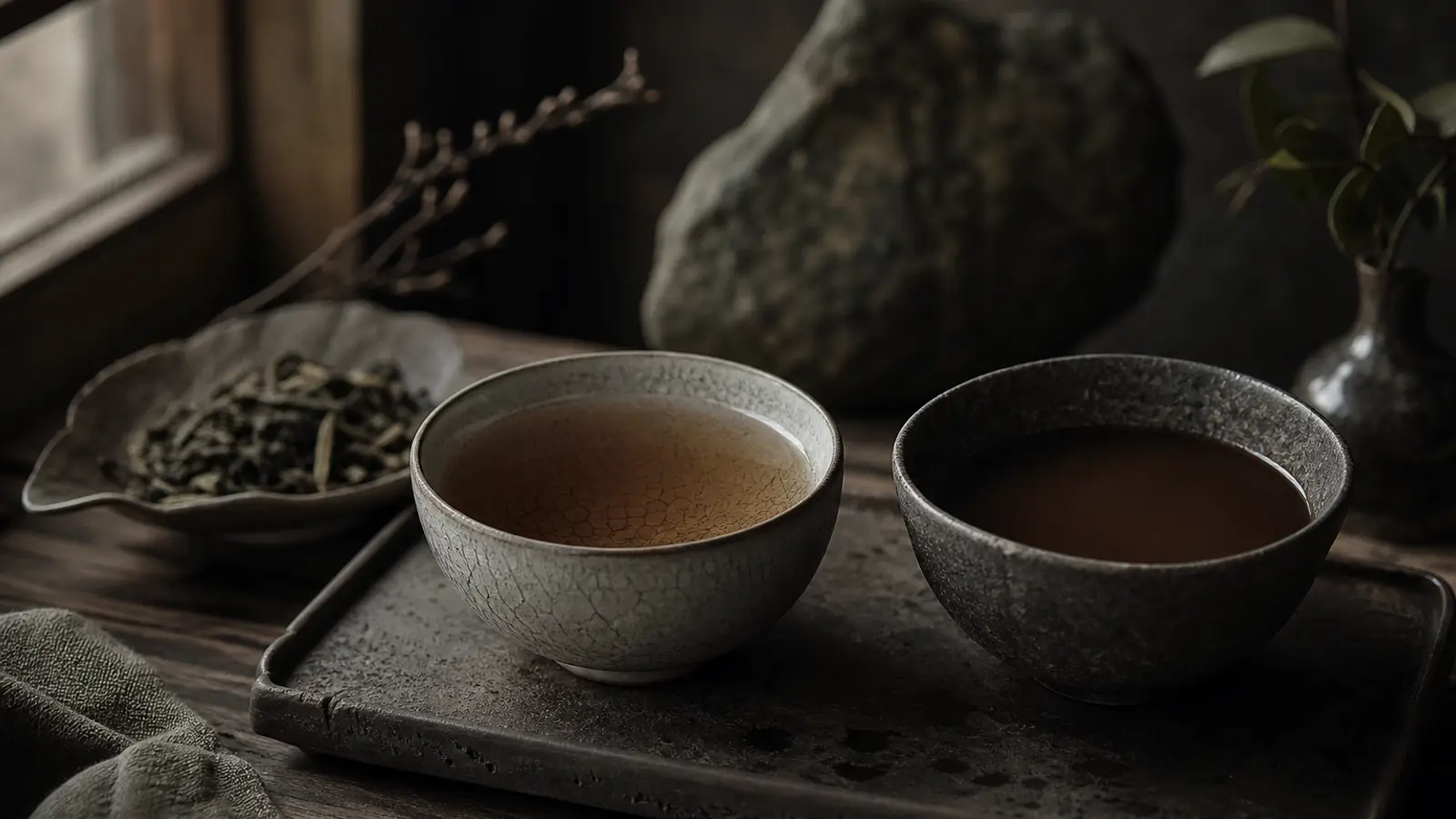
Two Chinese terms are reshaping how serious tea drinkers in the West describe what they sense in the cup. Gu gan (骨感) and rou gan (肉感) — bone feeling and flesh feeling — give you the anatomical precision that English tasting language has always lacked. They describe not flavor, not aroma, but the physical architecture of a liquor on your palate.
Understanding gu gan rou gan tea vocabulary is not a matter of academic interest. It changes what you notice, and what you notice changes what you taste.
What Gu Gan (骨感) Means: The Bone Feeling
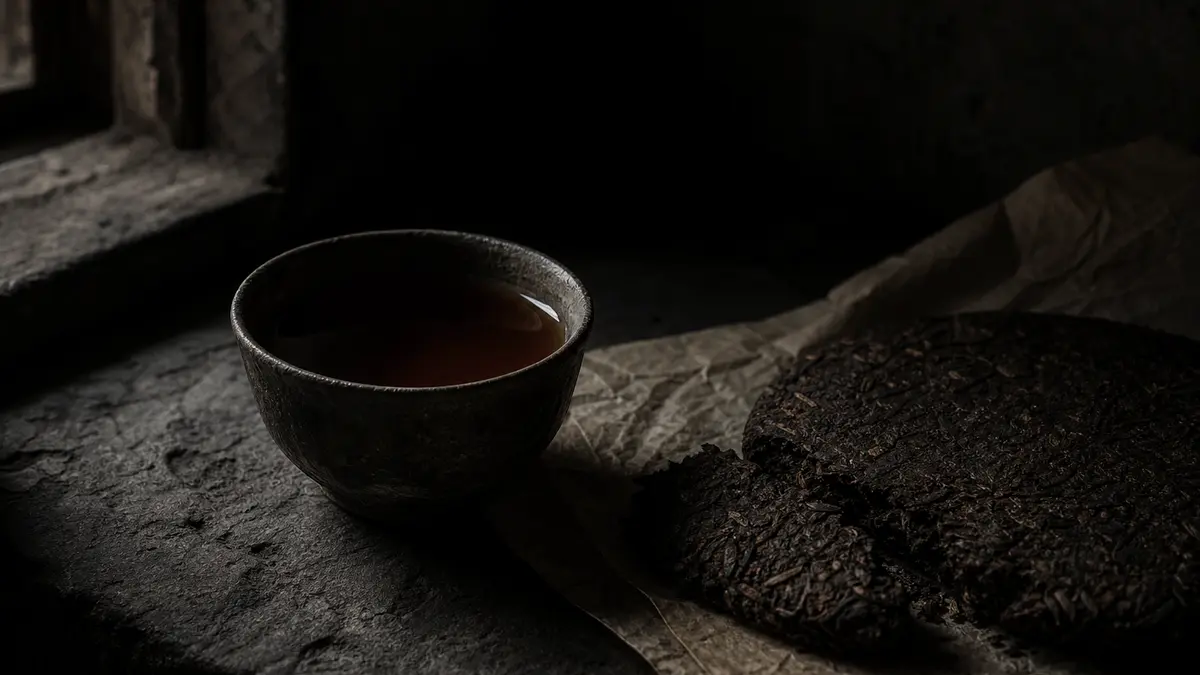
Gu gan breaks down directly: 骨 (gǔ) means bone, 感 (gǎn) means feeling or sensation. A tea with strong gu gan feels lean and defined. There is a skeletal quality to the liquor — you sense its edges, its frame, the way it articulates itself on your tongue and in the back of your throat.
This is not thinness. A thin tea has no presence. A tea with gu gan has very strong presence, but that presence is structural rather than volumetric. Think about what makes a building feel solid: not the mass of the walls but the clarity of the load-bearing elements. Gu gan is the load-bearing element of a tea’s mouthfeel.
The sensation often announces itself as a kind of mineral linearity. On Da Hong Pao (大紅袍), it comes through as a rock-mineral edge — the famous yan yun (岩韻), cliff rhyme, has a backbone to it that you can trace. On a young, high-altitude sheng puerh (生普洱), gu gan might arrive as bitter astringency that resolves into defined lines rather than diffuse grip.
If you have tasted Barolo, you know this sensation. That wine’s tannins are architectural. They stand upright in the palate. You feel the scaffold before you feel anything else. That is gu gan translated into grape.
What Rou Gan (肉感) Means: The Flesh Feeling
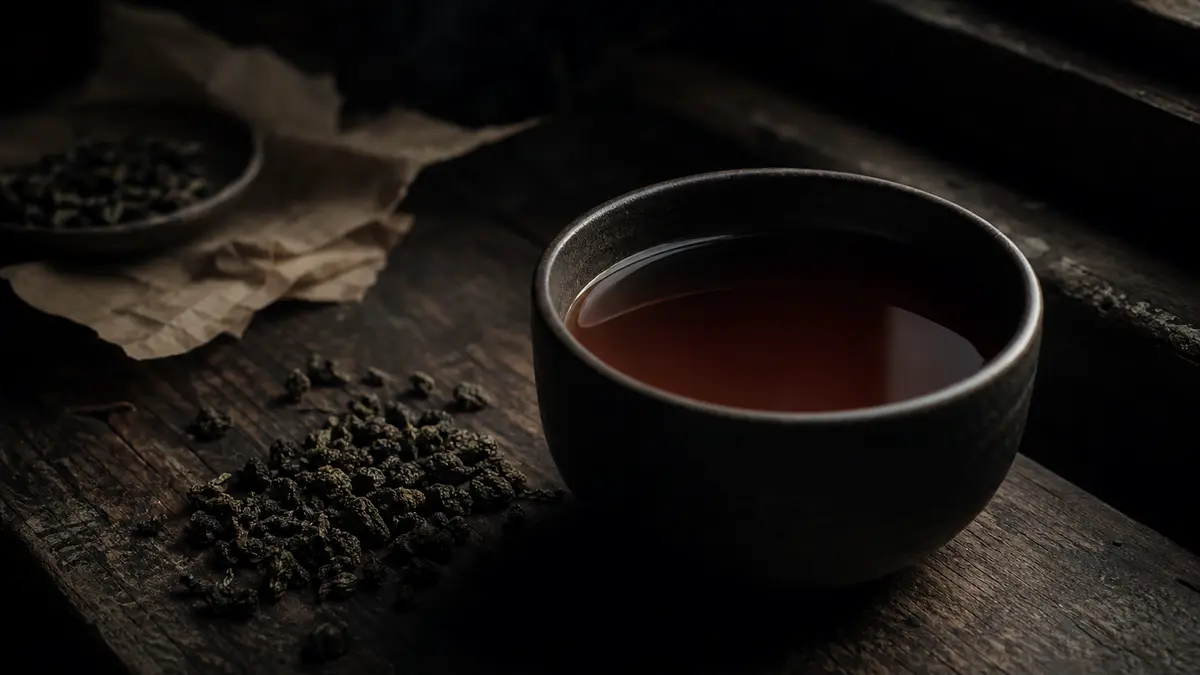
Rou gan breaks down as: 肉 (ròu) means meat or flesh, 感 (gǎn) means feeling. A tea with strong rou gan feels plush, enveloping, thick. There is a sense of mass and warmth. The liquor coats the palate rather than articulating itself.
Where gu gan gives you edges, rou gan gives you volume. Sip a heavily aged shou puerh (熟普洱) from old trees and the liquor does not so much move across your tongue as it settles. There is weight to it. Comfort. The sensation is closer to broth than to water.
The Châteauneuf-du-Pape parallel is apt: that wine leads with generosity, warmth, and a plush mid-palate that wraps around you before any structural element registers. That is rou gan in a glass.
In tea, rou gan typically correlates with:
- Higher amino acid content — the compounds that produce umami-adjacent weight
- Substantial dissolved solids — old-tree material tends toward dense, mineral-rich extraction
- Transformation through aging or processing — roasting, fermentation, and long storage all tend to round and fatten a liquor’s body
These Are Not Opposites
This is the conceptual point worth sitting with. Gu gan and rou gan exist on separate axes, not at opposite ends of the same line. A tea can have both simultaneously — strong structure and strong body — or one without the other, or neither.
| High Rou Gan | Low Rou Gan | |
|---|---|---|
| High Gu Gan | Grand Cru Burgundy; aged Da Hong Pao; mature LBZ sheng | Young high-mountain dancong; some Wuyi shui xian |
| Low Gu Gan | Old-tree shou puerh; aged liu an basket | Light-roast Japanese gyokuro; delicate white teas |
A well-aged Da Hong Pao demonstrates the both-and possibility clearly. The mineral rock framework — yan yun at its most defined — gives you pronounced gu gan. Then the thick, oily coating that good aging and heavy roast develops gives you rou gan. You feel the bone, then the flesh around it.
A young Lao Ban Zhang (老班章) sheng puerh is almost pure gu gan in its youth. The bitter polyphenol structure dominates — lean, powerful, relentless. The rou gan comes later, as aging transforms those compounds. Collectors who age LBZ are, among other things, waiting for the flesh to grow around the bone.
How to Detect Gu Gan and Rou Gan in the Cup
The detection protocol is simple and rewarding once you practice it deliberately.
- Pour a small volume — 15 to 20ml in a gongfu context (功夫茶). You need enough to coat the palate without overwhelming it.
- Take the sip and hold it still for two to three seconds before moving it around. Let it settle.
- Ask: do I feel edges or volume? Is the liquor defining itself spatially — drawing lines on your palate — or filling space?
- Notice what happens in the throat and upper chest — gu gan often produces a descending, defined line of sensation; rou gan produces warmth and spreading weight.
- After swallowing, assess the residue. Gu gan leaves clarity and mineral definition; rou gan leaves coating and warmth. This overlaps with huigan (回甘, returning sweetness) but is a distinct sensation.
The exercise is worth doing blind if you have a tasting partner. Steep the same tea twice: once at a higher temperature (95°C) to accentuate structural extraction, once lower (80°C) to emphasize body and sweetness. The higher infusion will typically push toward gu gan expression; the lower toward rou gan. Same tea, different architecture.
Why Western Tasting Language Falls Short
English has “structured” and “full-bodied” but both are loose approximations. “Structured” in wine language implies tannin presence and acidity — it does not cleanly translate to tea, where tannins behave differently. “Full-bodied” implies weight and alcohol in wine — a metric that obviously does not apply to tea at all.
The result is a vocabulary gap that most English-speaking tea drinkers fill with imprecision: “thick,” “heavy,” “strong,” “smooth,” “clean.” These are not wrong, exactly, but they collapse distinctions that matter. Gu gan and rou gan separate what “thick” was trying to say — is it structural thickness (gu gan) or volumetric thickness (rou gan)?
The anatomical metaphor makes the sensation immediately tangible. If I say a tea has bone, you know what I mean. You can feel what that would mean in your mouth. If I say a tea has flesh, the sensation is equally vivid. No translation required.
Teas Worth Studying
A few teas that reward deliberate gu gan/rou gan analysis:
For pronounced gu gan: Young high-mountain dan cong (單欉) oolongs, especially Mi Lan Xiang (蜜蘭香) from Fenghuang. The floral aromatics distract many tasters from the defined mineral framework underneath. Focus past the fragrance and feel the bone.
For pronounced rou gan: Well-aged ripe puerh from old-tree material. The liquor at five-plus years of storage develops a characteristic thickness that is distinct from the more syrupy sweetness of young shou. The flesh is present without being cloying.
For both together: A correctly produced and adequately aged Da Hong Pao demonstrates how the two qualities coexist. The roast builds body; the yan yun (岩韻) rock terroir builds structure. Neither quality cancels the other.
For contrast: Taste a mid-grade commercial shou puerh against old-tree shou from the same harvest year. The commercial version often has rou gan without gu gan — thick, sweet, but formless. The old-tree version has both in proportion.
Placing This in Your Tasting Practice
Gu gan and rou gan are mouthfeel terms, not flavor terms. They sit alongside huigan (回甘), cha qi (茶氣), and hui wei (回味) in the category of what the tea does to your body rather than what it presents to your nose and tongue.
Developing sensitivity to them requires patience and repetition. Take notes on mouthfeel specifically — not flavor, not aroma. Just: what is the physical architecture of this liquor? Does it feel like a frame or like a cushion?
Over time, you will find these terms arriving naturally as you taste, not because you are performing expertise but because the sensations they name are genuinely distinct. The vocabulary exists because the experience exists. Once you feel the difference between bone and flesh in a cup, you will not reach for “smooth” and “heavy” again.