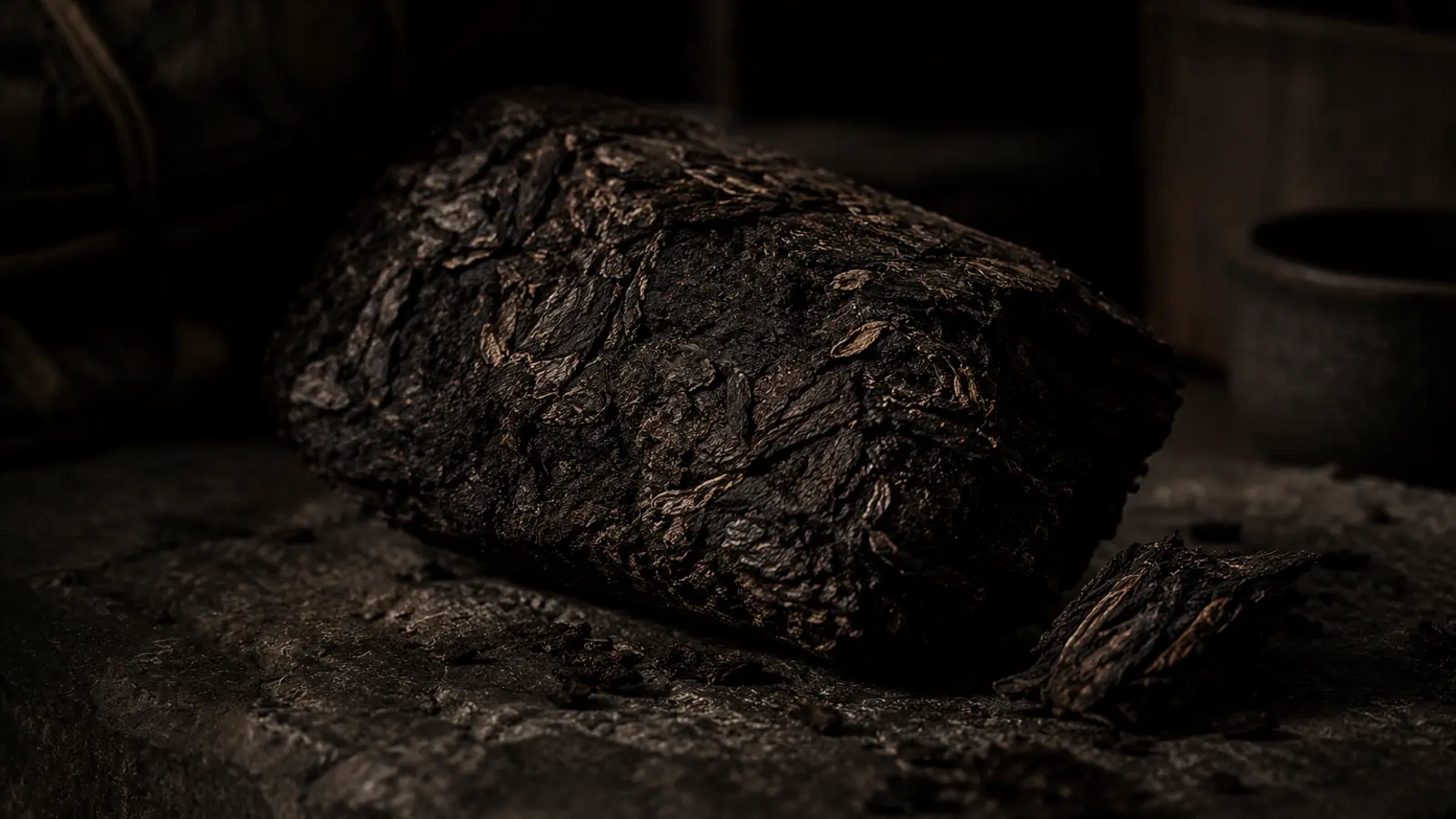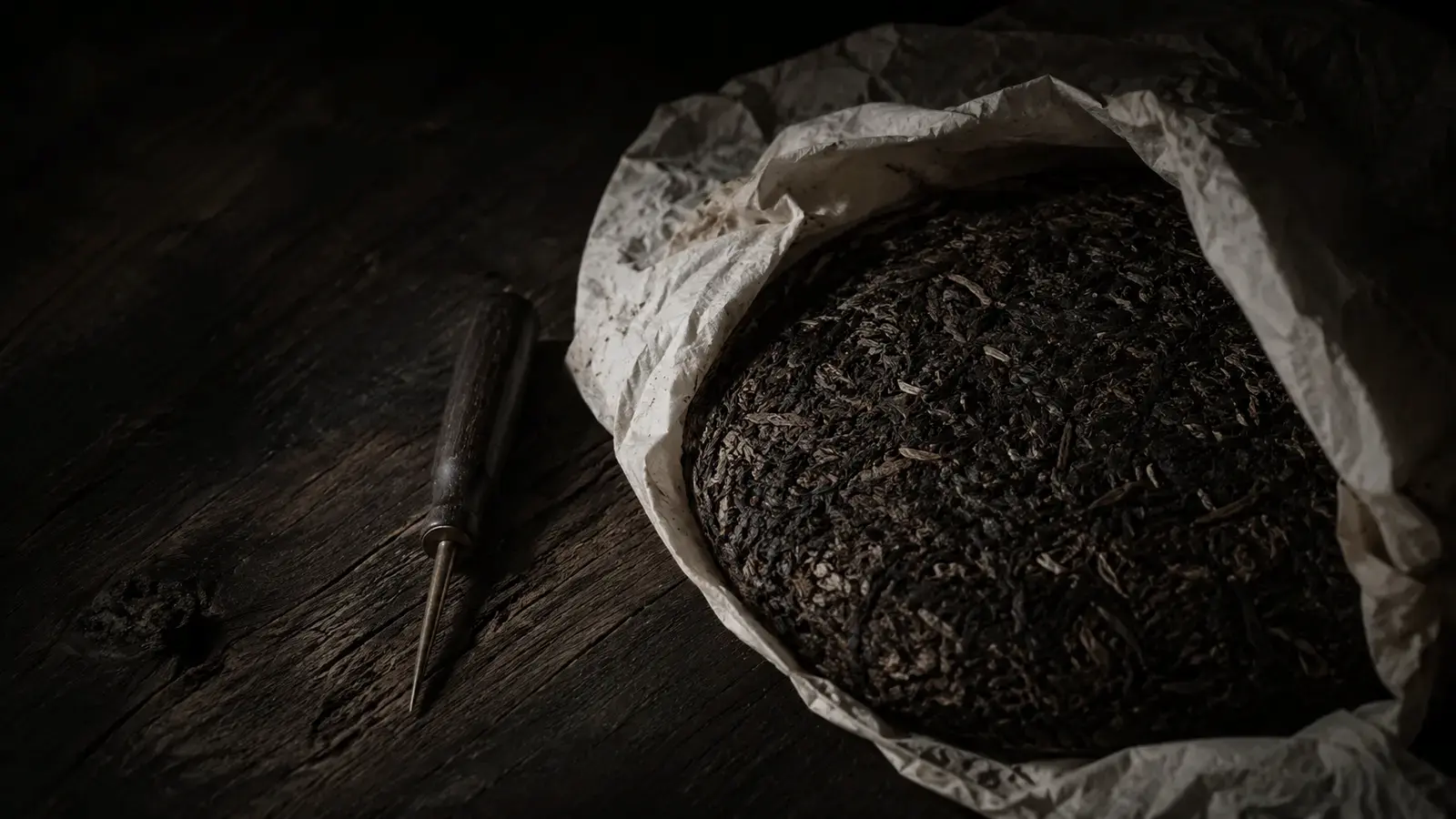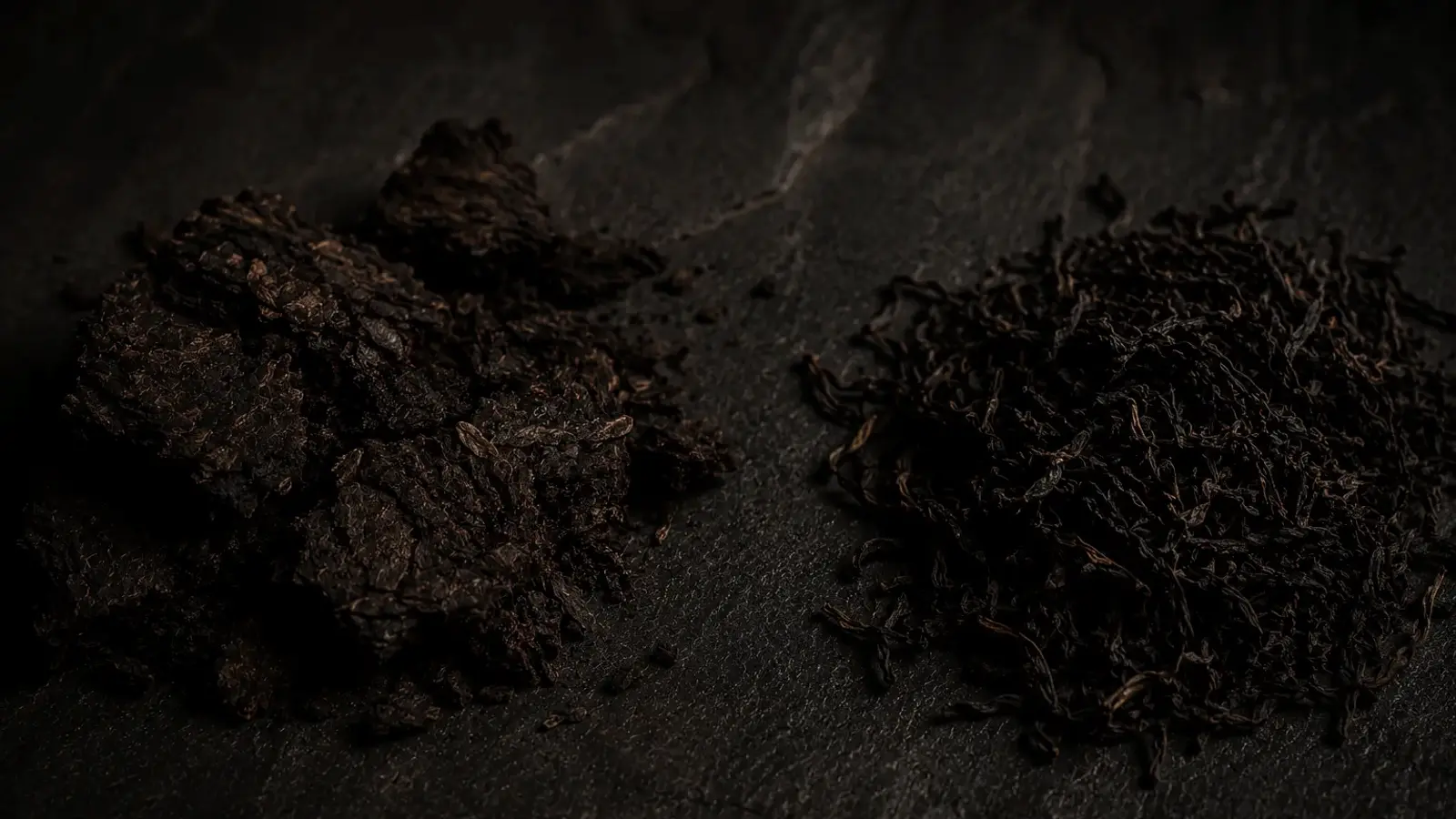
Liu bao tea (六堡茶) is one of China’s most historically significant yet least understood dark teas outside of specialist circles. It comes from Guangxi, not Yunnan. It ages in bamboo baskets, not pressed cakes. And when it reaches maturity, it produces an areca nut fragrance — binlang xiang (槟榔香) — that exists nowhere else in the tea world.
Most writing on Liu Bao skims the surface: a paragraph on Guangxi, a mention of “earthy flavor,” a comparison to shou pu-erh that doesn’t hold up to scrutiny. This guide goes deeper. I’ll cover the geography and cultivar, how Liu Bao is processed and graded, what makes aged Liu Bao distinctive, how it compares to shou pu-erh, how to brew it, and what 30-plus years of age actually produces in the cup — drawing on a 1993 lot I’ve been working through.
What Is Liu Bao Tea?
Liu Bao is a hei cha (黑茶, “dark tea”) — China’s category of post-fermented teas that also includes shou pu-erh (熟普洱), Fu brick (茯磚), and a handful of other regional styles. The name comes from Liu Bao (六堡) village in Cangwu County, Wuzhou City, Guangxi Zhuang Autonomous Region. “六堡” translates literally as “six fortresses” or “six stockades” — a reference to the administrative divisions of the original producing area.
The tea’s defining characteristics are:
- Terroir: Guangxi’s subtropical climate, red soil, and indigenous cultivars produce a leaf base with distinct chemistry from Yunnan’s broad-leaf Da Ye (大葉) cultivars.
- Post-fermentation: Like shou pu-erh, Liu Bao undergoes wo dui (渥堆), a controlled microbial pile-fermentation. But the microbial communities differ, the humidity and temperature conditions differ, and the outcome differs.
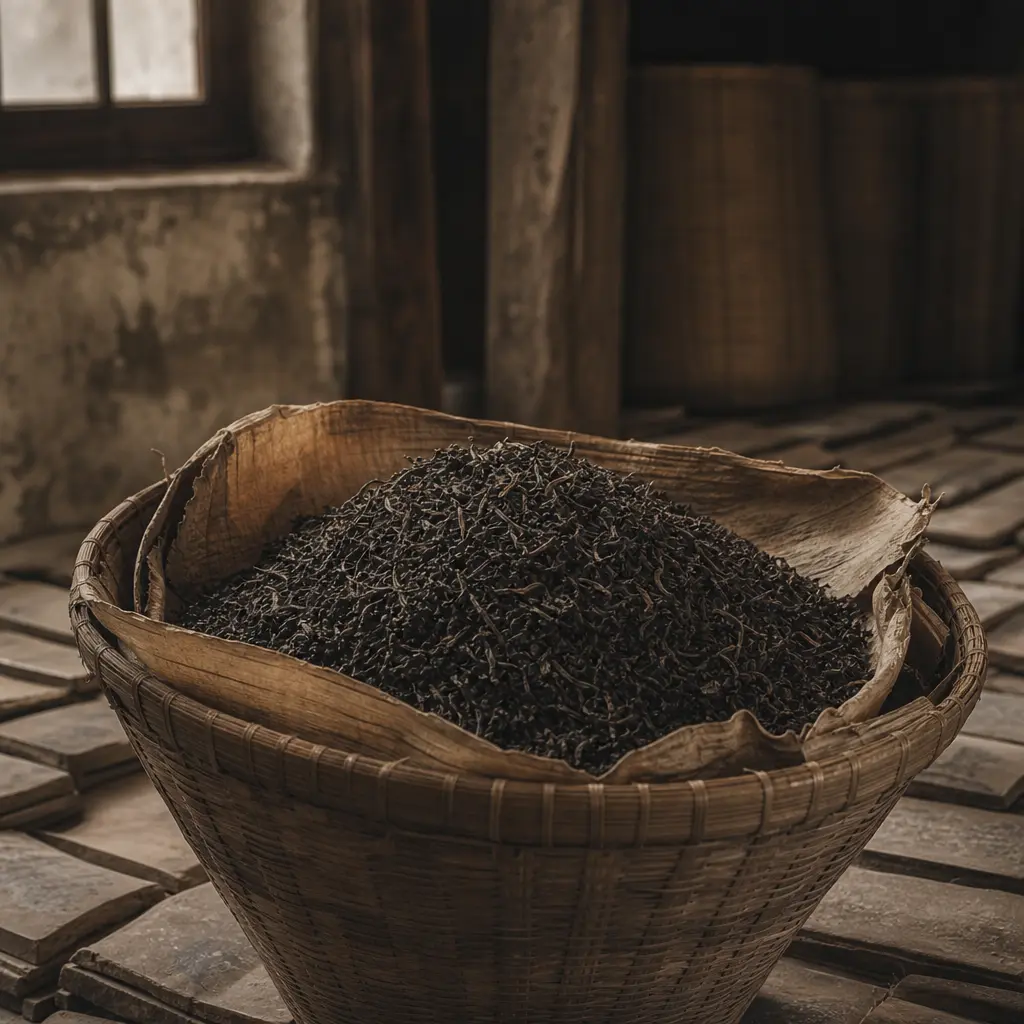
- Bamboo basket aging: Traditional Liu Bao is packed into large bamboo baskets (竹簍) lined with bamboo leaves for storage and further aging. The bamboo contributes a subtle vegetal sweetness and influences moisture equilibration.
- Binlang xiang (槟榔香): The areca nut aroma — sometimes described as betel nut, sometimes as a dry, faintly sweet, resinous note — that emerges in quality aged Liu Bao and is the single clearest quality marker for the category.
Origin and Terroir: Why Guangxi Matters
Liu Bao’s origin is specific enough that the Chinese government has granted it a Protected Geographical Indication (地理标志保护产品). Only tea processed from leaves grown within designated areas of Wuzhou, and processed using traditional Liu Bao methods, can legally carry the name.
The core producing zone centers on Liu Bao village and extends through Cangwu County into parts of surrounding counties. The region sits at roughly 22–24°N latitude, at elevations between 200 and 1,000 meters, receiving 1,500–2,000mm of annual rainfall. Soils are predominantly acidic red earths and yellow-red earths typical of southern China’s lateritic zones.
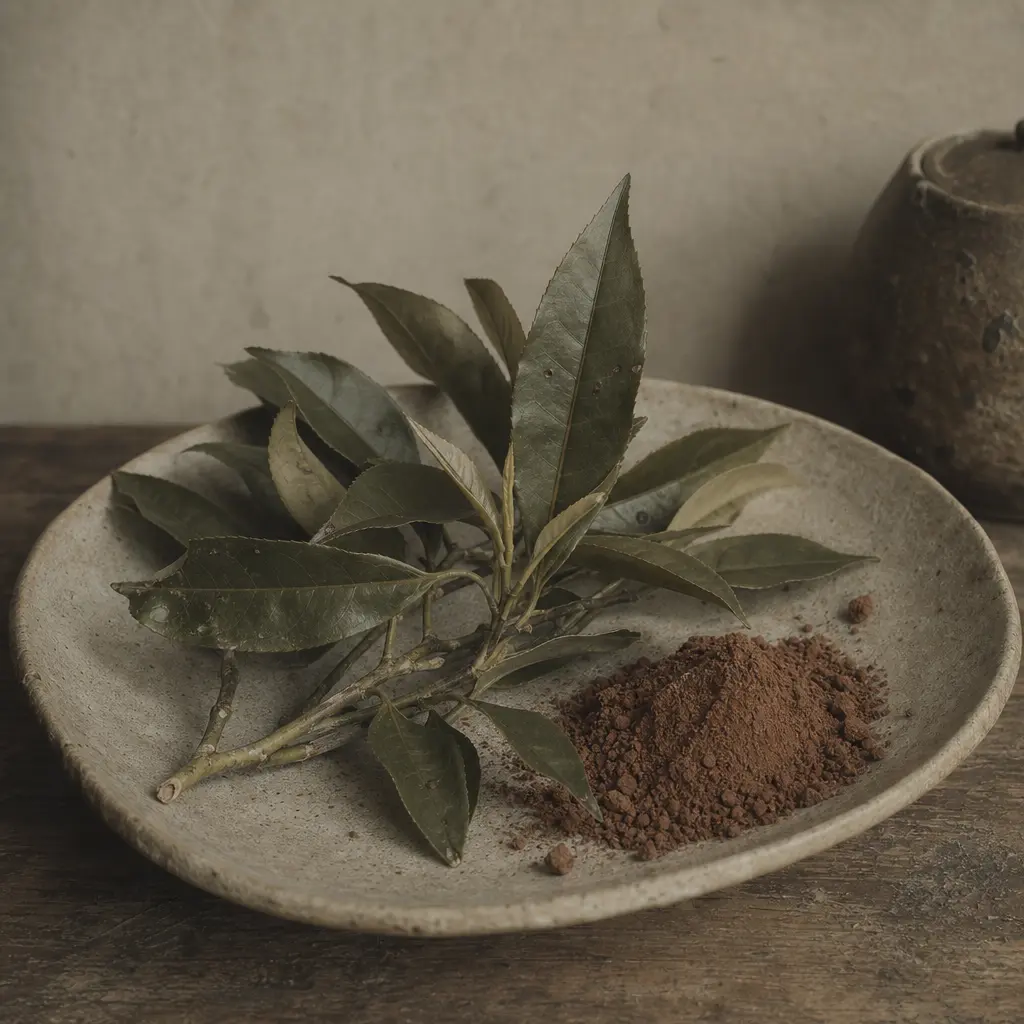
The dominant cultivar is Guangxi’s indigenous zhong ye (中葉, “medium leaf”) type — smaller-leafed than Yunnan’s assamica-derived Da Ye but larger than the small-leaf (小葉) cultivars of Fujian and Zhejiang. This cultivar produces a tea that, post-fermentation, has a different polyphenol profile and a distinct mineral character compared to Yunnan material.
This matters when comparing Liu Bao to shou pu-erh. The raw ingredient is fundamentally different before processing begins. You’re not comparing two identical teas with different finishing steps — you’re comparing two different cultivars, two different growing environments, processed through broadly similar but meaningfully distinct methods. For more on how growing environment shapes what ends up in the cup, see our guide to tea terroir.
Processing: From Fresh Leaf to Bamboo Basket
Understanding Liu Bao’s processing explains much of what ends up in the cup.
Traditional Processing Steps
1. Picking Medium-grade Liu Bao uses a one-bud, two-to-three-leaf standard. Lower grades extend to older, more mature leaves. Higher grades use more tender material, though the grading system (covered below) doesn’t map simply onto leaf grade alone.
2. Withering (萎凋, wēidiāo) Light wilting reduces moisture and begins enzymatic activity. Traditional Liu Bao withering is gentler than sheng pu-erh and closer to a brief ambient wither.
3. Kill-green / fixation (殺青, shāqīng) Heat application — historically in wok-fired panning, now often in steam or drum fixation — halts oxidation. Liu Bao’s kill-green is less aggressive than green tea and leaves some residual enzyme activity.
4. Rolling (揉捻, róuniǎn) Cell rupture releases sap and aids fermentation. Rolled into the characteristic loose leaf or, for lower grades, more compressed-looking material.
5. Wo Dui — pile fermentation (渥堆) This is where Liu Bao’s character begins to form. Moistened tea is piled and covered, allowing thermophilic bacteria and fungi — primarily Aspergillus niger and related species, plus various bacteria — to transform the leaf. The pile heats to 50–65°C internally. Duration varies by producer and target profile, typically 45–60 days.
The critical difference from shou pu-erh’s wo dui: the microbial community in Guangxi is not identical to Yunnan’s. The local water, the ambient microflora, the facility-specific microbiome, and the cultivar’s chemistry all shape which organisms thrive. This produces different metabolic outputs — different flavor compounds, different post-fermentation aroma profile.
6. Drying Sun-dried or shade-dried after fermentation to bring moisture to stable levels.
7. Steaming and basket packing Here Liu Bao diverges most visibly from pu-erh. Traditional Liu Bao is lightly steamed to increase pliability, then packed into conical bamboo baskets (竹簍) that hold anywhere from 50 grams to 50 kilograms depending on grade and intended market. The baskets are lined with fresh bamboo leaves.
During subsequent warehouse aging — often 6 months to several years before release — the bamboo leaves contribute volatile compounds. The basket weave allows gentle gas exchange. Tea stored this way picks up a subtle bamboo character that integrates with its base flavor over time.
8. Aging Unlike shou pu-erh, which is often released relatively quickly after production, quality Liu Bao is warehoused before sale, sometimes for 2–3 years at minimum. Premium aged Liu Bao extends this to decades.
The Six-Grade System
Liu Bao uses a numerical grading system from Grade 1 (一级) through Grade 6 (六级), with some producers additionally offering a “Special Grade” (特级) above Grade 1.
| Grade | Leaf character | General use |
|---|---|---|
| Special / 特级 | Fine tips, golden buds visible | Gongfu brewing, gift, collectors |
| Grade 1 (一级) | Tender, tight roll, minimal stems | Gongfu brewing, premium retail |
| Grade 2 (二级) | Slightly larger leaf, even roll | Daily gongfu, mid-range market |
| Grade 3 (三级) | Medium leaf, some variation | Everyday drinking, export |
| Grade 4 (四级) | Coarser, more mature leaf | Industrial, export, blending |
| Grade 5 (五级) | Old leaf, stem content increases | Blending, functional use |
| Grade 6 (六级) | Mature leaf, pronounced stems | Industrial, historical export grades |
The historically exported Liu Bao shipped to Malaysian and Singaporean mining communities was predominantly Grade 3–6 — not because quality was unimportant, but because these grades were durable, affordable, and aged predictably in humid tropical conditions. Many prized aged lots today originated as “lower grade” export material.
Liu Bao’s History and the Southeast Asian Connection
Liu Bao is one of the original Chinese export teas to Southeast Asia, and its history there runs deeper than almost any other tea type.
From the mid-19th century through the mid-20th century, hundreds of thousands of Hakka Chinese (客家人) migrated to the tin mines of Malaya (present-day Malaysia) and rubber plantations of the region. They brought Liu Bao with them — not as a luxury but as a daily necessity. The tea was considered protective against the heat, humidity, and physical strain of mine work. Traditional Chinese medicine frameworks classified it as cooling and digestive.
Liu Bao arrived by ship in large quantities, packed in those characteristic bamboo baskets and wooden crates. In the humid warehouses of Penang, Ipoh, Kuala Lumpur, and Singapore, the tea continued aging. The result, decades later, was an aged Liu Bao distinct from anything aged in drier continental climates — darker, smoother, with the developed binlang xiang that became the category’s quality benchmark.
This Malaysian and Singaporean aged Liu Bao became the reference point for what “good aged Liu Bao” means. When collectors talk about 50-year or 60-year “old Liu Bao,” they are often referring to lots that spent decades in exactly these conditions — tropical humidity between 70–85%, ambient temperatures of 27–32°C year-round.
Hong Kong played a similar warehousing role. The humid, warm conditions of Hong Kong’s older godowns (倉庫) produced a style of aged Liu Bao that is slightly different from Malaysian-stored examples — comparable humid transformation, but with some differences in flavor expression attributed to different ambient microflora.
This history is inseparable from the tea’s identity. Liu Bao is not an abstract category of hei cha — it is deeply tied to the Hakka diaspora, to the physical labor of the mining industry, and to the specific flavor memory of a community.
Binlang Xiang: The Areca Nut Aroma
Binlang xiang (槟榔香) is Liu Bao’s most distinctive quality marker and deserves dedicated attention.
Binlang (槟榔) is the areca nut — the seed of Areca catechu, chewed throughout South and Southeast Asia. The aroma is difficult to describe if you haven’t encountered it directly: dry, slightly sweet, faintly resinous, with a medicinal undertone. It is not aggressive or unpleasant — in a well-aged Liu Bao it integrates with aged wood, dried dates, and forest floor notes to create a complex aromatics profile that experienced drinkers immediately recognize as characteristic.
Not all Liu Bao develops strong binlang xiang. It requires:
- Quality base material: Leaf from older bushes in the core producing area tends to develop it more reliably.
- Appropriate wo dui: The fermentation conditions and microbial activity affect precursor compound formation.
- Sufficient aging: Binlang xiang typically becomes pronounced after 10+ years and deepens through 20–40 years. Young Liu Bao (under 5 years) rarely shows it clearly.
- Correct storage conditions: Humid-stored examples develop it more reliably than dry-stored.
The biochemistry is not fully characterized in the literature available to me — I’m working from organoleptic experience and the general understanding that the aroma compounds are products of microbial transformation and Maillard-adjacent reactions during aging. What I can say with certainty from firsthand experience: when a well-aged Liu Bao expresses strong binlang xiang, it is immediately recognizable and unlike anything in pu-erh, black tea, or any other category.
Liu Bao vs. Shou Pu-erh: A Genuine Comparison
The comparison between liu bao and shou pu-erh is the most common source of confusion for new drinkers, and most treatments of it are superficial. Here is a structured breakdown.
| Attribute | Liu Bao (六堡茶) | Shou Pu-erh (熟普洱) |
|---|---|---|
| Origin province | Guangxi | Yunnan |
| Primary cultivar | Medium-leaf Guangxi types | Yunnan broad-leaf assamica |
| Kill-green method | Pan-fired or steam | Sun-dried (晒青) — no fixed kill-green |
| Wo dui (pile fermentation) | Yes, traditional | Yes, invented 1973 |
| Aging vessel | Bamboo baskets (traditional) | Compressed cakes, bricks, tuos |
| Typical aging climate | Subtropical to tropical | Variable; Kunming dry to tropical |
| Characteristic aroma | Binlang xiang (areca nut) | Pond water/petrichor when young; dried fruit, aged wood when old |
| Liquor color | Deep amber to dark chestnut | Deep burgundy to near-black |
| Flavor profile | Earthy, dried dates, aged wood, binlang | Earthy, mushroom, dark fruit, barnyard (young), smooth (aged) |
| TCM framework | Cooling, digestive | Warming |
| Historical export | Malaysia, Singapore, Hong Kong | Hong Kong, then global |
| Grading system | 6 numerical grades | Grade variations but not standardized |
The single most important point: Liu Bao and shou pu-erh are not interchangeable. They can occupy similar use cases — daily dark tea, aged tea for contemplative sessions — but they taste different, they age differently, and they carry different cultural histories. Treating Liu Bao as “Guangxi shou pu-erh” misrepresents both teas.
The key flavor distinction in aged examples: shou pu-erh, even well-aged, tends toward a heavier, more saturated earthiness with stone fruit and sometimes a dry mineral note. Aged Liu Bao is lighter on the palate with more clarity, the earthiness resolves earlier in the sip, and the binlang xiang provides a finishing note that shou pu-erh doesn’t replicate.
Aging Liu Bao: What Time and Humidity Do
Liu Bao’s aging dynamics are one of the most compelling aspects of the category.
Young Liu Bao (1–5 years)
Freshly produced Liu Bao often carries a “heap smell” (堆味, duī wèi) — a moist, slightly musty fermentation note common to all newly wo-dui-processed teas. The flavor is earthy, sometimes sharp, without developed sweetness or binlang xiang. Drinkable, functional, but not at its best.
Developing Liu Bao (5–15 years)
The heap smell dissipates. The liquor clears to a deep amber. Dried dates, dried longans (龍眼), and autumn leaves emerge. The earthy base becomes rounder. Early binlang xiang may appear as a background note. This is the stage where Liu Bao becomes genuinely pleasurable for daily drinking.
Mature Liu Bao (15–30 years)
The transformation is well underway. Binlang xiang is distinct. The tea has a smoothness and weight that younger examples lack. Dried fruit notes deepen. Huigan (回甘) — the returning sweetness felt in the throat after swallowing — becomes more pronounced. The liquor is deep chestnut to dark amber.
Deeply Aged Liu Bao (30+ years): A Firsthand Account
I have a lot of 1993 Liu Bao — factory-produced, stored in Guangdong before coming to me, now held in Bangkok where ambient conditions run 65–80% relative humidity and 25–30°C year-round.
At 30-plus years, this tea is remarkable in a specific, quiet way. The entry is smooth — no roughness, no sharpness, no residual fermentation character. The base note is aged camphor wood and dried dates with a mineral undercurrent that I associate with older hei cha in general. The binlang xiang is present throughout, particularly on the finish and in the empty cup: dry, faintly sweet, persisting for several minutes after the tea is gone.
The huigan is deep and relatively slow — it builds over 30–60 seconds after swallowing rather than appearing immediately. The mouthfeel is full but not heavy; it coats without cloying.
What strikes me most about older Liu Bao compared to similarly aged shou pu-erh is a cleaner quality in the earthiness. Aged shou can retain a saturated, sometimes murky quality. This 1993 Liu Bao is clear — in the liquor visually, in the aroma, and in the flavors. Age has simplified and refined rather than just transformed.
I brew it in a small Yixing clay pot at around 95–98°C rather than full boil — the slightly lower temperature compared to fresh Liu Bao seems to open the aromatics more gently without stripping anything. Steeps of 25–45 seconds yield six to eight good infusions before the tea begins to fade.
This is, to be honest, among the finest teas I regularly drink. Not because of rarity or price — though aged Liu Bao isn’t cheap — but because of what it does in the cup.
Liu Bao and Tropical Storage
Liu Bao ages particularly well in tropical conditions, which is historically accurate and practically relevant.
The same principles that made Malaysian warehouse storage so transformative apply today. Consistent warmth (25–32°C) and moderate-to-high humidity (65–80% RH) accelerate the secondary fermentation and enzymatic activity that drives flavor development without the interruptions of seasonal temperature and humidity swings common in continental climates.
If you’re in Thailand, Singapore, Malaysia, or similar climates: Liu Bao is an excellent long-aging candidate for your local conditions. It does not require the elaborate humidity management that sheng pu-erh demands. It tolerates the high ambient humidity of tropical environments and, to a significant degree, benefits from it.
Practical parameters for tropical Liu Bao storage:
- Target humidity: 65–78% RH. Above 80% risks mold growth if airflow is insufficient.
- Temperature: 25–32°C. Avoid locations with direct sun heating or wide daily swings.
- Airflow: Gentle circulation prevents stagnant conditions. Don’t seal Liu Bao in airtight containers.
- Vessel: The traditional bamboo basket is ideal. Ceramic crocks, unglazed clay, or breathable paper wrappers all work. Avoid plastic bags.
- Odor isolation: Like all dark teas, Liu Bao absorbs ambient aromas. Keep away from strong odors.
- Turning: Occasional rearrangement of baskets or parcels promotes even aging, though Liu Bao is more forgiving than sheng pu-erh in this regard.
The results of good tropical storage over 10–20 years are worth the patience.
How to Brew Liu Bao Tea
Liu Bao is a forgiving tea, but specific parameters bring out its best.
Equipment
A porcelain or ceramic gaiwan (蓋碗) works well and is my default for evaluating a new Liu Bao — it adds no flavor of its own and lets the tea speak clearly. Aged Liu Bao, particularly 20+ years, benefits from an unglazed Yixing clay pot if you have one dedicated to hei cha. The clay’s porosity softens any residual edge and deepens the apparent body.
Avoid glass for aged Liu Bao — it doesn’t harm the tea, but something about glass vessels seems to flatten the aroma experience compared to ceramic.
Water
Use soft to medium-hardness water. Filtered tap water is fine; heavily mineralized water can clash with Liu Bao’s earthy notes. Temperature: 100°C (212°F) for factory-produced or younger Liu Bao. For deeply aged examples (20+ years), I sometimes drop to 95–98°C to preserve the delicate binlang xiang, but this is preference rather than rule.
Parameters (Gongfu style)
- Leaf-to-water ratio: 6–8 grams per 100ml
- Vessel size: 100–150ml gaiwan or teapot
- Rinse: One quick rinse, 10–15 seconds, discard
- 1st infusion: 20–30 seconds
- 2nd infusion: 25–35 seconds
- 3rd+ infusions: Add 10–15 seconds per round
- Total infusions: 6–10 for good factory-produced Liu Bao; 8–12 for quality aged examples
Liu Bao does not turn bitter or astringent easily. If you extend steeps, the result is typically a darker, more full-bodied cup rather than an unpleasant one. This makes it excellent for casual brewing — grandpa style (grandpa brewing, 老爺泡), where you simply add a generous amount of tea to a mug and top with water repeatedly, is entirely viable with Liu Bao.
For First-Time Drinkers
Start with 5 grams in a 120ml gaiwan, fully boiling water, 30-second steeps. The tea you encounter should be smooth, earthy, and warming — not harsh, not bitter. If it tastes sharp or overly tannic, the wo dui hasn’t fully resolved and the tea needs more time.
Buying Liu Bao: What to Look For
The Liu Bao market has less deep fraud than pu-erh — partly because it has attracted less speculative investment, partly because quality indicators are fairly accessible to a trained nose. A few guidelines:
Factory vs. traditional: Large Guangxi state factories (三鹤, Sanhe; 梧州茶厂, Wuzhou Tea Factory) produce consistent, reliable Liu Bao with clear date codes. These are the workhorses of the category and where I’d recommend starting.
Age claims: The same skepticism applied to aged pu-erh applies here. “1980s Liu Bao” at a suspiciously accessible price should be verified — or simply enjoyed without certainty about date. The tea itself will tell you most of what you need to know if you’ve tasted enough examples across ages.
The smell test: Good Liu Bao should smell clean, earthy, and slightly sweet. Mold, sourness, or a harsh chemical note are disqualifying. Binlang xiang in aged examples should be pleasant, not overpowering.
Price context: Factory-produced 10-year Liu Bao retails in the range of $15–$50 per 100g depending on grade and vendor. Genuine 30-year-plus examples from reputable sources run $80–$200+ per 100g. Anything claiming significant age at well below these price points warrants scrutiny.
Liu Bao in Context: Its Place in Hei Cha
Liu Bao is one of several hei cha (黑茶) styles, each with distinct regional character. The broader category includes:
- Shou pu-erh (熟普洱) — Yunnan, post-1973
- Fu brick tea (茯磚茶) — Hunan, with “golden flower” (金花, Eurotium cristatum) fungal colonies
- Qianjiang Prefectural Tea (千兩茶) — Hunan, pressed into large log forms
- Tibetan brick tea (藏茶) — Sichuan and Yunnan, compressed for the Tibetan trade
- Liu Bao (六堡茶) — Guangxi, bamboo basket, Southeast Asian export
Each has distinct processing, distinct flavor, distinct use history. Liu Bao’s distinguishing features within hei cha are its bamboo basket tradition, its Southeast Asian cultural roots, and above all the binlang xiang that makes it immediately identifiable.