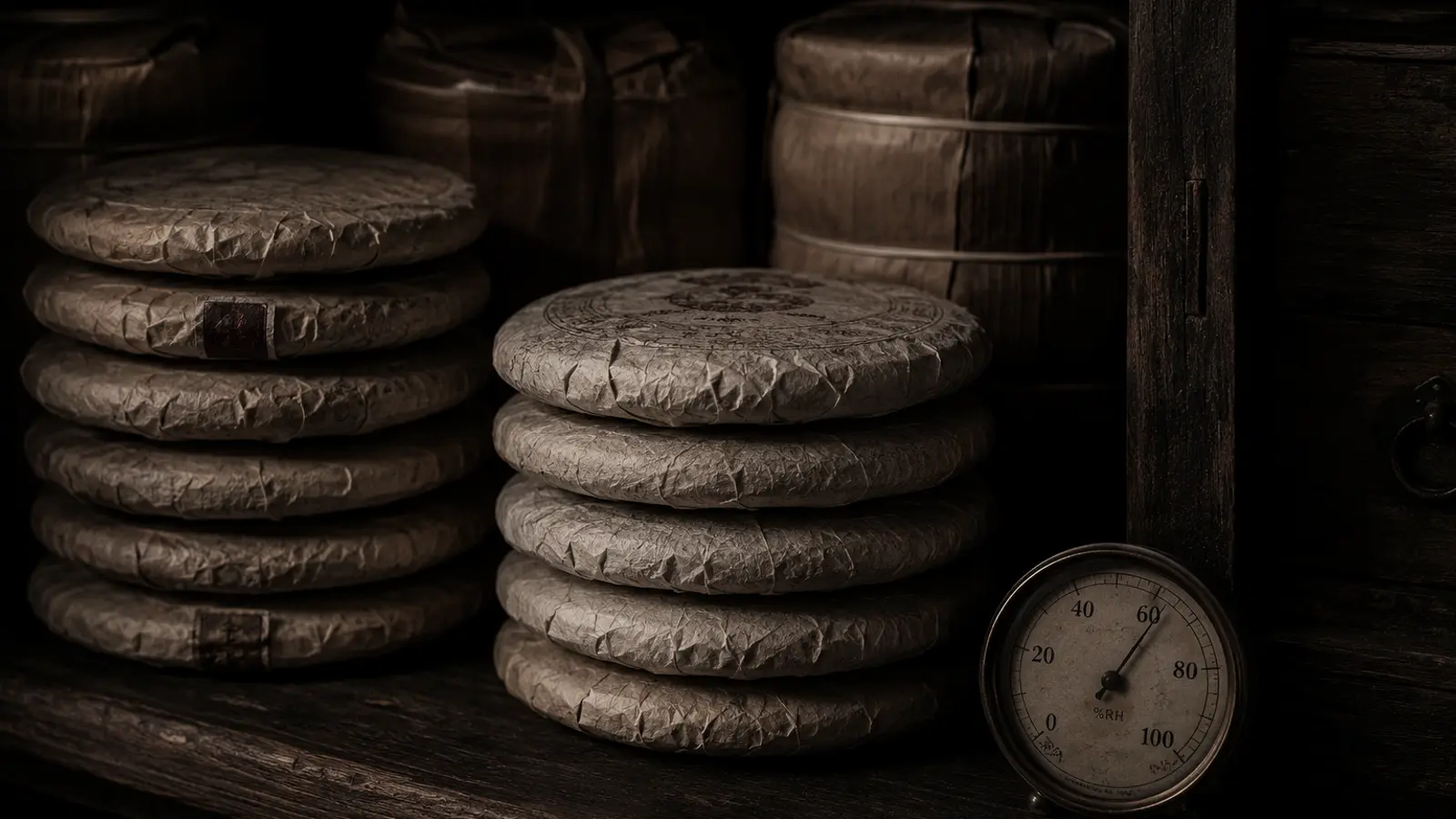
I store tea in southern Thailand. Ambient relative humidity here runs 70–85% year-round, and temperatures sit between 30°C and 35°C from April through October, dipping to a still-warm 26–28°C in the coolest months. The rainy season drives humidity toward the top of that range for weeks at a stretch.
This environment is not an obstacle to aging pu-erh (普洱茶). It is, if managed correctly, an asset. But almost none of the available guidance on pu-erh tea storage humidity was written with the tropics in mind. Most of it assumes a temperate basement, a wine cellar in a mild climate, or at minimum a home with air conditioning set to 22°C. I am writing this article because the advice that applies to a collector in Portland or London will get you mold in Chiang Mai.
Here is what I know, what I have built, and where I am still working from community reports rather than personal verification.
The Storage Spectrum: Wet, Dry, and the Tropical Middle Ground
Before getting into practical construction, it helps to understand where tropical ambient storage sits on the historical spectrum.
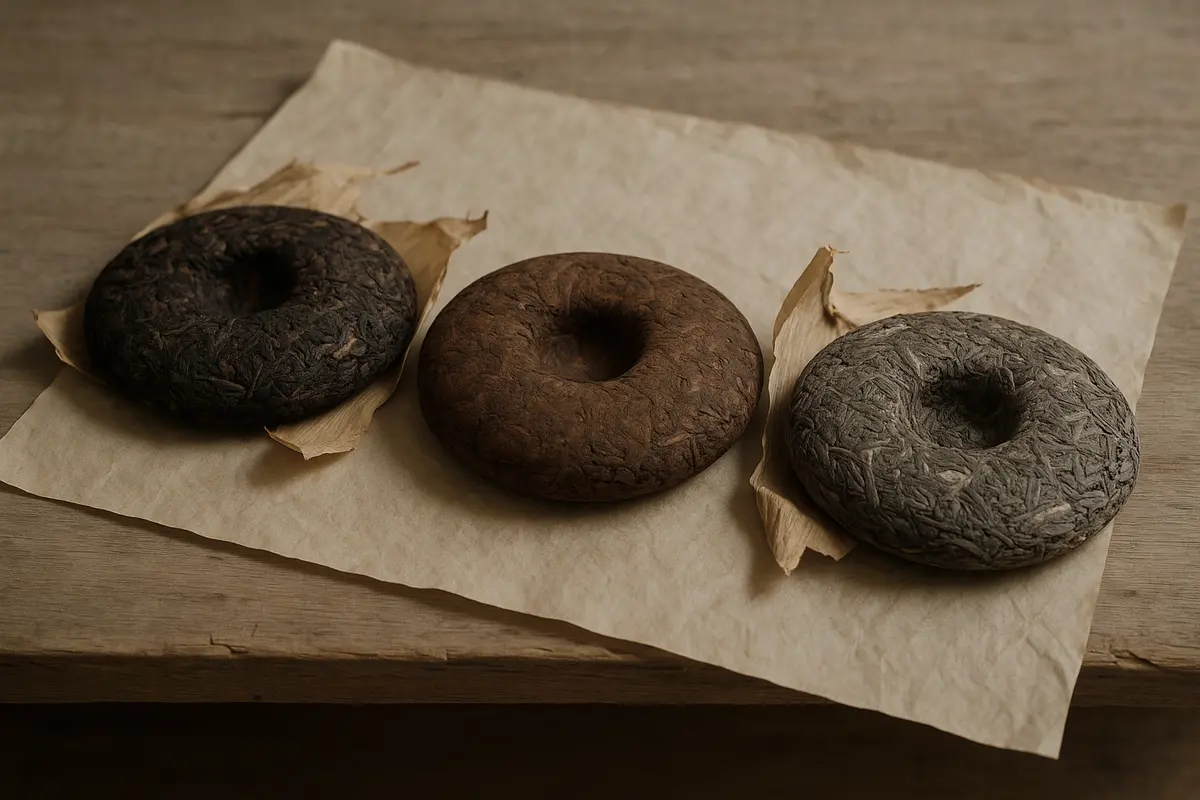
Traditional wet storage (濕倉, shī cāng) is the Hong Kong method. Warehouses running at 80–95% RH, often with deliberate moisture introduction, temperatures kept high. This accelerates microbial transformation dramatically. The result is that characteristic damp-earth, camphor, and mushroom flavor profile associated with older Hong Kong-stored sheng (生普). The method fell out of fashion partly because it is easy to ruin a cake with mold or excessive “warehouse taste,” and partly because the mainland Chinese market grew to prefer cleaner-tasting storage.
Traditional dry storage (乾倉, gān cāng) is associated with Kunming (昆明), the capital of Yunnan province, elevation 1,895 meters, average annual humidity around 55–65% RH, and mild temperatures. Tea stored here ages slowly and cleanly. The flavor development emphasizes gradual oxidation over microbial transformation. It takes time — collectors speak of 15–20 year Kunming-stored sheng as just getting interesting.
Tropical ambient storage falls between these two poles, but closer to the wet side than most collectors appreciate. At 75–85% RH and 30–35°C, you are not running intentional wet storage, but the conditions are warm and humid enough to encourage genuine microbial activity. The fungi and bacteria responsible for pu-erh’s post-fermentation transformation (the reason pu-erh is classified as a 後發酵茶, hòu fājiào chá — post-fermented tea) are active at these temperatures and moisture levels.
The practical implication: tropical storage is not simply dry storage in a warm room. It produces a different flavor trajectory, requires different monitoring, and demands different containment strategies.
What Your Conditions Actually Are (Before You Modify Them)
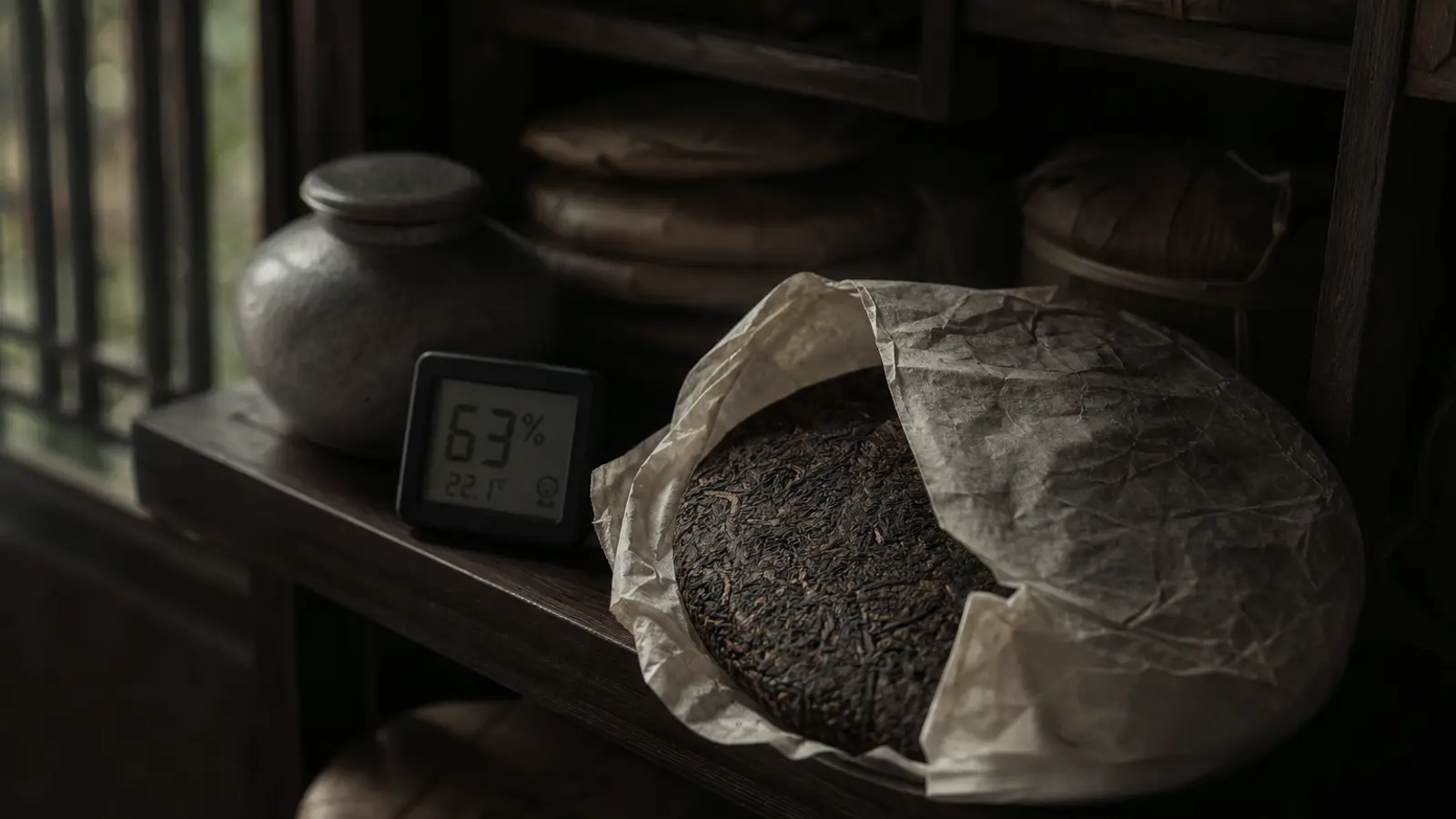
The first thing I recommend is buying a calibrated digital hygrometer and letting it run in whatever space you initially plan to store tea. Do this for at least four weeks, including both dry and wet weather. Log the daily highs and lows. You will likely find:
- Dry season baseline: 65–75% RH indoors, temperatures 28–32°C
- Monsoon season: 78–88% RH indoors, temperatures 30–34°C
- Near exterior walls or concrete floors: 5–10% RH higher than the room average
- Air-conditioned rooms: Humidity drops significantly, often to 50–60% RH
These numbers matter because they determine what intervention your storage actually needs. If you are in a dry-season apartment with air conditioning running, you may need to add humidity. If you are in an open-plan shophouse near the coast during monsoon, you are more likely fighting excessive humidity.
The hygrometer is not optional equipment. A $15 AcuRite or Govee unit from Lazada is sufficient. Calibrate it using the salt test before trusting it: place the sensor in a sealed bag with a damp paper towel saturated in salt water for six hours — it should read approximately 75% RH. Adjust your readings accordingly if it deviates by more than 3%.
The Pumidor: Practical Construction for the Tropics
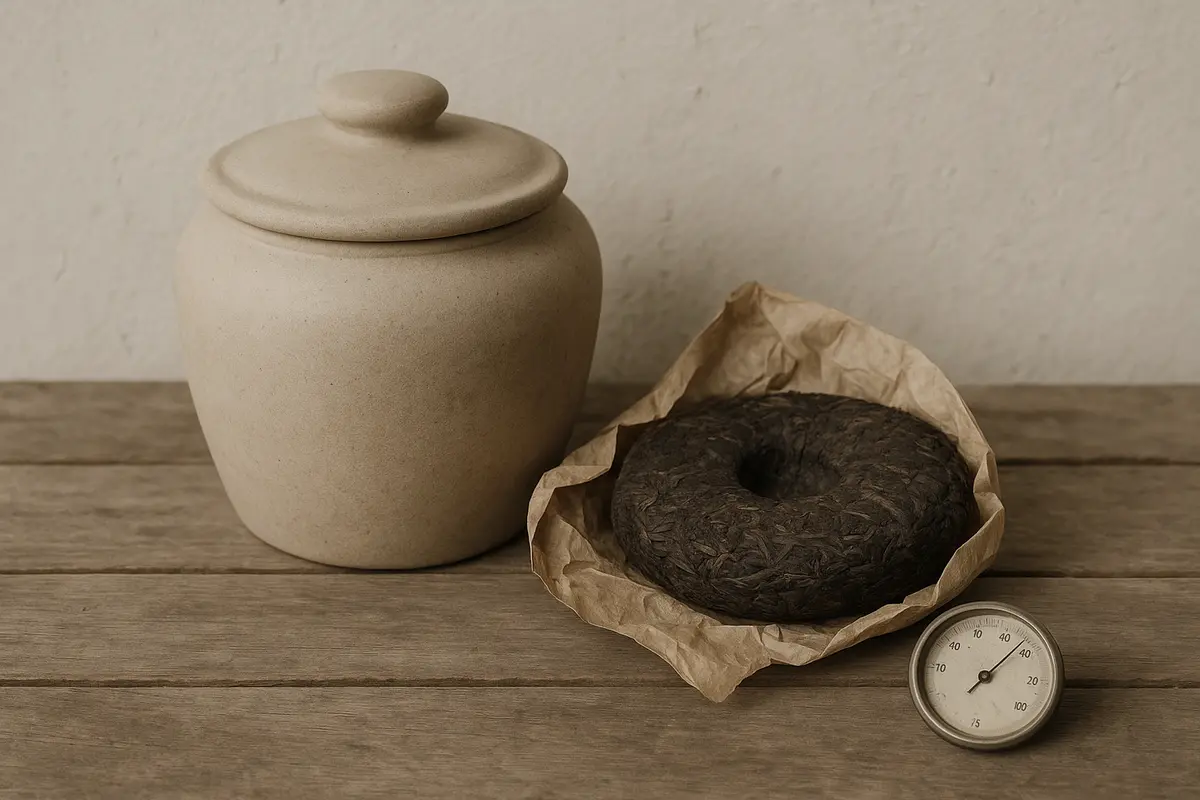
A pumidor is a sealed storage container used to maintain stable humidity for aging pu-erh. The name combines “pu-erh” and “humidor.” In temperate climates, the goal is usually to add humidity. In the tropics, the goal is often to buffer against excessive humidity during monsoon, prevent wide RH swings, and keep the storage environment from turning into intentional wet storage by accident.
Container Selection
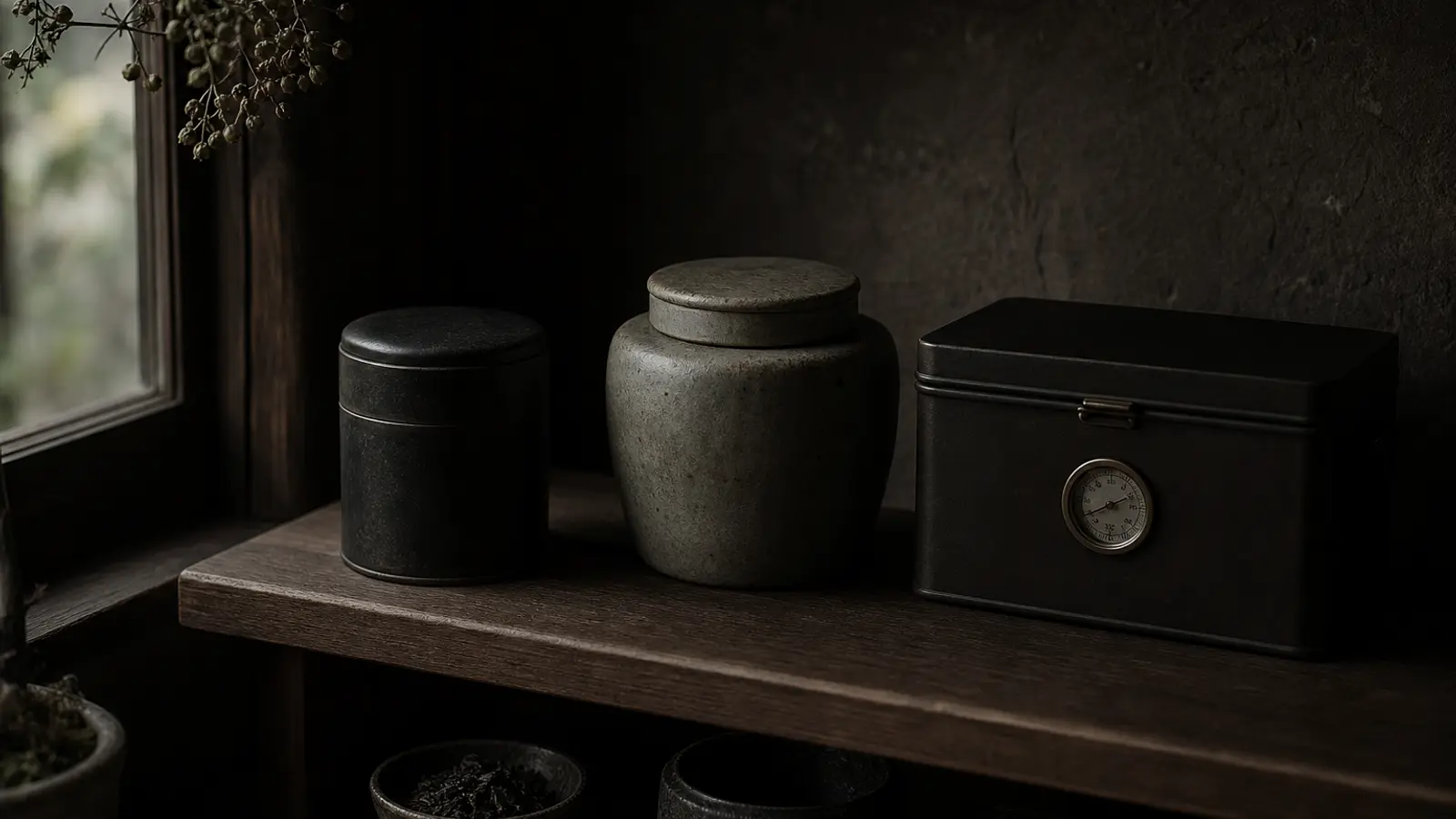
Food-grade plastic storage bins (30–60 liters) are my current solution. HDPE bins from Makro or BigC in Thailand cost 150–300 THB ($4–$9 USD) and seal well when the lid is pressed down. I use two: one for sheng (生茶) and one for shou (熟茶), for reasons I will explain under cross-contamination.
Wooden cabinets are popular in the pu-erh community but require careful sourcing in the tropics. Wood absorbs and releases humidity, which provides some buffering, but untreated tropical hardwoods can introduce tannins and off-flavors. If you use a wooden cabinet, line the interior with unscented cedar boards or leave them unlined but never use MDF or particleboard, which off-gas formaldehyde.
Repurposed wine coolers or mini-fridges work well if the compressor is either removed or permanently off. The insulation and tight seal are the useful parts, not the cooling function. A wine cooler running without power maintains stable temperature better than an open wooden cabinet in a hot room.
What to avoid: cardboard boxes (humidity absorption causes structural failure and introduces off-flavors), anything previously used to store spices or strong-smelling foods, and any container with plastic lining that is not food-grade.
Humidity Regulation Inside the Pumidor
Boveda 72% packs are the easiest solution. These two-way humidity control packs release or absorb moisture to maintain a target RH. In the tropics, you will mostly find them absorbing moisture during monsoon and releasing it during dry spells. One 60-gram Boveda 72% pack handles approximately 15–20 liters of container volume. Replace every three to six months, or when the pack feels rigid (it has been fully saturated). Cost is approximately $3–5 USD per pack via Shopee Thailand, more if you buy from international sources.
Kitty litter (unscented, bentonite-based) is the budget alternative. A dish of dry kitty litter inside the container absorbs excess humidity. A dish of water with a sponge adds humidity if needed. This requires more active monitoring than Boveda packs but costs a fraction of the price and works well for larger volumes.
Salt-based regulation (the same principle as calibrating your hygrometer) is effective for maintaining specific RH targets. A saturated solution of potassium chloride maintains approximately 85% RH; sodium chloride maintains approximately 75% RH. Place the solution in a small open container inside your sealed storage vessel. This is more commonly used in laboratory conditions but functions in a sealed pumidor.
Air Exchange
Sealed containers need periodic ventilation or they become stagnant and anaerobic. In temperate climates, this matters less. In 34°C tropical heat, a completely sealed container can develop off-odors within weeks and mold within months.
I open my bins for approximately 10–15 minutes weekly. I choose a dry morning when outdoor humidity is lower — typically 9–11 AM before the afternoon humidity climbs. This brief air exchange prevents stagnation without destabilizing the RH significantly. Some collectors use a small aquarium pump with an air stone on a timer to provide continuous micro-ventilation. I have not tried this but the principle is sound.
Monitoring: What to Track and How Often
A basic monitoring log does not need to be elaborate. I keep a note in my phone:
- Date, time, RH reading, temperature reading
- Any anomalies: visible condensation, unusual smell when opening, cake inspection notes
- Boveda pack status
Review this monthly. Look for trends: is your RH creeping up through monsoon? Is it dropping below 60% in February? Catch these trends early and adjust your humidity-control materials before the tea is affected.
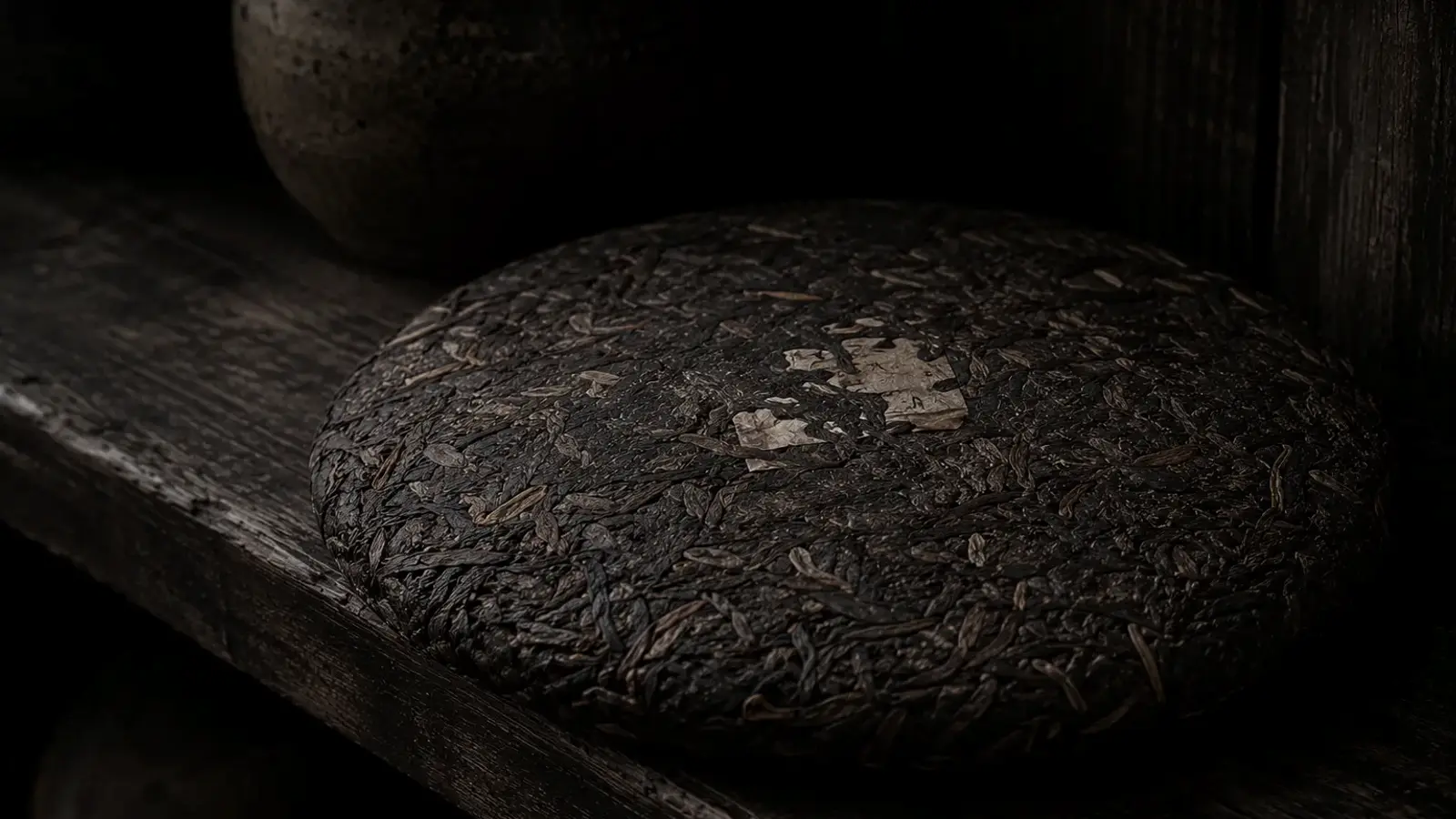
The most important inspection is the tea itself. Once a month, remove two or three cakes at random and examine them closely. Look at the edges, the center hole if there is one, and the compressed surface. White frost (霜, shuāng) on the surface is normal — these are compressed tea buds. White fuzzy patches that look like cotton or powdery growth are mold. These require immediate action.
Mold: Prevention and Response
Mold on pu-erh is a serious problem but not an automatic catastrophe if caught early. The conditions that cause it: sustained RH above 82–85%, poor air circulation, temperature above 35°C for extended periods, or moisture contamination from a wet surface contact.
Prevention:
- Keep RH in the 62–78% range inside your storage container
- Ensure cakes do not touch the container walls or floor directly (use a wooden slat, bamboo mat, or a raised platform)
- Do not introduce wet or freshly rinsed objects into the storage environment
- Inspect monthly without exception
Response to mold:
Remove the affected cake immediately and isolate it. Take it to a dry, shaded location with airflow — a fan on low, indirectly blowing across it. Do not put it in the sun, which can damage aromatics. Over two to five days, the mold should die and dry out. You can then brush the affected area gently with a dry, clean brush. Whether the cake is salvageable depends on how deep the mold penetrated. Surface mold caught early is usually recoverable. Mold that has penetrated into the compressed mass is harder to assess.
Do not store a recovered cake back with your other teas immediately. Keep it separate, inspect it weekly for one month, and only reintroduce it when you are confident the mold is gone.
Sheng vs. Shou: Store Separately, Always
Sheng (生茶, raw pu-erh) and shou (熟茶, ripe pu-erh) must never be stored together. This is not a minor preference — it is the rule that experienced collectors consistently enforce.
Shou pu-erh undergoes a wet-pile fermentation (渥堆, wòduī) during production that produces intense microbial activity and a strong, characteristic “pile smell” in younger material. This smell transfers readily to other teas in a shared storage environment. It will fundamentally alter the aroma profile of your sheng, imparting an earthy, composted flavor that the tea did not develop organically.
Beyond shou, different sheng cakes from different regions and producers should ideally be stored separately if their flavor profiles are very different, but this is a refinement rather than a strict rule. The sheng/shou separation is the baseline minimum.
Different types of tea — white tea, oolong, black tea — should also be stored completely separately from pu-erh. The cross-contamination risk is real, and the unique storage requirements of each type (lower humidity for white tea, no active humidity needed for most blacks) conflict with pu-erh’s requirements.
Cake vs. Loose Leaf Storage in Tropical Conditions
Compressed cakes (餅茶, bǐng chá, along with tuo cha and bricks) are more stable in tropical conditions than loose-leaf pu-erh for several reasons:
Compression reduces the surface area exposed to ambient air and humidity per unit of tea mass. The outer layers of a cake act as a buffer, absorbing environmental fluctuations before the inner leaves are affected. This means a 357-gram cake in a 75% RH environment will experience less volatility in its interior than the same tea stored loose.
Loose-leaf pu-erh is more vulnerable to rapid humidity swings, more susceptible to absorbing off-aromas, and dries out faster in dry conditions. If you are storing loose-leaf material, seal it in small airtight containers within your main pumidor, and check it more frequently.
For long-term aging over five or more years, I only buy compressed cakes. Loose-leaf is for tea I plan to drink within 12–18 months.
How Fast Does Tropical Storage Actually Age Pu-erh?
This is the question I am asked most often, and I want to be honest about the limits of my answer.
The Kunming dry storage benchmark is the standard reference point. At 55–65% RH and relatively cool temperatures, a young sheng will show meaningful flavor development over 10–15 years — increased complexity, reduced astringency, emerging sweetness (回甘, huígān — the returning sweetness that lingers after swallowing). The tea’s green, fresh aromatics gradually transition toward dried fruit, camphor, and aged wood. You can read more about this sensory marker in the guide to what huigan is, and more about the transformation timeline in the guide to how pu-erh tea ages.
At Thai ambient conditions — 70–85% RH, 28–35°C — the transformation proceeds faster. Based on community reports from collectors in Guangzhou, Fujian, Malaysia, and Thailand, the rough consensus estimate is 1.5–2x the Kunming aging rate. By this hypothesis, a tea that reaches peak drinkability after 10 years of Kunming storage might arrive at a comparable state after 6–7 years of Thai ambient storage.
I want to be explicit that this is Tier 2 knowledge: research-based, derived from community consensus, and not yet verified through my own controlled side-by-side comparisons. The difficulty of such a comparison is obvious — you need the same material stored simultaneously in both environments, inspected periodically over a decade. Very few individuals have done this rigorously, and published documentation on this is thin.
What I can say from direct observation: young sheng I purchased in 2023 and stored in my pumidor here in Thailand is already showing measurable changes. The aggressive astringency of a compressed young Menghai-area sheng has softened. The aroma profile has shifted from fresh grass and stone fruit toward something warmer and more complex. Whether this trajectory will hold and result in a well-aged tea rather than an over-transformed one is something I will be able to report in five years, not now.
The flavor profile will also differ from Kunming-stored tea of the same age. Tropical storage at elevated humidity introduces more microbial influence, pushing the flavor toward the earthier, more traditionally “aged” character versus the cleaner stone-fruit-and-camphor direction of dry storage. Neither is objectively better — they are different expressions. Know which one you are aiming for.
The Economics: Should You Store Young Sheng in the Tropics?
Buying young sheng to age yourself is a financial bet: the tea costs less now, and if the aging trajectory goes well, you end up with aged tea worth significantly more per gram and with better flavor than you could have bought already-aged.
The tropical storage context changes the economics in a few ways.
Accelerated aging reduces the time your capital is tied up. If the 1.5–2x rate hypothesis holds, you are reaching a 10-year Kunming result in 6–7 years. That is real. Compounding over a collection of 50–100 cakes, it means your cellar matures faster and you can start drinking or trading the results sooner.
The storage overhead is lower in Thailand than in wine-country environments. A basic pumidor setup here costs $30–60 USD to establish. The tea itself, if you are buying from reputable vendors or markets in Thailand, is often 20–40% cheaper per cake than equivalent material sold by Western importers.
The risks are higher than temperate storage. Mold is a real threat. Power outages during monsoon season can cause temperature spikes. Storage failures wipe out the financial logic immediately. Calculate the replacement cost of your storage before you fill it with expensive tea.
My personal threshold: self-storage makes sense when the tea I plan to age costs at least $15–20 USD per cake and I am buying at least 20–30 cakes from the same production. Below that volume and price point, the monitoring time and risk do not pencil out compared to buying already-aged material when I want it.
Practical Setup Summary
If you are starting from nothing in a tropical climate, here is the minimum viable setup:
- Buy a 30-liter food-grade HDPE bin with a tight-fitting lid.
- Buy a calibrated digital hygrometer and run it in your storage location for four weeks before adding any tea.
- Add two 60-gram Boveda 72% packs to the bin.
- Place a wooden slat or bamboo mat in the bottom so cakes do not contact the plastic directly.
- Store sheng and shou in separate bins.
- Open the bin for 10–15 minutes weekly, preferably on a dry morning.
- Inspect cakes monthly. Log humidity and temperature readings.
- Replace Boveda packs when they feel rigid.
That is it. The complexity comes later, if you scale up. Start simple, monitor obsessively, and let the tropical conditions do what they do.