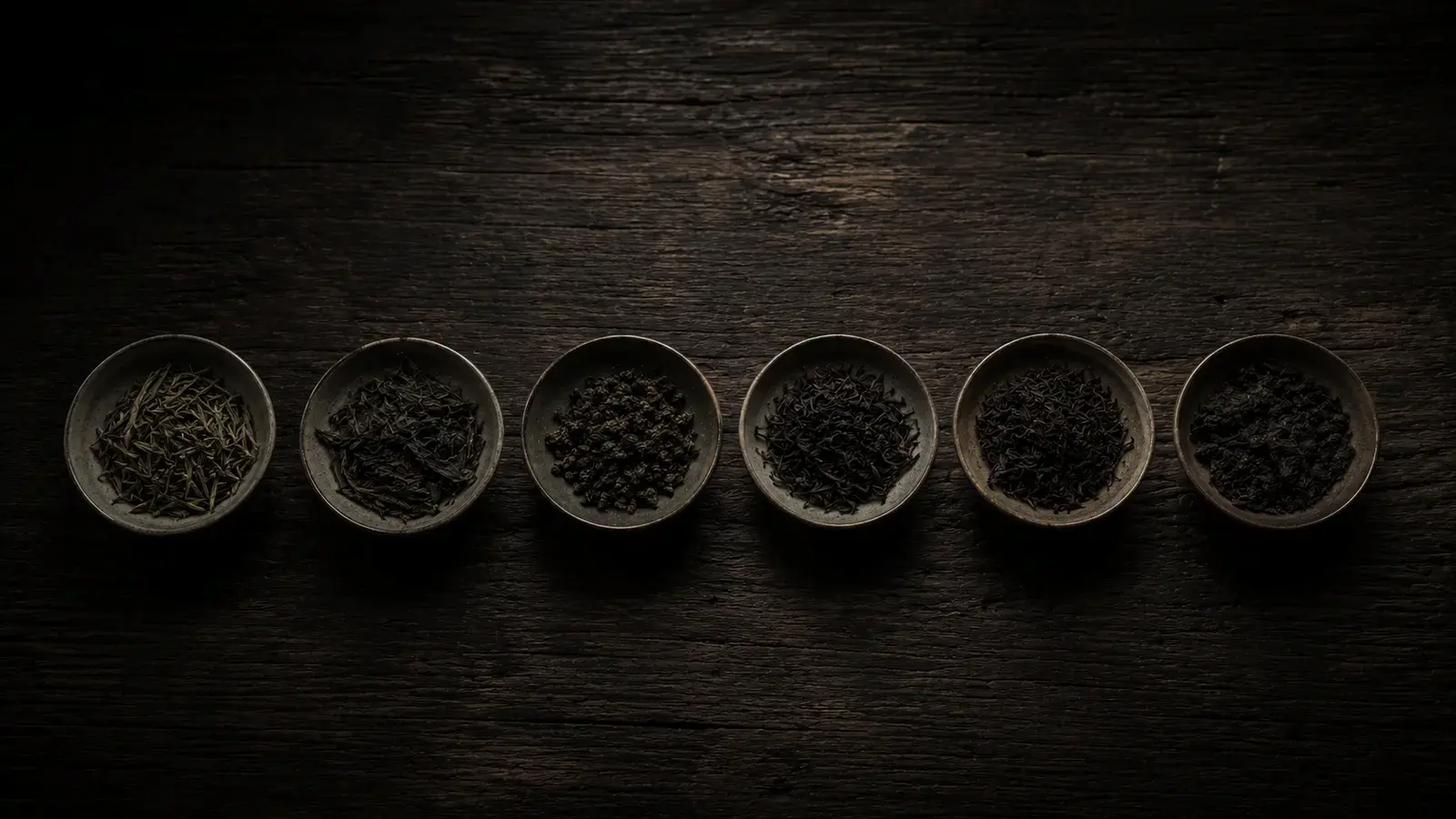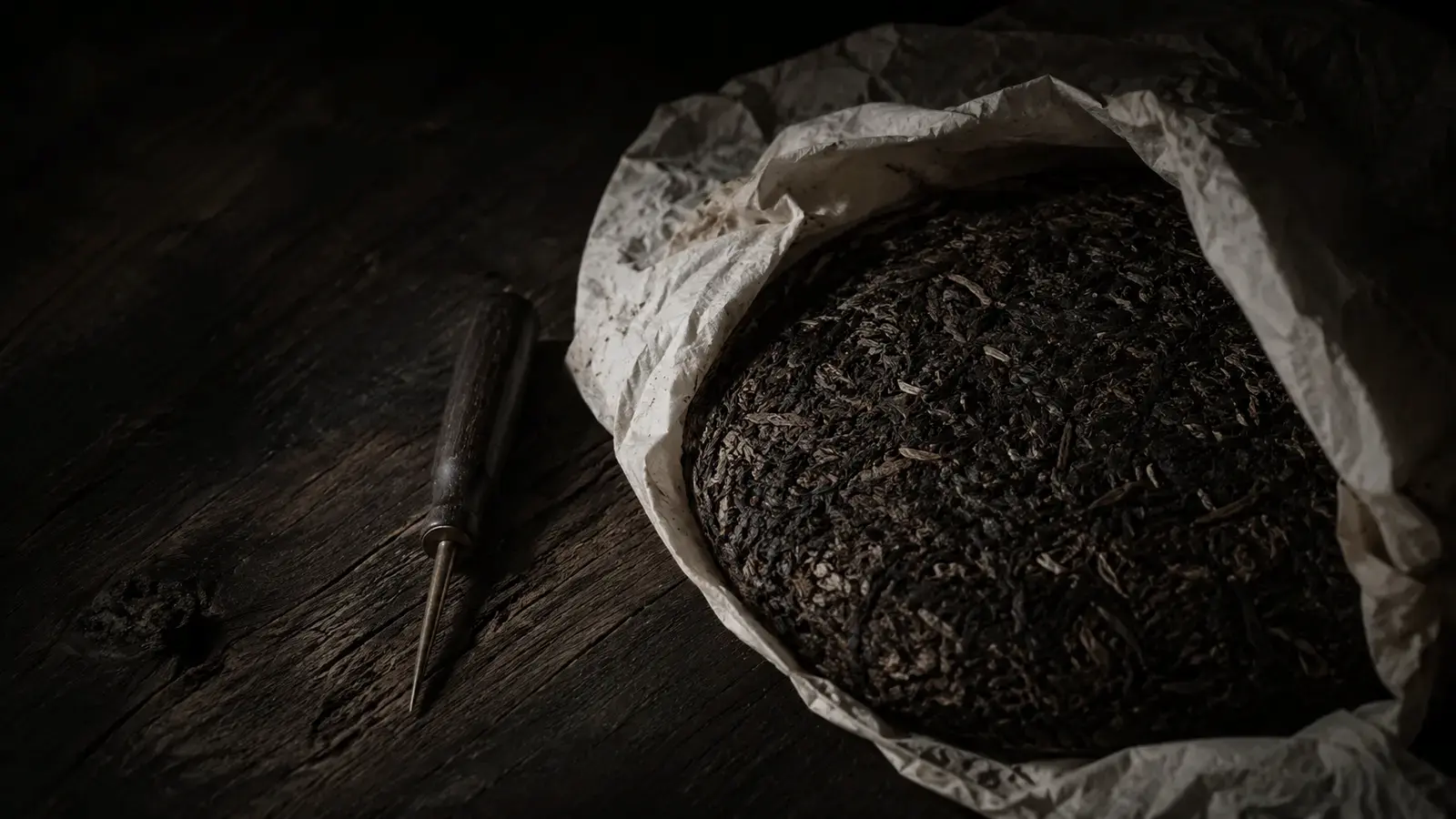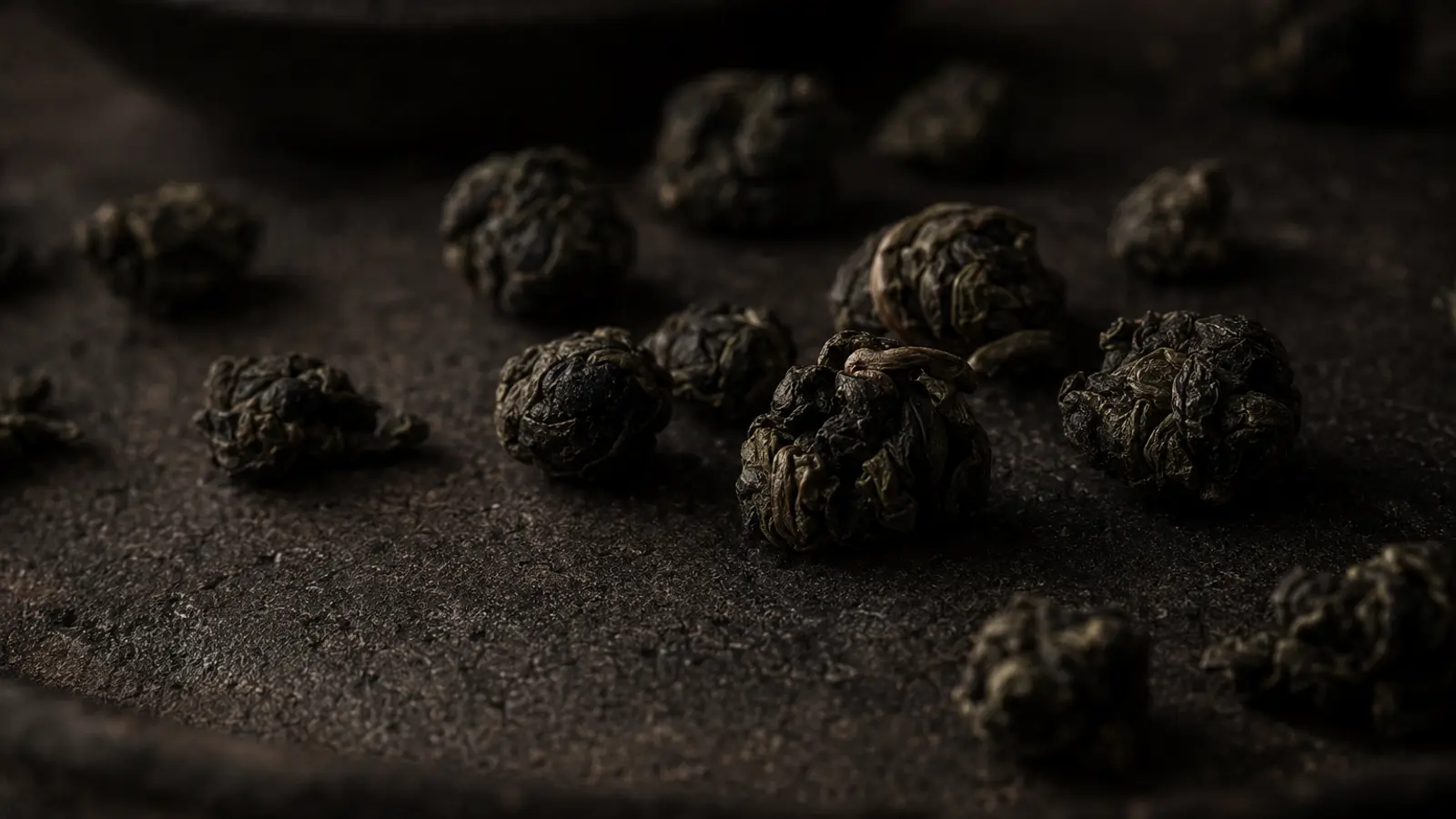
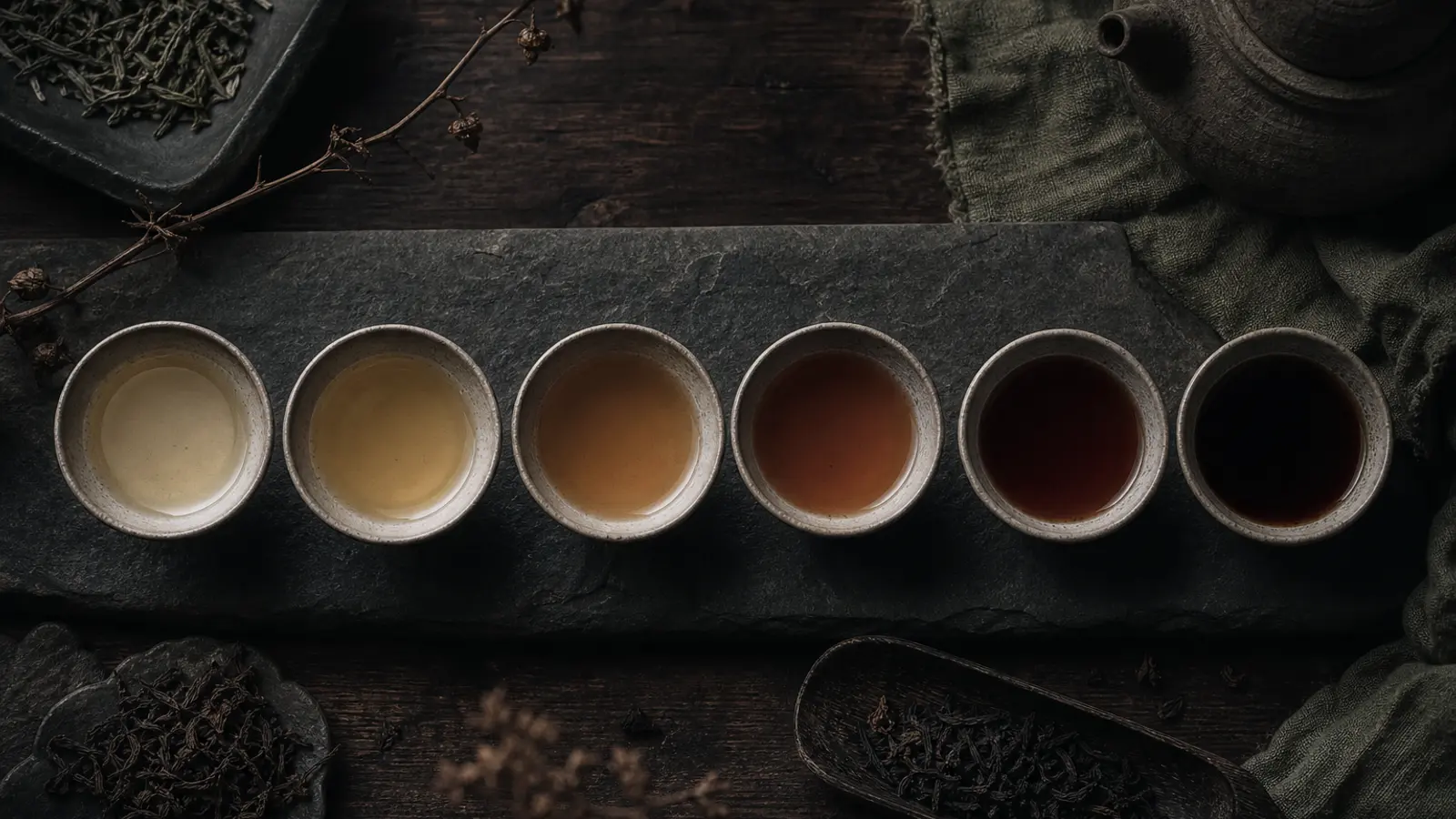
A heavily roasted Tieguanyin (铁观音) and a ripe shou pu-erh (熟普洱) sit in completely different technical categories—one is a partially oxidized Fujianese oolong, the other a post-fermented compressed cake from Yunnan. But they produce nearly identical sensory experiences: thick mouthfeel, chest warmth, a sedating quality that signals the end of a stressful day. They belong together in any practical framework.
Conversely, a Yiwu (易武) sheng pu-erh and a Keemun (祁门红茶) black tea are processed in entirely different ways, but both deliver the same elegant, florally-ascending, long-finishing sensation that feels like it was designed for contemplative drinking. Grouping them by processing tells you nothing useful. Grouping them by feeling tells you everything.
That’s what the Steep Atlas Six Sensory Styles does.
The Six Sensory Styles
Style 1: Clean Freshness
The feeling: A sea breeze moving through a room. Transparent clarity in the cup, light sweetness on the palate, and no residue. You finish a bowl and feel like you’ve opened a window.
How to identify it: The liquor is pale—green-gold, silver, or barely yellow. Aromas are fresh: grass, spring rain, white flowers, oceanic minerals. The aftertaste is clean and brief. There’s no coating on the tongue. The overall effect is energizing without being stimulating.
Representative teas:
- Longjing (龙井) — West Lake Dragon Well, flat-pan-fried green with a distinctive chestnut note underneath the vegetal freshness
- Japanese sencha (煎茶) — especially fukamushi-style, with sea-green depth
- Silver Needle (白毫银针) — white tea made from unopened buds, pure and almost crystalline
- High-mountain oolong (高山烏龍) — Taiwan’s Lishan or Alishan above 1,500m, where cold nights concentrate clarity
Wine parallel: Chablis Premier Cru, Sancerre. The same mineral transparency, the same sense that the glass is showing you the land rather than the winemaker’s hand.
Try this if you like: Crisp white wine, clean flavors, simplicity. If your instinct at a restaurant is to order the lightest thing on the menu, this is your style.
Style 2: Floral With Long Finish
The feeling: Sweetness that arrives after you swallow, not before. In Chinese tea vocabulary this is hou yun (喉韻)—throat resonance—combined with huigan (回甘), the returning sweetness that blooms in the back of the mouth 30 to 90 seconds after the sip. There’s often a floral quality to the aroma, and an elegance that feels designed rather than raw.
How to identify it: Look for a liquor that seems simple at first and then opens up. The cup may smell of orchid, dried roses, or honey. The mouthfeel is medium, never heavy. The defining sensation is the finish—if the tea keeps giving after you’ve swallowed, you’re in Style 2 territory.
Representative teas:
- Yiwu sheng pu-erh (易武生普洱) — the classic example; soft entry, pronounced huigan, long throat resonance
- Jingmai sheng pu-erh (景迈生普洱) — honey and wild orchid notes from old arbor trees near the forest edge
- Dongfang Meiren (東方美人) — Taiwanese bug-bitten oolong with muscatel and stone fruit, extraordinary finish
- Keemun black tea (祁门红茶) — the “Burgundy of tea,” with rose, dried fruit, and a finish that extends well beyond the cup
Wine parallel: Red Burgundy, Mosel Riesling. The defining characteristic isn’t power but length and elegance—what the French call longueur en bouche.
Try this if you like: Pinot Noir, aromatic whites, wines where elegance matters more than impact. If you prefer finesse to force, this style will reward you.
Style 3: Intense Power and Reversal
The feeling: Bitterness that hits immediately and completely—then, as if a switch flips, transforms into explosive sweetness. This is huigan (回甘) in its most dramatic form. The bitterness isn’t unpleasant; it’s the setup for the payoff. There’s an overwhelming physical presence, often felt in the temples, chest, and jaw.
How to identify it: The liquor is often deep gold or amber. The aroma is complex, sometimes mushroomy or mineral. The first sip may make you pause—it’s a lot. But hold it on your tongue, swallow slowly, and wait. Within 20 to 40 seconds, the reversal happens. That’s the point.
Representative teas:
- Lao Ban Zhang (老班章) — the most famous bitter-power tea in the world; dense bitterness followed by long, sweet huigan and strong qi (氣)
- Lao Man’e (老曼峨) — even more bitter than Lao Ban Zhang, prized by drinkers who want the full reversal experience
- Da Hong Pao (大红袍) — Wuyi yan cha (武夷岩茶) with mineral power, deep roasted complexity, and a bitterness that resolves into sweetness
- Assam (阿萨姆) — the malt and tannin structure of a well-made Assam has its own version of this dynamic, especially in second flush
Wine parallel: Barolo, Hermitage. Nebbiolo’s tannin structure with that famous “tar and roses” reversal is exactly the tea parallel. Syrah from the Northern Rhône has the same combination of severity and payoff.
Try this if you like: Nebbiolo, Syrah, big red wines with tannin structure. If you think bitterness is interesting rather than something to avoid, this style was built for you.
Style 4: Soft Depth
The feeling: Thickness in the mouth—what the Chinese call hou du (厚度), meaning depth or body—combined with warmth in the chest and a gentle sedative quality. This style doesn’t demand attention. It rewards it. After a session with a Soft Depth tea, you feel settled. Stress relief is not a side effect; it’s the primary function.
How to identify it: The liquor is medium to deep in color—amber, garnet, or dark chestnut. The mouthfeel is noticeably viscous, coating the tongue without being heavy. Flavors lean toward earth, dried fruit, wood, leather, and sometimes chocolate. There’s almost no sharp edge anywhere in the cup.
Representative teas:
- Shou pu-erh (熟普洱) — the archetype; wet-piled post-fermented tea with an earthy warmth that has no equivalent elsewhere
- Liu Bao (六堡茶) — Guangxi dark tea with a distinctive pine and wood quality, excellent aged
- Zhengshan Xiaozhong (正山小种) — Lapsang Souchong’s ancestor, smoky and fruited with genuine depth
- Tieguanyin (铁观音) — traditionally roasted versions, not the modern green style, deliver exactly this comfort and warmth
Wine parallel: Pomerol, aged Rioja. The plush, comfortable, deep-earth quality of Merlot-dominant Bordeaux. Not exciting in an intellectual sense; deeply satisfying in a physical one.
Try this if you like: Merlot-based Bordeaux, comfort wines, wine as relaxation rather than analysis. This is the style for evenings, not mornings.
Style 5: Wild Energy
The feeling: Cha qi (茶氣) that moves through the body—sometimes a warmth spreading from the chest outward, sometimes a slight tingling in the limbs, occasionally a calm alertness that doesn’t feel like caffeine. There’s a wildness to the flavor: forest floor, hay, ancient wood, something almost animal. This style has what some drinkers call shan ye qi yun (山野气韵)—the resonance of mountain wilderness.
How to identify it: The liquor is often turbid, unfiltered-looking. Aromas are feral—mushrooms, bark, dried herbs, forest after rain. The cup tastes like it was made somewhere without electricity. The qi effect is usually felt by steep three or four, and it’s unmistakable once you’ve experienced it.
Representative teas:
- Gushu sheng pu-erh (古树生普洱) — old-arbor single-origin raw pu-erh, especially from remote areas where farming practices haven’t changed; the qi is the main event
- Wild tea (野生茶) — semi-wild or fully wild-collected tea from forests in Yunnan or Burma, where the trees are decades or centuries old
- Wild dancong (野生单丛) — from Phoenix Mountain’s (凤凰山) least-cultivated bushes; the varietals with forest and honey notes
- Kokang pu-erh (果敢普洱) — material from Myanmar’s Kokang region, which behaves like old-Yunnan with even more primal energy
Wine parallel: Natural wine, old-vine Grenache. The same funky, unfiltered, terroir-expressive character. The appeal is precisely the parts that don’t conform.
Try this if you like: Natural wine, skin-contact whites, pét-nat, any wine that tastes like the person who made it had strong opinions about not intervening. This style rewards drinking slowly with attention.
Style 6: Depth of Time
The feeling: Chen xiang (陳香)—the aroma of aging—combined with a softness that only comes from years in storage. The sharp edges of youth have been rounded by time. Bitterness has become sweetness; astringency has become texture; simplicity has become complexity. This style requires patience to collect and rewards patience when you drink it.
How to identify it: The liquor is deep amber to dark garnet. The aroma has a distinctive aged quality—dried wood, camphor, old books, dark dried fruit, sometimes a medicinal note that is entirely pleasant. The mouthfeel is smooth and the finish is long. Nothing about it rushes.
Representative teas:
- Aged sheng pu-erh (陈年生普洱) — 10+ year cakes that have undergone slow, dry-stored transformation; the difference between a 3-year and a 15-year cake is roughly the difference between a Beaujolais Nouveau and a 1996 Burgundy
- Aged yan cha (陈年岩茶) — Wuyi rock oolong stored for 5–10+ years; the roast integrates, the minerality deepens
- Seven-plus-year shoumei (寿眉) — aged white tea pressed into cakes; shoumei ages beautifully and develops a date-fruit depth that makes people question what they thought white tea was
Wine parallel: Aged Barolo, vintage Port. The whole point is the time. Drinking a young wine from this category—or a pu-erh cake before it’s ready—misses the point of why it exists.
Try this if you like: Aged wine, cellar character, complexity from patience. If you’ve kept wine to see what happens, you already understand this style. The only difference is the format.
How to Use This Framework
These six styles aren’t walls. A single session of aged Lao Ban Zhang might give you Intense Power and Reversal in steep one, shift toward Wild Energy in steep four, and land in Depth of Time by steep eight as the character evolves. Tea is not static.
But as a starting map, the Six Sensory Styles does something useful: it tells you where to begin.
If you’re new to tea, start with Clean Freshness or Soft Depth. Both styles are approachable, forgiving in the cup, and pleasurable without requiring a developed palate. A good Longjing brewed in a gaiwan (蓋碗) at 80°C with 4g of leaf to 100ml of water and a 30-second steep is one of the most immediately satisfying things you can put in a cup.
If you drink wine regularly, use your wine preferences as a calibration tool. The parallels are honest—not decorative. The same palate preferences that draw someone to Chablis over Chardonnay tend to draw them to clean, mineral tea over rich, oxidized styles.
If you already drink tea but feel stuck, identify which style you’ve been living in and try the adjacent one. Soft Depth drinkers often find that Wild Energy teas are the revelation they didn’t know they needed. Intense Power drinkers sometimes find that Depth of Time is where they were always heading.
For deeper exploration, brew the same tea across multiple parameters—water temperature, leaf weight, steep time, vessel—and notice which style it expresses most clearly. Tea is not fixed to one style; how you brew it shapes where it lands. Learning to brew with intention is how this framework moves from map to practice.
A Note on the Framework Itself
The Steep Atlas Six Sensory Styles was developed by mapping tea experiences against consistent sensory markers rather than chemical profiles. It doesn’t replace technical knowledge—understanding why a Yiwu tastes the way it does requires knowing about the region, the processing, the storage. But it provides an entry point that technical knowledge often doesn’t: a felt sense of what you’re looking for before you know the vocabulary to ask for it.
If you bring someone into serious tea by asking them what they like to drink—wine, coffee, whisky, nothing—you can place them in a style immediately. That’s the practical purpose. Use it as a compass, not a cage.