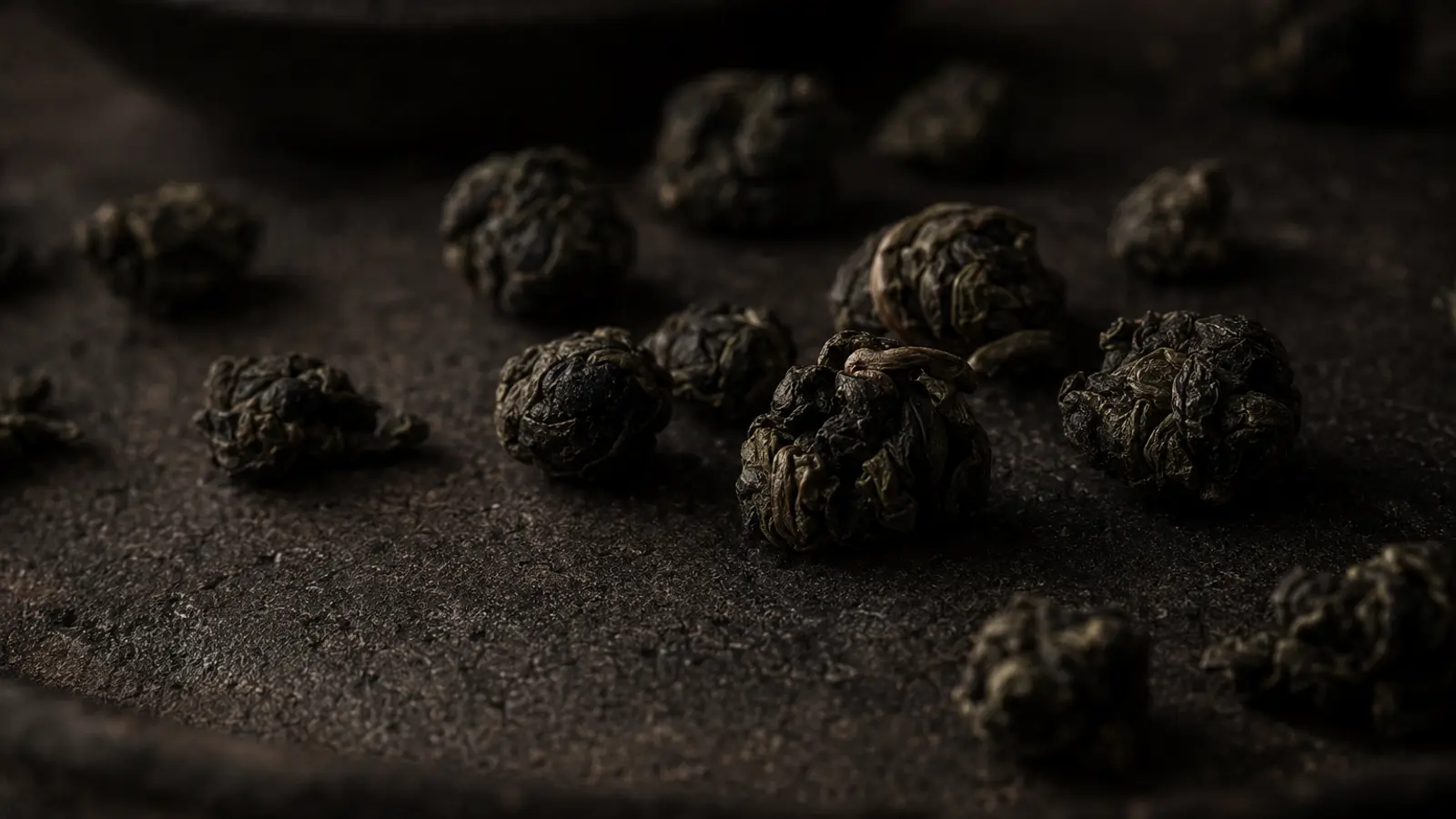
Oolong tea (烏龍茶) is a partially oxidized tea that falls between green and black on the processing spectrum, with oxidation levels ranging from roughly 15% to 85%. That range produces everything from light, floral Taiwanese high mountain teas to dark, roasted Wuyi cliff oolongs — the broadest flavor spectrum of any single tea category.
Oolong occupies the vast, unruly middle of the tea processing spectrum. The name itself — wu long (乌龙), literally “black dragon” — hints at something untamed, and the category delivers on it. Oolong oxidation ranges from 15% to 80%, which means the word covers teas that taste as different from each other as a Riesling does from a Cabernet. A single category label hides more diversity than the gap between some entirely separate tea types.
A lightly oxidized Taiwanese high-mountain oolong from 1,800 meters elevation is ethereal — orchid, cream, cool mountain air. A heavily roasted Wuyi yan cha from a cliff-side garden in Fujian is dark mineral depth — charcoal, stone, wet rock after rain. A Phoenix Mountain dancong from a single bush in Guangdong is an aromatic hallucination — one tree producing tea that smells exactly like gardenias, another like almonds, a third like ginger flowers. All three are oolong. All three are partial oxidation. None of them taste remotely alike.
Understanding oolong means understanding oxidation as a creative tool. The tea maker decides when to stop the leaf’s transformation, and that decision — that precise moment of intervention — is what defines the tea more than origin, cultivar, or any other variable. Oolong is the maker’s category. The grape is the same. The winemaking is everything.
How Oolong Is Made
Oolong production follows a sequence that looks simple on paper and takes years to master in practice.
Withering (wei diao, 萎凋). Fresh leaves are spread in sunlight or under warm air to begin losing moisture and softening the cell structure. Duration varies — a few hours for light oolong, longer for heavier styles. The withering begins chemical changes that set up the oxidation step.
Bruising (yao qing, 摇青). This is the step that makes oolong oolong. The wilted leaves are shaken, tossed, or tumbled — traditionally in bamboo baskets — to bruise the leaf edges while keeping the center intact. The bruised edges oxidize. The intact center stays green. This differential oxidation creates the complexity that defines the category: aromatic compounds from the oxidized edges, freshness from the preserved center.
The bruising is repeated multiple times over hours, with resting periods between rounds. Each round increases the oxidation level. The tea maker monitors the leaves by smell, touch, and visual inspection — judging when to stop based on the aromatic development and the degree of reddening at the leaf edges. There is no timer for this. It’s judgment. It’s skill. It’s gongfu in the original sense of the word.
Kill-green (sha qing, 杀青). When oxidation reaches the target level, heat is applied to halt the enzymes. The moment of kill-green determines the final oxidation percentage — and therefore the character of the finished tea. Fifteen percent produces a floral, green-leaning oolong. Fifty percent produces a rich, complex, amber tea. Eighty percent approaches black tea territory with roasted depth. The maker chooses.
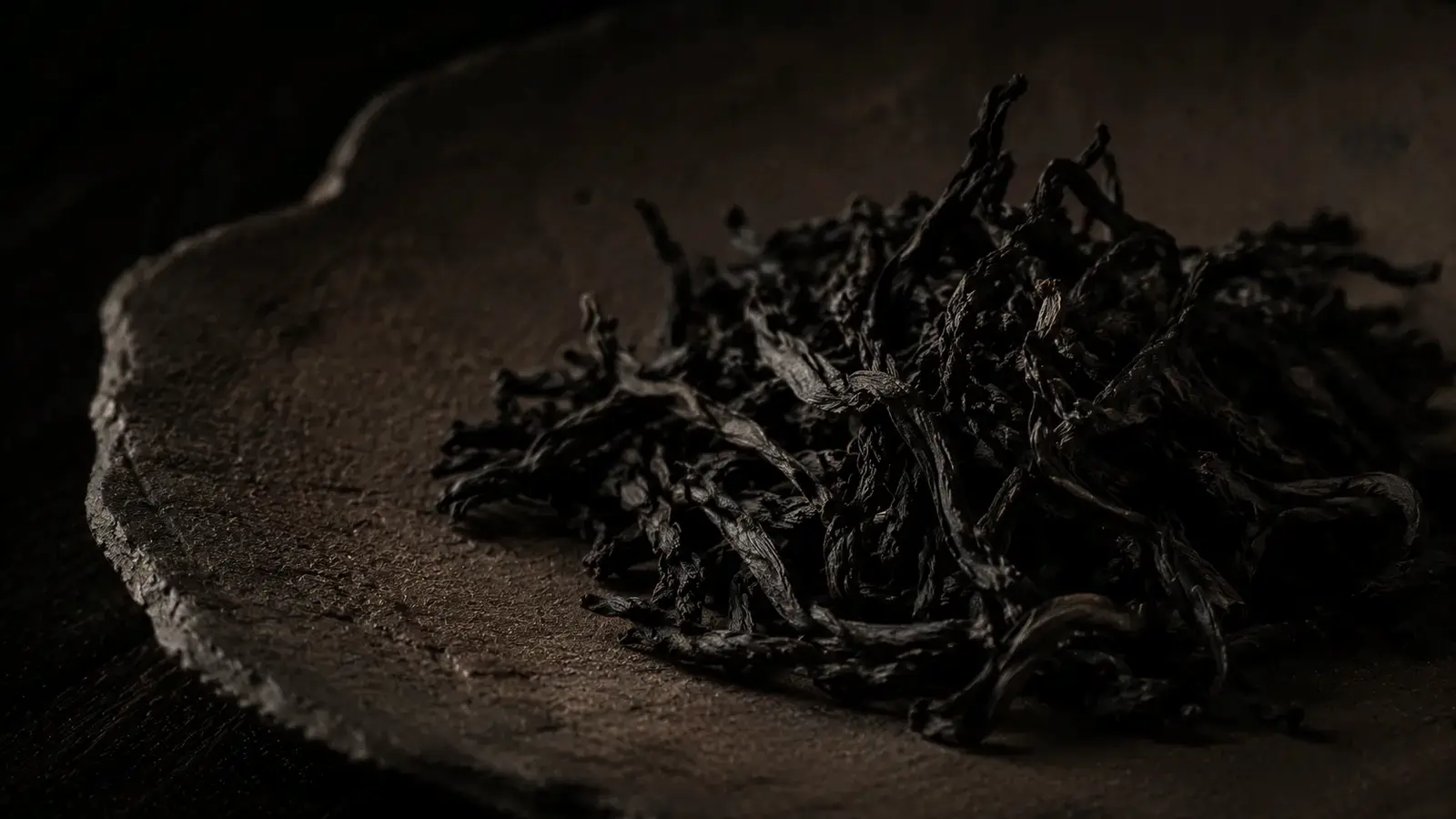
Rolling and shaping. The leaves are rolled — either into tight balls (the signature shape of Taiwanese and Anxi oolongs) or left as twisted strips (Wuyi yan cha, dancong). Ball-rolling is intensive: the leaves are repeatedly rolled in cloth bags, compressed, and re-rolled over hours or days until they form dense pellets that unfurl slowly during brewing. Strip-style oolongs are rolled once and dried.
Roasting (hong bei, 烘焙). Optional but defining for certain styles. Wuyi yan cha undergoes multiple rounds of slow charcoal roasting over weeks or months. The roasting transforms the tea — adding layers of toasted grain, caramel, and mineral depth on top of the oxidation-derived character. Lighter oolongs (Taiwanese high-mountain, some Tieguanyin) receive minimal or no roasting, preserving the floral and creamy character that roasting would overwrite.
The entire process can take 24-72 hours from picking to finished tea, depending on the style. That’s longer than any other tea type except dark tea’s fermentation. The extended timeline reflects the degree of control and judgment involved.
The Four Sub-Families
Oolong’s diversity organizes into four sub-families, each with distinct character, terroir, and production tradition.
1. Taiwanese High-Mountain Oolong
Oxidation: 15-25%. Roasting: Minimal or none.
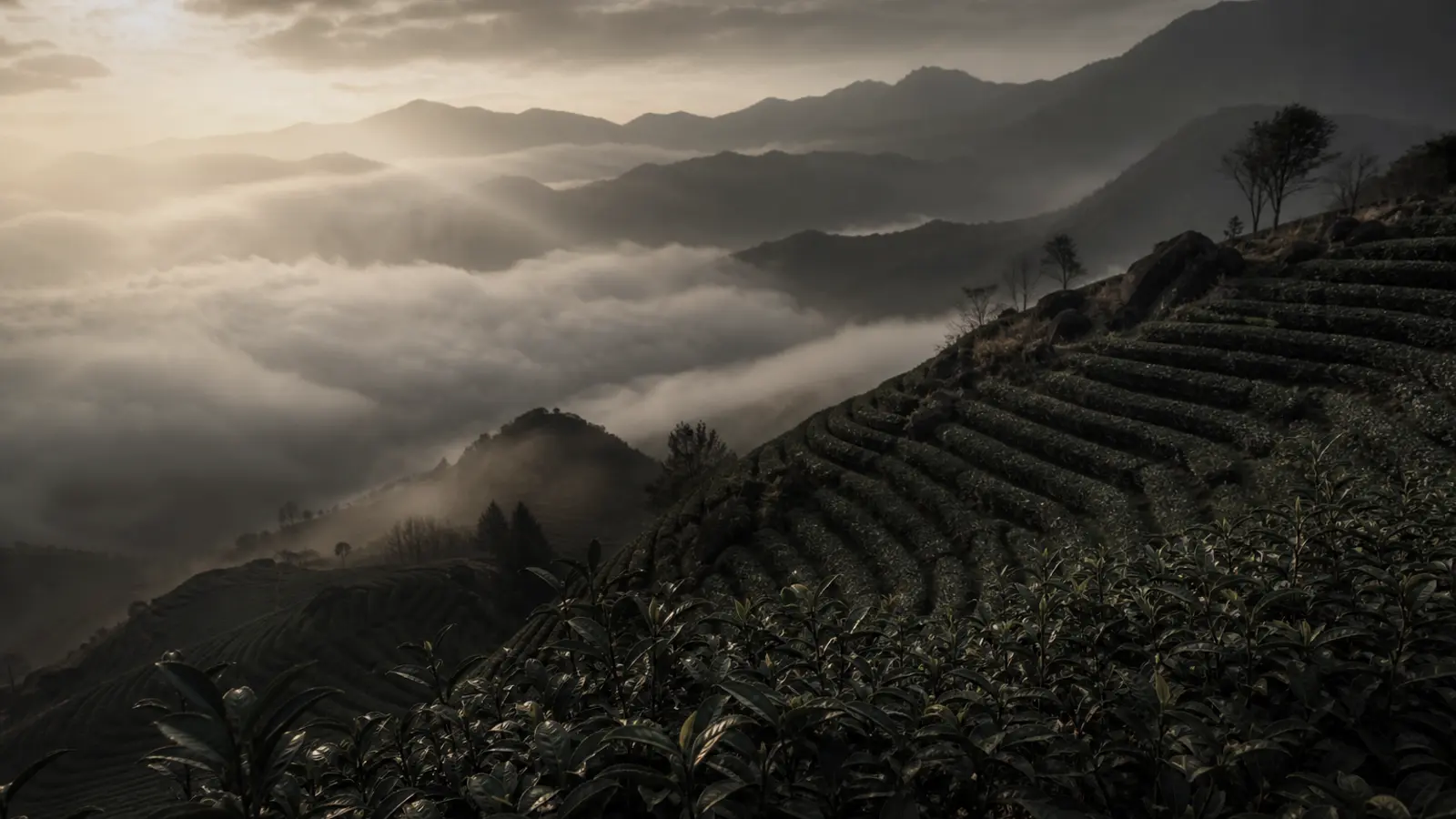
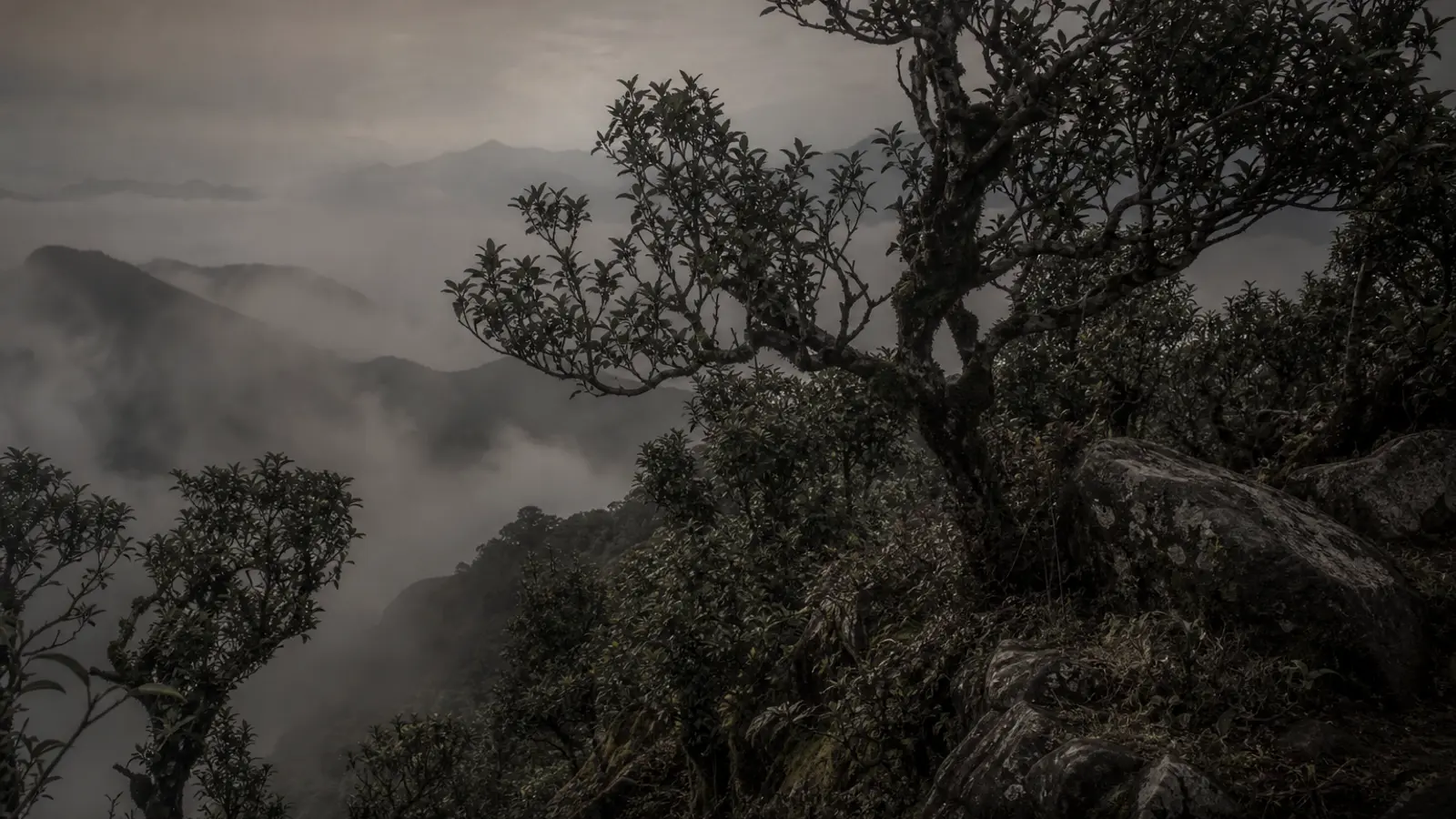
Grown above 1,000 meters — and the best above 1,500 meters — in Taiwan’s Central Mountain Range. The elevation creates cool nights and frequent fog that slow the leaves’ growth, concentrating amino acids and volatile aromatics. The result is a tea of extraordinary delicacy: floral (orchid, lily), creamy (milk, butter), and cool (mint, mountain air). The liquor is pale gold and crystalline. The body is light but not thin — there’s a silky texture that carries the aromatics.
Key growing areas: Ali Shan (阿里山, 1,200-1,600m), Shan Lin Xi (杉林溪, 1,600-1,800m), Li Shan (梨山, 1,800-2,400m), Da Yu Ling (大禹嶺, 2,400m+ — the highest commercially produced tea in Taiwan). Elevation correlates directly with price and perceived quality, though skill matters as much as altitude.
The processing tradition emphasizes restraint — light oxidation, minimal roasting, and ball-rolling that preserves the leaf’s natural aromatics rather than transforming them. The maker’s goal is transparency: let the mountain speak.
Wine parallel: high-mountain Taiwanese oolong is like Mosel Riesling from steep slate slopes — crystalline purity, mineral-driven, delicate but persistent, the terroir is the story.
Brewing: 90-95°C. 6-7g per 100ml. The tightly rolled balls need a few steeps to open — patience through steeps 1-2 rewards with a peak at steeps 3-6 where the floral aromatics are at their most expressive. Expect 8-15 steeps from quality material.
2. Wuyi Yan Cha (Rock Oolong)
Oxidation: 50-75%. Roasting: Heavy charcoal, multiple rounds.
The Wuyi Mountains (武夷山) in northern Fujian province produce oolong from an entirely different philosophy. Where Taiwanese high-mountain oolong pursues delicacy, Wuyi yan cha (岩茶, rock tea) pursues depth. The volcanic Danxia landform — ancient rhyolite and sandstone weathered into dramatic cliffs and narrow gorges — creates a terroir defined by rock. Tea grown in the core canyon area (zheng yan, 正岩, “true rock”) develops a mineral character called yan yun (岩韵, rock rhyme) — a stony, wet-rock sensation in the mouthfeel that no other tea region on earth produces.
The famous cultivars: Da Hong Pao (大红袍, Big Red Robe) — the most iconic, with toasted grain, caramel, and an orchid sweetness that emerges behind the roast. Rou Gui (肉桂, Cinnamon) — spicy, sharp, intensely aromatic. Shui Xian (水仙, Water Sprite) — thick, smooth, the workhorse cultivar. Tie Luo Han (铁罗汉, Iron Arhat) — one of the original Four Famous Bushes.
I drink Da Hong Pao as a regular work tea. The mineral backbone is what holds my attention — the highest mineral character of any tea I’ve evaluated. There’s a density to the mouthfeel that the Chinese term yan gu (岩骨, “rock bone”) captures precisely — a structural weight in the liquor that lighter oolongs don’t carry. The roast contributes toasted grain and caramel on the front, but the mineral emerges in the mid-palate as something geological, something the mountain deposited in the leaf before any processing began.
Roasting is central to yan cha identity. After oxidation, the tea undergoes charcoal roasting (tan bei, 炭焙) — sometimes three to five separate roasting sessions spread over weeks. The roast level ranges from qing xiang (清香, “light fragrance” — minimal roasting, more floral) to zu huo (足火, “full fire” — heavy roasting, deep and dark). Heavy-roasted yan cha needs 6-12 months of rest after production for the fire to settle (tui huo, 退火). Drinking it too soon is like opening a wine before it’s integrated.
Wine parallel: Wuyi yan cha is the Mosel’s opposite — where Mosel Riesling is about transparent delicacy, yan cha is about opaque depth. The rock terroir is the common thread but the expression is inverted. If anything, yan cha maps more closely to Priorat or volcanic Etna Rosso — mineral wines from rocky, dramatic landscapes where the geology is audible in the glass.
Brewing: 95-100°C. 6-7g per 100ml. Yan cha opens fast — the first steep is already substantive. Expect 8-12 steeps, with the roast character fading through the session to reveal the mineral underneath. The late steeps of quality yan cha are often the most interesting — the roast has receded and the pure terroir character shows.
For the Da Hong Pao deep-dive: Da Hong Pao: A Guide to Wuyi Rock Oolong. For the Wuyi terroir profile: Wuyi Mountains: Where Rock Becomes Tea.
3. Anxi Oolong (Tieguanyin and Kin)
Oxidation: 15-50%, depending on style. Roasting: None to moderate.
Anxi (安溪) county in southern Fujian is the birthplace of Tieguanyin (铁观音, Iron Goddess of Mercy) — arguably the most widely consumed oolong in China and the tea that introduced millions of Chinese drinkers to the category.
Two distinct styles compete within Anxi: Modern Tieguanyin (qing xiang, 清香, “fresh fragrance”) — light oxidation (15-25%), no roasting, bright green color, floral and butter-cream aromatics. This style dominated the market from the 2000s to the 2010s. Traditional Tieguanyin (chuantong, 传统) — medium oxidation (30-50%), some roasting, amber color, warmer and more complex with caramel, orchid, and toasted grain. A backlash against the modern style is underway, with traditional Tieguanyin regaining prestige among serious drinkers.
The Tieguanyin cultivar itself (hong xin Tieguanyin, 红心铁观音) is a specific clone that’s slow-growing and difficult to process but capable of remarkable orchid-like aromatics. Much commercial Tieguanyin is made from related but different cultivars (Mao Xie, Ben Shan, Huang Jin Gui) that are easier to grow and process. Distinguishing genuine cultivar Tieguanyin from substitute-cultivar Tieguanyin is a skill that takes experience.
Wine parallel: Anxi oolong is the Sancerre of tea — light, floral, immediately accessible, extremely popular, sometimes dismissed by connoisseurs as too simple but capable of genuine depth from old-bush material and skilled making.
Brewing: 90-95°C for modern style, 95-100°C for traditional style. 6-7g per 100ml. Ball-rolled Tieguanyin needs 2-3 steeps to fully open. Expect 8-12 steeps from quality material.
4. Guangdong Dancong
Oxidation: 50-70%. Roasting: Light to moderate.
Phoenix Mountain (feng huang shan, 凤凰山) in Guangdong province produces the most aromatically extraordinary oolong on earth. Dancong (单丛) means “single bush” — and the name is literal. Individual trees in the Phoenix Mountain gardens produce unique aromatic identities. One tree’s tea smells like gardenias. The neighboring tree smells like almonds. A third smells like aged osmanthus. These aren’t added flavors — they’re natural aromatic compounds expressed by specific genetic clones growing in specific micro-terroirs.
The major aroma types include: mi lan xiang (蜜兰香, honey orchid — the most famous and accessible), ya shi xiang (鸭屎香, “duck shit aroma” — a deliberately off-putting name for an extraordinarily floral tea), gui hua xiang (桂花香, osmanthus), xing ren xiang (杏仁香, almond), jiang hua xiang (姜花香, ginger flower), and others. Each represents a distinct cultivar or clone within the Phoenix Mountain gardens, maintained by local families over generations.
Dancong is high-wire brewing. The aromatic volatiles release rapidly — the first steep should be 5-8 seconds, not the 10-15 you’d use for most oolongs. Oversteep a dancong and the astringency will overpower the aroma that made it worth drinking. Respect the speed. The reward is a tea that changes your understanding of what leaves can express.
Wine parallel: dancong is like single-vineyard Grüner Veltliner or old-vine Trousseau — intensely site-specific, aromatically unique, produced in small quantities by dedicated families, and unknown to most of the drinking world. Discovering dancong is discovering that tea has more aromatic range than you imagined possible.
Brewing: 95-100°C. 7-8g per 100ml. Very short first steeps (5-8 seconds). Fast extraction. Expect 10-15 steeps from quality material — the aroma shifts across the session in ways that no other oolong type replicates.
The Korean Connection: Hwangcha
Korean hwangcha (황차) occupies the border between green tea and oolong. Made by allowing partial oxidation (10-40%) before pan-firing, hwangcha is warmer, softer, and less astringent than Korean green tea — with honey and stone fruit notes that neither green tea nor full oolong produces.
Hwangcha is not technically classified as oolong in the Chinese six-type system — it undergoes partial oxidation but through a different technique (natural withering rather than the deliberate bruising that defines oolong). But functionally, it lives in the same sensory space: the middle ground between green’s brightness and darker tea’s depth.
For tea drinkers exploring oolong, Korean hwangcha is an interesting lateral move — a different culture’s approach to the same oxidation range, producing something that resembles light oolong in character but arrives there through a different processing path.
Full guide: Hwangcha: Korea’s Forgotten Yellow Tea.
Brewing Oolong: The Method Matters More Here
Oolong is the category where gongfu brewing is not optional — it’s essential. The multi-steep progression IS the oolong experience. A single Western-style brew of quality oolong captures perhaps 30% of what the tea has to offer. The remaining 70% — the evolution from floral to mineral to sweet across a dozen steeps — requires the gongfu approach.
Quick reference:
| Sub-family | Leaf/100ml | Temp | First Steep | Steeps |
|---|---|---|---|---|
| Taiwanese high-mountain | 6-7g | 90-95°C | 15-20s (needs time to open) | 8-15 |
| Wuyi yan cha | 6-7g | 95-100°C | 8-10s | 8-12 |
| Anxi Tieguanyin | 6-7g | 90-100°C | 10-15s | 8-12 |
| Dancong | 7-8g | 95-100°C | 5-8s (fast — don’t oversteep) | 10-15 |
| Korean hwangcha | 4-5g | 80-85°C | 15-20s | 5-8 |
The dancong row is the one to pay attention to. Dancong punishes hesitation. If your first steep is 15 seconds instead of 8, the astringency will overpower the aroma. Pour fast.
Why Oolong Rewards Patience
Every tea type has depth. But oolong has a specific kind of depth that others don’t — it changes within a single session more dramatically than any other category. The first steep of a high-mountain Taiwanese oolong is orchid and cream. The fifth steep is stone fruit and mineral. The tenth steep is clean sweetness with a faint echo of the orchid from steep one. That arc — that evolution from pour to pour — is what makes oolong the tea type that converts casual drinkers into obsessives.
If you’ve ever opened a bottle of wine and noticed how it changed in the glass over an hour — more fruit at first, then earth, then something harder to name — oolong does the same thing, except you get fifteen discrete snapshots instead of one continuous evolution. Each steep is a frozen moment. The progression tells the story.
The terroir guide covers why origin matters across all tea types. For oolong, the origin story is particularly loud — Wuyi’s volcanic rock, Phoenix Mountain’s ancient single-bush gardens, Taiwan’s cold mountain fog. The geology speaks through the cup in oolong more clearly than in almost any other category.
Frequently Asked Questions
What does oolong tea taste like?
That depends entirely on which oolong. Light Taiwanese high-mountain oolong tastes like orchid and cream. Heavy-roasted Wuyi Da Hong Pao tastes like toasted grain and wet stone. Dancong oolong can taste like gardenias, almonds, or ginger flowers — each tree is different. Oolong spans a wider flavor range than any other tea type. Asking “what does oolong taste like?” is like asking “what does wine taste like?” — the only honest answer is: it depends.
Is oolong tea caffeinated?
Yes. Oolong caffeine content varies with oxidation level and brewing method but generally falls in the moderate-to-high range — roughly 30-60mg per cup in gongfu brewing. Heavier-oxidized oolongs (yan cha, dancong) tend slightly higher. In gongfu brewing, the first 2-3 steeps contain the bulk of the caffeine. Later steeps are progressively lighter.
Is oolong green tea or black tea?
Neither. Oolong is its own category — partially oxidized tea that sits between green (no oxidation) and black (full oxidation). The lightest oolongs lean toward green tea character. The heaviest oolongs lean toward black tea character. But the partial oxidation and the bruising technique that creates differential edge-vs-center oxidation make oolong fundamentally different from both.
What is rock oolong?
Rock oolong — yan cha (岩茶) — is oolong produced in the Wuyi Mountains of Fujian province, where volcanic rock soil creates a mineral character called yan yun (岩韵, rock rhyme). It’s a subset of oolong, not a separate type. The “rock” refers to the terroir, not a flavor additive. The most famous rock oolong is Da Hong Pao. For the full guide: Da Hong Pao: A Guide to Wuyi Rock Oolong.
What is the difference between oolong and green tea?
Processing. Green tea undergoes kill-green immediately after picking — oxidation is halted at near-zero. Oolong is deliberately bruised and allowed to oxidize (15-80%) before kill-green is applied. This oxidation creates the flavor complexity, the darker color, and the aromatic depth that distinguish oolong from green tea. The brewing parameters also differ — oolong generally takes hotter water and rewards more steeps.