Da Hong Pao (大紅袍, Big Red Robe) is the most famous tea from the Wuyi Mountains in Fujian province, and for years I found that fame more intimidating than helpful. Every source led with the mythology — six ancient bushes, imperial tribute, leaves worth more than gold — without explaining what the tea actually tastes like in a cup on a Tuesday morning.
This da hong pao guide is my attempt to fix that. I’ll cover what the tea is, why the terrain matters, how it’s made, what you’re tasting and why, how to brew it well, and how to think about the broader world of Wuyi yan cha (岩茶, rock tea) once you’re ready to explore. I drink da hong pao regularly, including a version from a specialist tea shop in Bangkok that’s become a near-daily work tea. The historical and processing detail draws on solid secondary research, and I’ll note where my direct experience runs out.
What Is Da Hong Pao Tea?
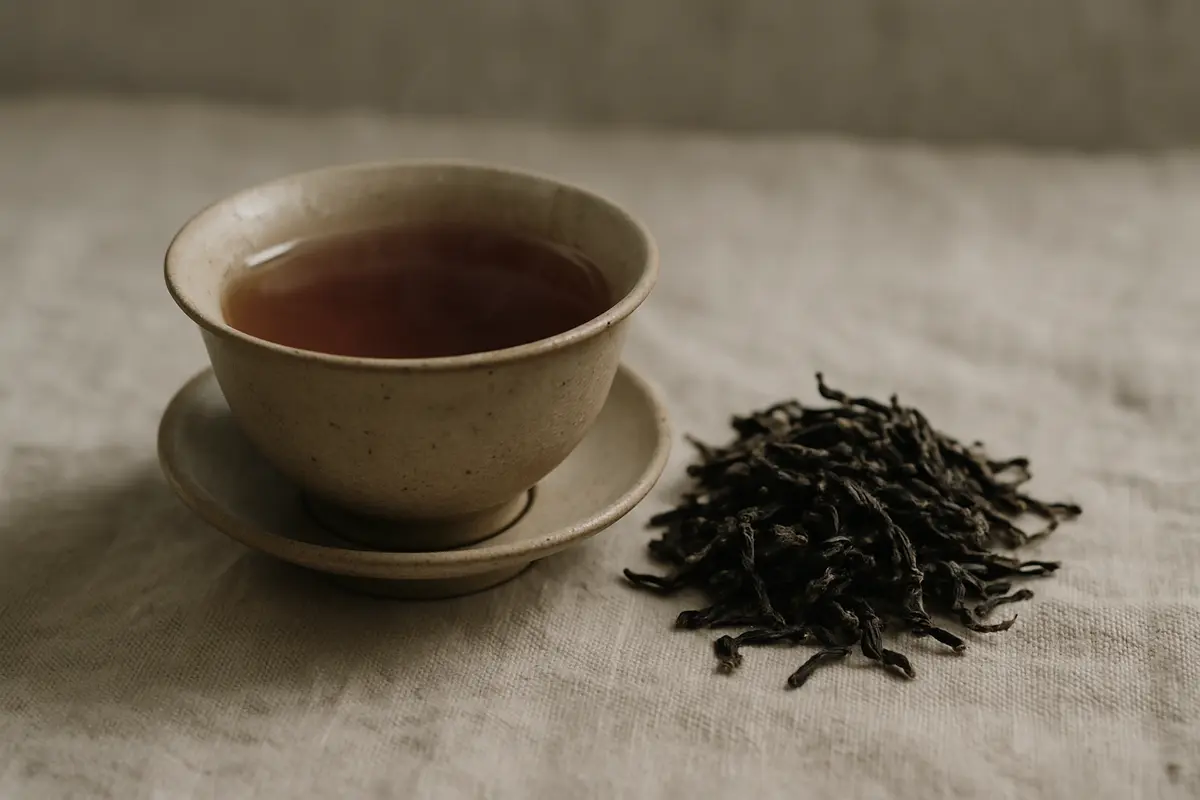
Da Hong Pao is a heavily roasted, partially oxidized oolong tea grown in the Wuyi Mountains (武夷山) of northern Fujian. It belongs to the yan cha family — a group of teas defined by their volcanic rock terroir and intense charcoal roasting.
The name means Big Red Robe, and the origin stories are multiple. The most repeated version involves a scholar who, on his way to imperial examinations, was healed by tea brewed from a particular cliff-face bush. He later covered the bushes in his red robe as an act of gratitude. The story is almost certainly apocryphal, but it captures the tea’s historical gravitas accurately enough.
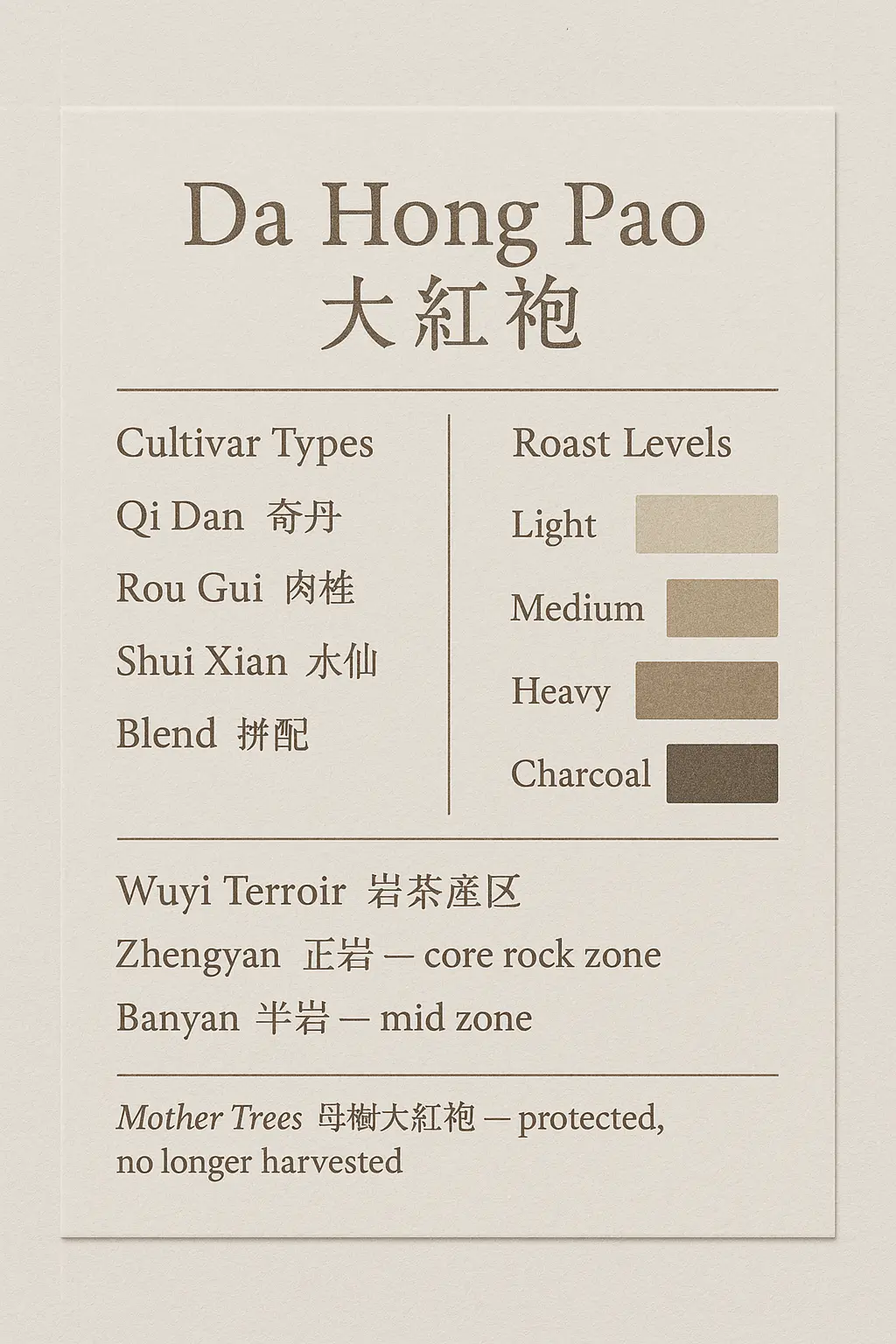
What matters practically: da hong pao is not a single cultivar. It is a type, a style, and historically a blend. The original mother-tree bushes (母树大红袍) are a specific set of six plants growing on a rock face in the Wuyi National Park. Those bushes are now protected and no longer harvested for commercial production — the last time their leaves were auctioned, the price was roughly $1,400 per gram. Commercial da hong pao is a blended product made from premium Wuyi cultivars, most commonly Qi Dan (奇丹), or blends of Rou Gui, Shui Xian, and other yan cha varietals constructed to deliver the flavor profile associated with the style.
This is not a scandal. It’s simply how the category works, and it’s no different from how a négociant assembles a Champagne to hit a consistent house profile year after year.
The Terrain: Why Wuyi Makes Rock Tea
Geology as Flavor
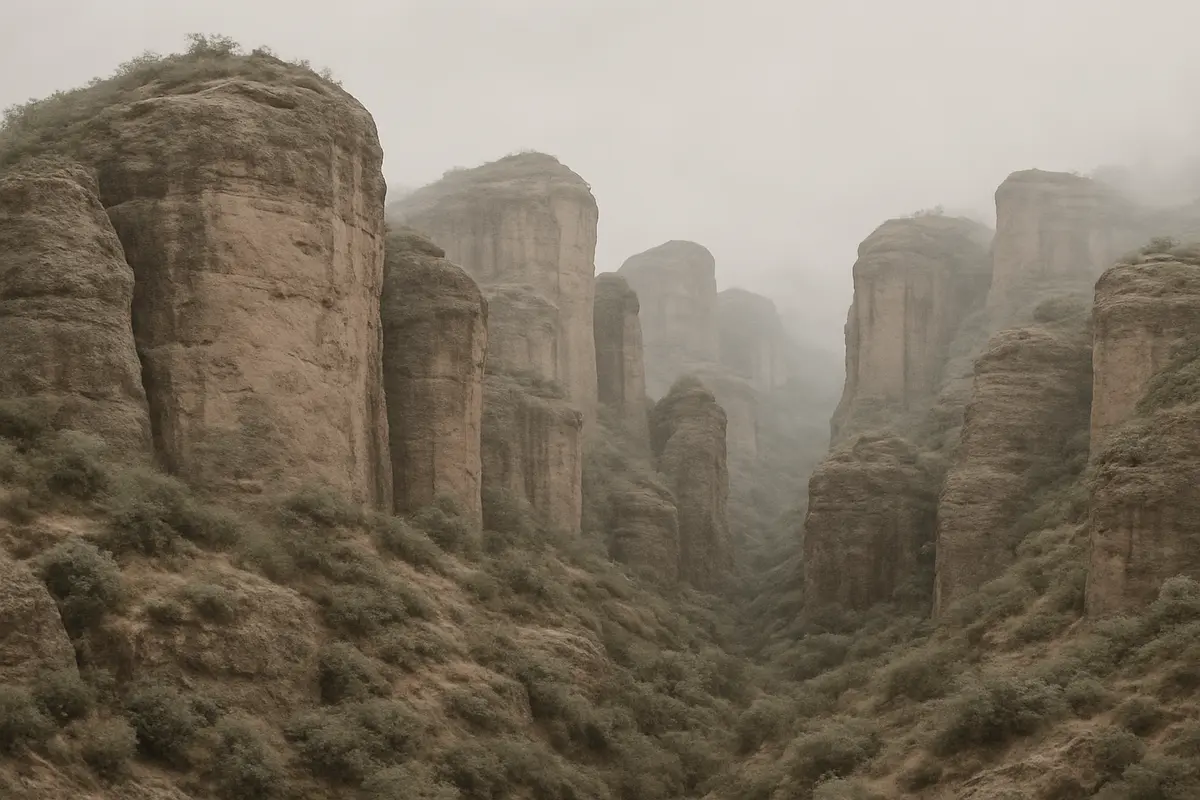
The Wuyi Mountains sit on a geological anomaly — a region of heavily fractured volcanic rock, primarily tuff and basalt, that has weathered over millions of years into a mineral-dense growing substrate. The mountain formations called danxia (丹霞) — reddish sandstone and conglomerate carved by water into dramatic gorges, cliffs, and ravines — create a landscape unlike any other major tea-growing region.
Tea plants grown in the crevices and terraced ledges of this terrain have their roots wedged into fissured rock. Drainage is extreme; rainfall moves straight through. The plants pull minerals directly from decomposed volcanic stone. This is the physical basis of yan yun (岩韻, rock rhyme), the mineral character that defines great Wuyi tea.
The climate compounds it. Wuyi has high humidity, significant cloud cover, and temperature differentials between valley floors and ridge lines. The mist and shade slow leaf development, concentrating aromatics. The mountain environment acts like a cold-climate slow-ripening mechanism for tea the way altitude does for high-mountain oolongs in Taiwan — but with a mineral intensity those teas don’t reach.
The Terroir Hierarchy
Within the Wuyi Mountains, location matters enormously. The highest-grade teas come from the Zhengyan (正岩, true rock) area — the inner gorge region of the National Park, sometimes referred to as the “three pits and two streams” (三坑两涧, Sān Kēng Liǎng Jiàn): Huiyuan Pit, Niulan Pit, Dafeng Pit, Liuxiang Stream, and Wuyuan Stream. Zhengyan teas command premiums because the rock-mineral concentration in the soil there is highest.
Below that is Banyan (半岩, half rock), grown on the park’s periphery. Then Zhou Cha (洲茶), grown on flat alluvial land outside the mountain core, which has minimal yan yun regardless of processing.
This hierarchy matters when buying. A “da hong pao” labeled from Zhengyan terroir and a generic commercial blend are both technically da hong pao; they occupy different planets in terms of character and price.
How Da Hong Pao Is Processed
The processing of da hong pao and other yan cha is among the most labor-intensive in Chinese tea. Understanding it explains why the tea tastes the way it does.
1. Picking
Wuyi oolongs are picked at a mature three-to-four-leaf stage, significantly more developed than the tight bud sets prized in green tea or high-mountain oolongs. Mature leaves contain more cell wall structure and can withstand the physical stress of the steps that follow.
2. Withering
Fresh leaves are spread on bamboo trays and sun-withered or shade-withered, losing moisture and beginning to relax.
3. Shaking (搖青, Yáo Qīng)
This is where yan cha diverges sharply from most other teas. The withered leaves are tumbled repeatedly in bamboo baskets or drums. The bruising damages leaf edges, triggering enzymatic oxidation at the margins while the leaf center remains relatively intact. This creates the distinctive “red-edged green center” appearance that marks well-processed oolong. The shaking rounds are interspersed with resting periods, and the whole cycle can run across a single overnight session with a skilled producer managing the progression by smell and touch.
Oxidation level for da hong pao typically lands in the 30–60% range — significantly higher than Taiwanese jade oolongs at 15–25%, but lower than black teas. This partial oxidation is what allows the roasting to work as effectively as it does.
4. Kill-Green (殺青, Shā Qīng)
A high-heat step in a wok or tumbler that arrests enzymatic oxidation by deactivating the oxidative enzymes. At this stage the leaf has a rough, grassy-oxidized character that bears no resemblance to the finished tea.
5. Rolling
Leaves are rolled into the characteristic tight twisted strips that distinguish Wuyi oolongs from the ball-rolled style of Taiwanese oolongs.
6. The Roasting — Baking (焙火, Bèi Huǒ)
This is the signature step, and it’s what separates yan cha from almost every other tea in the world. Traditional da hong pao undergoes multiple rounds of charcoal roasting in woven bamboo baskets set over slow-burning longan wood charcoal.
A single roasting round runs 6–10 hours at controlled temperatures that vary by the producer’s intent — lighter roasts at lower temperatures, heavier roasts pushing higher. After each round the tea rests for weeks to allow the heat stress to stabilize and the flavor to integrate. Then the next round begins. A finished high-end da hong pao may have undergone three to five rounds of roasting over a period of several months.
The roasting accomplishes several things simultaneously:
- It drives off residual moisture, extending shelf life dramatically
- It transforms grassy, oxidized compounds into caramel, toasted grain, and nutty notes via Maillard reactions
- It deepens and concentrates the mineral character rather than masking it
- It creates the thick, oily mouthfeel characteristic of quality yan cha
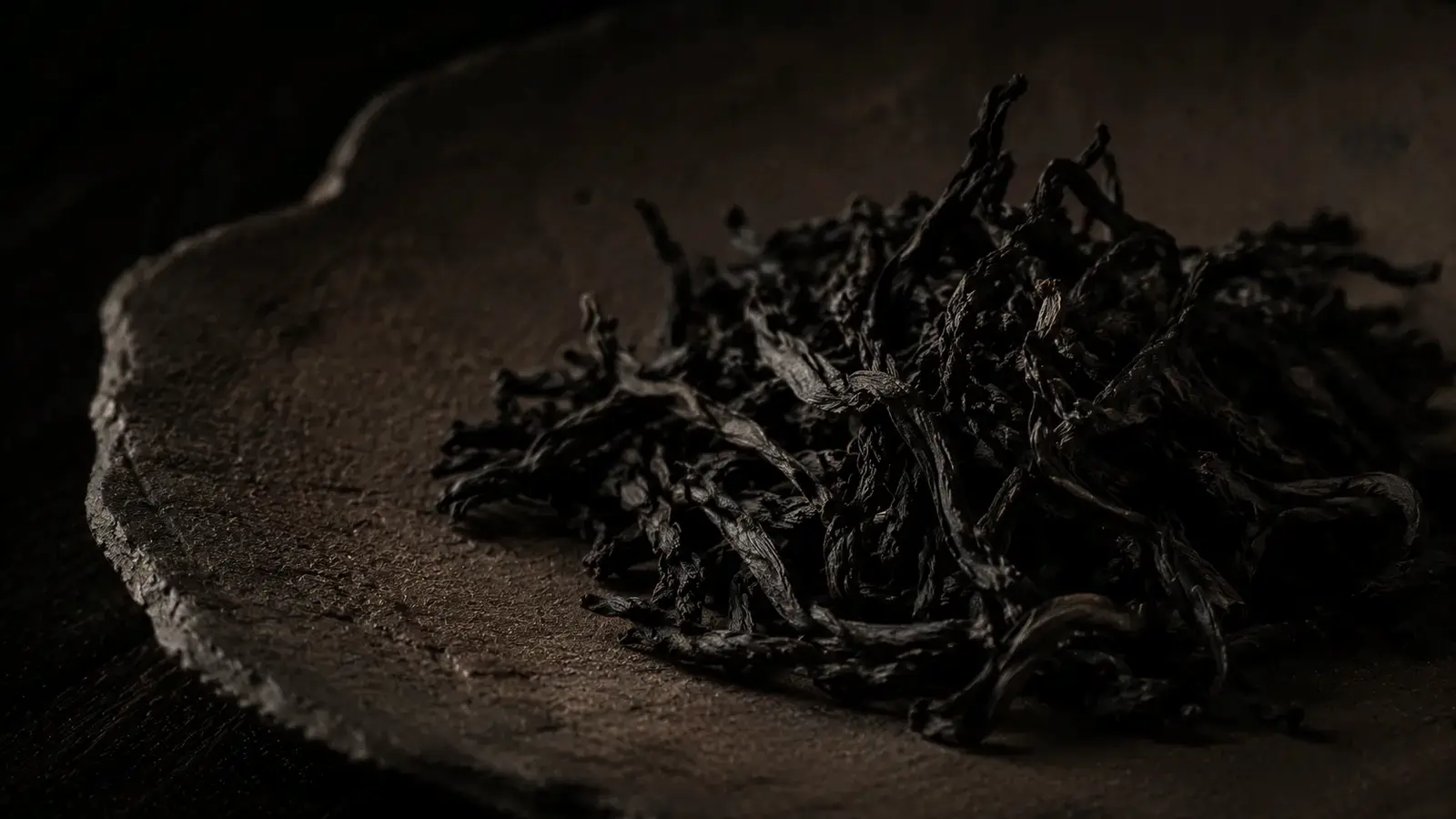
Roast level classifications you’ll encounter: light roast (轻火, qīng huǒ), medium roast (中火, zhōng huǒ), and heavy roast (足火 or 炭焙, zú huǒ or tàn bèi). Fresh heavy-roast teas benefit from a resting period of several months before drinking; the fire needs time to integrate.
What Yan Yun Tastes Like: A First-Person Account
Yan yun (岩韻, rock rhyme) is the term I encounter most often in discussions of Wuyi tea, and it’s also the term I’ve seen most consistently misused or left vague. Let me be direct about what I taste.
The da hong pao I’ve been drinking regularly — sourced from a specialist tea shop in Bangkok — opens with toasted grain on the nose, something between roasted barley and fresh bread crust. The first steeping delivers caramel up front, smooth and clean without any bitterness. Then the mineral backbone arrives in the mid-palate. It’s stony, slightly metallic, and I don’t mean that as a flaw: it’s the sensation of wet slate, or the smell of rain hitting a hot stone path. It’s brief but distinctive, and it’s followed by an orchid sweetness that surfaces in the finish.
The mouthfeel is thick and oily in a way that takes adjustment if you come to this from green tea or lighter oolongs. Producers describe this density as “rock bone” (岩骨, yán gǔ) — structure, weight, presence. It’s what the terrain and roasting together produce.
The huigan (回甘, returning sweetness) is reliable and sustained — a sweetness that builds for a minute or two after swallowing and lingers in the throat. This is one of the markers I use to evaluate quality across all gongfu teas, and good da hong pao delivers it consistently.
Qi-wise — and I’ll speak to this carefully, because it’s subjective — I find da hong pao produces a focused, warming body sensation rather than the lighter expansiveness I get from greener teas. It’s my preferred work tea because the alertness it provides feels grounded rather than edgy.
Brewing Da Hong Pao: Method and Parameters
Da Hong Pao is more forgiving than most teas at the same price point. The charcoal roasting buffers against common brewing errors. That said, it rewards careful technique.
Equipment
A gaiwan (蓋碗) or a small unglazed or glazed clay teapot works well. I default to gaiwan because it allows me to observe the leaf and manage temperature more precisely. For a teapot, choose one you’re comfortable keeping close to dedicated use for yan cha — the oil accumulation over time actually improves the pot’s performance.
Parameters
| Variable | Recommendation |
|---|---|
| Water temperature | 95–100°C; near-boiling or full boiling |
| Leaf-to-water ratio | 7–8 g per 100 ml |
| First steep (rinse) | 5–10 seconds, discard |
| Second steep (drinking) | 20–30 seconds |
| Subsequent steeps | Add 10–15 seconds per round |
| Number of steepings | 6–10 depending on quality |
| Vessel size | 100–120 ml |
The Rinse
Flash the first steeping and pour it away. This awakens the leaves, removes residual roasting dust, and prepares the tea for optimal extraction. Some people drink the rinse — I don’t. It’s rarely the best the tea offers.
Water Temperature
Use boiling or near-boiling water. This is non-negotiable for heavy-roast yan cha. The compounds that produce yan yun and roasted complexity require high temperatures to extract properly. Using 80°C water the way you might for a Taiwanese oolong will give you a thin, muted version of what the tea can do.
This runs against the instinct of new gongfu brewers who’ve been told lower temperatures protect delicate teas. Da hong pao is not delicate. Use the heat.
For a broader reference on water temperature across tea types, see the tea brewing water temperature guide.
Aggressive Brewing
Da hong pao handles high leaf ratios and shorter steeps well. If you want to probe the tea’s capacity — or evaluate a new purchase — try pushing the ratio to 9–10 g per 100 ml and keeping steeps at 15–20 seconds. You’ll get a concentrated, intense expression that reveals whether the mineral character holds up under pressure. Good yan cha does.
The Grading Question: What Are You Actually Buying?
Quality variation in commercial da hong pao is extreme. Understanding the market helps you spend money intelligently.
Mother tree da hong pao (母树大红袍): The six original bushes. Not commercially available. Essentially a museum artifact of Chinese tea history.
Qi Dan (奇丹) single cultivar: Sometimes sold as “pure” or “original strain” da hong pao. Qi Dan is believed to be a propagation from the mother trees. It’s rare, expensive, and when you find a credible source it’s worth trying. This is where I defer to more specialist vendors than my current Thailand supplier.
Premium Zhengyan blend: High-quality blends of Rou Gui, Shui Xian, and other cultivars from certified Zhengyan terroir. This is where most serious commercial da hong pao sits. Prices at this level run $0.50–$1.00+/g from reputable sources.
Standard commercial blend: Blends using Banyan or Zhou Cha material, roasted to deliver the stylistic profile. Accessible, consistent, and fine for daily drinking. This tier runs $0.20–$0.50/g and is what I’d recommend for anyone new to the category.
Generic supermarket or low-end online DHP: Often old stock, poorly stored, or processed with electric rather than charcoal roasting. The roast can cover problems, which makes this tier tricky. Buy less, spend proportionally more, and source from vendors who can speak to origin.
A reliable starting point for quality that won’t frustrate a new drinker: $0.30–$1.00/g from a vendor who can tell you the roast level and approximate origin. At that price you’re getting genuinely good yan cha.
Da Hong Pao vs. Pu-Erh: Two Philosophies of Depth
I came to yan cha with years of pu-erh drinking behind me, and the comparison has been instructive. Both tea types pursue depth and complexity, but through entirely different means.
Pu-erh — especially aged sheng — builds depth through microbial fermentation, compression, and time. Decades of storage transform raw, astringent material into something smooth, earthy, and medicinal. The depth is biological and temporal.
Da hong pao builds depth through fire. Charcoal roasting compresses flavor, transforms chemistry, and creates complexity within a matter of months rather than decades. There is no microbial transformation, no storage aging required (though rested fire is better than fresh-roasted). The mineral character of yan yun has no pu-erh equivalent — pu-erh’s earthiness is organic, fungal, biological; yan yun is geological, mineral, stony.
If pu-erh is fermentation taken seriously, yan cha is fire taken seriously. They’re more parallel philosophies than competing options.
One practical difference: da hong pao does not require the storage infrastructure that serious pu-erh collecting demands. A sealed, dry, odor-free container at room temperature is sufficient. The roasting handles long-term stability.
Beyond Da Hong Pao: The Broader Yan Cha World
Da Hong Pao is the front door to yan cha. Once inside, the landscape expands considerably. Three cultivars to explore next:
Rou Gui (肉桂, Cassia/Cinnamon): The dominant cultivar in modern Wuyi production. Higher fire, more pronounced spice — a cinnamon-bark warmth that gives it its name. Compared to DHP it’s sharper and more aromatic, less smooth.
Shui Xian (水仙, Narcissus/Water Sprite): A traditional cultivar, usually lower-roasted than Rou Gui, producing a rounder, more floral profile with strong orchid notes. Old-bush Shui Xian from Zhengyan can rival any tea I’ve tasted for mouthfeel and complexity.
Tie Luo Han (铁罗汉, Iron Arhat): One of the traditional “Four Famous Bushes” (四大名枞) of Wuyi alongside Da Hong Pao. Rarer, with a darker, more fermented-fruit character and excellent huigan.
The yan cha world rewards systematic exploration. Start with a quality DHP to calibrate your palate for the style, then move to Rou Gui for contrast, then Shui Xian for breadth.
Sourcing Notes
My regular da hong pao comes from a specialist tea shop in Bangkok with a strong Wuyi selection. For readers in North America and Europe, I’d recommend seeking out specialty Chinese tea vendors who can specify roast level, approximate terroir tier, and harvest season. Vendors who use language like “Zhengyan” or “Banyan,” specify the roasting process, and offer samples before full-size purchases are generally more trustworthy than those leading with mythology about mother trees at commodity prices.
Expect to pay for what you’re getting. A 50g package at $0.50/g — $25 total — will give you enough tea for twenty or more gongfu sessions. Evaluated that way, it’s not an expensive habit.