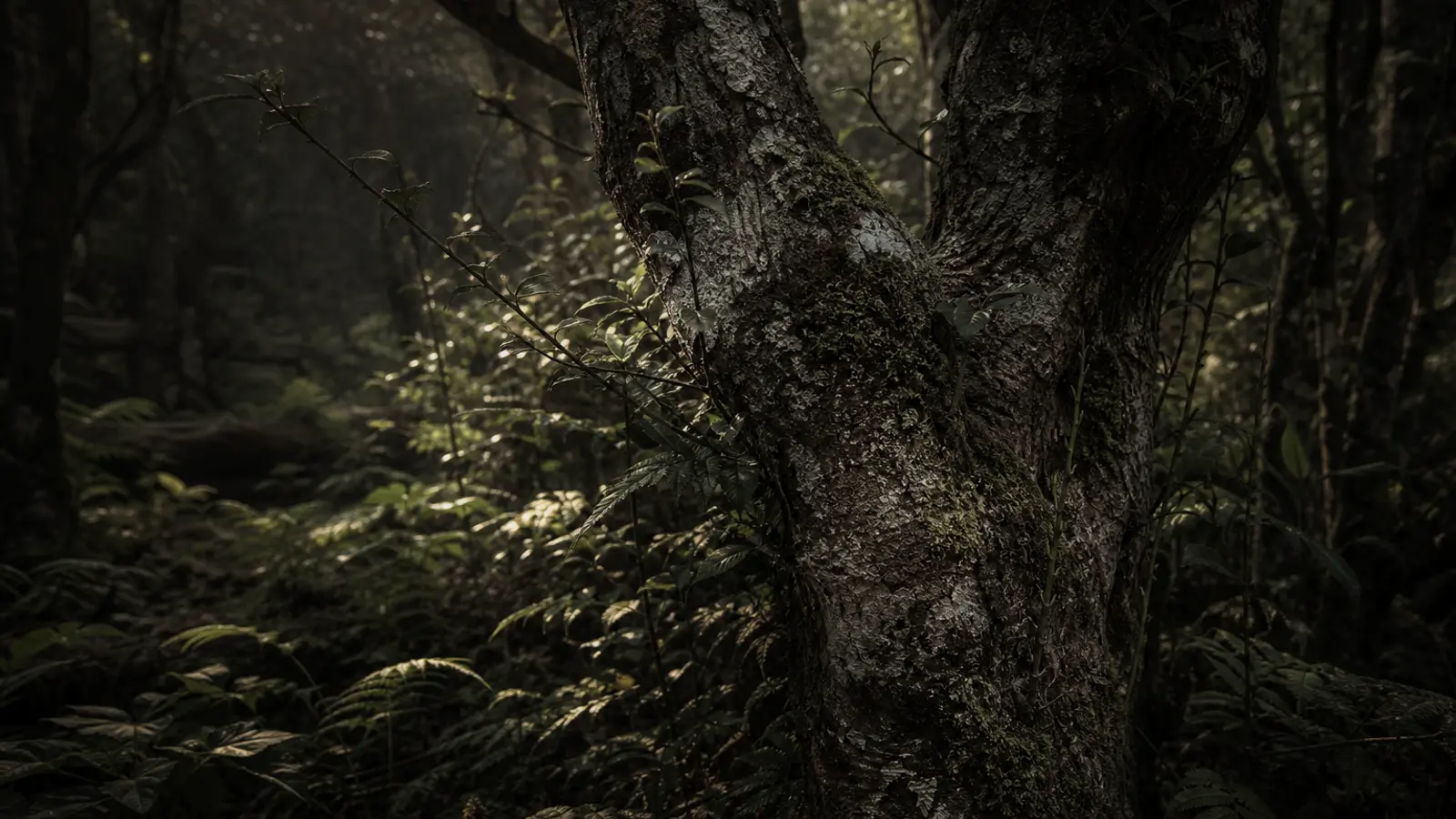
Pour a cup of genuine gushu (古樹, ancient tree) sheng pu-erh and lean into the steam before you sip. If the tea is real, something happens in that first breath that is difficult to articulate but immediately recognizable: you are standing at the edge of a forest.
That quality has a name. Shan ye qi yun (山野氣韻) — mountain-wild atmosphere-resonance — is the defining character of tea grown inside a functioning forest ecosystem rather than on a plantation. Understanding it changes how you evaluate pu-erh and explains why a genuine gushu cake commands prices that plantation material never will.
What Shan Ye Qi Yun Actually Means
Break the term apart. Shan (山) is mountain. Ye (野) is wild — uncultivated, undomesticated, belonging to the forest. Qi (氣) is the atmospheric quality of a thing, closer to “energy” or “breath” than anything English renders cleanly. Yun (韻) is resonance — the way something continues to reverberate after the immediate sensation has passed.
Put together: the mountain-wild quality that resonates through the experience of the tea.
This is not a flavor descriptor the way “stone fruit” or “wet stone” are flavor descriptors. It is a gestalt — the character that emerges from many things being integrated correctly. In the cup, shan ye qi yun registers as:
- A first aroma that suggests damp forest floor, green canopy, and living soil simultaneously
- A flavor impression that is complex without being identifiable as any single component
- A finish — huigan (回甘, sweet returning aftertaste) — that arrives slowly and carries wild herb notes
- A body sensation that some describe as expansive or cooling, distinct from the lighter mouthfeel of plantation tea
You can have individual notes that evoke “wild” without having shan ye qi yun. A tea can smell mossy, or earthy, or herbaceous. Shan ye qi yun is what happens when those qualities are not separate descriptors but an undivided impression — forest as a single thing, not a list of forest components.
The Forest Ecosystem Behind the Cup
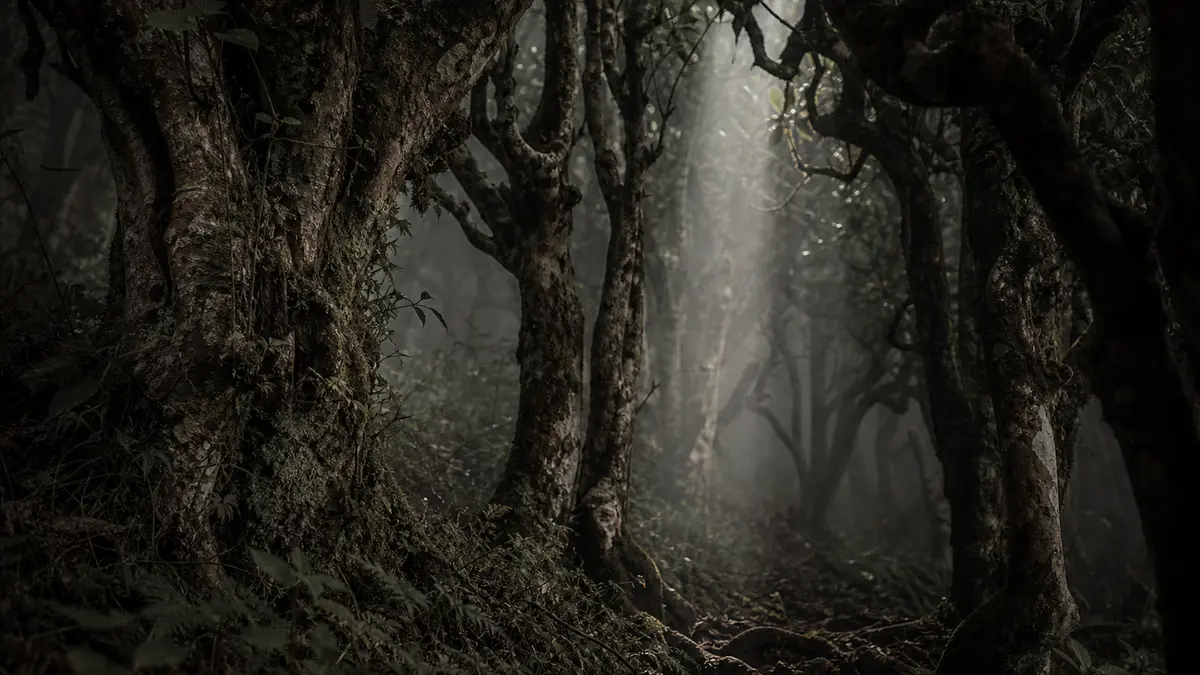
Gushu tea trees are not planted in rows. They grow within functioning subtropical forest systems, surrounded by dozens of other species: camphor trees, wild fruit trees, banyan relatives, forest understory plants, ferns, mosses. Some trees in Yunnan’s tea-growing regions like Xishuangbanna (西雙版納) and Lincang (臨滄) are hundreds of years old, their root systems reaching meters into soil that has never been tilled.
This matters because of what happens underground.
Forest ecosystems are connected by mycorrhizal networks — symbiotic fungal systems that colonize plant root systems and link individual trees across large areas. The Canadian forest ecologist Suzanne Simard documented extensively how these networks allow trees to exchange not just nutrients but chemical signals and even defensive compounds. A tree under insect attack can signal neighboring trees through the fungal network; those trees respond by upregulating their own defenses before the insects arrive.
A gushu tea tree growing in an intact forest is embedded in exactly this kind of network. Its roots are in communication with camphor trees, wild orchids, bamboo, and species we may not have catalogued. The biochemistry of the tea tree — the compounds that end up in its leaves and therefore in your cup — is influenced by what those neighboring trees are doing, what stresses they face, what compounds they produce.
This is, I think, the most likely explanation for shan ye qi yun that current science supports. The wild forest character in the cup may be the chemical fingerprint of an entire ecosystem, not just a single tree species. The tea is not just from the forest — it is of the forest.
This hypothesis remains exactly that: a hypothesis. The specific compounds responsible for shan ye qi yun have not been isolated and mapped against mycorrhizal network activity in tea trees, to my knowledge. But the mechanism is plausible, the forest-ecology science is solid, and it coheres with what experienced tasters observe when comparing genuinely wild-grown material to plantation tea.
Why Plantation Tea Cannot Have This Quality
Plantation tea (臺地茶, táidì chá) grows in conditions designed for agricultural efficiency: cleared land, uniform rows, regular pruning, often fertilizer application. The trees are young — typically under thirty years — and they grow in soil that has been disturbed and homogenized.
There are no camphor trees sharing a mycorrhizal network with a plantation tea bush. There are no centuries-old root systems accessing deep mineral layers. The fungal networks that take decades to establish in undisturbed forest soil do not exist in recently cleared agricultural land, or exist only in impoverished form.
The result is tea that can be skillfully produced, clean, consistent, and genuinely enjoyable — but that cannot carry shan ye qi yun. The character is not there to be drawn out by processing, because it was never in the leaf material.
This is important for the market. No amount of processing skill — no adjustment to kill-green (殺青, shāqīng) temperature, withering duration, or compression — can introduce forest biochemistry into a leaf that does not have it. Shan ye qi yun is an upstream quality: it exists or does not exist before the tea reaches the factory floor.
The Wine Parallel: Goût de Terroir and Living Soil
The French concept of goût de terroir — taste of place — is the closest wine parallel I reach for. A Burgundy Grand Cru expresses not just Pinot Noir but a specific patch of limestone soil, a particular microclimate, the organic matter built up over centuries in Côte de Nuits.
The parallel becomes sharper in natural wine circles, where the most revered bottles come from old vines grown in living soil with intact fungal networks. Conventional viticulture that sterilizes soil and applies synthetic fertilizer produces technically clean wine; natural wine producers argue it also produces wine without the resonant complexity that comes from a vine genuinely embedded in its ecosystem.
The argument is structurally identical to gushu versus plantation. Old vines in living soil with mycorrhizal connections versus young vines in managed monoculture. Shan ye qi yun is goût de terroir for ancient forest tea. If you want to understand how terroir shapes tea more broadly, the principles that govern wine translate with surprising fidelity.
Identifying Shan Ye Qi Yun: What to Look For
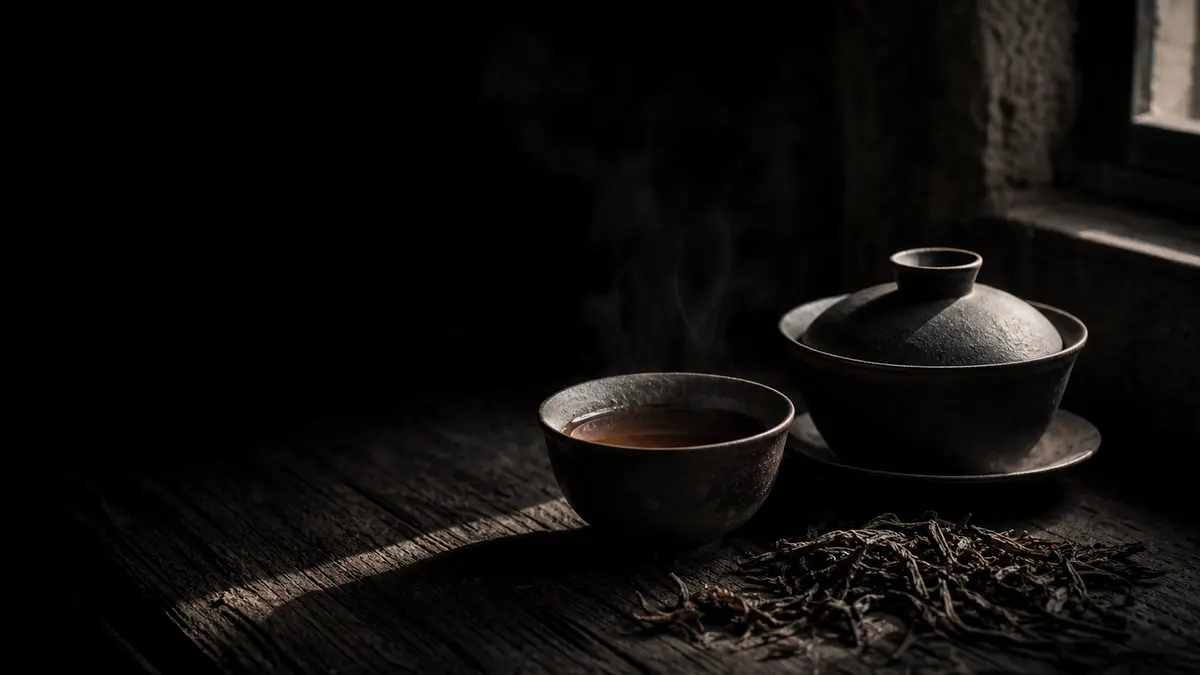
Shan ye qi yun is most accessible in the aroma of the first steep from a warmed vessel — I use a gaiwan (蓋碗) for evaluation because the ceramic is neutral and the lid concentrates the aroma. The moment you lift the lid of a gaiwan holding genuinely forest-grown gushu, the impression arrives whole: you are not parsing “camphor note, then earth note, then orchid note.” You are somewhere other than your kitchen.
A few more reliable markers:
Coherence over components. Plantation teas with good processing can show individual interesting notes. Shan ye qi yun is distinguished by how its elements cannot be fully separated. The earthy quality and the floral quality and the mineral quality arrive as one thing.
Persistence in the huigan. The sweet returning aftertaste in genuine gushu is slow and carries complexity — wild herb notes, sometimes a cooling sensation at the back of the throat. Plantation tea huigan tends to be faster, cleaner, and simpler.
The body impression. Many experienced drinkers describe a physical quality to high-shan ye qi yun tea — a feeling of expansion or energy that plantation tea does not produce. This is the qi element of the term. I’m cautious about overclaiming here, but the observation is consistent enough across tasters I take seriously that I include it.
What it is not. Smokiness is not shan ye qi yun. Heavy camphor notes from processing or storage are not shan ye qi yun. A tea can smell complex and “forest-like” from processing artifacts without having the underlying wild character. The test is whether the quality survives across multiple steeps — genuine shan ye qi yun is present in steep one through steep eight; processing artifacts fade.
Shan Ye Qi Yun as Authentication Marker
Because shan ye qi yun cannot be faked at the processing stage, it functions as one of the most reliable markers for genuine gushu material. This matters commercially. Gushu tea commands significant price premiums — material from old trees in famous production areas like Laobanzhang (老班章) or Bingdao (冰島) can reach hundreds of dollars per hundred grams at the international retail level, compared to single digits for commodity plantation material.
The pu-erh market has significant adulteration problems. Plantation material blended with small quantities of gushu, or plantation material mislabeled as gushu entirely, is common. Processing tricks can produce some gushu-adjacent flavors in plantation material, but they cannot produce shan ye qi yun.
A taster who has calibrated their palate against confirmed forest-grown material from established old-growth areas has a meaningful advantage in evaluating claims. The quality is not subtle in good examples — it announces itself. What takes time is learning to distinguish genuine integration from clever simulation.
Developing Your Palate for This Quality
I’ll be direct: shan ye qi yun is one of those qualities that is easy to read about and harder to locate in the cup until you have experienced it clearly once. The approach I recommend is calibration from the ends.
Start with something you know is commodity plantation material — any inexpensive young sheng from a major factory will do. Brew it, and pay close attention to the aroma and first impression. Note its character.
Then find confirmed old-growth material from a reputable source with documented provenance. The price difference will be real. Brew the same way, same parameters, and pay attention to what is different about that first aroma from the warmed gaiwan.
The contrast is instructive. After you have felt the difference once — the forest arriving whole versus the components arriving separately — you have a reference point. It does not leave you.
The Larger Point
Shan ye qi yun matters beyond connoisseurship. It is an argument for forest preservation. The old-growth tea forests of Yunnan, Laos, and Myanmar are not just picturesque — they are functioning ecosystems producing tea with qualities that cannot exist without the ecosystem intact. Deforestation or conversion to plantation agriculture in these areas does not just reduce biodiversity; it eliminates the conditions under which this particular quality of tea can exist at all.
The cup of forest-grown tea is an argument made in biochemistry: this is what living soil and connected ecosystems taste like. You cannot get there any other way.