Two mountain ranges. Two nations. One tea tradition that predates both borders. The comparison between Thai pu-erh and Yunnan pu-erh is one I’ve been thinking through for several years, and it remains one of the more instructive exercises available to anyone serious about understanding how place shapes a tea.
I want to be clear about what I’m working from: the Thai side is firsthand—primarily Chiang Rai ancient arbor material at 1,000–1,400 meters from a heritage Chiang Rai factory with Yunnan-lineage production—and the Yunnan side is drawn from years of drinking across the classic villages: Yiwu (易武), Bulang (布朗), Menghai (勐海), and others. This is Tier 1 knowledge on both sides. Where I go beyond that, I’ll say so.
Let me say upfront that this is not a competition. Neither tea wins. They’re different accents of the same language, and fluency in one makes you a better reader of the other.
What Is the Difference Between Thai and Yunnan Pu-erh?
Thai pu-erh is grown primarily in Chiang Rai province from Camellia sinensis var. assamica trees related to Yunnan stock, producing tea with similar structure but distinctive regional character — often lighter body, more floral aromatics, and different mineral profiles. Yunnan remains the historical origin and global benchmark for both sheng and shou production.
At a Glance:
| Attribute | Thai Pu-erh (Chiang Rai) | Yunnan Pu-erh (Classic regions) |
|---|---|---|
| Sheng character | Floral, open, tropical fruit, soft mineral | Structured, camphor, stone fruit, deep mineral |
| Shou texture | Velvety, smooth, gentle | Grippy, muscular, intense |
| Aging potential | Promising but less documented | Well-documented over decades |
| Off-note risk (shou) | Lower | Higher at lower price points |
| Price range | ~$20–80 per 357g cake | ~$20–500+ per 357g cake (vast range) |
| Best for beginners | Yes — lower entry bar | Yes, but choose style carefully |
The Shared Root: One Tree, Two Countries
Before comparing them, it’s worth understanding how closely related these teas actually are.
The tea plant at the center of both traditions is Camellia sinensis var. assamica—large-leaf, ancient, capable of living for centuries as a forest tree rather than a pruned garden shrub. The ancient arbor trees (古樹, gǔshù) of Yunnan’s Xishuangbanna (西雙版納) and the old-growth trees of northern Thailand’s highlands are botanical relatives, likely part of the same continuous historical range before modern borders divided the landscape.
The Ancient Tea Horse Road (茶馬古道, chámǎ gǔdào) passed through what is now northern Thailand. The Shan, Akha, and other ethnic groups who cultivated tea in these hills were not separated by nationality—they were the same people practicing the same agriculture across a region that became multiple countries in the 20th century. When you drink a Thai pu-erh from Doi Mae Salong and a Yunnan sheng pu-erh from Mengla, you’re not drinking from entirely different traditions. You’re drinking from the same tradition at different coordinates.
That context matters. It tells you the comparison is legitimate—these are real relatives, not merely superficially similar teas.
The Growing Regions
Yunnan: Altitude, Age, and Famous Villages
Yunnan’s pu-erh producing regions sit at elevations ranging from roughly 1,200 to over 2,000 meters. The most celebrated areas cluster in two prefectures:
Xishuangbanna (西雙版納) is the historical center. Here you find Menghai county with its famous Bulang Mountain (布朗山), Nannuo Mountain (南糯山), and Jingmai Mountain (景邁山). To the east lies the Yiwu mountain complex—six famous tea mountains (六大茶山, liù dà cháshān) historically prized for their clean, elegant, florally complex sheng. Menghai county also houses the large state and private factories—Dayi (大益), Xiaguan (下關)—whose commercial shou established global benchmarks.
Lincang (臨滄) is increasingly recognized as a major source of old-tree material, with areas like Bingdao (冰島) and Xigui (昔歸) fetching prices that rival or exceed Yiwu’s most famous productions.
The geological diversity within Yunnan is significant. Yiwu sits on older, more weathered granite-based soils. Bulang’s darker, more mineral soils produce a different character. Lincang’s terroir differs again. Yunnan is not one flavor—it’s a continent of pu-erh.
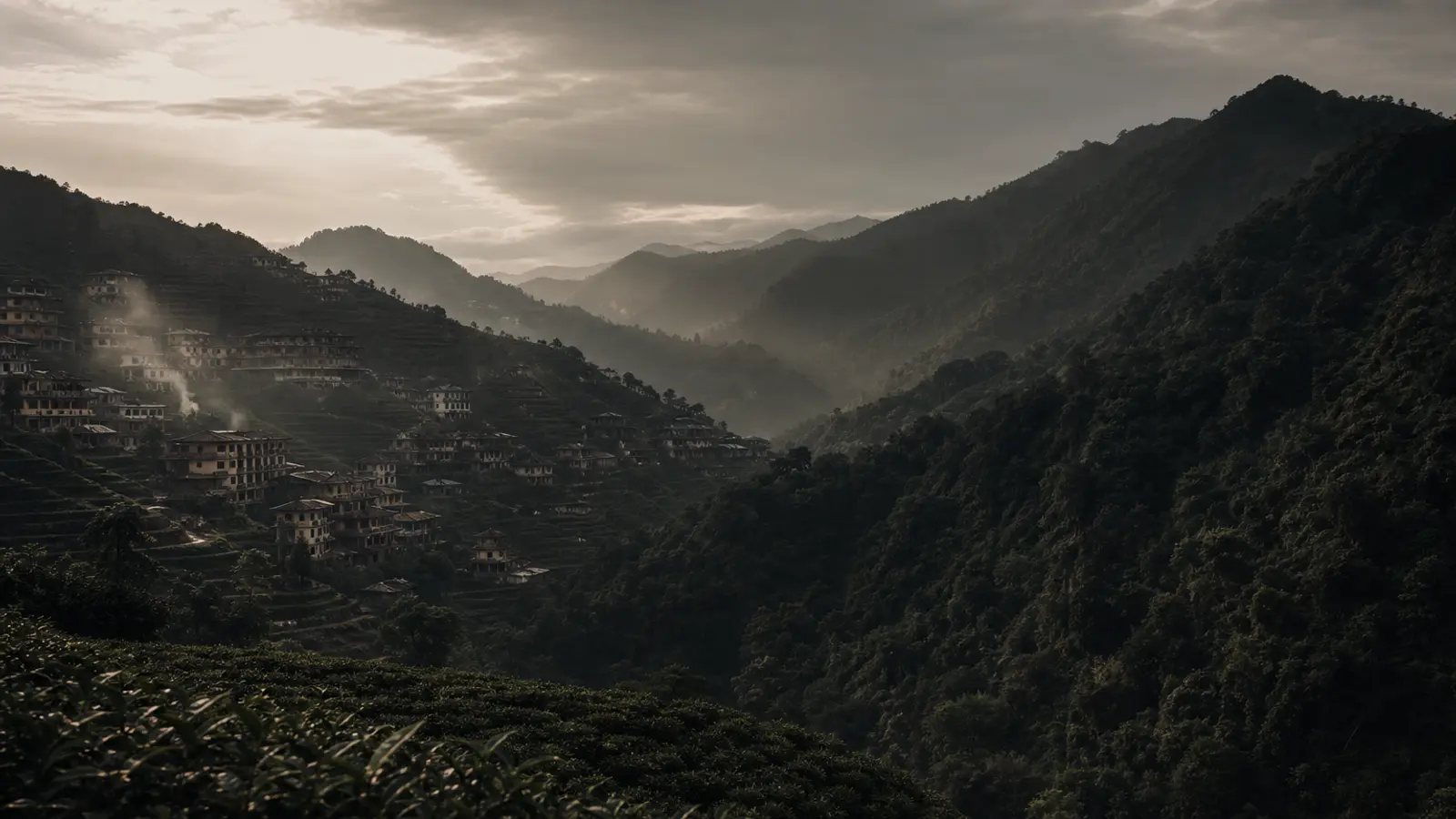
Thailand: The Northern Highlands
Thai pu-erh production concentrates in Chiang Rai and Chiang Mai provinces, roughly 1,000 to 1,400 meters above sea level. Key areas include:
Doi Mae Salong (ดอยแม่สลอง): A mountain famous for its Chinese nationalist history—KMT soldiers settled here after 1949, bringing Yunnan tea cultivation practices with them. The tea culture on Doi Mae Salong is directly descended from Yunnan.
Doi Wawee (ดอยวาวี): Known for both plantation and older arbor material, with some trees of significant age.
The Shan and Akha highlands along the Myanmar border: Less documented in international sources, but home to ancient forest tea trees that some producers are beginning to work with seriously.
The leading heritage factory in Chiang Rai sources ancient arbor material and processes it using traditional Yunnan pu-erh methods — the clearest reference point for Thai sheng and shou quality at a serious level.
The elevation gap between Thailand (1,000–1,400m) and Yunnan’s top sites (up to 2,000m+) is real and likely contributes to some of the character differences discussed below. Cooler temperatures slow leaf development, concentrate compounds, and generally produce more structured, complex tea. Thai growing conditions are warm and humid, which shapes the leaf differently.
Sheng (生普): The Green Comparison
Sheng pu-erh (生普, shēng pǔ) is the uncooked, naturally fermented style—pressed into cakes and aged over years or decades. It’s where terroir expression is most legible, because the processing does least to obscure origin character.
Yunnan Sheng: Structure and Backbone
Yunnan sheng from quality old-tree material has a structural quality I’d compare to a well-made Burgundy: there’s a backbone. Tannins (茶多酚, cháduōfēn) are present and felt, especially in young Bulang sheng, which can be genuinely grippy, almost aggressive in its first years. Yiwu sheng is softer but still has architectural presence—florals over a firm mineral foundation.
The flavor vocabulary I reach for with Yunnan sheng:
- Young Yiwu: apricot, honey, white flower, dried hay, mild camphor (樟香, zhāngxiāng)
- Young Bulang: bitter melon, dark stone fruit, pronounced astringency, tobacco leaf
- Aged Yunnan sheng (10+ years): leather, dried jujube, forest floor, dried orange peel, deep sweetness
The huigan (回甘)—the returning sweetness felt in the throat after swallowing—is one of Yunnan old-tree sheng’s most distinctive qualities. A great Yiwu sheng has huigan that arrives slowly and lingers for minutes.
Thai Sheng: Floral, Open, Accessible
Thai sheng from Chiang Rai ancient arbor is a different experience. The first thing I notice is a lighter structural register. The tannins are present but softer—less grip, more texture. Young Thai sheng often opens with pronounced florals: orchid, sometimes jasmine, a brightness that can read almost like a well-made white tea before the deeper notes emerge.
There’s a tropical fruit quality that appears in some Thai sheng—ripe mango, lychee—that I don’t often find in Yunnan material at comparable price points. Whether this is the warmer growing conditions, the specific cultivars, or processing variables, I can’t fully separate with certainty.
What Thai sheng tends to lack, relative to serious Yunnan material, is depth of bitterness and structural complexity. This isn’t a flaw—it’s a characteristic. A Bulang sheng’s aggressive young bitterness is often described as a feature (it signals aging potential). Thai sheng is more immediately approachable, but whether it ages as dramatically is something the record doesn’t yet fully show, given that serious Thai pu-erh production at quality levels is relatively young.
Shou (熟普): Where the Contrast Is Sharpest
Shou pu-erh (熟普, shóu pǔ) is the cooked, artificially fermented style developed in the 1970s to produce aged-tasting tea without the decades of waiting. The wò duī (渥堆) fermentation process—controlled microbial composting of the tea leaf—is where the two origins diverge most dramatically in character, and where my firsthand experience is most direct.
Yunnan Shou: Muscular, Grippy, Intense
Yunnan shou from quality material—especially Menghai-area productions—is what I’d call muscular. There’s a weight to it. The liquor is often deep garnet-brown to near-black, and the flavor hits with authority: dark chocolate, dried longan, forest floor, sometimes a pronounced earthiness that can read as petrichor or as aged wood depending on the production.
Good Yunnan shou has grip. There’s a finish that coats the mouth, a texture that lingers. The huigan is deeper and slower than in many shou from other origins—it surfaces as a rich sweetness well back in the throat. Badly made Yunnan shou can veer into “pond” or “compost” territory, a flaw that improves with 2–3 years of dry storage but remains a quality marker to watch.
The classic Menghai factory (大益 / Dayi) 7572 cake is probably the world’s most widely drunk shou reference point. It’s consistent, competent, and muscular in exactly the way I’m describing.
Thai Shou: Velvety, Smooth, Gentle
Thai shou is a revelation if you come to it expecting the Yunnan register. It’s not weaker—it’s different.
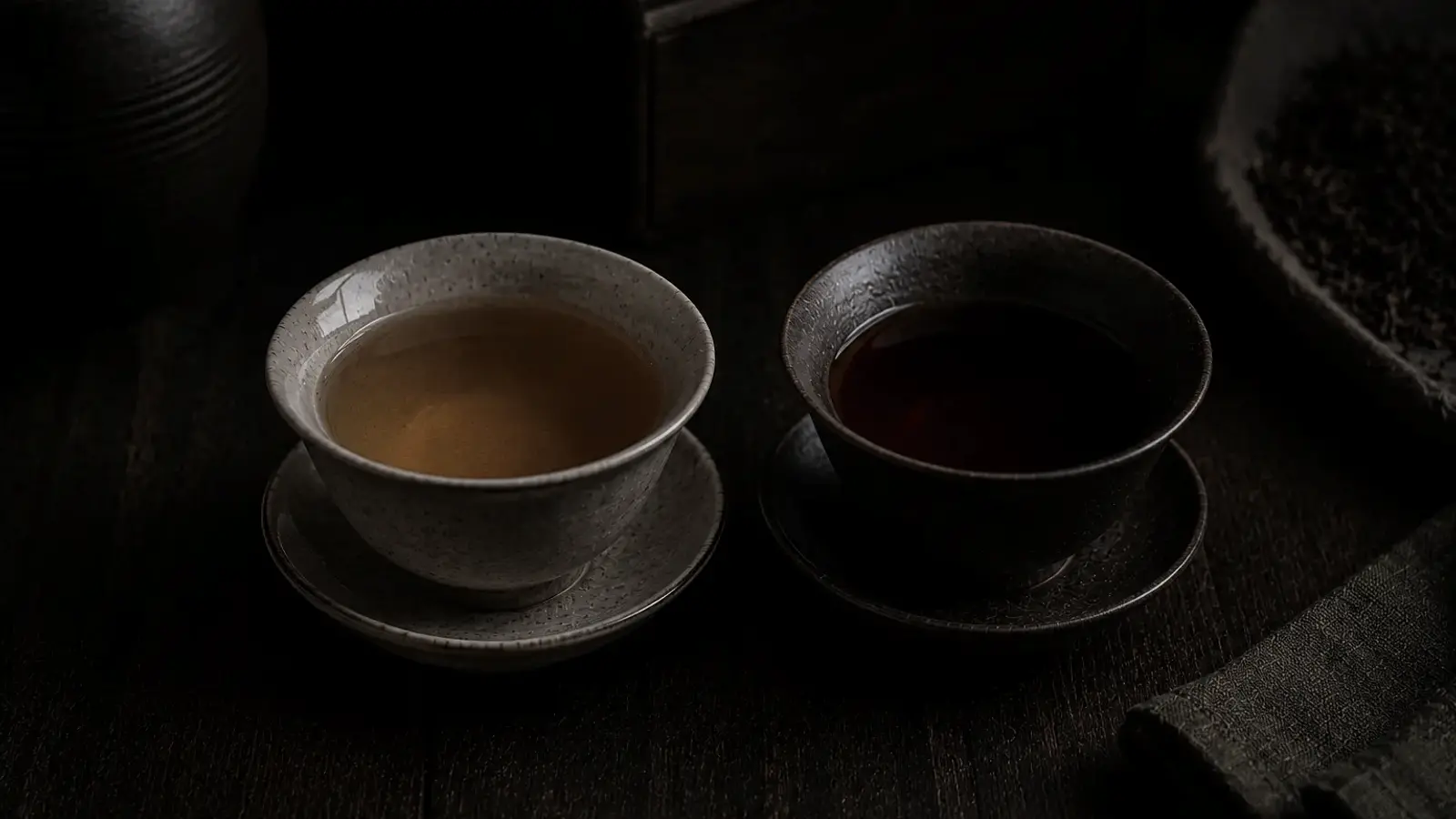
The texture is what strikes me first: velvety. Where Yunnan shou grips the mouth, Thai shou slides across it. The liquor is often lighter in color for equivalent steeping parameters—a clear mahogany rather than opaque black. The flavor profile is quieter: cocoa powder rather than dark chocolate, dried longan but softer, a sweetness that comes forward more readily and isn’t buried under mineral weight.
Chiang Rai ancient arbor shou from this heritage factory demonstrates this clearly. The wò duī fermentation produces a clean, approachable result that is notably free of the “pond” off-note that plagues lower-quality Yunnan productions. I don’t know if this is the leaf quality, the fermentation conditions, or the smaller-batch approach—possibly all three.
If Yunnan shou is a Rhône Syrah—structured, dark, demanding—Thai shou is closer to a Burgundy Pinot: lighter on its feet, immediately giving, and perhaps more accessible to newcomers.
Head-to-Head Comparison Table
| Attribute | Thai Pu-erh (Chiang Rai) | Yunnan Pu-erh (Classic regions) |
|---|---|---|
| Elevation | 1,000–1,400m | 1,200–2,000m+ |
| Tree age | Old-growth to ancient, some centuries old | Ancient arbor, some 500–1,000+ years documented |
| Sheng tannin level | Low to medium | Medium to high (especially Bulang) |
| Sheng character | Floral, open, tropical fruit, soft mineral | Structured, camphor, stone fruit, deep mineral |
| Shou texture | Velvety, smooth, gentle | Grippy, muscular, intense |
| Shou sweetness | Forward, immediate | Deeper, slower huigan |
| Aging potential | Promising but less documented | Well-documented over decades |
| Off-note risk (shou) | Lower | Higher at lower price points |
| Price range (quality material) | ~$20–80 per 357g cake | ~$20–500+ per 357g cake (vast range) |
| Global recognition | Emerging | Established, legally defined |
| Best reference producers | Heritage Chiang Rai factory | Dayi, Xiaguan, small-village producers |
| Best for beginners | Yes—lower entry bar | Yes, but choose style carefully |
Why Yunnan Gets the Fame
This is a legitimate question and deserves a direct answer rather than diplomatic hedging.
Yunnan pu-erh is more famous for reasons that are structural, historical, and legal—not because Thai pu-erh is inferior.
History: Yunnan has documented pu-erh trade going back to the Tang dynasty (618–907 CE) and continuous production through the tea horse trade era. The accumulated knowledge of aging, storage, and production in Yunnan is measured in centuries. Thailand’s serious pu-erh-style production at quality levels is decades old at most.
Legal definition: Under Chinese national standard GB/T 22111-2008, pu-erh is legally defined as tea made from sun-dried maocha (曬青毛茶, shàiqīng máochá) originating from specific areas of Yunnan Province. Thai productions cannot legally be called “pu-erh” in China. They’re often labeled as “aged compressed tea” or similar. This creates a semantic barrier to recognition that has nothing to do with quality.
Scale and infrastructure: Yunnan’s production infrastructure—factory capacity, aged inventory, global distribution networks—dwarfs Thailand’s. Dayi alone produces more pu-erh annually than Thailand’s entire output.
Collector culture: The pu-erh collector community is built around Yunnan villages, specific production years, storage provenance. Thai tea hasn’t had time to build equivalent mythology.
None of this means Thai pu-erh is lesser tea. It means it’s newer to the international stage.
Brewing Both: Practical Notes
Both teas reward similar gongfu approaches, but they respond differently to parameter adjustments.
Water temperature: 95–100°C for both. Full boil extracts the mineral depth in Yunnan sheng; Thai sheng is more forgiving but doesn’t suffer from high heat.
Gaiwan (蓋碗) or teapot? I prefer a gaiwan for comparing both side by side—it neutralizes the vessel variable. A yixing pot (宜興壺) suited to one may not suit the other equally.
Leaf ratio: I use 6–7g per 100ml for both styles.
Steep times: Start at 10–15 seconds for young sheng, extending each round. Thai sheng often peaks earlier in the session—rounds 3–6 show its best florals before it drops off. Yunnan old-tree sheng frequently gives 10–15 good infusions with sustained complexity.
Water: The mineral content of your water matters more with Thai sheng, which is delicate enough that heavily mineralized water can flatten it. Yunnan sheng is more robust. Soft, clean water around 50–75 ppm TDS serves both well.
Which to Try First
My honest recommendation: start with Yunnan.
Not because it’s better—it isn’t, categorically—but because it’s the reference point. Understanding what Yiwu sheng tastes like, what good Menghai shou does, gives you a map. Thai pu-erh then becomes legible as a variation on that map rather than an isolated experience you have no frame for.
Specifically:
- Yunnan shou first: A reliable Dayi or Xiaguan production, or a small-producer shou from Menghai. This establishes the muscular benchmark.
- Thai shou second: A Chiang Rai ancient arbor shou from a reputable Chiang Rai producer. The contrast in texture is immediately apparent and instructive.
- Yunnan sheng third: A reputable Yiwu production. Budget $30–50 for a 357g cake to get genuine old-tree character rather than plantation material.
- Thai sheng fourth: With Yunnan sheng as context, Thai sheng’s floral-forward, lighter-structured character makes complete sense as a geographical dialect of the same language.
If you reverse the order and start with Thai sheng, you may find Yunnan sheng harshly structured by contrast. Starting with Yunnan first calibrates your palate toward the stronger end of the range.
The Terroir Argument
Terroir is a wine concept, but it applies here. Soil mineral content, elevation, temperature variation between day and night, rainfall patterns, humidity, tree age, surrounding forest ecology—all of it ends up in the leaf.
What I taste in Thai sheng from 1,200 meters in Chiang Rai is genuinely different from what I taste in Yunnan sheng from 1,800 meters in Lincang, and the differences are consistent enough across multiple sessions to feel like place rather than batch variation. The warmer, more humid Thai highlands produce a leaf that expresses itself differently—more immediately floral, less structurally severe—than the cooler, more continental Yunnan growing conditions at altitude.
This is not a hierarchy. It’s a vocabulary. Burgundy and the Rhône both produce serious wine from different conditions and different grapes. Yiwu and Chiang Rai both produce serious compressed tea from related trees in related but distinct environments.
The fact that Yunnan has centuries of aging data and Thailand doesn’t is a historical artifact, not a quality judgment. I expect that as Thai pu-erh-style productions age in serious collectors’ hands over the next 20–30 years, the conversation about relative merit will deepen considerably.
For now: drink both. Take notes. Let your palate develop the comparison over time rather than resolving it prematurely in favor of either.