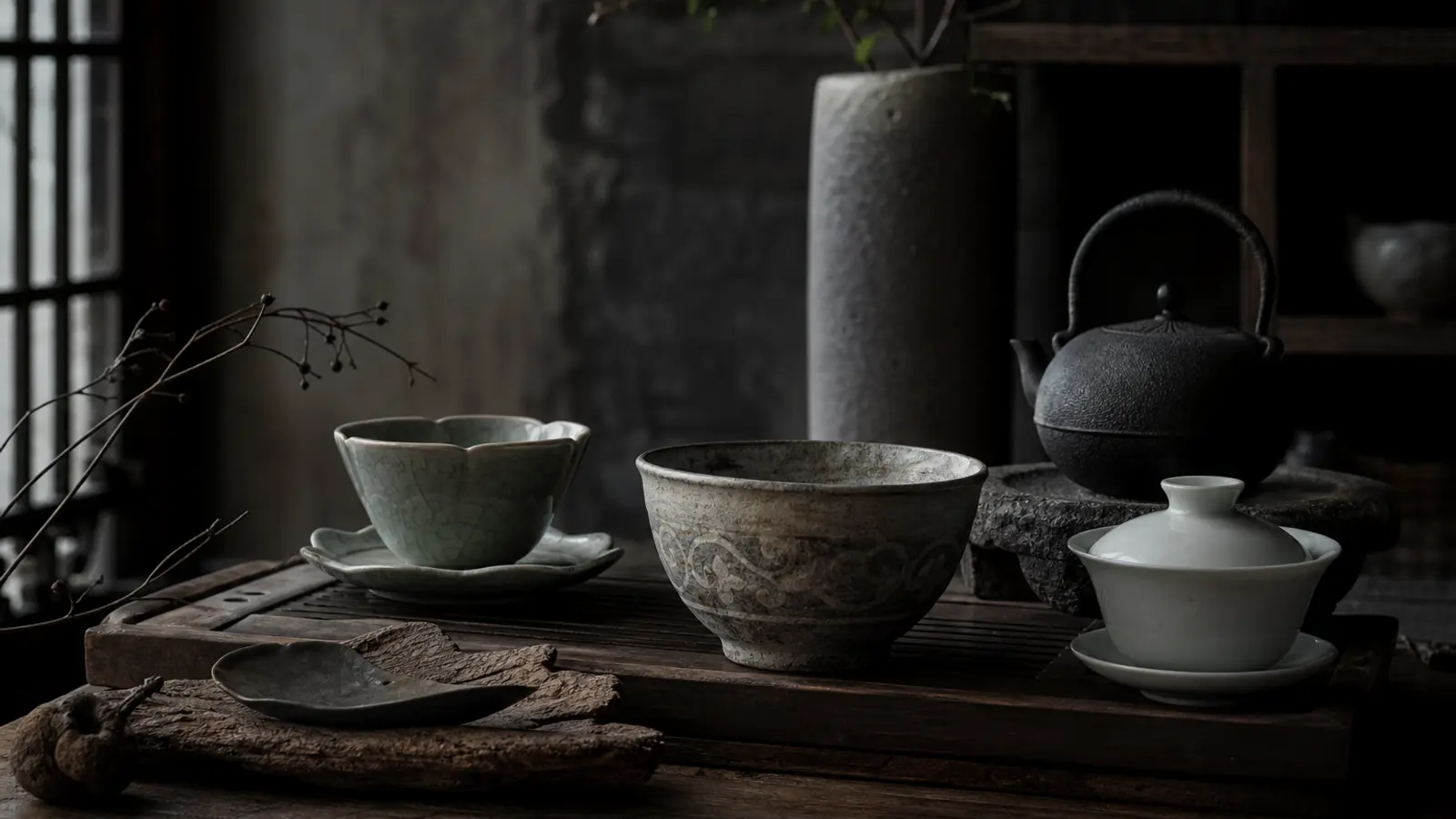
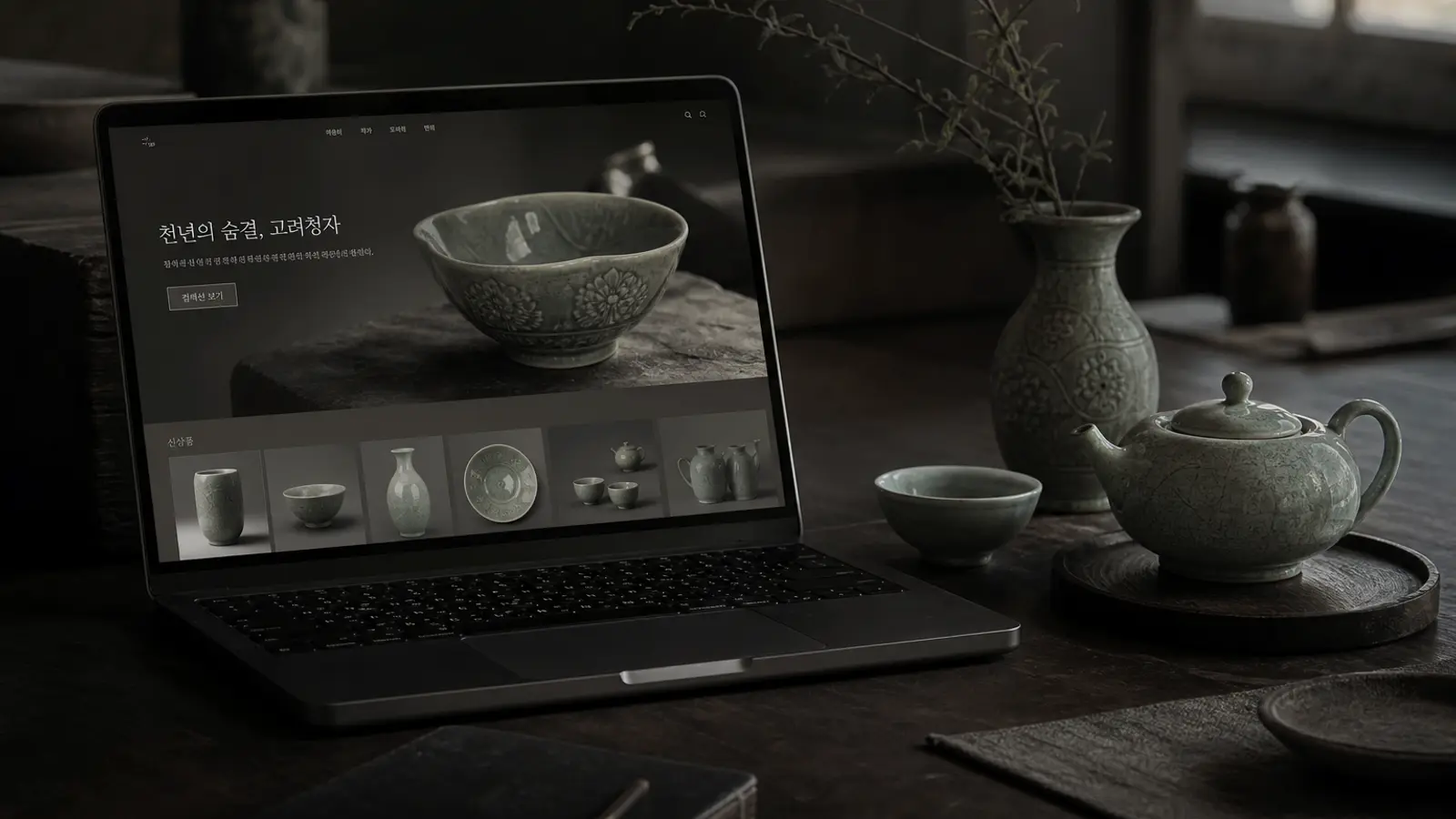
The best Korean teaware is not found through a search bar. It is made by a specific person, in a specific region, using clay and technique that carry a thousand years of accumulated knowledge. The piece you hold in your hands during an evening session — the weight of it, the texture under your thumb, the way the glaze pools unevenly where the maker’s hand moved fastest — that piece came from somewhere. Understanding where changes what you’re looking for and what you recognize when you find it.
Korean pottery is not one tradition. It is several, each rooted in a physical place. Goryeo celadon emerged from kilns in the south. Joseon white porcelain was produced at royal-appointed kilns near the capital. Buncheong (분청사기) developed from folk kilns scattered across the peninsula after the Goryeo-Joseon transition. The contemporary potters who work in these traditions are typically based in or near those historical centers — inheriting not just technique but clay, kiln atmosphere, and the aesthetic memory of the place itself.
When you know that a piece comes from Icheon versus Gangjin versus Mungyeong, you know something about its lineage, the clay body likely used, and the tradition the potter is working within. That context is the difference between buying a ceramic object and buying a ceramic piece.
The Pottery Regions
Icheon (이천) — Korea’s Ceramics Capital
Eighty kilometers southeast of Seoul in Gyeonggi Province. UNESCO Creative City of Crafts designation — one of roughly forty cities worldwide recognized for living craft traditions. Over 300 pottery studios operate within the city and surrounding area. The concentration is remarkable: designated national masters, mid-career studio artists, and emerging potters all working within a few kilometers of each other.
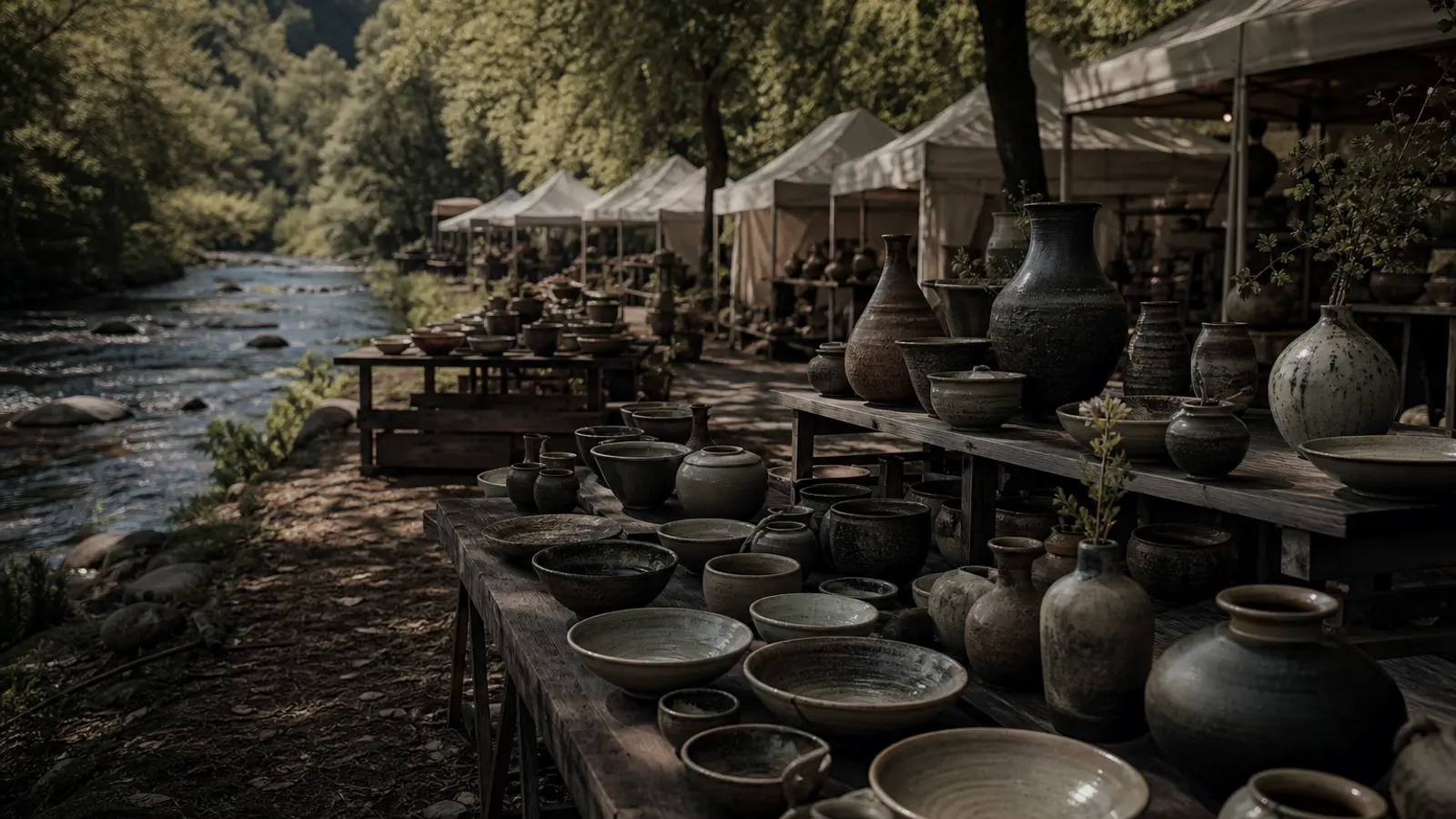
The annual Icheon Ceramics Festival (이천도자기축제), held each May, is the largest ceramics event in Korea and one of the most significant in Asia. Working kilns, demonstration firings, gallery exhibitions, and direct sales from hundreds of potters in a single location. For a serious buyer, it’s the most efficient access point to the full range of the tradition in one trip.
What Icheon produces: Goryeo-revival celadon with sanggam (상감, inlay) decoration. Joseon-style white porcelain. Contemporary interpretations of classical forms. The full spectrum — from entry-level production pieces to museum-quality designated master work. The studio density means price competition exists, which is unusual in the Korean ceramics market and works in the buyer’s favor.
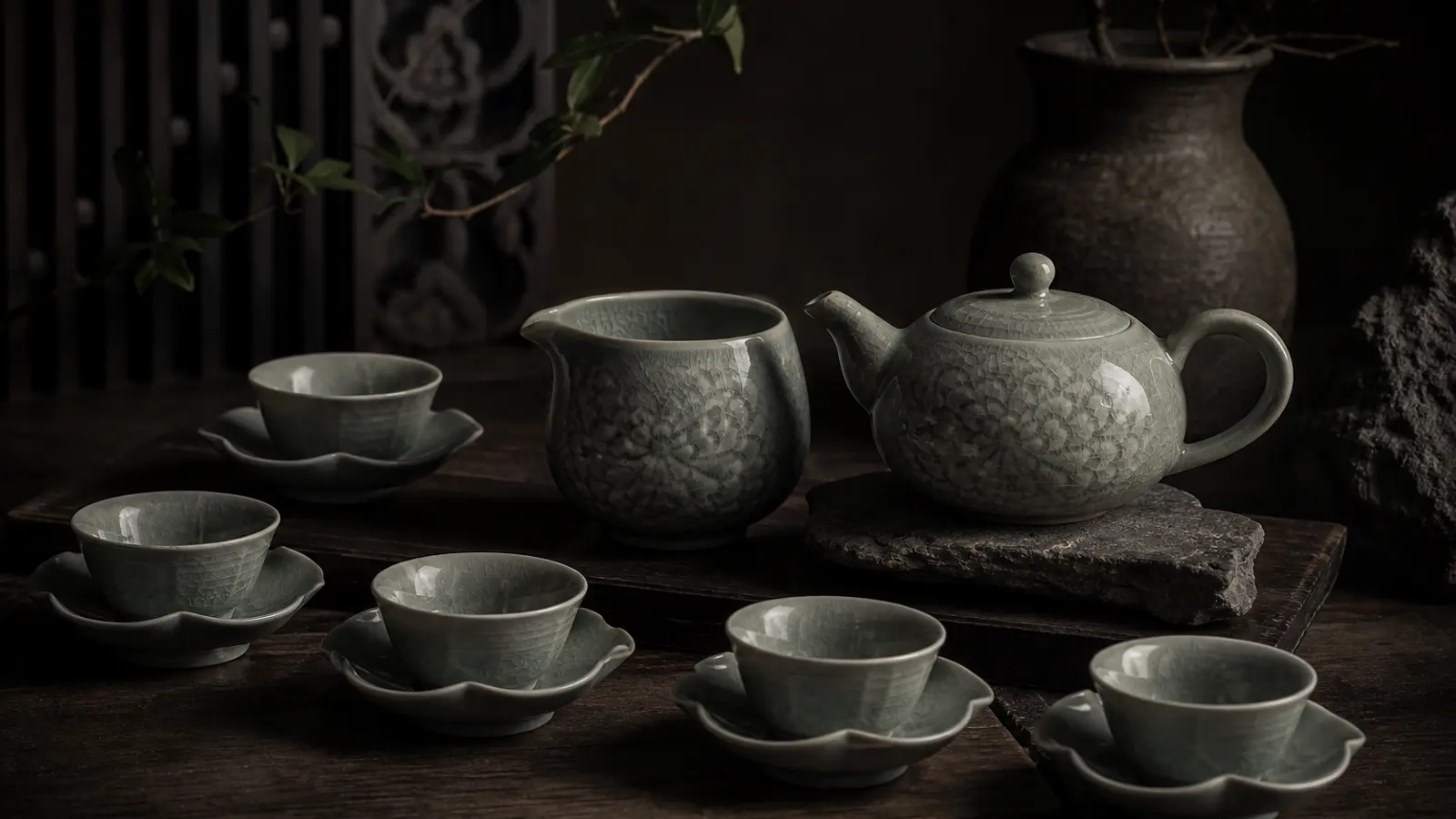
Why it matters for tea: Icheon celadon tea sets — teapot, fairness pitcher, cups, saucers — are the flagship Korean teaware category. The jade-green glaze (bisaek, 비색) that Song Dynasty China acknowledged as superior to their own is produced here by artisans who have spent decades refining the reduction-atmosphere firing that creates it. A celadon tea set from an Icheon master is functional art that connects your evening session to a thousand years of ceramic history.
Gangjin (강진) — The Celadon Heartland
South Jeolla Province, on the southwestern coast. This is where Goryeo celadon began — the archaeological kiln sites where ninth-century Korean potters first achieved the jade-green glaze are here, adjacent to the Gangjin Celadon Museum (강진청자박물관).
The studios in Gangjin work with celadon in a different register from Icheon. Less revival, more direct inheritance. The clay is local. The reduction firing follows traditions that connect to the original Goryeo-era production in ways that larger commercial centers don’t always replicate. The potters here tend to be less commercially oriented and more interested in the lineage — which means the work is sometimes harder to find and always worth the search.
The annual Gangjin Celadon Festival (강진청자축제), held in summer, draws collectors specifically interested in celadon’s direct historical lineage.
What Gangjin produces: Classical Goryeo celadon with historical glaze recipes. Sanggam inlay work referencing Goryeo originals. The closest living connection to the source tradition.
Why it matters for tea: If Icheon celadon is the polished contemporary expression, Gangjin celadon is the archaeological one — pieces that feel closer to the original Goryeo aesthetic. For a tea drinker who values historical depth over modern refinement, Gangjin is the origin point.
Mungyeong (문경) — The Tea Bowl Town
North Gyeongsang Province, in the mountainous interior. Mungyeong is specifically significant for the tea bowl tradition — the area has been producing sabal (사발, Korean tea bowls) continuously since the Joseon period, and several of the pieces that became revered Japanese tea ceremony bowls (Ido chawan, 이도다완) originated in kilns from this region.
The Mungyeong Traditional Pottery Festival (문경전통찻사발축제), held annually in late April to early May, is the most focused ceramics event in Korea for dawan (다완, tea bowl) buyers. The concentration on tea ceremony vessels — and the presence of potters who have dedicated entire careers to the sabal form — makes this the right destination for anyone who wants a single extraordinary tea bowl rather than a matching set.
The mountain setting and surrounding ceramics village (도자기마을) create a context that is noticeably more contemplative than Icheon’s commercial energy. You feel what you’re buying here.
What Mungyeong produces: Sabal tea bowls in ash-glazed, iron-glazed, and natural wood-ash finishes. Forms referencing Joseon folk pottery — the tradition that Japan elevated to sacred status.
Why it matters for tea: This is the wellspring of the 이도다완 (Ido chawan) tradition — the rough, asymmetric Korean folk bowls that Sen no Rikyū recognized as the highest expression of wabi-sabi and that Japanese tea ceremony still reveres as its most treasured objects. A dawan from Mungyeong is not just a vessel. It’s an argument about what beauty means.
Gwangju/Bunwon (광주/분원) — The Royal Kiln District
Gwangju in Gyeonggi Province — not to be confused with the city of the same name in South Jeolla — was the site of Bunwon (분원), the royal kilns that supplied the Joseon court with white porcelain for four centuries. The kiln site at Bunwon-ri operated under direct royal mandate from 1468 to 1883.
Contemporary potters in the Gwangju-Icheon corridor work primarily in the baekja (백자, white porcelain) tradition that originated here. The aesthetic is rigorous: pure white clay body, minimal ornamentation, forms that depend entirely on proportion and the quality of the white itself. The visual restraint is not poverty of technique. It is the technique.
What Gwangju produces: White porcelain in classical Joseon proportions. Blue-and-white cheonghwa baekja (청화백자) with brushed underglaze decoration.
Why it matters for tea: White porcelain is the neutral vessel — closest in function to a Chinese white porcelain gaiwan. For analytical tasting sessions where you want the tea and nothing else, Korean baekja serves the same purpose with a different cultural weight. The walls are typically thicker than Chinese porcelain, changing the heat retention and the feel in your hands.
Insadong and Anguk (인사동/안국) — Seoul’s Gallery District
For buyers in Seoul without time to travel to production regions, the Insadong-Anguk corridor in central Seoul is the primary destination for curated Korean ceramics. Traditional arts galleries and contemporary ceramics spaces cluster within walking distance of each other, carrying work from potters across all regions.
The range is wide — from tourist-facing commercial shops to serious curatorial operations representing individual artists. Learning to distinguish them quickly is the skill this neighborhood develops. The markers: provenance documentation, signed or sealed pieces, staff who can name the potter and describe the kiln. If the person selling the piece can’t tell you who made it and where, you’re in the wrong gallery.
The Dosan area nearby extends the curated ceramics scene into a more contemporary register — studio artists working at the intersection of traditional technique and modern form.
What you’ll find: The full price spectrum. Convenience at the cost of some curation vigilance.
Hadong (하동) — Where Tea and Pottery Meet
Hadong in South Gyeongsang Province is primarily known as Korea’s oldest tea origin — wild tea plants on the slopes of Jirisan dating back over a thousand years. But the intersection of tea culture and pottery tradition here is significant. The artisans who produce tea ceremony ware for the Jirisan tradition — tea bowls, small teapots, water warmers — are working in direct relationship with the tea culture the vessels serve.
Visiting Hadong for pottery means visiting it as a tea destination. The vessels you find here are not decorative objects — they are made by people who brew tea in them every day.
What to Look for When Buying
Buying Korean teaware — whether in person or remotely — means reducing uncertainty through documented information. The markers of trustworthy sourcing:
The potter’s seal (인장, injang). Most established Korean potters use a personal seal impressed or painted on the foot ring. The seal is the maker’s signature. No seal on a piece claiming named attribution is a flag worth investigating.
Clay and firing documentation. Reputable sources describe the clay body (Icheon white clay, buncheong clay, specific regional materials) and firing type (wood-fired jangjakgama 장작가마, electric kiln, gas reduction). Listings that describe only the visual appearance offer less provenance assurance than those documenting the making.
Glaze variation as a trust signal. Good Korean celadon has natural variation in glaze pooling and color across the surface. A source that acknowledges this variation — noting that pieces differ slightly because they are handmade — is more trustworthy than one presenting identical-looking documentation for supposedly handmade work.
Designated master verification. Pieces by designated masters (명장, myeongjang) or intangible cultural heritage holders (무형문화재, muhyeong munhwajae) carry verifiable provenance. The Korean Crafts Foundation (한국공예디자인문화진흥원) maintains a database of legitimate designations. Korean Master Potters Making Teaware Today profiles several active masters.
Price Calibration
The range in Korean teaware is wide, and understanding what different budgets access prevents both overpaying and underbuying.
Under $70 (₩100,000). Entry-level functional teaware. Small celadon cups, basic tea set components from established production workshops. Expect consistent forms from reputable kilns rather than individual artist work. Good for learning the vocabulary of Korean ceramics — how celadon feels in your hand, how buncheong’s texture changes the grip — without high financial risk. Start here.
$70-200 (₩100,000-280,000). The most interesting range for a practical buyer. Named workshop pieces, mid-tier gallery work, and individual tea bowls from serious emerging potters all become accessible here. A single well-chosen piece in this range — a buncheong dawan from a potter whose career you can follow — beats a matched set of uncertain-provenance pieces at half the price. This is where Korean teaware starts being personal.
$200-500 (₩280,000-700,000). Gallery-represented artists, individual pieces from designated masters, full matched tea sets from named workshops. Korean teaware at this level is competitive with high-tier Japanese studio pottery and mid-tier Yixing work — and often better value for equivalent craft and heritage depth.
Above $500 (₩700,000+). Significant designated-master works, heritage-line pieces, major studio productions. These are considered purchases that reward either a direct relationship with the studio or an informed intermediary who understands the market. The ceiling extends well above this — museum-quality pieces from Korea’s most celebrated living potters reach into the thousands.
Matching Vessel to Tea
The material choice shapes the session. For the full guide to using Korean teaware in gongfu practice:
Celadon (청자) works beautifully with green teas and light oolongs. The jade glaze and the tea’s pale liquor complement each other visually — aesthetics matter when you’re paying attention to every dimension of the experience. The thin-to-medium walls suit lower steeping temperatures. Celadon is the ceremonial vessel — refined, historical, composed.
Buncheong (분청) suits aged teas, roasted oolongs, and shou pu-erh. The earthy, textured surface absorbs and seasons slowly over years of use — building a patina that records your practice the way an old Yixing pot records its owner’s. The mechanisms differ (buncheong is semi-porous, Yixing is microporous with different clay chemistry) but the principle is the same: the vessel develops memory. Buncheong is the daily companion — rough, warm, alive.
White porcelain (백자) is the neutral instrument. Closest in function to a Chinese white porcelain gaiwan — clean, non-reactive, reveals the tea without adding character. Use it when the tea is the only variable you want to evaluate. White porcelain is the analytical tool.
Building a Collection
Rather than buying a full matching set immediately, build piece by piece around a single aesthetic lineage. Korean ceramic hyang (향 — the sensory and aesthetic presence of an object) accumulates through coherence, not completeness.
A practical sequence: start with two or three teacups from one potter or tradition. Use them daily. Develop an understanding of what you’re drawn to — the celadon’s cool elegance or the buncheong’s earthy warmth or the baekja’s quiet restraint. Then find a teapot or dawan that shares the aesthetic. Let the collection grow from practiced preference, not from impulse.
Mismatched Korean teaware from thoughtful sources reads as intentional — the Korean aesthetic of sobakham (소박함, understated simplicity) embraces imperfection and asymmetry. A celadon cup next to a buncheong bowl next to a white porcelain pitcher is not a clash. It’s a conversation between traditions. But the conversation only works if each piece was chosen with attention. The $4.5 million moon jar that broke auction records was valued precisely because its asymmetry was deliberate — the imperfection was the art.
A Note on Access
The reality of sourcing serious Korean teaware internationally is this: the best work is largely invisible to the international market. Most designated masters don’t maintain international-facing websites. Many don’t maintain websites at all. The gallery and studio ecosystem that connects Korean potters to serious buyers operates primarily in Korean — through Korean craft platforms, Korean social media, and personal relationships built through studio visits and festival attendance.
This is an access problem that Steep Atlas is positioned to solve. My wife is Korean. Our sourcing operates through Korean-language networks. We visit the studios, read the artisan portfolios in the original language, and understand the cultural context that determines whether a piece is production work or genuine craft.
We’re building a curated selection of Korean teaware sourced directly from master potters and established studios — pieces with documented provenance, verified maker attribution, and the kind of context that the international marketplace cannot offer. The collection will be small, selective, and backed by the editorial depth that every article on this site represents.
When it launches, newsletter subscribers hear first.
Frequently Asked Questions
Can you buy Korean teaware outside Korea?
Limited options exist internationally. Some Korean craft platforms offer international shipping, and individual potters occasionally sell through international gallery representation. The best selection and the best prices are accessible through Korean-language channels — which is the access gap Steep Atlas is building to bridge.
How much does Korean teaware cost?
The range spans from under $35 for basic production celadon cups to several thousand dollars for designated-master work. The most interesting range for a serious tea drinker building a first collection is $70-200, where named workshop pieces and emerging artist work become accessible. Korean teaware at equivalent craft and heritage level is often more affordable than Japanese or Chinese artisan teaware.
What is the best region for Korean pottery?
Each region specializes differently. Icheon is the broadest — the most studios, the widest range, the biggest festivals. Gangjin is deepest for celadon specifically — the historical heartland. Mungyeong is the destination for tea bowls (dawan). Hadong is where tea and pottery intersect. The “best” region depends on what you’re looking for.
Is Korean teaware good for gongfu brewing?
Yes. Korean gaewan (개완, the Korean gaiwan) features thicker walls than Chinese porcelain gaiwan, providing different heat retention. Korean dawan (다완, tea bowls) held with both hands create a contemplative, grounding experience particularly suited to evening shou pu-erh sessions. The semi-porous bodies of celadon and buncheong season over time, developing character with use. Korean teaware serves gongfu practice differently than Chinese vessels — less precision-focused, more presence-focused. Both have a place. The complete guide to Korean teaware for gongfu covers vessel selection in detail.