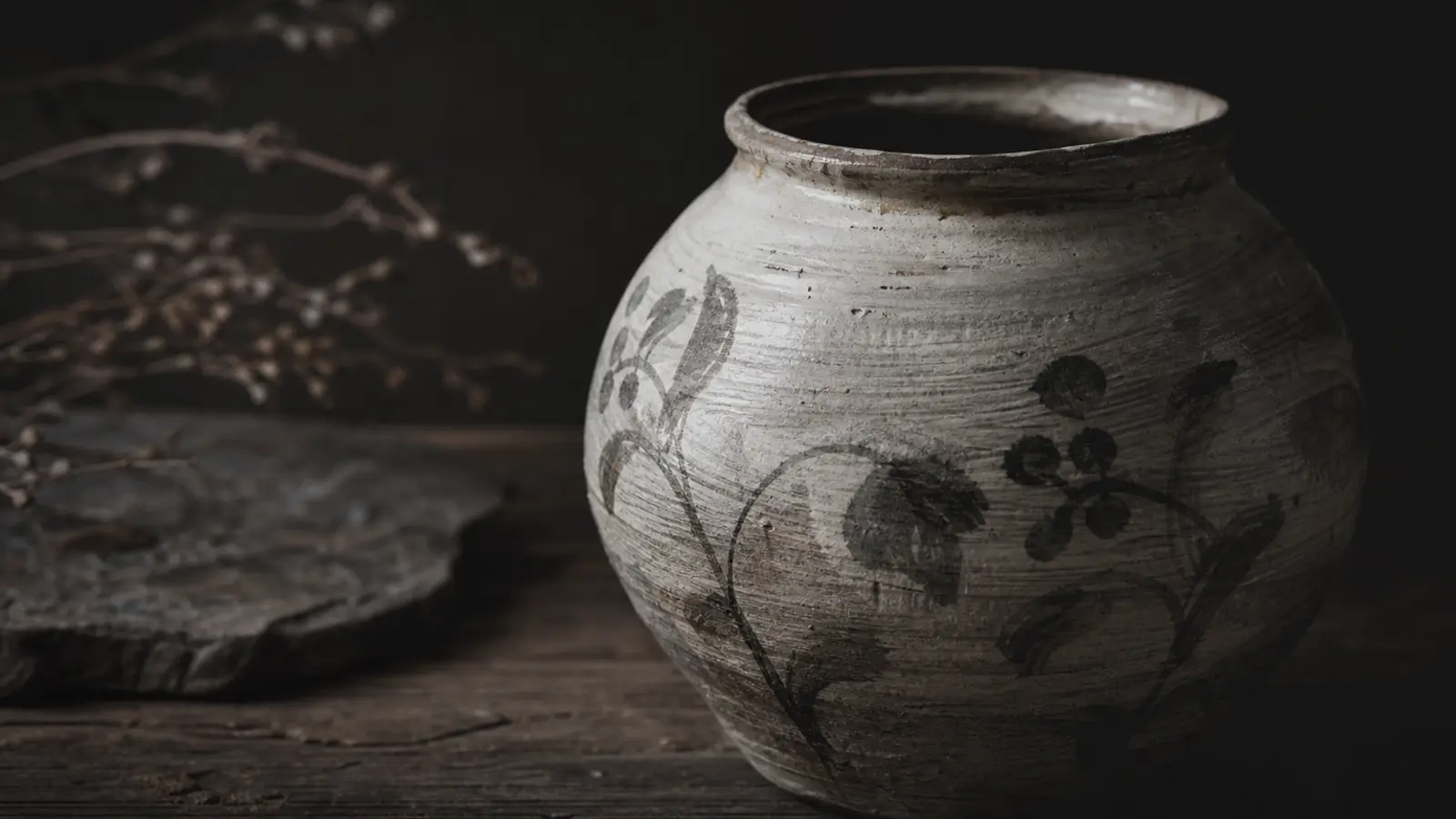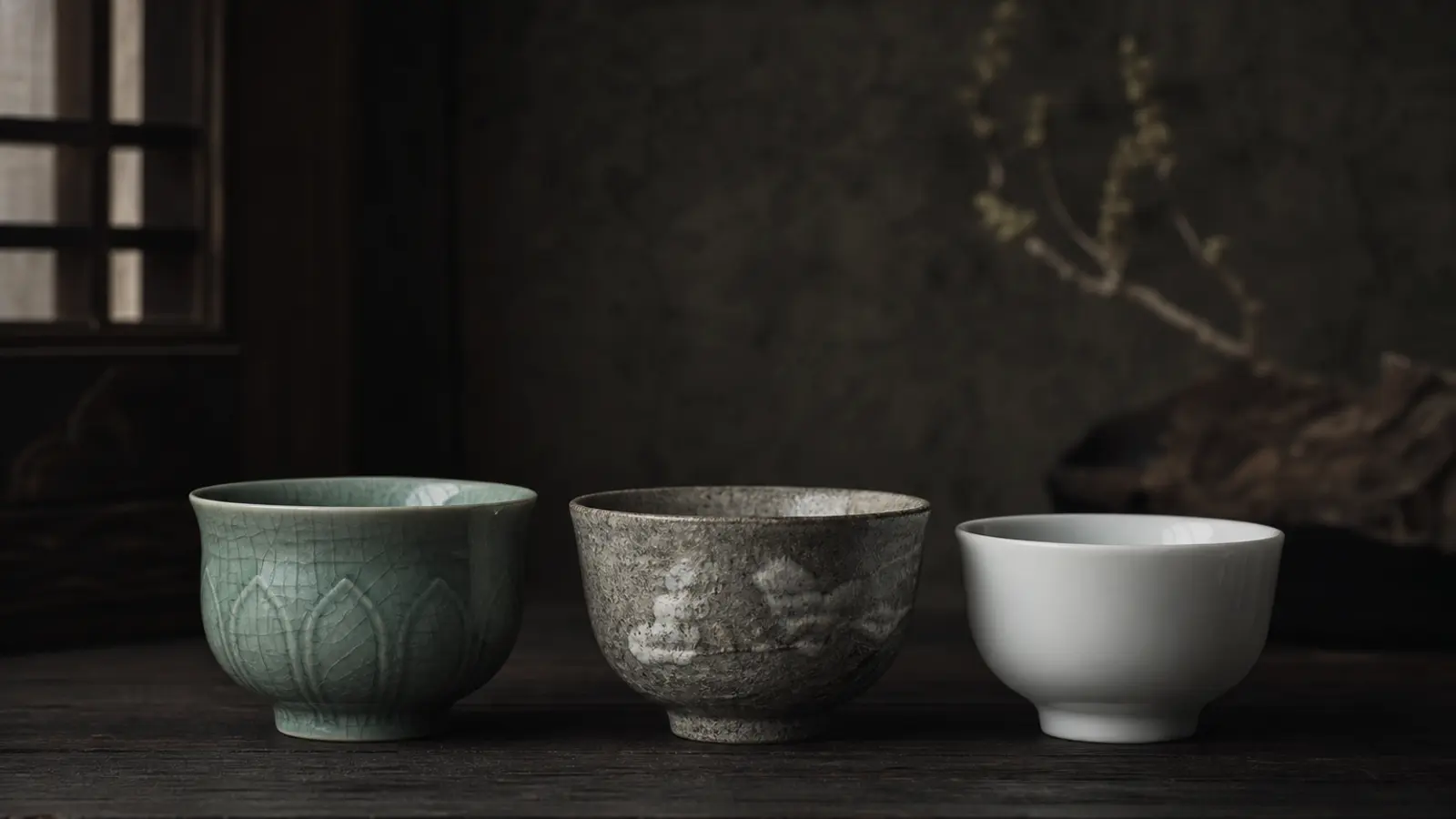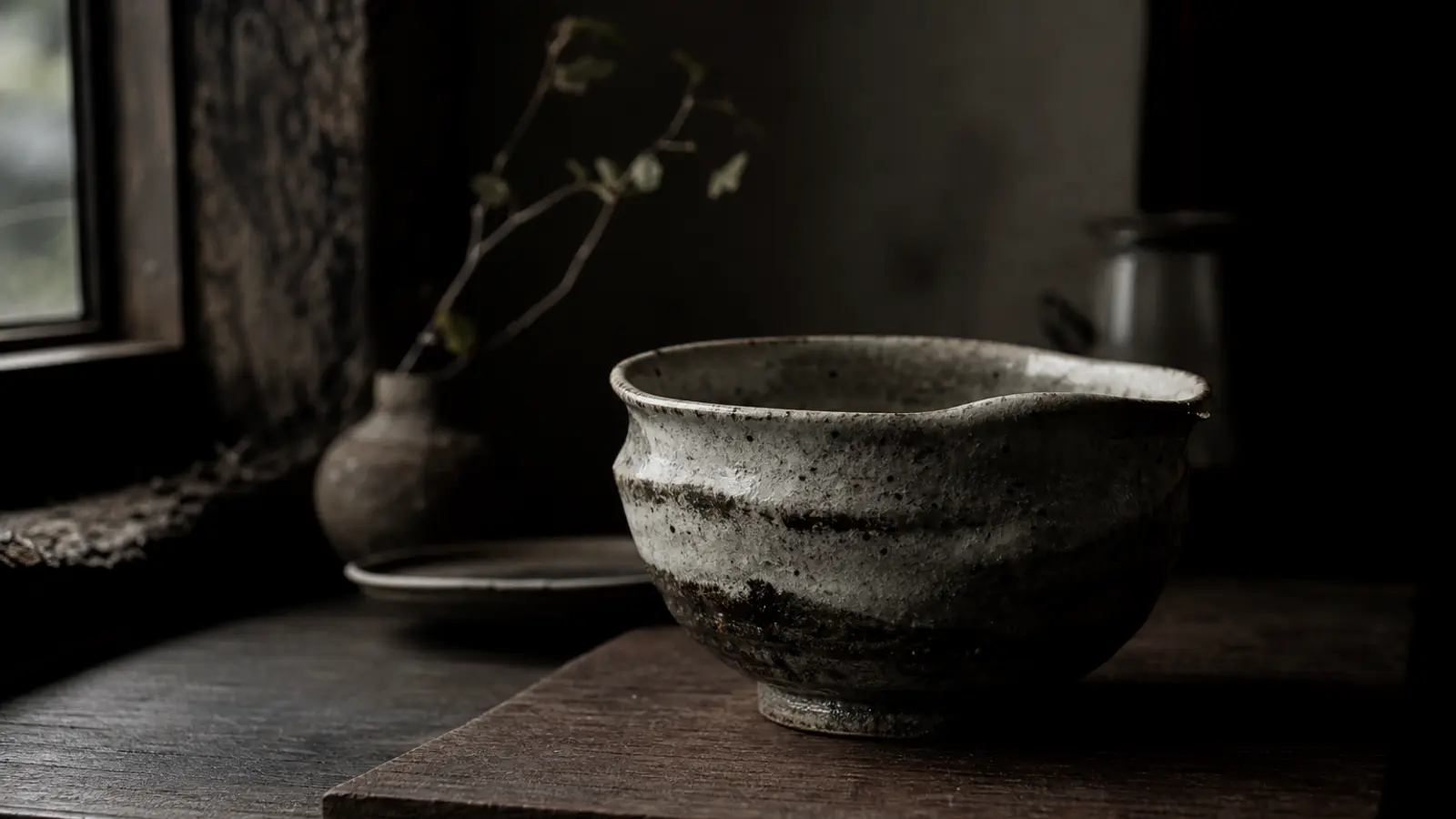
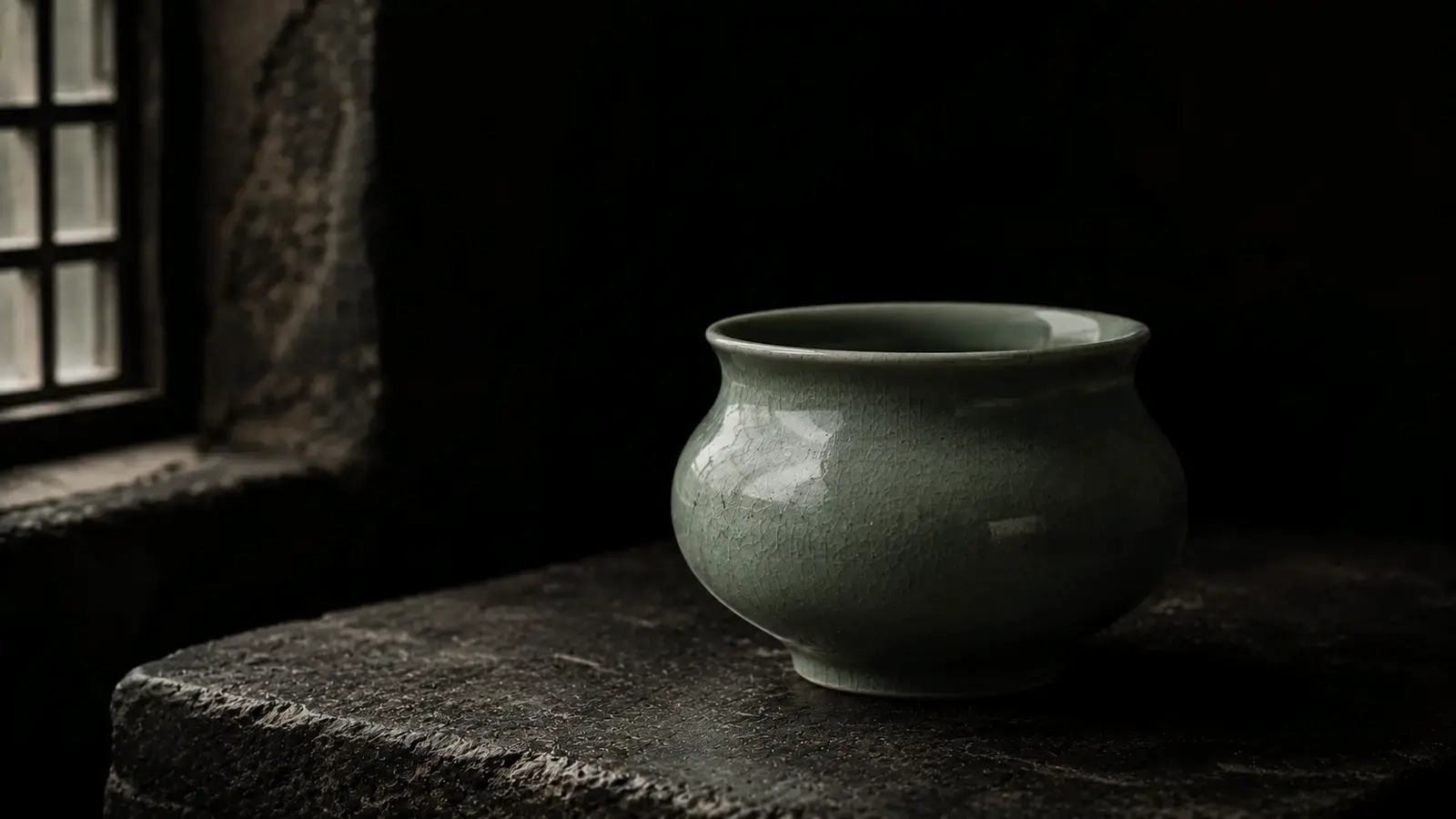
Goryeo celadon (고려청자, 高麗靑瓷) is the jade-green glazed ceramic produced during Korea’s Goryeo Dynasty (918-1392) — acknowledged by Chinese Song Dynasty scholars as “first under heaven” (天下第一) for the translucent quality of its bisaek (비색, jade color) glaze. The sanggam (상감) inlay technique — carving designs into clay and filling with contrasting slip — was invented in Korea and has no Chinese or Japanese equivalent.
Jade (翡翠, fěicuì in Chinese, 비취 bichui in Korean) occupied a position in East Asian culture that has no clean Western equivalent. It was simultaneously a precious material, a moral symbol, and a spiritual substance. Confucian texts compared its virtues to those of the ideal gentleman: hard yet yielding, luminous without ostentation, cool under the hand. To possess jade was to possess something ancient, earth-formed, morally weighted.
When Goryeo potters achieved a glaze that evoked jade — not merely resembled it but called it to mind with the same quality of light — they had done something culturally significant. The Korean scholar 이색 (Yi Saek, 1328–1396) wrote poetry comparing Goryeo celadon to “jade reflecting the sky.” That line is worth pausing over. Not jade. Not the sky. Jade reflecting the sky — a dynamic optical quality, the sense of depth and movement in the glaze surface. Yi Saek understood exactly what he was seeing.
The color itself has a precise material explanation. Iron oxide, present in concentrations typically between 1% and 3% in the glaze recipe, transforms under the right conditions from the warm browns it produces in an oxidizing kiln atmosphere to something cooler and more complex when oxygen is restricted. In a reduction atmosphere — a kiln environment where incomplete combustion creates oxygen-hungry gases that pull oxygen from iron compounds in the glaze — iron shifts from its oxidized state to a reduced state, and the optical result is that blue-green that bisaek describes.
This is the same chemistry that produces Chinese Longquan celadon (龍泉青瓷), Thai Sawankhalok celadon, and every other celadon tradition. The chemistry is universal. The results are not. Firing temperature (Goryeo potters typically worked between 1250°C and 1280°C), the specific clay body composition, the rate of temperature change, the tightness of reduction control in the kiln’s final stages — all of these interact. The difference between acceptable celadon and bisaek is the difference between a winemaker producing correct Pinot Noir and a winemaker producing great Burgundy. The grape is the same. The conditions, the attention, the accumulated knowledge are not.
How Goryeo Potters Found the Color
Goryeo Dynasty Korea (918–1392 CE) began producing celadon in the late 10th century, drawing on both Chinese Five Dynasties and early Northern Song techniques brought by potters who crossed the Yellow Sea. The early wares were technically competent but not yet distinctive. The first century of production was, in effect, a long apprenticeship to Chinese ceramic traditions.
The transformation happened along the southern coast of the Korean peninsula, particularly in the region that is now Gangjin (강진) in South Jeolla Province, where the combination of suitable local clays, abundant timber for kilns, and access to sea transport created conditions for extended technical refinement. Hundreds of kiln sites have been excavated in and around Gangjin; the accumulation of waster shards at some sites suggests generations of continuous production, each generation building on the failures and successes of the last.
By the mid-11th century, Korean potters had not only matched the Chinese standard for celadon glaze quality — they had exceeded it in the specific characteristic the Chinese themselves most valued. The Song Dynasty Chinese who observed Korean celadon firsthand weren’t being politely diplomatic when they praised it. The documentary record is consistent: bisaek represented something the Chinese kilns, despite their longer history and greater technical infrastructure, had not achieved to the same degree. The likely explanation is not mystical but practical: Korean potters were working with slightly different clay bodies, slightly different glaze compositions, and had developed kiln firing protocols optimized specifically for their local materials rather than inherited from a broader tradition.
Sanggam: The Korean Innovation That Changed Everything
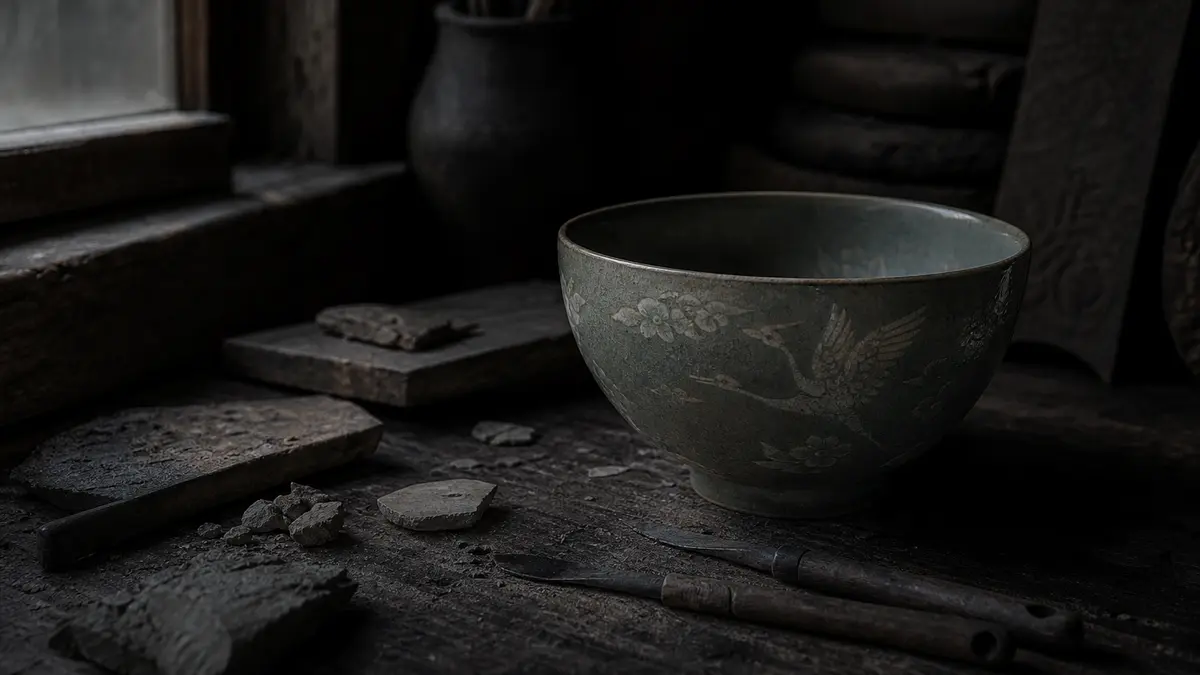
If bisaek is what Goryeo celadon is named for, sanggam (상감) is what makes it unique in world ceramic history.
The technique works like this. The potter forms a vessel and allows it to dry to the leather-hard stage — firm enough to hold its shape, soft enough to carve. Using sharp tools, the potter cuts the design into the clay surface: lines, shapes, outlines of flowers or birds or geometric patterns. The depth of the cut is critical; too shallow and the inlay won’t hold, too deep and the vessel wall weakens. Then, before the clay dries completely, the recessed areas are filled with contrasting slip: white kaolin clay (백토, baekto) for white inlay, iron-rich clay (자토, jato) for dark inlay. The surface is scraped flush. The vessel is dried, glazed, and fired.
The result is decoration that exists within the clay body rather than on top of it. After firing, the inlaid design sits at exactly the surface level — not raised, not recessed, just there, as if it always had been. The white inlay emerges as bright white against the grey-green of the fired clay and glaze. The dark inlay reads as near-black. The bisaek glaze pools over everything equally, unifying surface and decoration into a single cohesive object.
No Chinese potter independently developed this technique, despite centuries of ceramic production at far greater scale than anything in Korea. No Japanese potter developed it either. Sanggam is, as far as the historical record shows, a Korean invention — likely developed at the Gangjin kilns in the 12th century and refined through the 13th century into its most sophisticated forms. The historical question of exactly how it was invented remains open; there are no written accounts of the moment of discovery. What the excavated kiln records show is a gradual refinement from simpler single-color inlay to complex multi-element compositions involving both white and dark inlay in the same piece.
The technique’s sophistication lies in its demands on the potter’s judgment at every stage. The clay must be at exactly the right moisture content for carving. The inlay slips must shrink at nearly the same rate as the body clay during drying and firing, or the inlay will crack and fall out. The glaze must be applied at the right thickness to read the inlay clearly without obscuring it. A two-color sanggam piece with a complex design represents dozens of interdependent decisions, each of which can fail.
The Motifs and What They Mean
Goryeo celadon decoration operates in a symbolic vocabulary that rewards knowing. The three most prevalent motifs each carry specific meaning.
Crane-and-cloud (운학문, unhangmun) is the defining Goryeo celadon image. Cranes in East Asian iconography represent longevity, nobility, and transcendence — they are birds of the immortals, inhabitants of the space between earth and heaven. Clouds represent the celestial realm. Cranes flying through clouds place the viewer’s imagination in the space between worlds. On a celadon vessel, rendered in white inlay against that jade-green ground, the image achieves exactly the quality Yi Saek described: something between material and sky. The unhangmun motif appears on everything from wine ewers to incense burners to tea bowls, always with that same compressed elegance.
Plum blossom (매화, maehwa) represents resilience and the emergence of beauty under difficult conditions — the plum blooms in winter, before any other flowering tree. This made it a favorite subject for literati painting and poetry, and its ceramic rendering carries the same associations. A maehwa sanggam bowl is a contemplative object.
Chrysanthemum (국화, gukhwa) signals integrity and scholarly virtue. In the Confucian symbolic system the Goryeo court inhabited, the chrysanthemum’s late-season flowering despite cold represented the principled person’s resistance to compromise. It appears frequently on ceremonial wares and objects associated with the court.
These motifs were not arbitrary decoration. They communicated the cultural and moral aspirations of the people who commissioned and used these objects. A Goryeo celadon piece bearing crane-and-cloud inlay was a statement about longevity and transcendence. It was also, simply, beautiful — the symbolic and aesthetic functions were never separate.
What Happened to the Tradition
The Goryeo Dynasty ended in 1392, replaced by the Joseon Dynasty, which brought with it a Confucian ideological orientation that, paradoxically, led away from celadon’s elaborate aesthetic. The early Joseon period produced buncheong (분청사기) — a more vernacular, energetic, deliberately less refined ceramic tradition that retained sanggam inlay among other techniques but applied it with a looser hand and a different sensibility. Later Joseon ceramics moved toward the pure white of porcelain (백자, baekja), which aligned better with Neo-Confucian aesthetic values of simplicity and moral clarity.
Goryeo celadon’s specific tradition — bisaek glaze, refined sanggam, the specific symbolic motifs — effectively ended with the dynasty. The kilns at Gangjin fell silent. The knowledge of exactly how to achieve bisaek, transmitted through working master-apprentice relationships, fragmented.
The 20th century brought serious revival efforts, supported in part by the South Korean government’s designation of human cultural treasures in traditional crafts. The research required to reconstruct bisaek production involved archaeological excavation of kiln sites, chemical analysis of historical wasters, and extended practical experimentation by potters willing to spend years on a specific technical problem.
Modern Masters of an Ancient Tradition
The living practitioners keeping Goryeo celadon alive represent different facets of the tradition.
보광 조세연 (Bogwang Cho Seyeon), based in Icheon (이천) — itself a significant ceramic production center — holds government designation as a master specializing in reproducing national treasure pieces. His work focuses on reconstructing the precise glaze chemistry and firing protocols of Goryeo’s peak period. The reproduction of a national treasure is not copying for its own sake; it is the most rigorous possible documentation of what the original potters achieved and how they achieved it.
서광 박병호 (Seogwang Park Byeongho) specializes in 투각 (tugak), openwork — a technique where the vessel wall is pierced with cut-through patterns, creating a lattice of clay with the glaze pooling in the openings. Openwork celadon represents one of the most technically demanding expressions of the form; the vessel must survive both the carving process and the kiln without the structural support of a solid wall.
예진 한기웅 (Yejin Han Giung) focuses on national treasure reproduction with particular attention to complex sanggam compositions. His work documents what is possible when the inlay technique is pushed to its limits.
These makers are not museum curators working in clay. They are active potters engaging with a living technical tradition, making objects that function as both historical documentation and contemporary craft. The distinction matters. Goryeo celadon’s survival as a tradition — not merely as a historical artifact — depends on people who actually throw clay, mix glazes, and fire kilns.
The Same Impulse, Three Cultures
The pursuit of a jade-like glaze wasn’t uniquely Korean. Chinese Longquan potters worked toward the same ideal for centuries. Thai potters at Sawankhalok and Si Satchanalai — producing the celadon that shaped Southeast Asian ceramic trade from the 13th through 16th centuries — were working the same vein. Same iron oxide chemistry, same reduction firing, same aesthetic aspiration rooted in jade’s cultural meaning.
What Korean potters added to this shared project was sanggam — a solution to a different problem entirely. Not the glaze surface, but what to do inside it. The Chinese answer was carved relief decoration under the glaze, or painted decoration over it. The Korean answer was to put the decoration inside the clay body itself, flush with the surface, so that glaze and decoration existed in the same plane. That is a fundamentally different way of thinking about the relationship between material, surface, and image.
The parallel to Burgundy is apt here, though I’d frame it slightly differently. The pursuit of bisaek is less like the pursuit of balance and more like the pursuit of terroir expression — the attempt to make something that could only come from this specific place, these specific materials, this specific accumulated knowledge. Longquan celadon and Goryeo celadon are both celadon the way Chambolle-Musigny and Gevrey-Chambertin are both Burgundy: same grape, same general geography, different results that reflect different soils, different exposures, different generations of human decision-making. The jade-green ideal was shared. What Korean potters made of it was distinctly their own.
Seeing Goryeo Celadon in Person
Text and photographs do not fully convey bisaek. The glaze has an optical depth — that quality Yi Saek described as jade reflecting the sky — that requires seeing under natural light, ideally at different angles, to appreciate fully. Museum photographs tend to flatten the surface and shift the color toward either grey or blue-green depending on the lighting used; neither is quite right.
The National Museum of Korea in Seoul holds the most important public collection, including the famous National Treasure No. 68, a melon-shaped ewer whose glaze quality represents the peak of what Goryeo potters achieved. The Gangjin Celadon Museum places the finished wares in the context of their production — the kiln sites, the waster shards, the archaeology of how these objects were made rather than just what they look like. Outside Korea, the Metropolitan Museum of Art, the British Museum, and the Victoria and Albert Museum each hold representative pieces.
If you have the opportunity to handle a piece — even a reproduction by a Korean master potter — the weight and temperature of celadon are part of its communication. It is denser and cooler than most people expect. The glaze under the fingertip feels like compressed stone. The bisaek color, seen from a centimeter away rather than across a gallery case, has a crystalline interior quality.
That quality is what the Song Dynasty Chinese recognized, what Yi Saek put into verse, and what generations of Korean potters spent their working lives trying to achieve and transmit. The name — celadon named after jade — is accurate not as metaphor but as description. The best Goryeo pieces don’t remind you of jade. They make you reconsider what jade was trying to be.