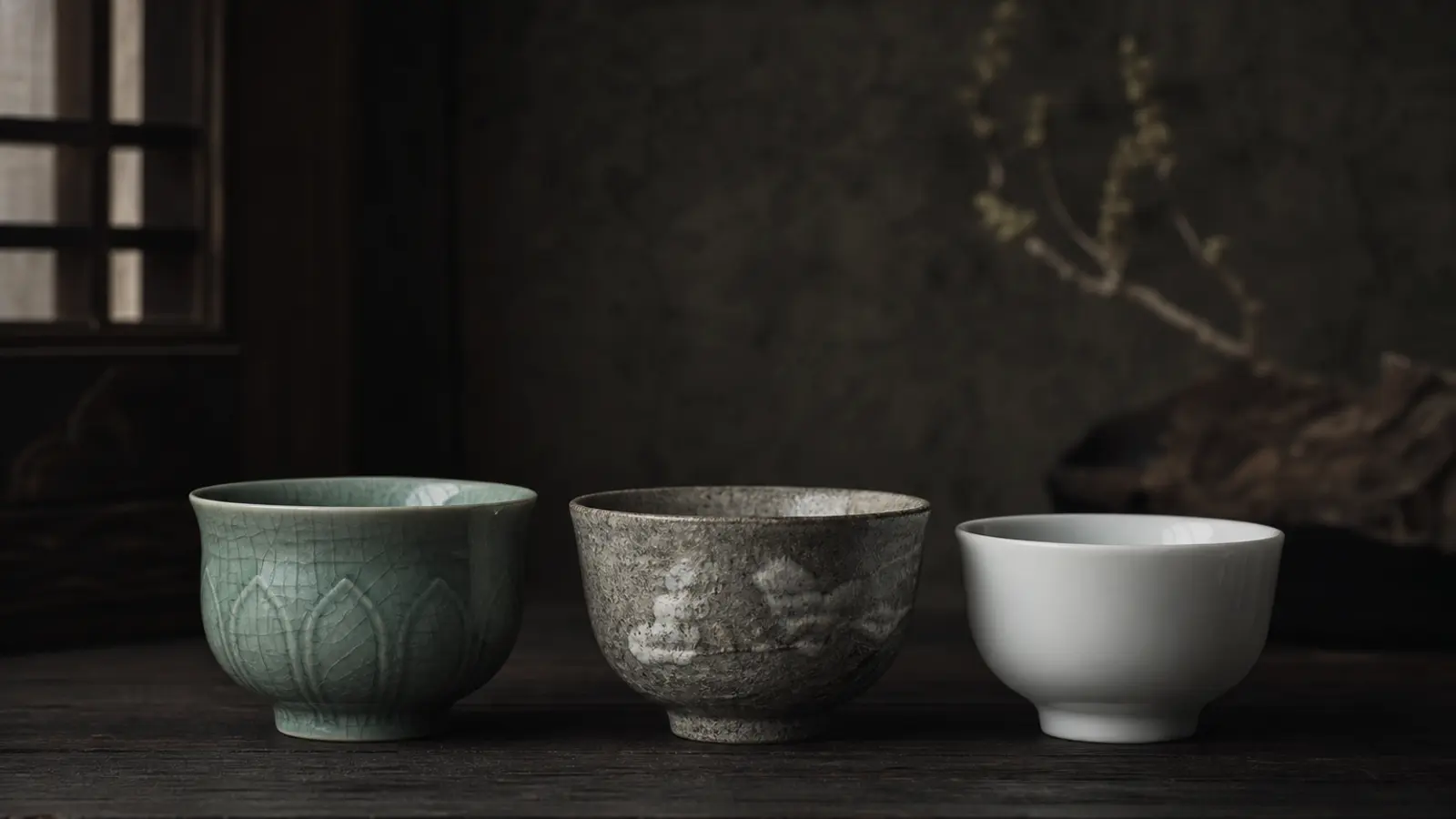
Korea’s three ceramic traditions — celadon, buncheong, and white porcelain — represent three distinct aesthetic philosophies that span a thousand years of Korean cultural history and produce three fundamentally different relationships between the vessel and the tea it holds. Each one emerged partly in reaction to the tradition before it. Each one answers the question of what beauty means in a vessel with a different and fully considered answer.
Understanding the sequence matters. Celadon (청자 cheongja) set a standard of aristocratic refinement that became, over centuries, a kind of cultural weight. Buncheong (분청사기) broke away from that weight toward something rawer and more alive. Baekja (백자) then stripped away even buncheong’s exuberance and arrived at pure restraint. The arc is not one of improvement — it is one of philosophical argument, each tradition making its case across generations.
For the tea drinker, the practical stakes are real. These three traditions produce vessels that feel different in your hands, retain heat differently, interact with tea differently, and create entirely different drinking experiences. Choosing between them is not just an aesthetic decision. It is a decision about what kind of attention you want to bring to a session.
What Is the Difference Between Celadon, Buncheong, and Baekja?
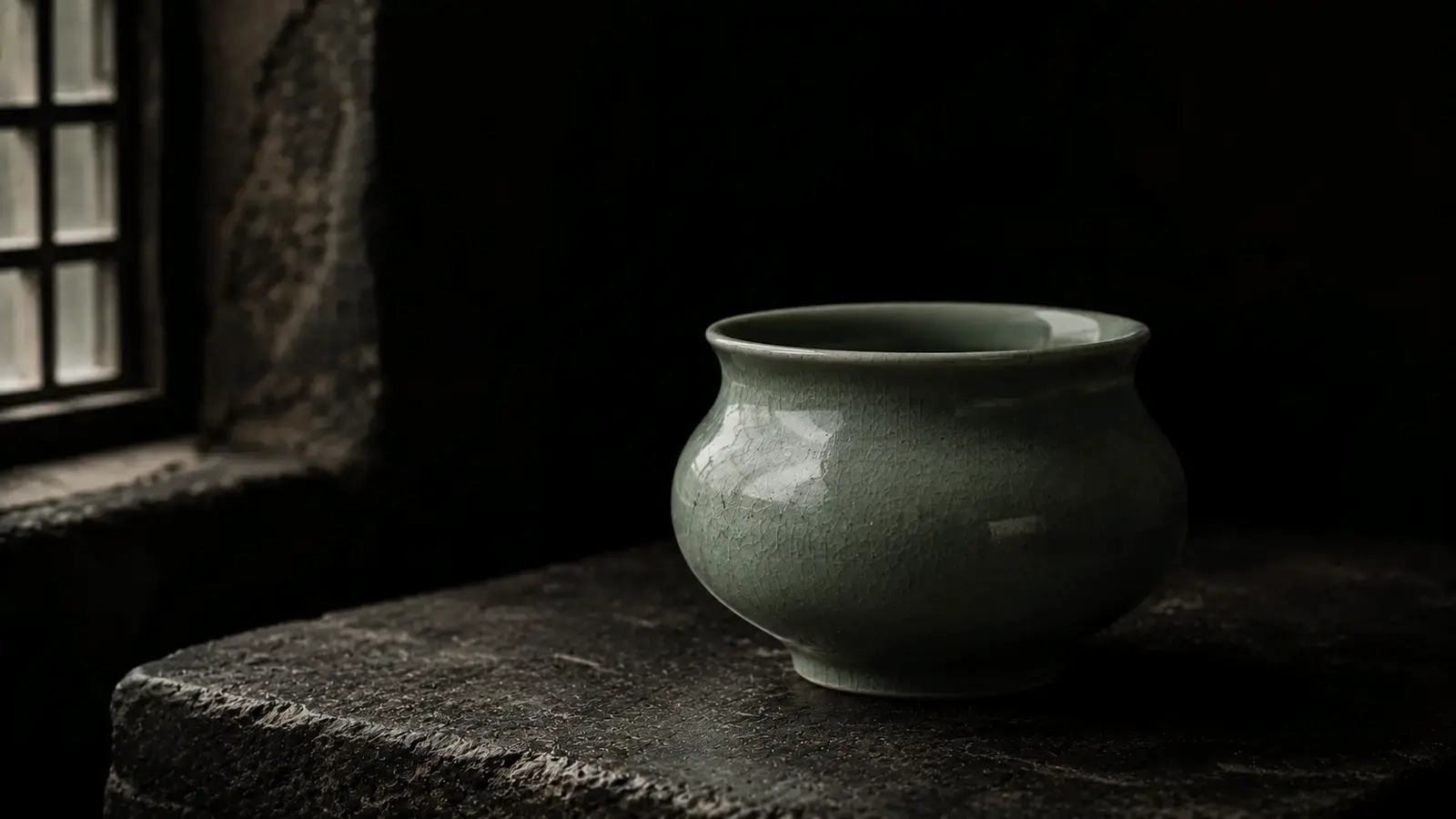
Celadon (청자) is defined by its jade-green glaze and refined Goryeo-dynasty origins. Buncheong (분청) emerged after celadon’s decline — rougher, freer, decorated with white slip over dark clay. Baekja (백자) is Korean white porcelain, the Joseon dynasty’s ideal of restraint and purity. Three aesthetics, three dynasties, three philosophies of form.
At a Glance:
| Attribute | Celadon (청자) | Buncheong (분청사기) | Baekja (백자) |
|---|---|---|---|
| Dynasty / Period | Goryeo (10th–14th c.) | Goryeo-Joseon transition (14th–16th c.) | Joseon (15th–19th c.) |
| Aesthetic philosophy | Aristocratic refinement | Democratic spontaneity | Philosophical restraint |
| Glaze / Surface | Jade-green reduction glaze (bisaek 비색) | White slip over dark body | Clear glaze over white porcelain |
| Tea pairing | Green tea, light oolong | Aged teas, roasted oolong, shou pu-erh | Any tea; best for neutral evaluation |
| Builds patina? | No | Yes, significantly | No |
| Price range (contemporary) | $40–$400+ per cup | $30–$250+ per cup | $35–$300+ per cup |
The Historical Arc: How Each Tradition Emerged
Celadon and the Goryeo Ideal
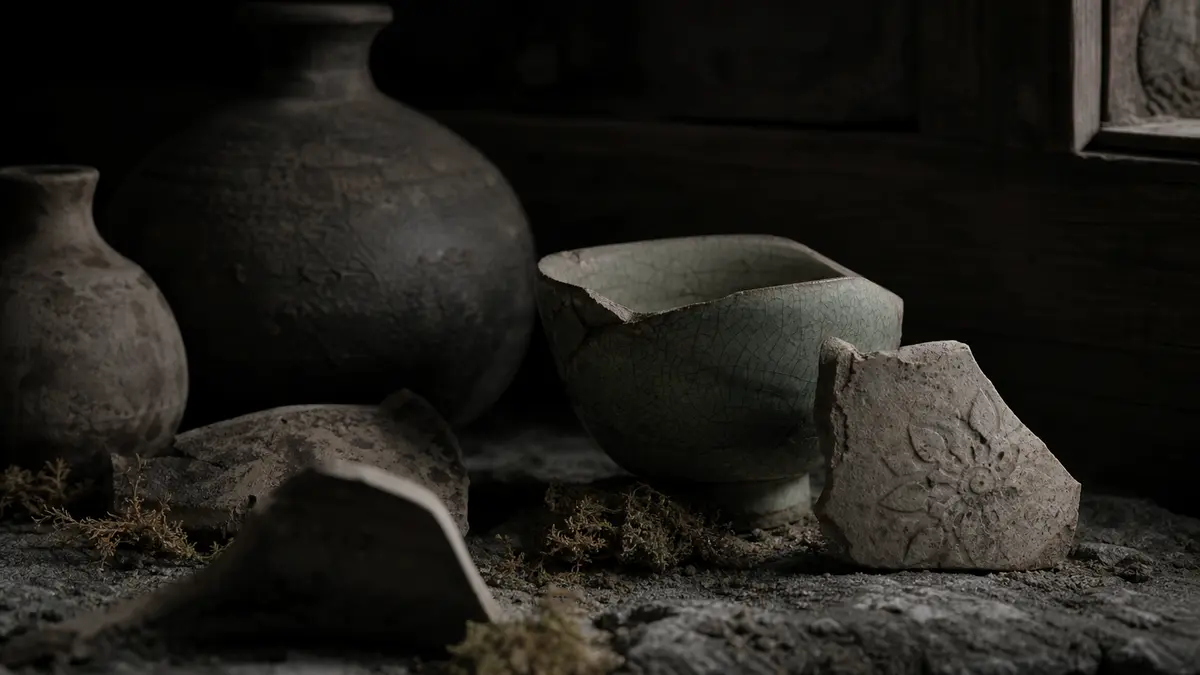
Korean celadon reached its peak during the Goryeo Dynasty (918–1392), when court culture placed enormous value on refinement, scholarship, and Chinese-influenced aesthetics. Korean potters studied Chinese Yue ware and eventually produced something that Chinese connoisseurs themselves acknowledged as exceptional: a jade-green glaze of extraordinary depth and translucency.
The aesthetic target had a name: 비색 (bisaek), literally “secret color” or jade color. It described a specific quality of green — not opaque, not simply green, but something suggesting jade and sky simultaneously, with depth that seems to come from inside the glaze rather than sitting on its surface. Song Dynasty Chinese ceramics scholar Xu Jing wrote in 1124 that Korean celadon was among the finest he had seen. That is not a minor endorsement.
The signature decorative technique — 상감 (sanggam) inlay — is uniquely Korean. Potters incised designs into the clay body, pressed white or red slip into the incisions, scraped the surface clean, and applied the celadon glaze over the top. After firing, the inlaid designs appear beneath the translucent glaze as subtle white or dark patterns: cranes, clouds, chrysanthemums, willows. The effect is precise and restrained. Every line was deliberate.
Celadon production collapsed with the fall of the Goryeo Dynasty and the Mongol invasions. The specific conditions that produced the finest bisaek glaze — particular kiln sites, specific clay compositions, accumulated generational knowledge — were largely lost. Contemporary celadon revivalists work from surviving vessels and documented reconstruction efforts, and the best modern work is serious. But the Goryeo peak occupies a particular place in the historical record that cannot be replicated.
Buncheong and the Democratic Break
Buncheong emerged at the transition between Goryeo and Joseon, roughly the 14th through 16th centuries, and it represents a fundamental shift in sensibility. Where celadon was court production aimed at aristocratic ideals, buncheong was made in provincial kilns for a broader range of uses. The clay was the same iron-rich stoneware body that had produced celadon, but the glazing approach changed entirely.
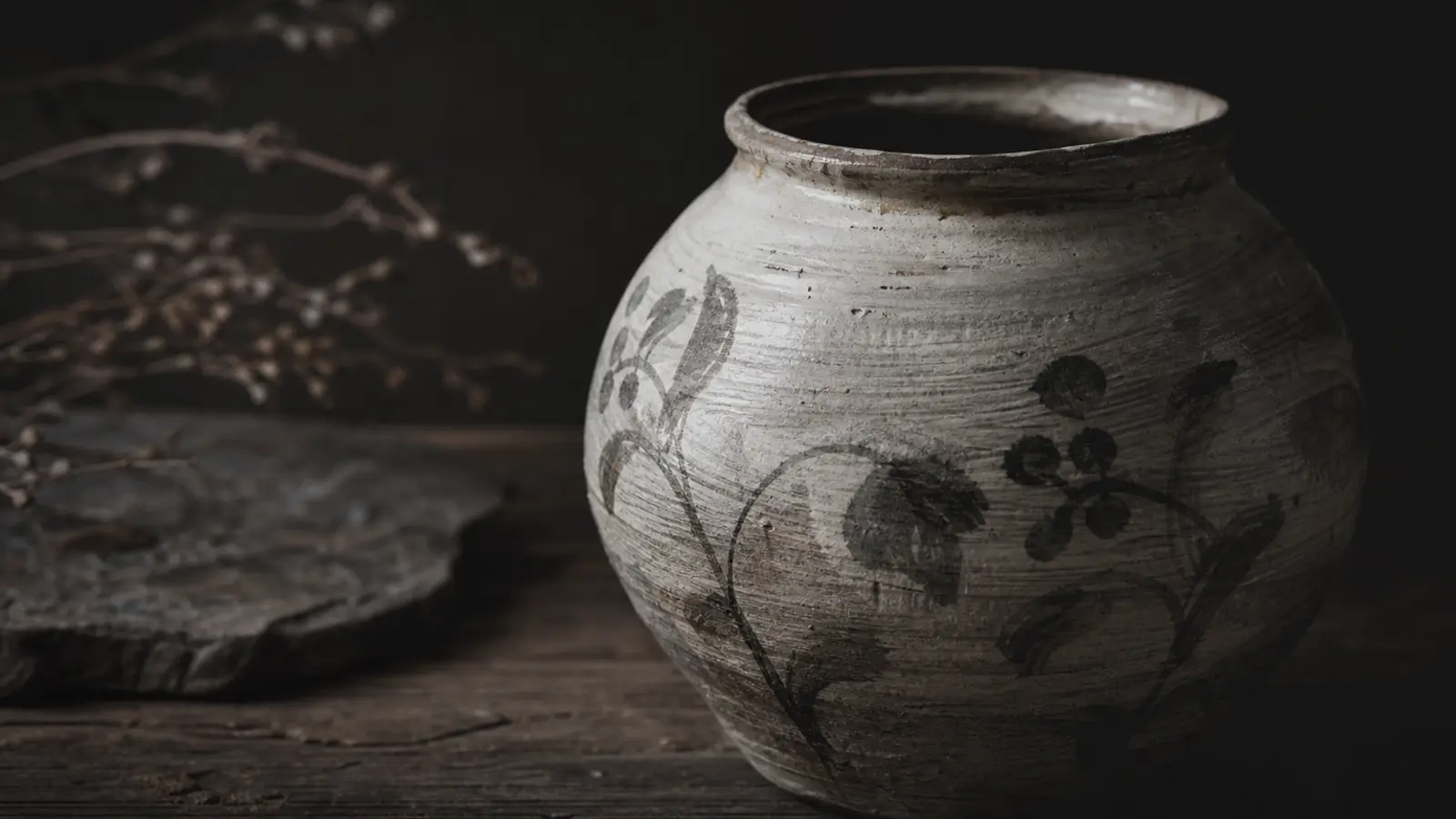
Rather than applying the refined celadon glaze, buncheong potters coated their vessels in white slip — 분장 (bunjang) — and decorated them through several distinct techniques. 박지 (bakji) sgraffito scraped away slip to reveal the dark clay body beneath, creating designs through contrast. 음각 (eumgak) incised lines directly into the clay. 철화 (cheolhwa) iron-painted decoration applied brushwork in iron oxide before firing, producing loose, gestural marks that look nothing like sanggam’s precision. Some vessels were simply dipped in slip and left almost plain, the beauty living in the texture and slight variation of coverage.
The aesthetic result is hard to describe without sounding like you are downgrading the tradition. Buncheong is not failed celadon. It is deliberately, confidently different. The vessels are earthy, textured, and alive in a way that the formally beautiful celadon vessels are not. They feel like objects made by a specific person, not refined toward an ideal.
Buncheong’s influence reached Japan in an unexpected way. During the Imjin War (1592–1598), Japanese forces under Toyotomi Hideyoshi abducted Korean potters and brought them to Japan. These potters established kiln traditions in Kyushu that directly shaped Japanese ceramics — Satsuma ware, Agano ware, and others trace lineage to Korean buncheong traditions. The tea masters of the Momoyama period, particularly those in Sen no Rikyū’s circle, recognized immediately what buncheong had: wabi-sabi aesthetic before the term existed. The spontaneous, textured, imperfect vessel was precisely what they valued for chanoyu.
Baekja and Joseon Restraint
The Joseon Dynasty (1392–1897) adopted Neo-Confucian philosophy as its governing framework, and that philosophy shaped ceramic aesthetics directly. Confucian scholarship valued restraint, moral seriousness, and the elimination of excess. Celadon’s elaborate sanggam decoration and even buncheong’s lively slip decoration were, from this perspective, too much.
Baekja — white porcelain fired from pure white clay — became the dominant tradition. Its beauty is almost entirely in proportion and in the quality of the white itself. Decoration, when it appears at all, is minimal: a few brushed cobalt lines, a simple painted motif. The moon jar (달항아리), one of the most recognizable forms in all of Korean material culture, is a large rounded vessel made by joining two bowls at their equators. Its slight asymmetry and the warm, off-white quality of the glaze surface are its entire aesthetic content. There is nowhere to hide in a baekja vessel. Every proportion decision is visible.
The guiding principle is 소박함 (sobakham) — a kind of understated simplicity that is not the same as minimalism. Minimalism can be austere and cold. Sobakham is warm in its restraint, human in its modesty. The finest baekja pieces feel quietly confident rather than deliberately spare.
The Three Traditions at the Table: Tea Pairings
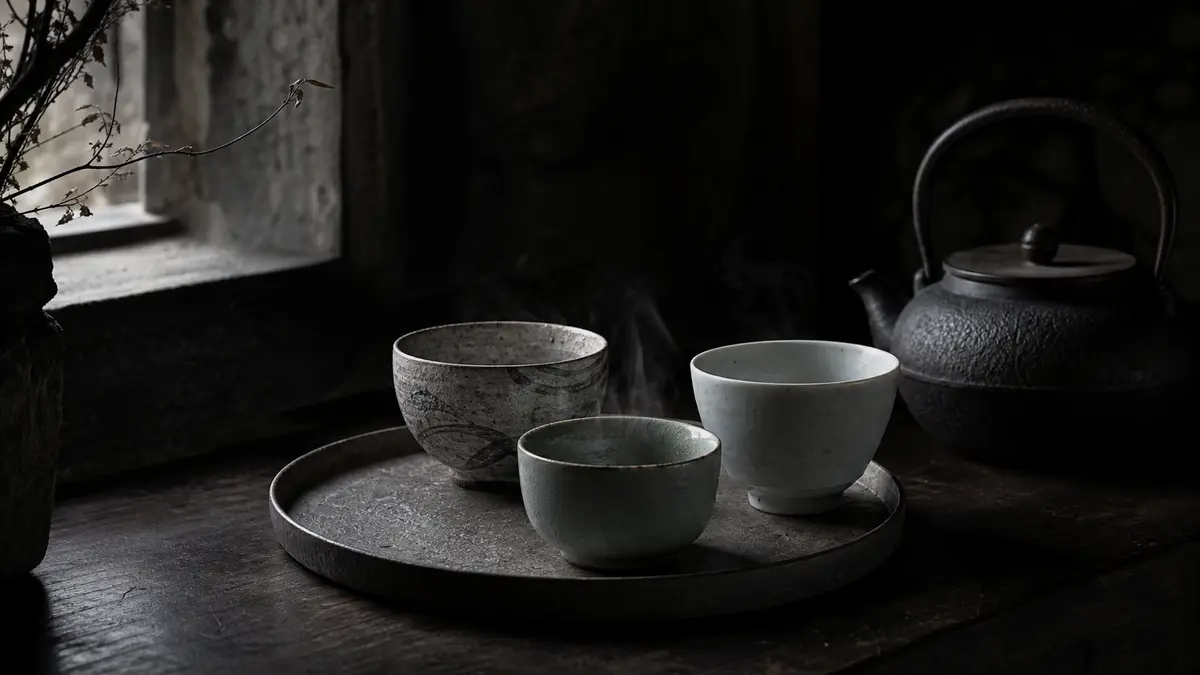
The comparison between these three traditions maps cleanly onto different categories of tea and different kinds of drinking sessions.
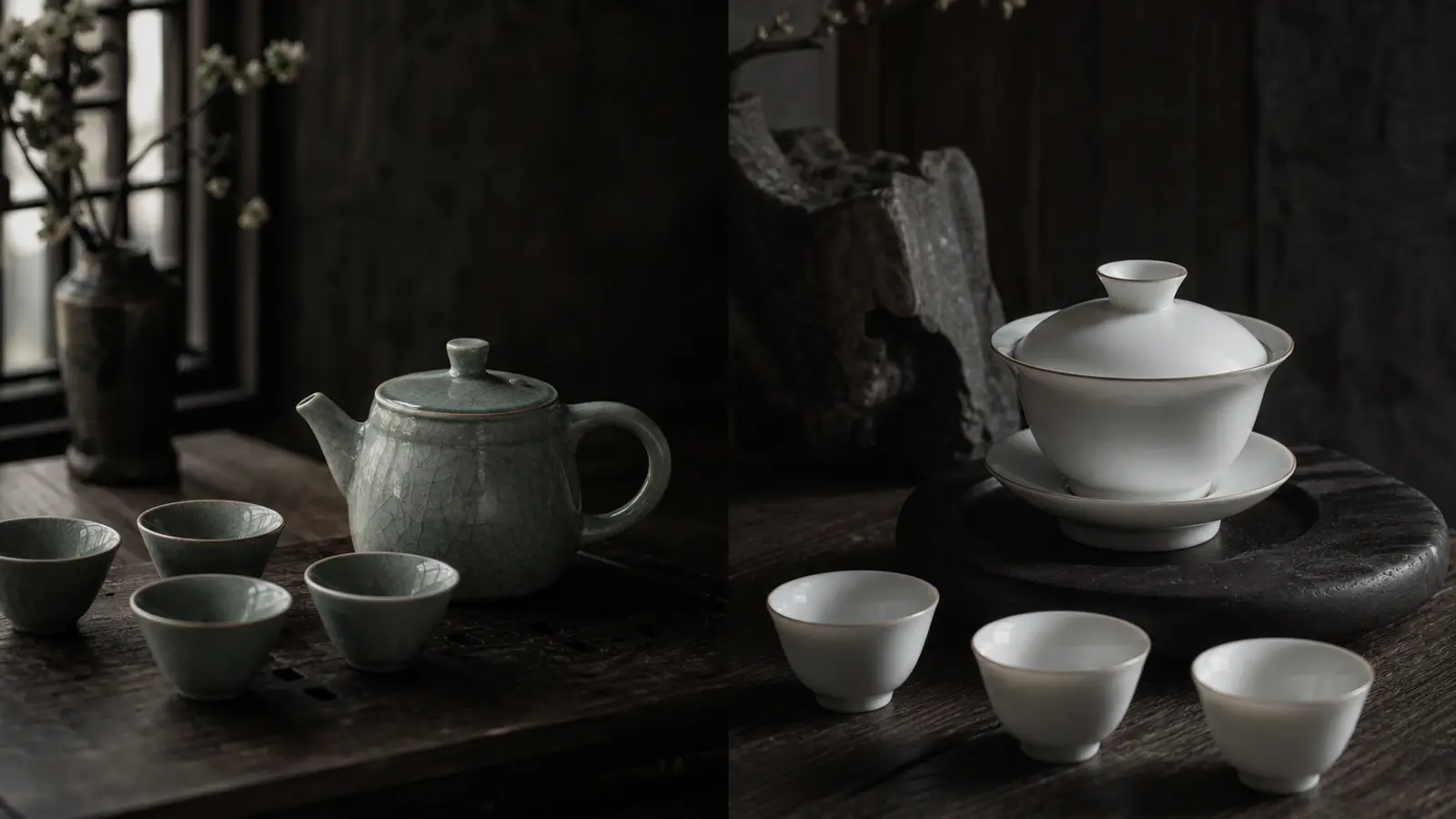
Celadon pairs best with green tea and light oolong. The smooth, refined surface adds nothing to the tea itself, and the visual harmony of jade-green glaze against pale yellow-green tea liquor is a genuine aesthetic contribution to the session. The thin-to-medium walls of quality celadon cups suit lower brewing temperatures — the kind you want for gyokuro (玉露), Korean nokcha (녹차), or a delicate Taiwanese high-mountain oolong. Celadon brings ceremony to the table. You drink from it with a particular kind of attention.
Buncheong suits aged teas, roasted oolongs, and darker liquors. The semi-porous stoneware body absorbs oils and compounds over years of use, building a patina called 차때 (cha-ttae) — tea stain — that changes the vessel’s character. A buncheong cup that has held ten years of shou pu-erh or heavily roasted wuyi oolong is a different object than it was when new. The texture affects the tactile experience of drinking in a way that smooth-glazed celadon and baekja do not. You feel the vessel. For aged sheng pu-erh (生普洱), the earthier character of buncheong creates a conversation between cup and tea rather than a neutral presentation.
Baekja is the analytical vessel. Like a Chinese white porcelain gaiwan (蓋碗), it adds nothing to the tea. Every quality — color, clarity, aroma released from the cup walls — is visible without interference. Baekja is the right choice when you want to evaluate a tea on its own terms, or when you are drinking something refined enough that you do not want any visual or tactile competition. The thicker walls typical of Joseon-style baekja, compared to Chinese porcelain, change heat retention slightly and give the cup a different weight in the hand — more substantial, less delicate.
The wine parallel holds up reasonably well here. Celadon is classified-growth Bordeaux: formal, historically weighted, beautiful in a way that carries institutional authority. Buncheong is natural wine: textured, alive, spontaneous, better with time in the glass (or decade in use). Baekja is Chablis: pure, restrained, beauty achieved through absence rather than addition.
Comparison Table
| Attribute | Celadon (청자) | Buncheong (분청사기) | Baekja (백자) |
|---|---|---|---|
| Dynasty / Period | Goryeo (10th–14th c.) | Goryeo-Joseon transition (14th–16th c.) | Joseon (15th–19th c.) |
| Aesthetic philosophy | Aristocratic refinement | Democratic spontaneity | Philosophical restraint |
| Clay body | Iron-rich stoneware/porcelain | Iron-rich stoneware | Pure white porcelain clay |
| Glaze / Surface | Jade-green reduction glaze (bisaek 비색) | White slip over dark body; various textures | Clear glaze over white clay; matte to glassy |
| Decoration technique | Sanggam (상감) inlay | Bunjang (분장) slip, bakji (박지) sgraffito, cheolhwa (철화) ironpainting | Minimal; cobalt brushwork or plain |
| Tea pairing | Green tea, light oolong | Aged teas, roasted oolong, shou pu-erh | Any tea; best for neutral evaluation |
| Builds patina? | No | Yes, significantly | No |
| Price range (contemporary) | $40–$400+ per cup | $30–$250+ per cup | $35–$300+ per cup |
| Best for | Ceremony, green tea sessions | Daily use, aged tea, texture lovers | Analytical brewing, precision sessions |
Price ranges reflect contemporary studio pottery from established Korean potters. Museum-quality historical pieces and works by designated Living National Treasures (人間文化財) command significantly higher prices.
Recognizing Quality Across All Three Traditions
What to Look for in Celadon
The glaze surface should have depth — color that seems to come from within rather than sitting on top. True bisaek has a quality Korean ceramics scholars describe as 맑음 (malgeun), clarity, combined with warmth. Thin, even walls that transmit some light when held up to a lamp indicate quality clay preparation and kiln control. Sanggam inlay, where present, should be crisp under the glaze rather than blurry. Contemporary celadon from the Gangjin (강진) region in South Jeolla Province (전라남도) follows the historical kiln tradition most directly.
What to Look for in Buncheong
Paradoxically, quality in buncheong is harder to articulate because the aesthetic celebrates variation. The distinction is between intentional spontaneity and simply poor execution. A good buncheong piece has energy — brushwork that is loose but controlled, slip application that is uneven but confidently so. The clay body should feel substantial, with a texture that is interesting rather than merely rough. Look at the foot ring: clean, deliberate trimming under an apparently casual vessel is a sign of a skilled hand.
What to Look for in Baekja
White porcelain is unforgiving. Proportion is everything, and proportion is visible from across the room. The white itself varies — some Joseon-influenced work aims for a cool blue-white; the most valued historical pieces have a warm, slightly ivory quality described as 설백 (seolbaek), snow-white. Wall thickness should be even throughout. The foot ring should be refined. Any decoration present should feel inevitable, not added.
Living Traditions: Contemporary Korean Pottery
All three traditions continue in active studio practice in Korea today. The Korean government recognizes master practitioners as 인간문화재 (Intangible Cultural Heritage, literally “human cultural assets”), and the designation carries significant weight in the ceramics market. Potters working in each tradition range from revivalists closely following historical methods to contemporary artists using traditional forms as departure points.
The regional geography of each tradition roughly persists. Celadon production remains concentrated in Gangjin and Buan (부안) in the southwest, both historical kiln centers. Buncheong work is more dispersed but has particular strength in Gyeongnam (경남) and among potters in the Gwangju (광주) area. Baekja traditions are associated with Gyeonggi Province (경기도) kilns that served the Joseon court.
For the tea drinker building a collection, understanding these traditions provides orientation rather than a purchasing roadmap. A single well-chosen buncheong cup that you use every day for a decade will tell you more about the tradition than reading about it for years. The same is true of celadon and baekja. These are objects meant to be used, not merely understood.
Three Philosophies, One Question
The question all three traditions answer is the same one that Japanese tea aesthetics and Chinese tea culture also grapple with: what is the right relationship between the vessel and the tea? Should the vessel amplify, complement, contrast, or disappear?
Celadon says: amplify through beauty. Make the vessel an equal participant in the aesthetic experience.
Buncheong says: participate through character. The vessel has a life of its own; let it develop alongside the practice.
Baekja says: serve through restraint. The best vessel is the one that gets out of the way and lets the tea speak.
None of these answers is wrong. A mature tea practice probably has room for all three.