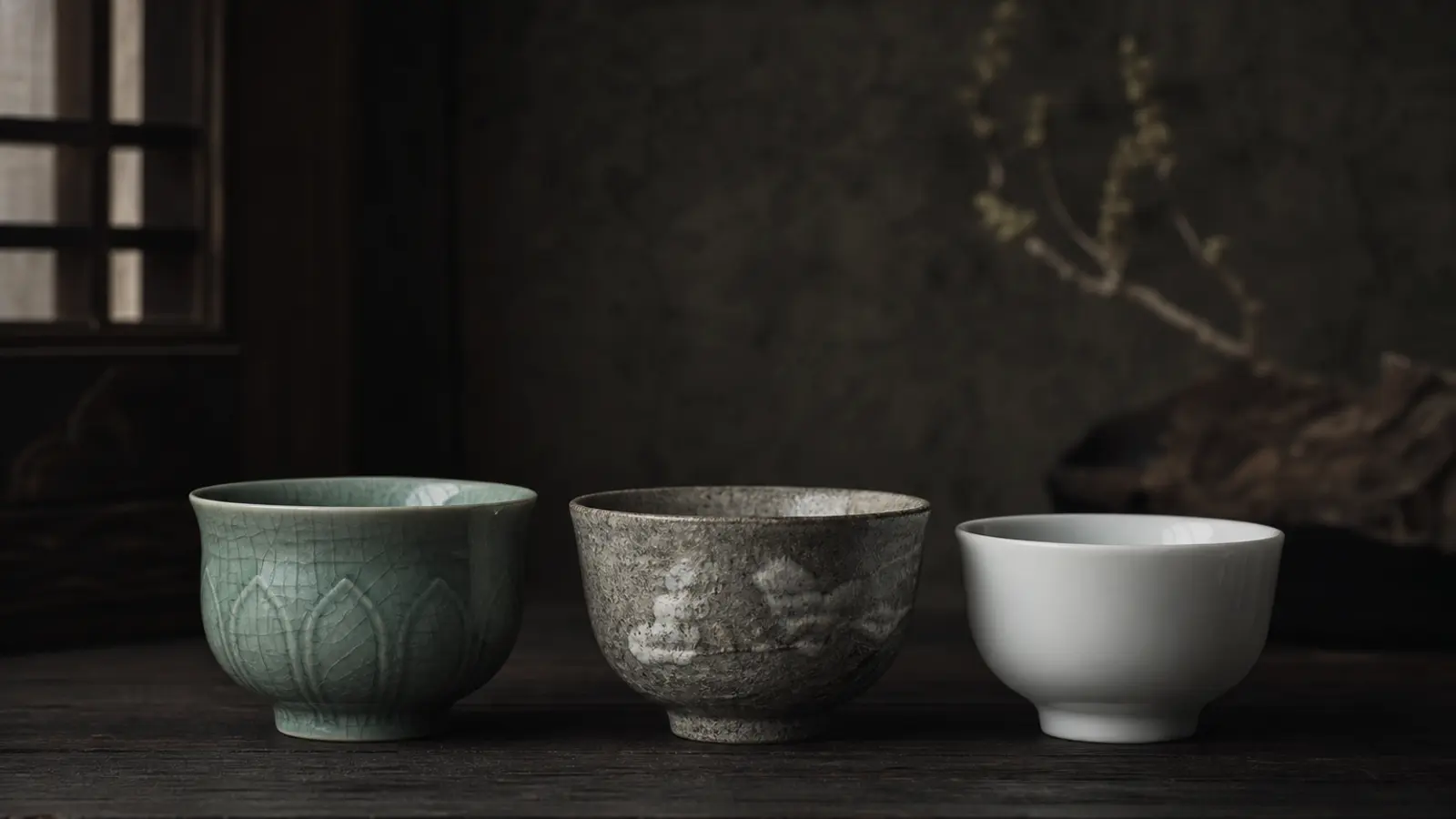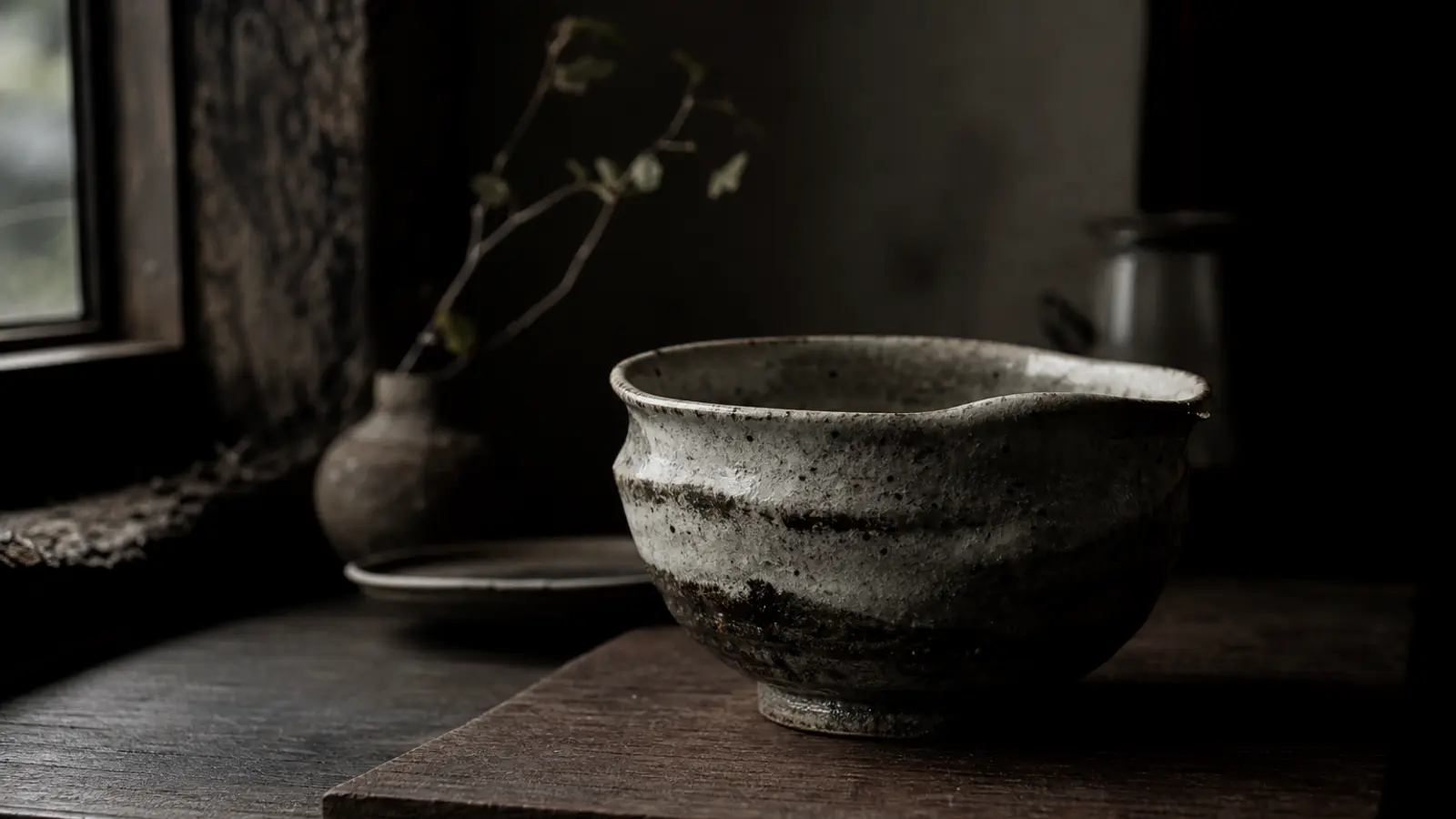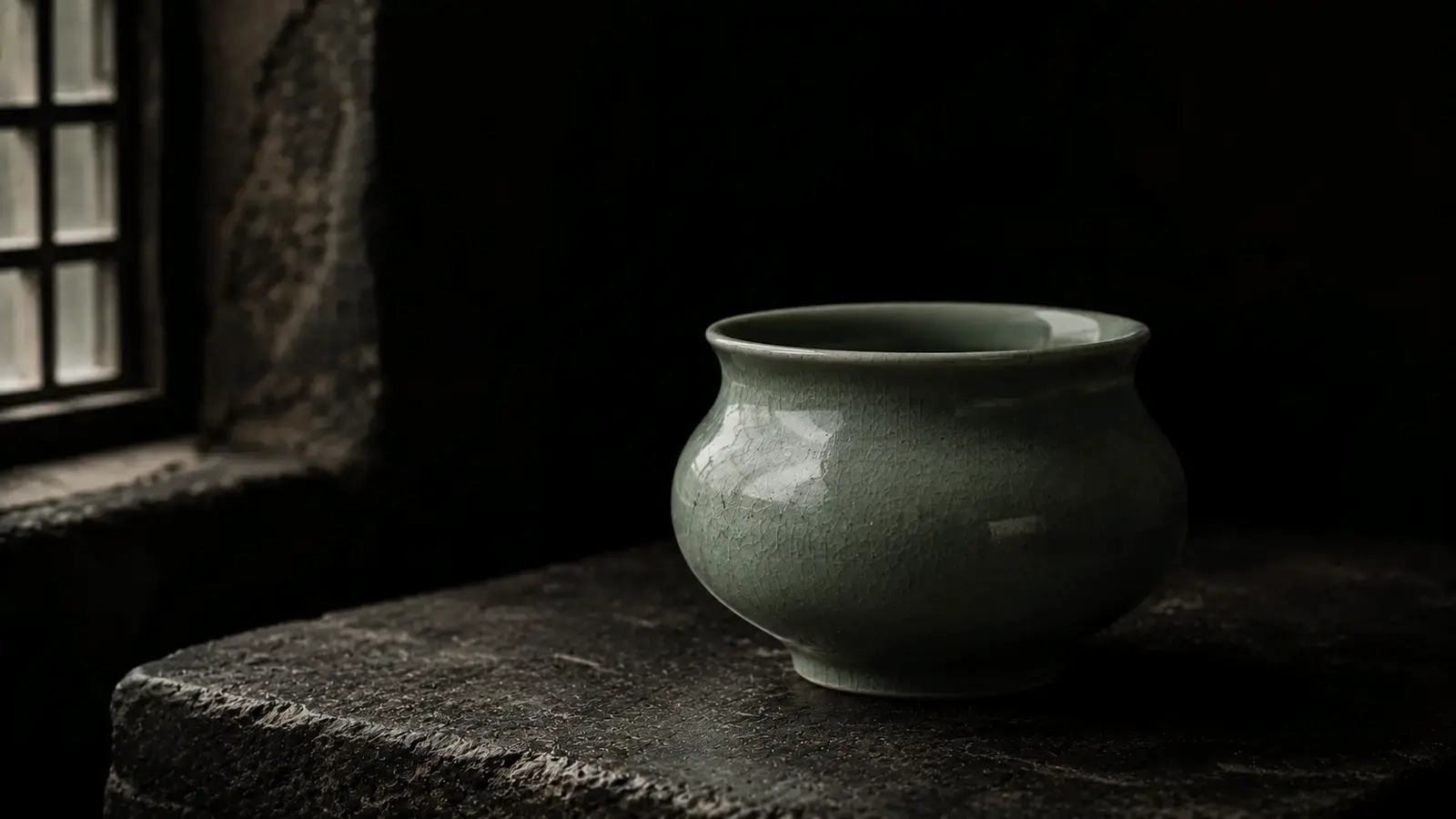
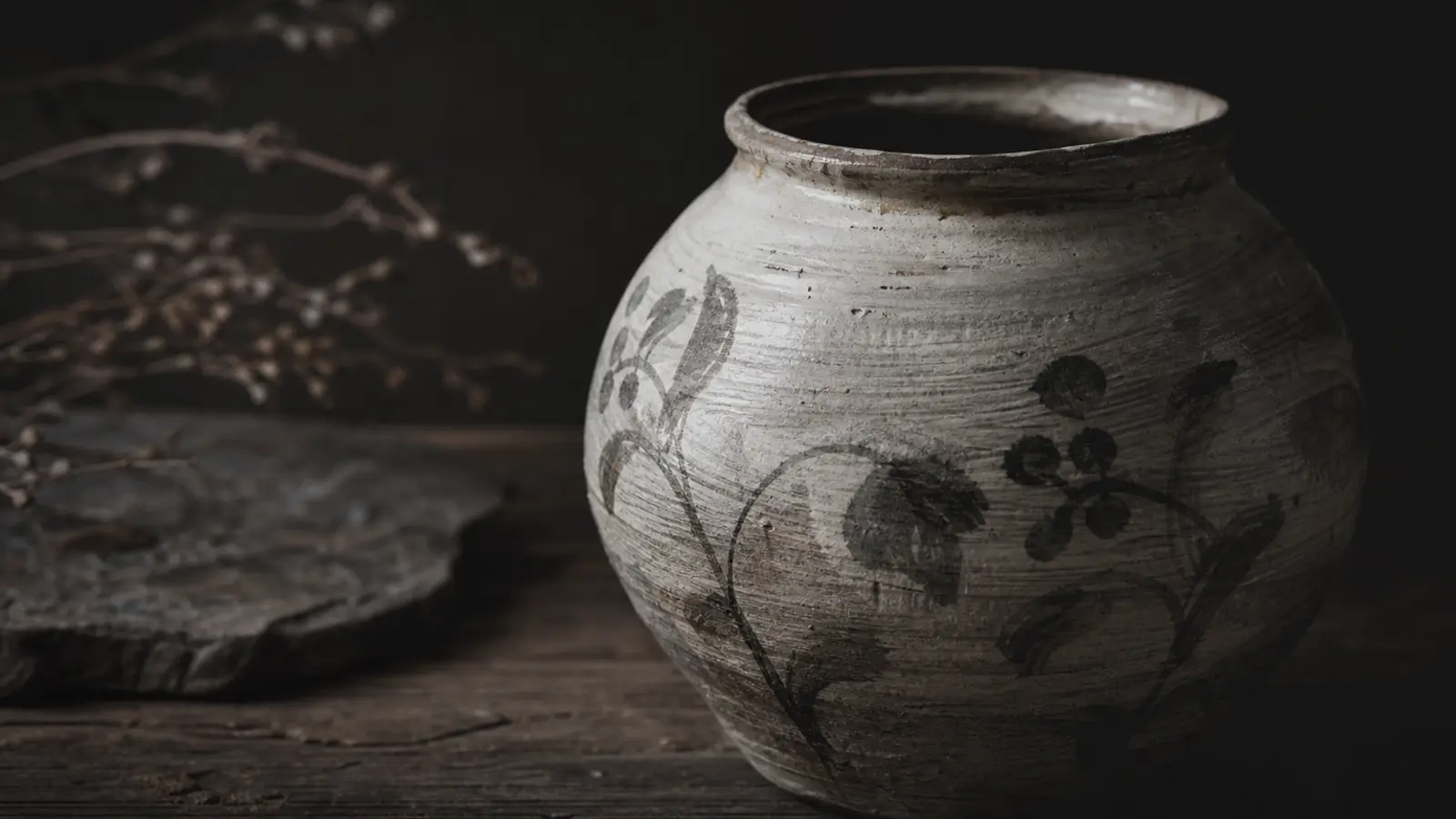
Buncheong (분청사기, 粉靑沙器) is Korean slip-decorated stoneware from the 15th-16th century Goryeo-Joseon transition — an earthy, spontaneous ceramic tradition defined by white slip application over dark clay using techniques like dipping (덤벙), brushwork (귀얄), and sgraffito (박지). Buncheong directly influenced Japanese tea ceremony aesthetics when Korean potters were taken to Japan during the Imjin War of 1592.
What Buncheong Pottery Actually Is
The name itself is a compression: bun (粉) refers to white powder or slip, cheong (靑) to blue-green, and sa (沙) to sand or grit. The full term buncheong sagi (분청사기) translates roughly as “powdered blue-green ware” — describing the white slip applied over a grey stoneware body that is the technique’s defining move.
Buncheong emerged during the turbulent transition from the Goryeo (고려) dynasty to the Joseon (조선) dynasty, roughly the late 14th into the 15th century. It was not a clean artistic break so much as a social and economic one. The refined aristocratic patronage that had sustained Goryeo celadon (고려청자) was fragmenting. Kilns that had produced technically perfect jade-green wares for court use now served a broader, less exacting market. The response was not degradation but transformation: potters took the inlay tradition of celadon and ran it in a rougher, faster, more energetic direction.
Where Goryeo celadon prized control — the glaze color, the symmetry, the fine inlaid designs — buncheong embraced a deliberate looseness. The clay body is grey and gritty. The white slip coating is thick, chalky, sometimes applied unevenly. Decorations range from formal to wildly spontaneous. The effect is immediate: these pots feel alive in a way that celadon’s perfection doesn’t quite permit.
Think of it this way. Celadon is to buncheong what classified-growth Bordeaux is to natural wine — one a triumph of controlled refinement, the other deliberately raw, textured, and making a virtue of its own aliveness. Neither is better. They are answering different questions about what beauty is for.
The Five Decoration Techniques
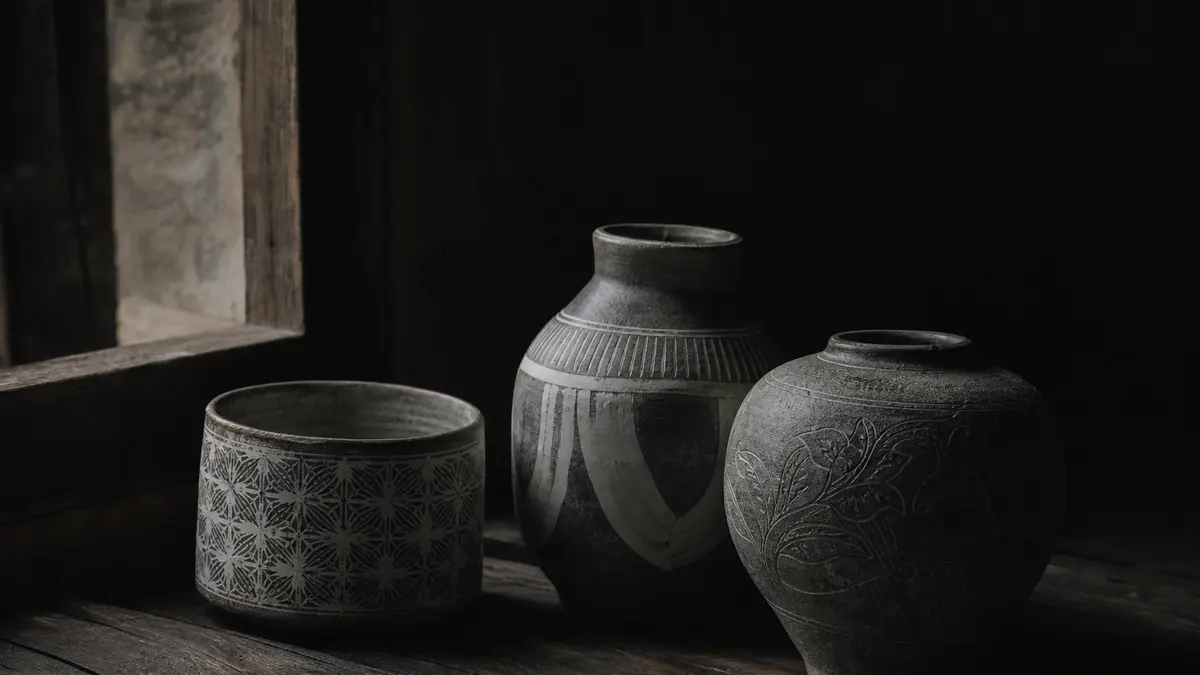
Buncheong is not a single style but a family of related techniques, each producing a distinctly different visual character. A working knowledge of all five changes how you read the pots.
상감 (Sanggam) — Inlay. The oldest technique, inherited directly from Goryeo celadon. Designs are carved into the leather-hard clay body, then filled with white or black slip before the whole surface is glazed. The result resembles the celadon tradition it comes from, but looser, often with bolder motifs — fish, lotus, willow, abstract patterns — that cover more of the surface with more confidence.
박지 (Bakji) — Sgraffito. Here the potter applies white slip to the whole surface, then carves away the background, leaving the design raised in white against the exposed grey clay. The labor-intensive reversal creates high contrast and a strong graphic quality. Some of the most striking buncheong pieces — bold chrysanthemum patterns, fish swimming in open space — use this technique.
음각 (Eumgak) — Incised Lines. The simplest approach: designs are scratched or carved directly into the clay before glazing. The lines show through the glaze as darker channels. Less dramatic than sgraffito, but capable of extraordinary delicacy — fine botanical drawings, calligraphic marks, abstract gestures.
철화 (Cheolhwa) — Iron Painting. Iron-rich slip is painted directly onto the white slip ground, creating dark brown or black brushwork under a transparent glaze. This technique is the most overtly painterly of the five, and the results can be genuinely astonishing — loose, confident brushwork that looks like ink painting translated into clay. Some iron-painted buncheong pieces have the same quality of arrested spontaneity as the best Zen-influenced calligraphy.
분장 (Bunjang) — White Slip Coating. The entire vessel is dipped or brushed in white slip, creating a uniformly pale surface with subtle variations where the coating pools or thins. No additional decoration, or minimal markings. The beauty is in the material itself — the slight unevenness of the slip, the places where the grey body shows through, the way the surface responds to the glaze pooling in foot ring crevices. This technique produces what many consider the purest expression of buncheong’s aesthetic: nothing hidden, nothing embellished.
The Japan Connection: How Korea’s “Second-Best” Became Japan’s Treasure
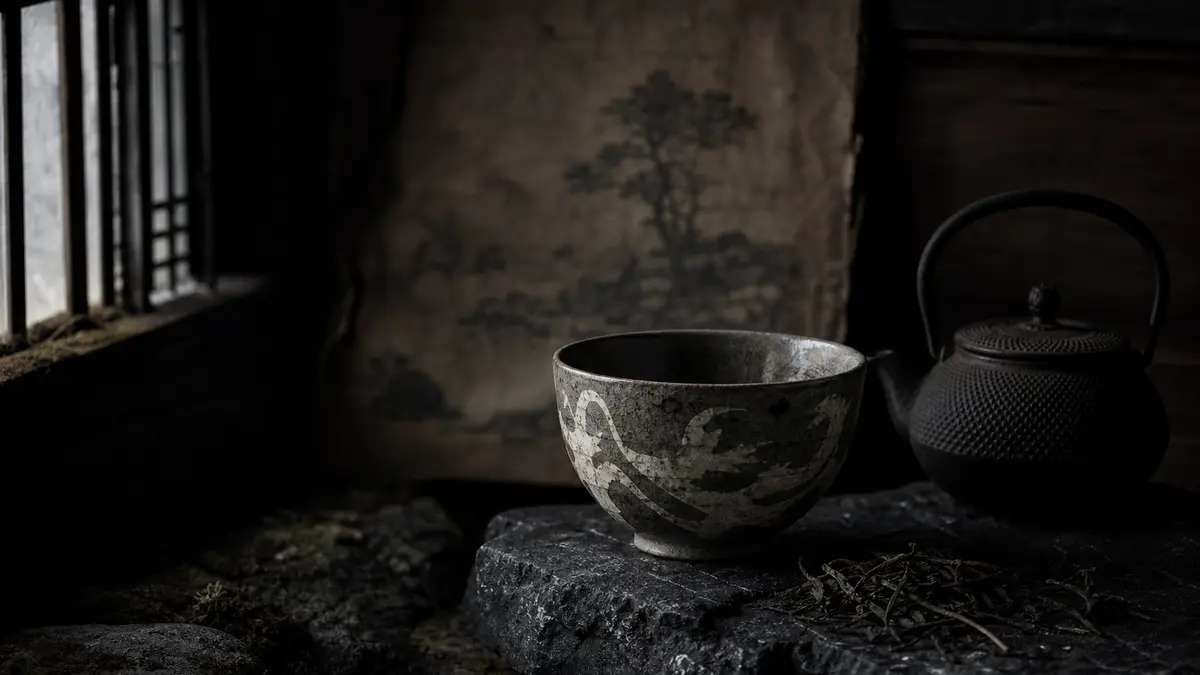
By the mid-16th century, buncheong had largely disappeared from Korean production. The Joseon dynasty had consolidated around a new aesthetic ideal — white porcelain (백자, baekja) — that reflected Confucian values of purity, restraint, and scholarly refinement. White porcelain was the new court standard. Buncheong kilns either converted or closed.
Japan had other ideas.
Buncheong had been reaching Japan through trade since at least the 15th century, arriving in Hakata (博多), the main port on Kyushu facing the Korean peninsula. Japanese tea masters, developing what would become the formalized aesthetic of 茶の湯 (chanoyu), the Japanese tea ceremony, encountered these Korean export wares and responded to them with unusual intensity. The rough surfaces, the pooled slip, the spontaneous brushwork — all of this aligned with the emerging wabi (侘) aesthetic being articulated by masters like Murata Jukō (村田珠光) and later Sen no Rikyū (千利休).
Rikyū, the defining genius of Japanese tea ceremony aesthetics, understood that a perfect pot could close down experience. An imperfect pot — one with an asymmetrical lip, a dimple in the foot, a place where the glaze ran — keeps the mind active. The object becomes a partner in the tea session rather than a passive container. Korean buncheong, produced without any awareness of Japanese tea culture, happened to embody exactly this principle.
Then came the invasions.
Imjin War (임진왜란) and the Pottery War
Toyotomi Hideyoshi (豊臣秀吉) invaded Korea in 1592. The conflict that Koreans call 임진왜란 (Imjin Waeran) lasted until 1598, devastated the Korean peninsula, and reshaped ceramics history on both sides of the Korea Strait.
Among the most consequential acts of the campaigns was the systematic abduction of Korean potters. Japanese daimyō (feudal lords), aware of the prestige value of Korean ceramics in the tea culture economy, took potters back to their domains in Kyushu and established kilns. This episode is sometimes called the “Pottery Wars” — a recognition, bitter on the Korean side, that ceramic knowledge was considered worth stealing.
The most direct lineage runs to Karatsu (唐津) in Saga Prefecture, Kyushu. Karatsu ware descends directly from Korean buncheong potters brought to Japan during and after the invasions. The grey clay bodies, the iron painted decoration, the thick white slip — all of it traces back to the buncheong tradition those potters carried. Karatsu-yaki (唐津焼) became, and remains, one of the most prized traditions in Japanese tea ceremony ceramics.
Other transplanted Korean potters established what became Hagi (萩焼), Satsuma (薩摩焼), and Agano (上野焼) wares — each carrying the Korean genetic code into Japanese ceramic culture. These transplanted traditions did not merely imitate; they evolved in dialogue with Japanese taste, materials, and patronage. But the buncheong root is visible in all of them.
What Korea Did Instead
Korea’s move to white porcelain was not a retreat. Joseon baekja is exceptional — among the finest porcelain made anywhere in the pre-industrial world. But it serves a different sensibility. White porcelain reflects the Joseon dynasty’s Confucian orientation: order, clarity, hierarchy made visible in material form. The Goryeo celadon’s Buddhist-inflected beauty and the rough democracy of buncheong were both, in different ways, out of step with what the new dynasty wanted ceramics to mean.
This means that buncheong, as a living tradition, went dormant in Korea for several centuries. When 20th-century Korean ceramicists began to look for indigenous traditions to revive, buncheong was there — preserved in museum collections, in Japanese tea ceremony rooms, in the kilns transplanted to Kyushu. The revival required Koreans to look partly at what Japan had done with their inheritance.
Yoon Kwang-cho (윤광조) and the Contemporary Revival
The most significant figure in buncheong’s modern resurrection is 윤광조 (Yoon Kwang-cho, born 1946). Working from the 1970s onward, Yoon did not simply replicate historical buncheong forms. He interrogated the tradition — its techniques, its logic, its philosophical implications — and pushed it into contemporary art territory.
His work sits in the permanent collections of the British Museum and the Metropolitan Museum of Art. That institutional recognition matters less than what his pots actually do: they extend the conversation about what buncheong’s aesthetic principles mean outside their original context. A Yoon Kwang-cho piece is not a reproduction of a Joseon storage jar. It is an argument, made in clay, about spontaneity, imperfection, and the relationship between maker and material.
The revival Yoon helped lead has produced a generation of Korean studio potters working seriously in the buncheong tradition. Artists like 녹원 유용철 (Nokwon Yoo Yong-cheol) produce teaware that behaves over time the way seasoned Yixing clay does — the surface develops a patina with use, the pores absorb tea oils and steam, the vessel records your practice. A buncheong cup used for two years of daily tea sessions looks different from a new one. It has accumulated something.
Using Buncheong for Tea
This patina quality matters practically. Buncheong teaware is not decorative-only. The stoneware body retains heat well — better than porcelain, comparably to most Yixing clay. The thick white slip surface is porous enough to absorb trace compounds from repeated use but not so porous that it transfers flavor between sessions the way unglazed Yixing clay does.
The texture of the surface changes how a cup feels in your hand. The rough, chalky quality of bunjang-technique cups in particular creates a tactile engagement that smooth porcelain doesn’t offer. In the context of Korean tea practice — 다례 (darye), the Korean tea ceremony — the physical presence of the vessel is part of the practice. You are not supposed to ignore the cup.
Different buncheong techniques suit different teas, at least aesthetically. Iron-painted pieces (cheolhwa) have a dynamic, painterly energy that pairs well with teas with their own assertive character — heavily roasted oolongs, robust Korean hwangcha (황차). The quieter bunjang technique, all surface and subtle variation, tends to complement the more contemplative experience of Korean nokcha (녹차, green tea) or aged teas brewed at lower temperatures.
These are aesthetic alignments, not technical requirements. Buncheong cups work fine for any tea. But paying attention to the pairing is part of what the tradition invites. For those exploring gongfu brewing with Korean vessels, a buncheong tea bowl brings a different tactile register than porcelain alternatives.
Why the Korea-Japan Story Still Matters
The arc of buncheong’s history raises questions that go beyond ceramics. Korea produced the tradition and then moved past it, deciding it was no longer the right expression of what the culture wanted to say. Japan received it, recognized something essential in it, and built an entire aesthetic philosophy partly on that recognition. Centuries later, Korea rediscovered its own tradition partly through the mirror of what Japan had preserved.
This is not a story about cultural theft, exactly — though the forced removal of potters during 임진왜란 was violence, and the Korean side carries that history with justified bitterness. It is a story about how aesthetic traditions survive through unexpected channels, how objects outlast the social conditions that produced them, and how the same pot can mean entirely different things depending on who holds it and when.
For anyone practicing tea seriously, buncheong is a reminder that the vessels on your table have histories that precede you by centuries. The Karatsu tea bowl in a Japanese tea room descends from a Korean potter who did not choose to make that journey. The contemporary buncheong cup from a Korean studio artist descends from a tradition that had to be recovered from museums and foreign collections. Both carry that weight.
Which is, in the end, part of what the wabi (侘) sensibility was always pointing at: beauty is not separate from time, impermanence, or difficulty. It is made of them.
Reading Buncheong in Practice
If you encounter buncheong pieces — in a museum, in a gallery, in a tea shop — the five techniques give you a framework for looking carefully.
Start with the clay body at the foot ring. If it’s grey and gritty, you’re likely looking at stoneware in the buncheong tradition. Note whether the white surface is the whole vessel (bunjang) or whether there are carved patterns revealing the grey beneath (bakji sgraffito). Look for dark brushwork under the glaze (cheolhwa iron painting). Check whether the designs sit in the surface as carved channels (eumgak) or appear as inlaid white against the body (sanggam).
Then notice what the surface does in light. Buncheong glazes tend to pool in crevices, thin over raised areas, and create subtle variations across the surface that a uniformly smooth piece cannot. Run your eye across the form slowly. The intention is there in the irregularities.
The Korean concept of 향 (hyang) — fragrance, atmosphere, the ambient quality a thing radiates — applies to buncheong in a particular way. These pots have a presence that arrives before analysis. The history is in the clay.