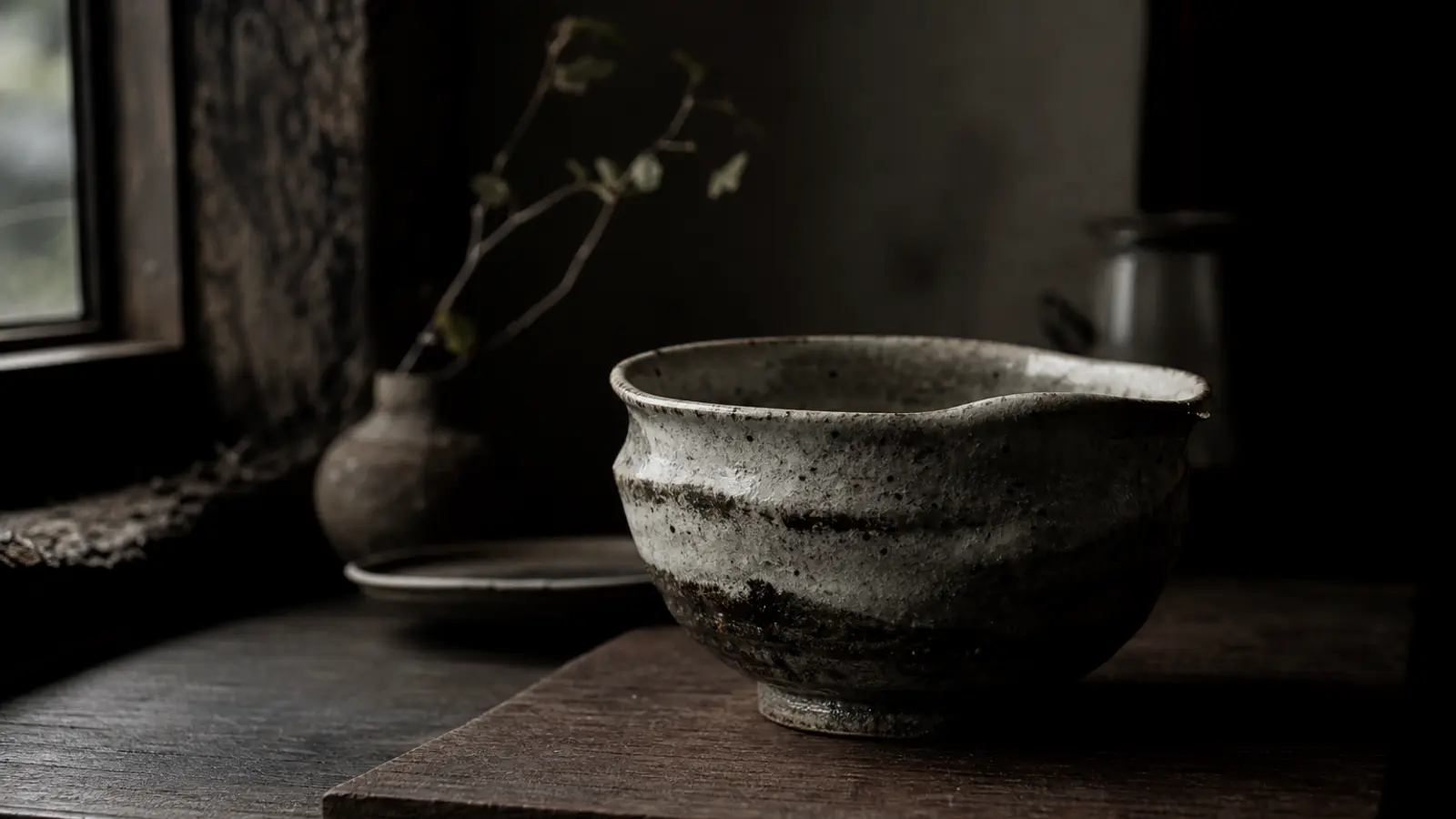
The most revered tea bowl in the world sits in a lacquer box inside a wooden box inside another lacquer box in a sub-temple of Daitokuji in Kyoto. Three containers for a single ceramic object. When the boxes are opened on special occasions, tea masters have been known to weep.
The Kizaemon Ido (喜左衛門井戸) is a Korean rice bowl. The potter who made it was almost certainly a villager working a folk kiln during the Joseon dynasty (朝鮮王朝, 1392–1897). He was making bowls for peasants to eat from. He had no idea he was making art. He almost certainly could not have imagined that five hundred years later, his anonymous bowl would be considered by many serious people — tea masters, museum curators, ceramic scholars — to be the single finest tea bowl on earth.
This is the story of how a korean tea bowl became sacred. It is also the story of how imperfection became the highest aesthetic virtue in East Asian tea, and how a cultural misreading became a cultural revolution.
The Bowl Nobody Valued in Korea
To understand why the Kizaemon Ido matters, you have to understand what it was before it mattered.
막사발 (maksa-bal, literally “rough bowl” or “thrown bowl”) were the everyday ceramics of the Korean countryside. Made at anonymous folk kilns called 사기점 (sagijjeom), they were functional ware — bowls for rice, for soup, for grain storage. They were made quickly, fired in wood kilns with variable temperatures, and glazed without particular precision. The feet were cut by hand in a few strokes. The walls were pulled unevenly. The ash glaze pooled and ran where it wanted.
Korean society under the Joseon dynasty was rigidly hierarchical, and that hierarchy extended to ceramics. The aristocratic 양반 (yangban) class used white porcelain (백자, baekja) — clean, controlled, Confucian in its restraint. 청자 (cheongja), the celadon that had made Goryeo-era Korea famous across Asia, represented elite taste. The grey-bodied, roughly thrown bowls of the folk kilns were beneath aesthetic consideration.
Nobody in Joseon Korea was looking at a 막사발 and thinking about beauty. That observation was reserved for someone with a completely different set of eyes.
Sen no Rikyū and the Wabi Revolution
Sen no Rikyū (千利休, 1522–1591) is the most important figure in the history of Japanese tea ceremony, and his aesthetic philosophy reversed the direction of Japanese culture for centuries.
Before Rikyū, Japanese tea ceremony — 茶の湯 (chanoyu) — was a display of wealth. The great tea masters competed with Chinese Song-dynasty ceramics, silk hangings, and imported bronze. Power expressed itself through possession of beautiful, recognized things.
Rikyū changed the question. Instead of asking “is this valuable?” he asked “does this move me?” And what moved him was not polish, symmetry, or recognized pedigree. What moved him was 侘び (wabi) — a quality sometimes translated as austere simplicity, the beauty of things that are incomplete, impermanent, imperfect.
The concept had precedents. His teacher Takeno Jōō (武野紹鷗, 1502–1555) had already begun moving Japanese tea toward domestic, rustic aesthetics. But Rikyū systematized it, made it a philosophy, and used it to redraw the entire hierarchy of objects.
Under wabi aesthetics, a rough Korean rice bowl ranked above a polished Chinese import. The logic was radical: the Korean bowl had no pretension. It had no ambition to be beautiful. It simply was what it was — and in being exactly that, without effort or self-consciousness, it achieved something that deliberate art could not.
This is the wine parallel I keep returning to: it’s like discovering that the best terroir in the world had been growing grapes on land that nobody valued because the stones looked wrong. Châteauneuf-du-Pape’s famous galets roulés — those large, heat-retaining river stones — were considered agricultural waste until someone noticed that the vines growing in them produced something extraordinary. The value was always there. The recognition came from outside.
Ido Chawan (이도다완) in Japanese Tea
The specific Korean tea bowl type that Japanese tea culture elevated above all others is called 이도다완 (ido-dawan, 井戸茶碗) in Korean, or 井戸茶碗 (ido chawan) in Japanese.
The etymology of 이도 (ido, 井戸) is debated, but the most widely cited explanation is also the most intuitive: the word means “well” in Japanese, and it refers to the wide, deep ring-shaped foot of these bowls — the 굽 (gulp) — which resembles the stone mouth of a traditional well. Some scholars argue it derives from the name of an early Japanese owner, or a place name. But look at the foot of a good Ido bowl and the well theory makes immediate visual sense.
The Ido form has specific characteristics that distinguish it from other Korean folk bowls:
- The foot ring (고대, godae in Korean; 高台, kōdai in Japanese): wide, rough-cut, slightly irregular, with a distinctive diagonal cut called 梅花皮 (kairagi) — a rough, crinkled texture that appears at the lower glaze line where the silica compounds crystallized differently during cooling
- The body: thick-walled, pulling outward from a tight lower third, opening into a generous lip
- The glaze: typically a feldspathic ash glaze in tones ranging from warm straw-yellow to grey-green, often with iron spots called 石目 (ishime), “stone eyes”
- The color: changes dramatically as it warms in the hand — this is critical to chanoyu, where the bowl is held, not displayed
None of these qualities were designed. They were the residue of fast, functional production.
The Kizaemon Ido: What We Know
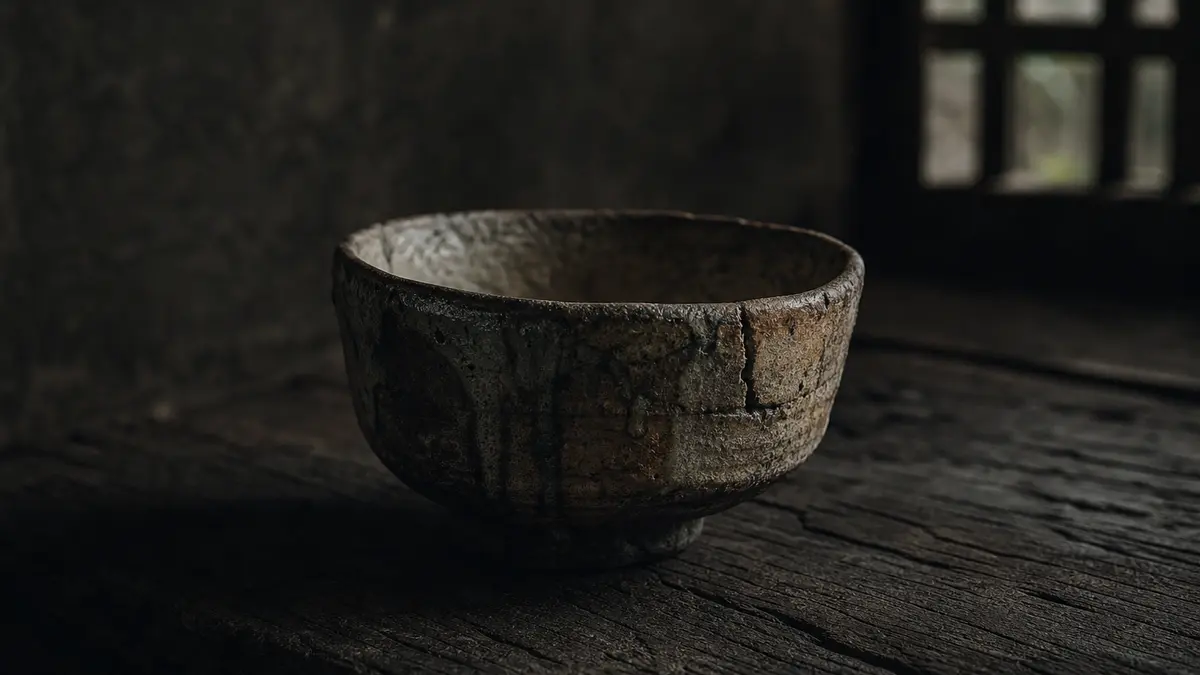
The Kizaemon Ido is the most celebrated Ido chawan, and the provenance record — such as it exists — begins in Japan, not Korea. There is no Korean record of this bowl. It simply appears in Japanese tea circles, likely entering the country in the 16th century through trade or the Imjin War period.
The bowl stands approximately 8.5 cm tall. The mouth diameter is roughly 15.5 cm, the foot roughly 5.8 cm. The glaze is a layered affair: grey-green in the upper portions, warming to ochre and straw near the foot, with iron-brown spotting throughout. There is a fine crack — called 景色 (keshiki), “scenery” in tea terminology — running through the body, which only adds to its considered perfection. The foot shows kairagi texture clearly.
The philosopher Yanagi Sōetsu (柳宗悦, 1889–1961), founder of the 民藝 (mingei, “folk craft”) movement, wrote what is probably the most-quoted description of this bowl. I’ll paraphrase rather than reproduce: he said the Kizaemon Ido is not striking at first glance. It is quiet, natural, and undemonstrative. But the longer you sit with it, the more it opens. He compared it to a field of silence rather than a shout. And then he said it “goes straight to the heart.”
The bowl is currently held at Kohoan (孤篷庵), a sub-temple of Daitokuji in Kyoto, under the care of the Matsuya family. It is classified as a National Treasure of Japan. It is not on regular public display. When it is shown, the showing itself becomes an event.
The Pottery Raids: The Imjin War and Its Ceramic Legacy
The story of Korean tea bowls in Japan cannot be told without confronting the Imjin War (임진왜란, Imjin Waeran, 1592–1598), the Japanese invasions of Korea under Toyotomi Hideyoshi (豊臣秀吉). These wars were catastrophic — hundreds of thousands killed, the Korean peninsula devastated, cultural artifacts looted.
Among those artifacts: Korean potters themselves.
The conflict is sometimes called “the Pottery Wars” (陶磁器戦争) in Japanese historical discourse, because Japanese daimyo systematically abducted Korean ceramics workers and relocated them to Japan to establish kilns. Provinces in Kyushu — particularly in what is now Saga and Kagoshima — became home to transplanted Korean kiln traditions that went on to form the foundation of several major Japanese ceramic styles.
Arita ware (有田焼), which underpins much of Japan’s porcelain tradition, traces directly to Yi Sam-pyeong (이삼평, 李參平), a Korean potter abducted during the invasions who discovered kaolin clay in Kyushu. Satsuma ware (薩摩焼) descends from Korean potters brought to Kagoshima by the Shimazu clan. Hagi ware (萩焼), among the most prestigious tea ceramics in Japan, was established by Korean brothers Yi Sukkwang and Yi Kyung.
The Kizaemon Ido and most Ido chawan that arrived in Japan before the invasions came through trade. But the invasions dramatically accelerated the flow of Korean ceramic knowledge into Japan and demonstrated, in the most brutal possible terms, that Korean pottery knowledge was something Japan considered worth taking by force.
In Korea, the potters who had been abducted were often remembered as tragic figures — people who made their art for the wrong audience. Their descendants, known in Japan as 朝鮮唐津 (Karatsu) or by various other designations, became foundational to Japanese ceramic culture while the Korean tradition they represented remained relatively unremarked in their homeland.
Why Imperfection Became Sacred
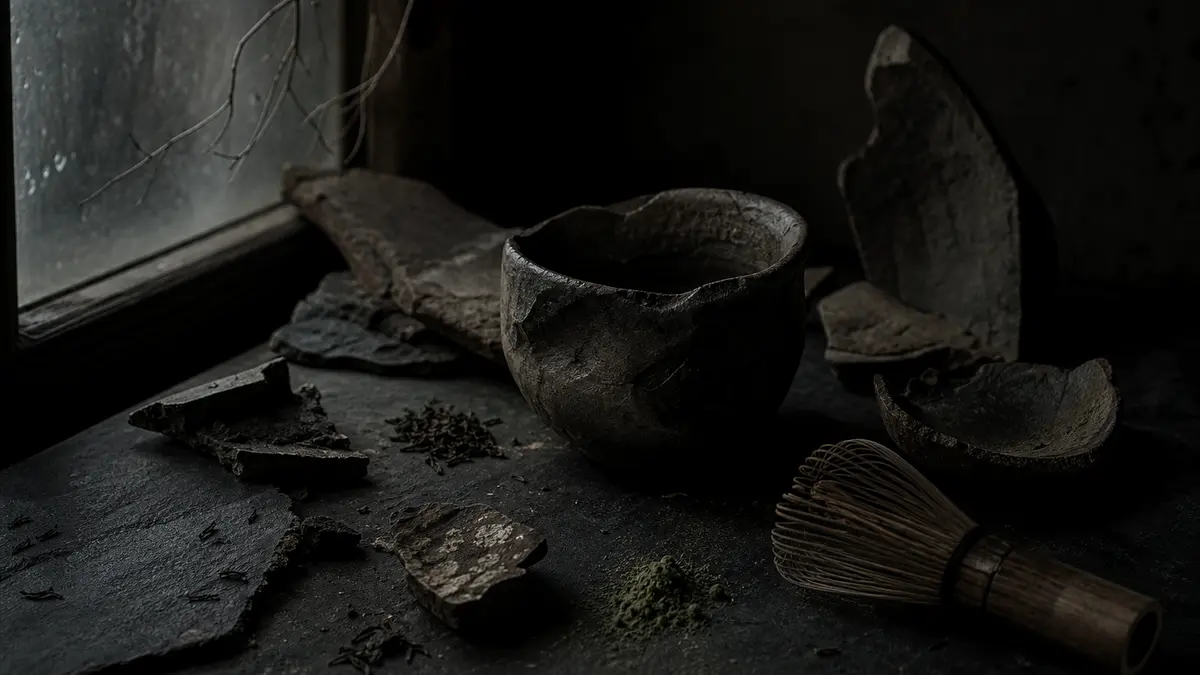
The core question is philosophical: why did unintentional imperfection become the highest aesthetic value, while deliberate perfection became suspect?
Rikyū’s answer was essentially this: deliberate beauty is always about the maker. It announces intention, skill, ego. Unintentional beauty is about the material, the fire, the moment. It has no author to impress you, nothing to prove. It simply exists.
This connects to the broader Japanese concept of 物の哀れ (mono no aware) — the pathos of things, the bittersweet awareness that all things are impermanent. A perfect bowl has nowhere to go but decline. An already-imperfect bowl is already in honest relationship with time. The crack is not a flaw; it is a conversation with mortality that the bowl has already started having.
There is something in this that specifically required Korean origin. Japanese potters, trained within a culture that now valued wabi, could attempt rough asymmetry — and many did. The great Japanese buncheong pottery traditions influenced countless later ceramicists. But the effort always shows, at some level. You can see the decision. The Korean maksa-bal had no decision in it. The roughness was not chosen; it was simply what happened when a skilled but unhurried craftsman made a bowl without aesthetic ambition.
Rikyū understood this. He is reported to have said that if anyone makes a tea bowl like the Koreans, he will immediately cut it to pieces. A Japanese pot trying to be a Korean pot was, to him, precisely wrong — the wabi was faked, and faked wabi was worse than no wabi at all.
This is the paradox at the center of the entire tradition. The most perfect tea bowls cannot be deliberately made. They can only be found — usually in places where no one was looking for beauty.
The Korean Silence
Here is what makes this story genuinely strange: Korea itself did not valorize these bowls.
Korean ceramic aesthetics, both historically and in the modern period, has centered on white porcelain (백자) and celadon (청자). These are the objects in Korean national museums, the ones that appear in histories of Korean art, the pieces Korea is internationally known for. The rough folk bowls that Japan elevated? For much of the 20th century, they were barely discussed in Korean art history.
This began to change through the work of figures like Yanagi Sōetsu and, later, Korean scholars who re-examined their own folk material culture tradition through a partly Japan-mediated lens — which creates its own uncomfortable irony. The Korean rediscovery of maksa-bal beauty partly came through realizing that Japan had been calling it beautiful for 400 years.
Contemporary Korean ceramics culture has developed a rich discourse around 이도다완 and folk pottery traditions. There are potters in Korea today — in the South Jeolla region (전라남도, Jeollanam-do) and around the Goryeong (고령) and Hadong (하동) areas — working in traditions that descend from or reference Joseon folk kiln techniques. Korean tea culture has also developed its own distinct practice, including the formal ceremony tradition 다례 (darye), which uses Korean teaware with a different sensibility than Japanese chanoyu.
But the canonical 이도다완 remain in Japan, classified as Japanese national treasures. The conversation about who “owns” this aesthetic legacy — culturally, historically, materially — is ongoing and not simple.
What the Bowl Teaches About Tea
I think about this story when I’m handling a bowl before a session. The rough foot. The slight wobble when it sits on the table. A glaze that pools unevenly.
There is a version of tea practice that wants everything calibrated — precise temperatures, exact gram weights, specific timing. I am not against this. Precision matters enormously in brewing and I write about it regularly. But precision is about consistency, about removing the variables that obscure the tea.
The bowl is different. The bowl is the part of tea where you stop trying to control.
The Kizaemon Ido’s lesson is that the most important things often come from where you weren’t looking. The great Korean peasant potter made his bowl and moved on to the next one. He did not know he was making an object that would cause grown men to weep five centuries later. That anonymity is not incidental to its greatness — it is the source of its greatness. He had nothing to prove.
Wine people have a phrase: “let the terroir speak.” It means get out of the way and let the place say what it has to say. The Korean folk kiln tradition did exactly this, without intending to. The clay spoke. The fire spoke. The rough, un-precious hand of someone making a rice bowl spoke. And what it said turned out to be, apparently, something close to perfection.
The boxes around the Kizaemon Ido are not pretension. They are acknowledgment. Someone understood that an anonymous peasant, in a moment of unhurried craft, had done something that all the deliberate art in the world couldn’t redo. The boxes say: we know we didn’t make this. We’re just trying to take care of it.
Characteristic Forms: Recognizing an Ido Bowl
Not all Korean tea bowls are Ido forms, and the category itself has gradations. Japanese connoisseurs historically divided Ido chawan into:
| Category | Japanese Term | Characteristics |
|---|---|---|
| Great Ido | 大井戸 (Ō-ido) | Full classic form: wide kōdai, strong kairagi, warm glaze, ample body |
| Small Ido | 小井戸 (Ko-ido) | Similar form, smaller scale |
| Ido-type | 井戸脇 (Idowaki) | Shares characteristics but not canonical form |
| Other named types | Various | Katade (片手), Aoido (青井戸), etc. |
The Kizaemon is the supreme example of Ō-ido. It holds within itself all the qualities that define the category: the kairagi at the foot, the warm glaze shift, the generous mouth, the rough-cut foot ring that looks, yes, like the mouth of a well.
Approximately 200 Ido chawan of varying grades survive in Japan today. Almost all are classified as Important Cultural Properties or National Treasures. Three are generally considered the greatest: the Kizaemon (喜左衛門), the Katsumidera (勝見寺), and the Ōgawachi (大河内). All three are Korean.
A Note on Seeing These Bowls
The Kizaemon Ido is not easy to see. Kohoan at Daitokuji opens for limited periods each year — typically a few weeks in autumn and spring — and the bowl itself is not always on view even then. Other important Ido chawan can be seen at Tokyo National Museum and Osaka’s Fujita Museum, though their exhibition schedules vary.
If you are in Japan and serious about this, research before you travel. The experience of seeing even a minor Ido chawan in person is qualitatively different from photographs. The glaze does what photographs cannot reproduce: it shifts as the light changes, as if the bowl is breathing.
Photographs of the Kizaemon Ido have been published widely — in Yanagi Sōetsu’s writings, in the major works on Japanese ceramics by Louise Cort and other scholars, in Japanese museum catalogues. These give you the shape and something of the color. They don’t give you the weight in your hands or the silence the object makes in a room.
That silence is the point. That silence is what the anonymous Korean potter, moving quickly through a day’s work, left inside the clay without knowing it.