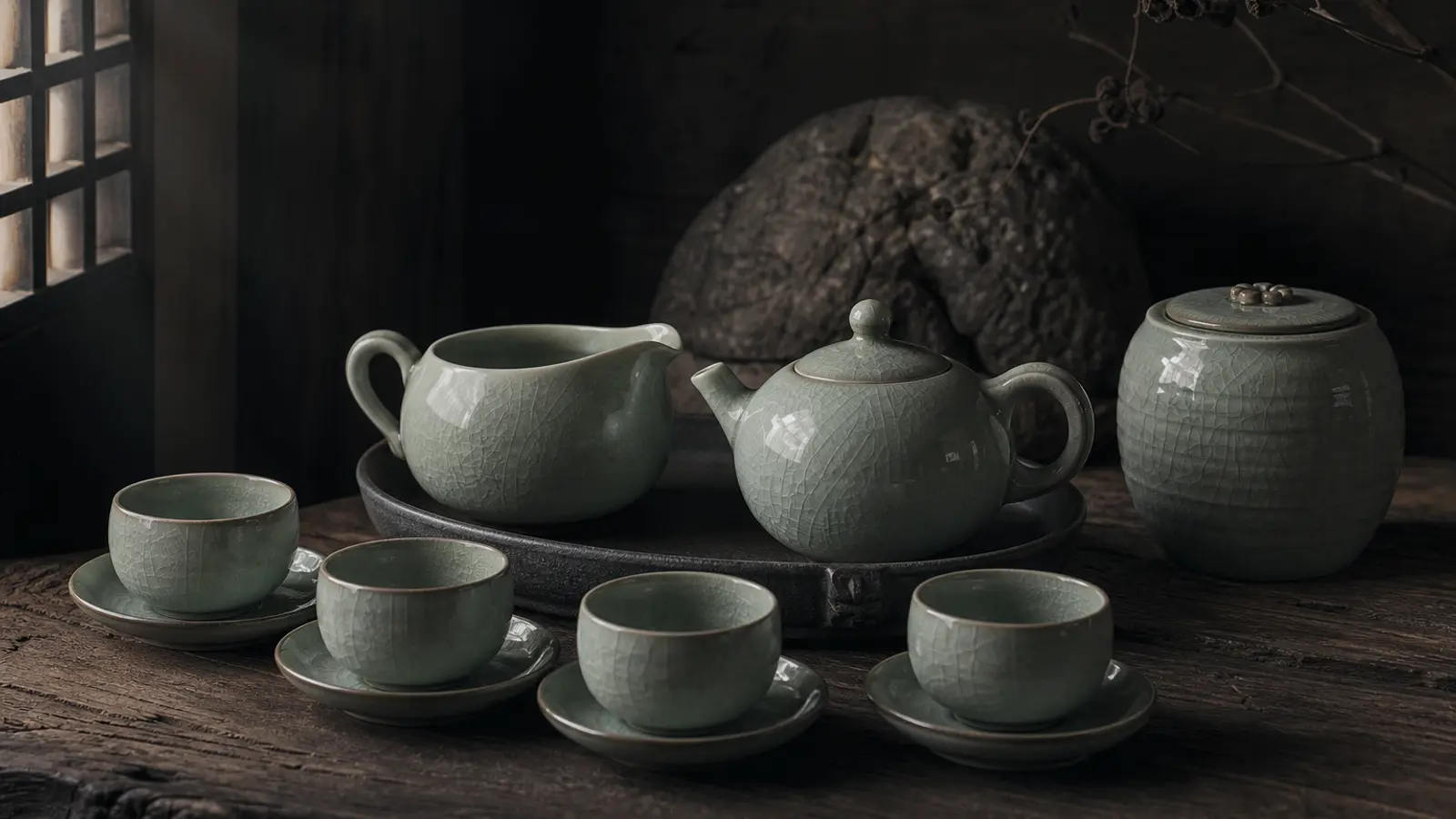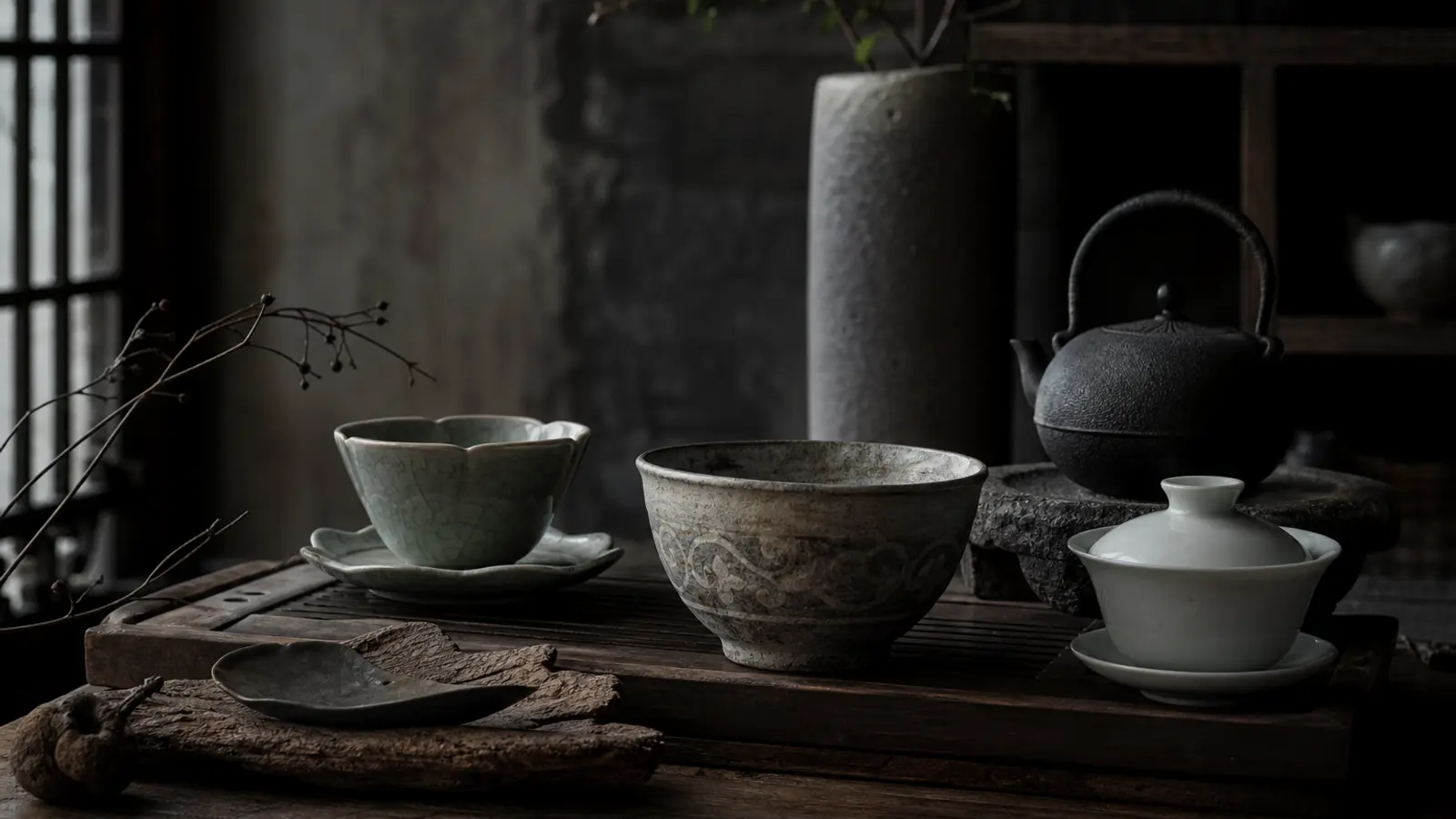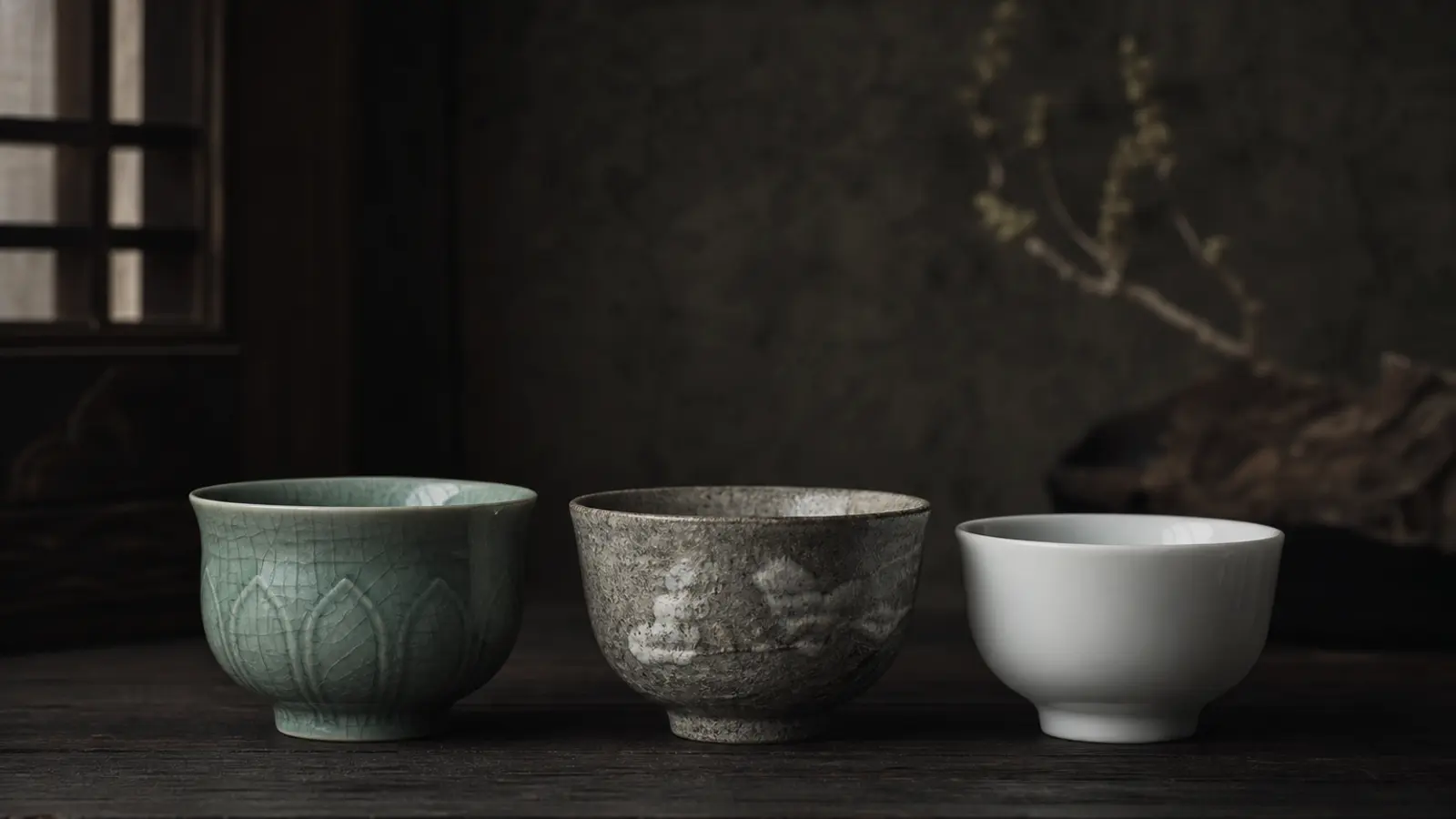
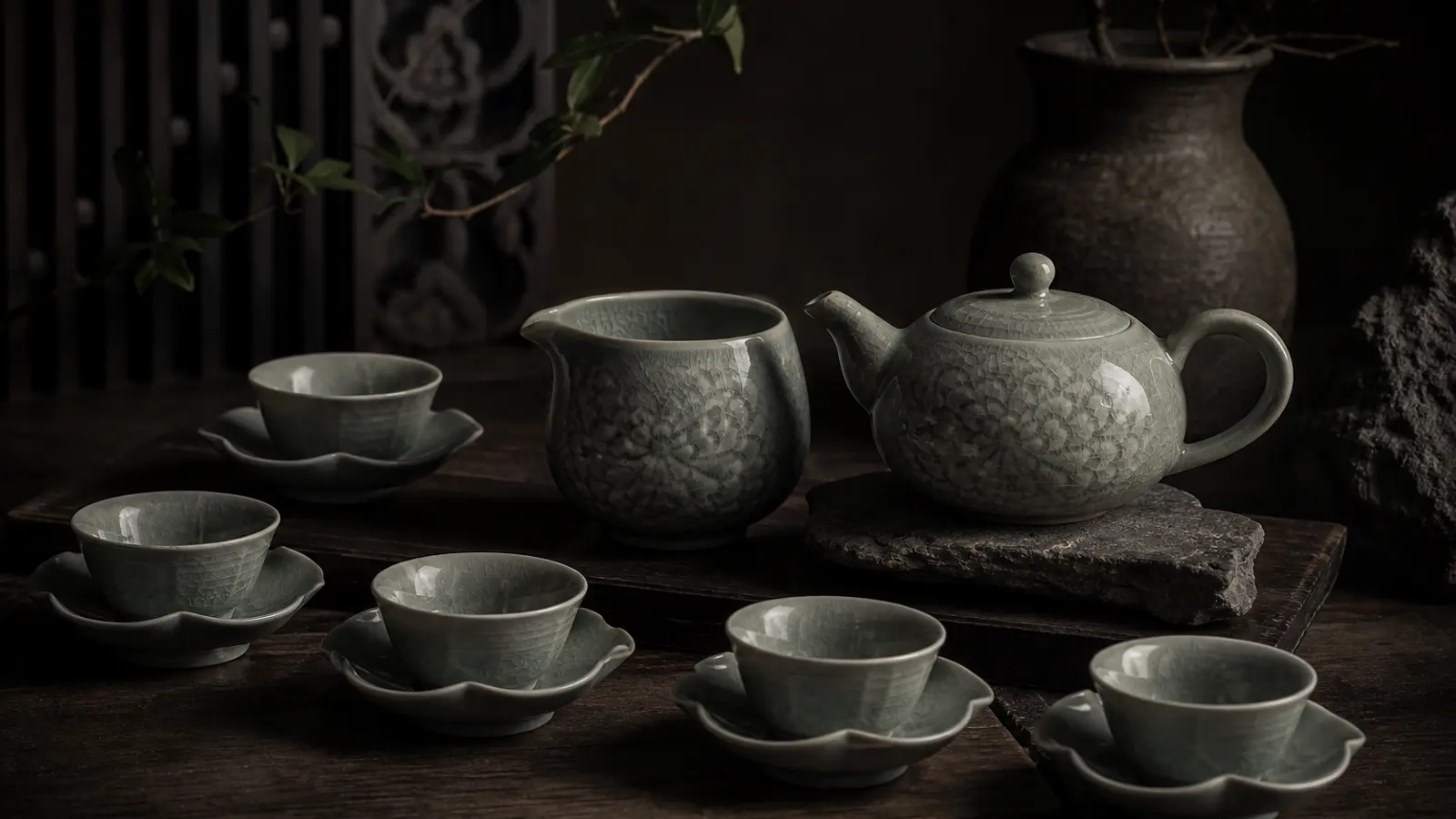
A Korean tea set combines a side-handle teapot, a cooling pitcher, individual cups, and individual saucers in celadon, buncheong, or white porcelain — each tradition producing sets with different character and a different relationship to the tea they serve.
That last element, the individual saucer, is worth noting immediately. No equivalent appears in Chinese or Japanese tea culture at this scale. In a Korean set, the 잔받침 (janbatchim) lifts the cup physically and marks each guest’s place ceremonially. It is the distinctively Korean contribution to the tea table, and it shapes how a Korean tea set looks, how it is laid out, and what it says about the person pouring.
This guide covers the three ceramic traditions that produce Korean tea sets, the components of each, the price tiers that correspond to maker quality, and the specific things to check before you buy.
What a Korean Tea Set Actually Contains
The standard Korean tea set is called a 다기세트 (dagi seteu). A core set includes four component types:
- 다관 (dagwan) — the teapot. Korean teapots are typically side-handle, meaning the handle extends horizontally from the body rather than arching over it. This keeps the hand lower and gives more controlled pour angle.
- 숙우 (sugu) — the cooling pitcher, sometimes called a fairness pitcher. Tea brews in the dagwan, then pours into the sugu to equalize temperature and distribute evenly before going into cups. This step distinguishes Korean service from a direct gongfu pour.
- 찻잔 (chatjan) — teacups. Sets typically include five.
- 잔받침 (janbatchim) — individual saucers for each cup. Also typically five.
Full sets (풀세트) add:
- 퇴수기 (toesugi) — a waste water bowl for rinse water and spent steeps
- 차호 (chaho) — a tea caddy for holding dry leaf during the session
The sugu is not optional decoration. It serves a genuine temperature-moderation function — Korean green teas often brew between 60°C and 75°C, and pouring through a second vessel lets the liquid drop a few degrees before reaching the cup. If you are buying a set primarily for high-temperature teas like aged pu-erh, the sugu still earns its place as a fairness vessel.
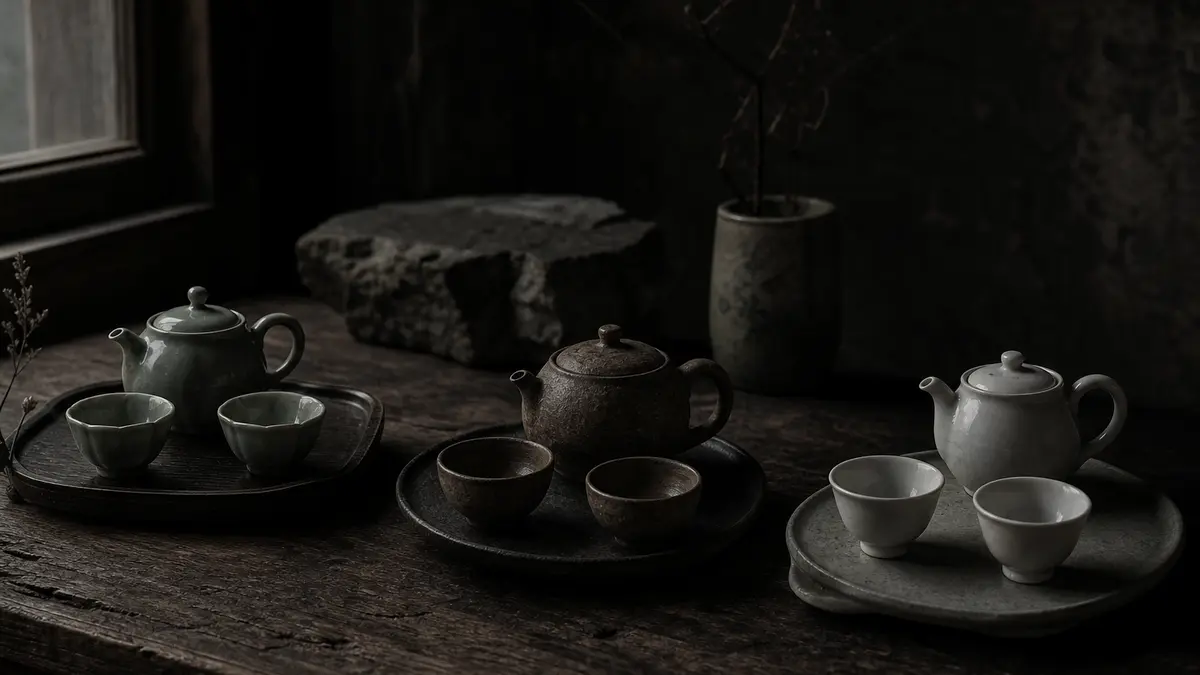
Three Traditions, Three Different Korean Tea Sets
Celadon (청자, Cheongja)
Celadon is the ceremonial tradition. The jade-green glaze — achieved through iron oxide fired in a reduction kiln — is one of the most technically demanding surfaces in East Asian ceramics. Goryeo-era (918–1392) Korean celadon was considered superior to Chinese celadon by Chinese critics of the period, a point Korean potters have not forgotten.
Decorative elements on celadon sets follow classical motifs: cranes, clouds, chrysanthemums, and willow. The signature technique is 상감 (sanggam) inlay, where the potter carves into the unfired clay, fills the channels with white or black slip, and fires the piece so the inlay sits flush beneath the glaze. A well-executed sanggam line is visible as a clean contrast pattern under the green surface without any raised edge.
Celadon sets pair best with Korean green tea (녹차, nokcha) and light oolongs. The glaze is non-porous, so it does not season like unglazed clay. What you buy is what you get, which means the initial quality matters completely.
Price ranges:
- Mid-range (named workshop): $145–$360
- High (gallery-represented or master-level): $500–$2,100+
Buncheong (분청사기)
Buncheong is the artisan tradition — rougher, earthier, and more alive in the hand than celadon. The term covers several decorative techniques, all involving white slip applied to a gray stoneware body. The effect ranges from dripped and brushed patterns to stamped impressions to surfaces where the slip has been partially scraped away to reveal the clay beneath.
Unlike celadon, buncheong absorbs use over time. The unglazed or partially-glazed clay body seasons the way Yixing clay does — slowly accumulating character from repeated tea contact. This makes buncheong a living set in a way celadon is not. Some collectors deliberately keep one buncheong set for aged sheng pu-erh, another for shou, and never mix them.
Buncheong pairs particularly well with aged teas, roasted oolongs (including heavy-roast tieguanyin), and shou pu-erh. The earthy, textured walls seem to belong with those flavors in a way clean porcelain does not.
Price ranges:
- Mid-range (named workshop): $100–$300
- High: $300–$800+
White Porcelain (백자, Baekja)
White porcelain is the analytical tradition. The glaze is clear over white clay, the walls are smooth, and there is nothing between you and the tea’s color. In a white chatjan, the liquor of a first-flush Korean green shows its precise shade of yellow-green. In a celadon cup, you lose that reference.
Baekja is the most versatile set. It works with every tea category, it reveals color accurately, and it pairs with any brewing style. If you are buying one Korean tea set and want maximum range, white porcelain is the honest recommendation.
Functionally, baekja comes closest to the Chinese 蓋碗 (gaiwan) in its analytical neutrality — though the dagwan-and-sugu workflow still differs from the gaiwan pour. Baekja sets are also the most accessible price entry point.
Price ranges:
- Entry level: under $70
- Mid-range (named workshop): $70–$200
- High: $200–$500
Korean Tea Set Price Tiers
The Korean ceramics market has a legible hierarchy. Price maps to maker identity more reliably here than in most categories.
| Tier | Price Range | What It Represents |
|---|---|---|
| Entry / Production | Under $70 | Factory or workshop production, no named potter |
| Named Workshop | $70–$200 | Identified workshop, consistent quality, limited variation |
| Gallery-Represented Artist | $200–$500 | Individual studio potter with exhibition history |
| Designated Master | $500+ | 무형문화재 (muhyeong munhwajae) — Intangible Cultural Heritage status or equivalent recognition |
The jump from named workshop to gallery-represented is not always visible in a photo. It shows in person: the weight distribution, the precision of the lid seat, the quality of the foot ring, the consistency of the glaze across every piece in the set. A set where all five chatjan feel identical in the hand and pour the same way is a sign of serious making.
What to Check When Buying a Korean Tea Set
Glaze Consistency
Look for even color saturation across the set. In celadon, patches of lighter green usually indicate uneven kiln placement or inconsistent glaze application. Some crazing (균열, gyunyeol — the network of fine cracks in the glaze surface) is acceptable and traditional; it fills with tea over time. Severe crazing that crosses lip or foot ring edges can be a structural concern.
Foot Ring Finish
Turn the piece over. The foot ring (굽, gup) is where makers reveal their hand. A well-trimmed foot ring is clean, even in height, and smooth enough not to scratch a surface. Rough, uneven, or visibly rushed foot rings are an honest indicator of overall attention to craft.
Lid Fit
On the dagwan, the lid should seat without rocking and lift cleanly. A lid that wobbles imprecisely will also let heat escape unevenly and may drip during pour. The fit between lid and rim is one of the few tolerance checks you can perform without brewing the pot.
Potter’s Seal
Most Korean studio potters mark their work with a 인장 (injang) — a stamped or incised seal, often pressed into the foot or base. If you are buying at a price point that claims gallery-represented or master-level quality, the injang should be present and identifiable. Reputable sellers can connect a seal to a specific potter’s biography. If the seller cannot identify the mark, the price tier claim is unsupported.
The Janbatchim: Korea’s Distinctive Contribution
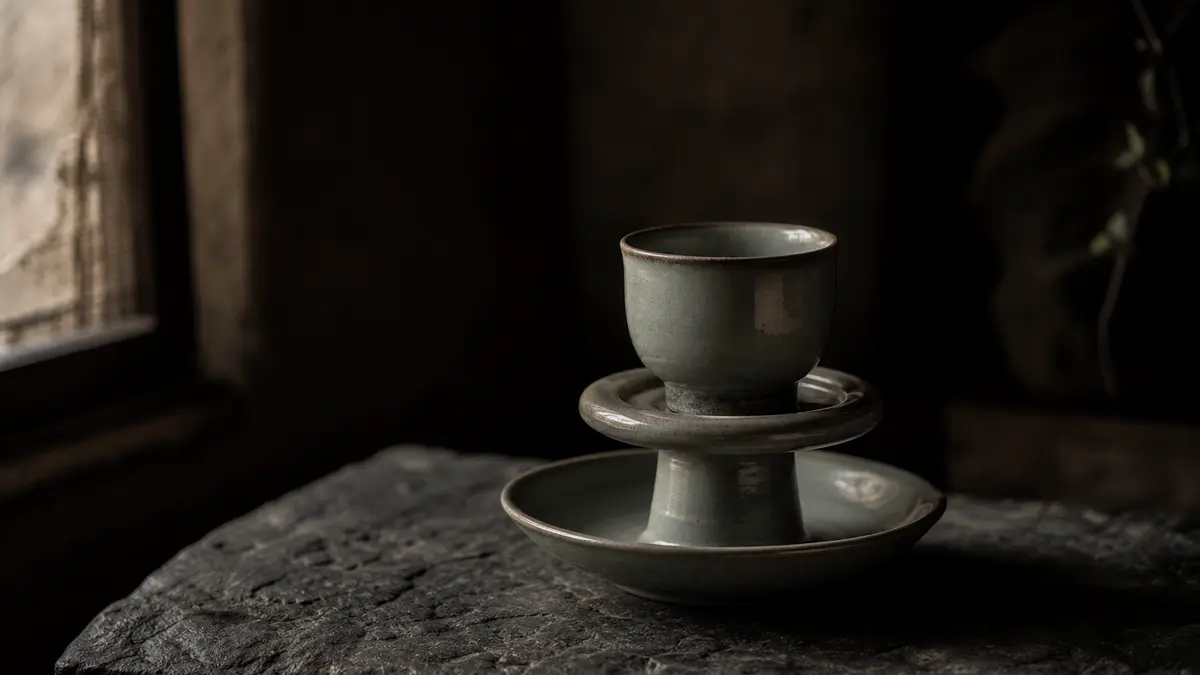
The individual saucer deserves its own section because it is genuinely absent from the standard Chinese and Japanese tea table.
In Chinese gongfu service, cups sit on the tray or in the hand. In Japanese ceremony, the bowl is held with both hands directly. The Korean janbatchim elevates each cup — physically off the surface by a few centimeters, and ceremonially into its own defined space at the table.
A full set of five chatjan and five janbatchim means five defined guest positions. The table layout communicates something before tea is poured. This is not a trivial design decision — it shapes the social geometry of the session.
When evaluating a set, the janbatchim should match the chatjan in glaze character and weight proportion. A saucer that feels too heavy for its cup breaks the set’s visual logic. A saucer too light for an earthenware cup looks undersized. Proportional balance across the set is worth checking piece by piece.
Choosing the Right Tradition for Your Tea Practice
The three traditions are not interchangeable, but they are also not mutually exclusive. Many serious Korean tea drinkers own sets in more than one tradition and choose by context.
If your primary teas are Korean green or light oolong, and you want a ceremonial set that reflects the deepest history of Korean ceramics, celadon is the right starting point. Budget at least $145 for a named workshop set.
If you drink aged teas, heavily oxidized oolongs, or shou pu-erh, and you want a set that develops character over years of use, buncheong offers that relationship. A good workshop buncheong set is available from around $100.
If you want one set that works with everything, reveals tea color accurately, and fits any guest or any tea, white porcelain baekja is the honest recommendation. A named workshop set in this tradition often starts under $150 and can represent genuinely good value.
Whatever tradition you choose, start with the foot ring, check the lid fit, find the injang, and hold every chatjan in the set before you decide. Korean ceramics rewards attention at the point of purchase — these are objects meant to last.