Learning how to brew tea well is simpler than most people expect, and more interesting than they imagine. You don’t need expensive equipment, a ceremony, or years of study. You need to understand three variables — water temperature, leaf-to-water ratio, and steep time — and pick a method that fits how you drink.
This guide covers three methods in order of complexity: Western-style brewing, grandpa style, and gongfu brewing. If you’re starting at zero, read the first two sections and brew something today. Come back for the third when you’re ready to go deeper.
The Three Variables That Control Every Brew
Before getting into methods, you need to understand what actually determines how a cup of tea tastes. Every method is just a specific combination of these three levers.
Water Temperature
This is the single biggest variable in tea brewing, and the most commonly ignored. Different teas require different temperatures because they contain different compounds. High heat extracts everything quickly — including catechins and tannins that taste bitter and astringent. Delicate teas like green and white tea are destroyed by boiling water; robust teas like black tea and pu-erh can handle it.
The most common beginner mistake is pouring boiling water over everything. It works fine for a tea bag of English Breakfast. It ruins a good Dragon Well (龍井).
General temperature ranges:
- Black tea: 90–100°C (194–212°F)
- Oolong: 85–95°C (185–203°F) depending on oxidation level
- Green tea: 70–80°C (158–176°F)
- White tea: 75–85°C (167–185°F)
- Pu-erh (ripe/sheng): 90–100°C (194–212°F)
- Herbal infusions: 95–100°C (203–212°F)
If you don’t have a temperature-controlled kettle, bring water to a boil and let it sit. One minute of resting drops the temperature roughly 3–5°C. For green tea, let it rest 5–8 minutes or add a small splash of cold water.
Leaf-to-Water Ratio
More leaf means a stronger, more concentrated brew. Less leaf means something lighter. The ratio you use depends on your method and personal taste, but the starting points below give you a baseline to adjust from.
Steep Time
Longer steeps extract more. Shorter steeps extract less. The relationship isn’t perfectly linear — compounds extract at different rates — which is why the first 30 seconds of a gongfu steep tastes different from minute four of a Western steep, even if both come from the same tea. Start with the recommended time, taste, and adjust on your next brew.
Method 1: Western Brewing
Best for: Black tea, herbal tea, rooibos, casual everyday drinking Equipment: Teapot or mug with an infuser, kettle
Western-style brewing is the method most of the world starts with, and for good reason. It’s forgiving, requires minimal gear, and produces a solid, satisfying cup when you follow basic temperature guidelines.
How to Brew Tea Western Style: Step by Step
- Heat your water to the appropriate temperature for your tea type (see the table below).
- Measure your tea. Use 2–3g of loose leaf tea per 200–300ml of water. For most teas that’s roughly one level teaspoon per cup, though leaves vary in density — bulky leaves like silver needle need more volume for the same weight.
- Warm your vessel. Pour a small amount of hot water into your teapot or mug, swirl it around, and discard. This prevents your vessel from dropping the brew temperature on contact. It takes ten seconds and it matters.
- Add your leaves to the infuser or teapot.
- Pour water over the leaves. Don’t pour directly onto the leaves from a great height if you can avoid it — gentler pours preserve delicate teas better.
- Steep for the recommended time. Black tea: 3–5 minutes. Green tea: 2–3 minutes. White tea: 3–5 minutes. Oolong: 3–4 minutes. Herbal: 5–7 minutes.
- Remove the infuser or strain the tea immediately once steep time is reached. Leaving leaves in contact with hot water past this point extracts bitterness.
- Taste, adjust, repeat. If your tea tasted bitter, steep shorter next time or lower the temperature. If it was weak, steep longer or use more leaf.
Most teas can handle a second Western steep — just add a minute or two to your original time. Beyond that, flavor often drops off steeply. If you find yourself wanting more from the same leaves, that’s usually a sign to consider the gongfu method.
Method 2: Grandpa Style (老人茶)
Best for: Green tea, light oolong, plain sencha, everyday drinking Equipment: None beyond a tall glass or large mug
Grandpa style — 老人茶 (lǎorén chá, “old man’s tea”) — is how millions of Chinese people drink tea every day. You put leaves directly in your cup, pour hot water, wait for the leaves to sink, and drink. When the water drops to about one-third, you refill. That’s it.
This method sounds casual because it is casual. It’s also surprisingly effective for green teas and light oolongs, which unfurl and release flavor slowly at lower temperatures.
How to Brew Tea Grandpa Style: Step by Step
- Add 3–5g of loose leaf tea directly to a tall glass or large mug. No infuser, no basket.
- Pour hot water at the appropriate temperature — 70–80°C for green tea, slightly hotter for light oolong. Fill the glass about two-thirds full.
- Let the leaves settle. Most leaves sink within 30–60 seconds. Once the bulk of the leaves have dropped below your drinking line, start sipping.
- Drink slowly. Grandpa style is meant to accompany a long conversation or a few hours of work. You’re not rushing through it.
- Refill when you reach one-third. Add more hot water when the tea is about one-third full. The ratio of water to residual wet leaf in the cup is your new “recipe.”
- Continue refilling until the flavor fades — usually 3–5 refills for a quality green tea.
A few practical notes: This method doesn’t work well for teas that produce lots of fine broken leaf — you’ll end up chewing your tea. It works best with whole-leaf teas that have clean, predictable sinking behavior. Avoid it for black teas or highly roasted oolongs, which can taste harsh without temperature control and timed extraction.
Method 3: Gongfu Brewing (功夫茶)
Best for: Oolong, pu-erh, aged teas, high-quality single-origin teas of any type Equipment: Gaiwan (蓋碗) or small teapot, serving pitcher (fairness cup/公道杯), cups
Gongfu brewing (功夫茶, gōngfu chá) translates loosely as “tea made with skill and effort.” It uses a high leaf-to-water ratio and a series of very short successive steeps from the same leaves. The same session that produces a 5-second first steep might run through 12 more steeps over the course of an hour, with the tea changing character — opening up, peaking, slowly fading — across all of them.
This is the deep practice. It’s how serious tea drinkers evaluate and experience high-quality teas, and it’s why the same oolong from Wuyi that tasted one-dimensional in a mug reveals mineral complexity, floral shifts, and a persistent throat sweetness called huigan (回甘) when brewed gongfu style.
You don’t need to start here. But knowing this method exists — and understanding why it works — will reframe everything you thought you knew about what tea can taste like.
How to Brew Tea Gongfu Style: Step by Step
- Heat water to the appropriate temperature for your tea type.
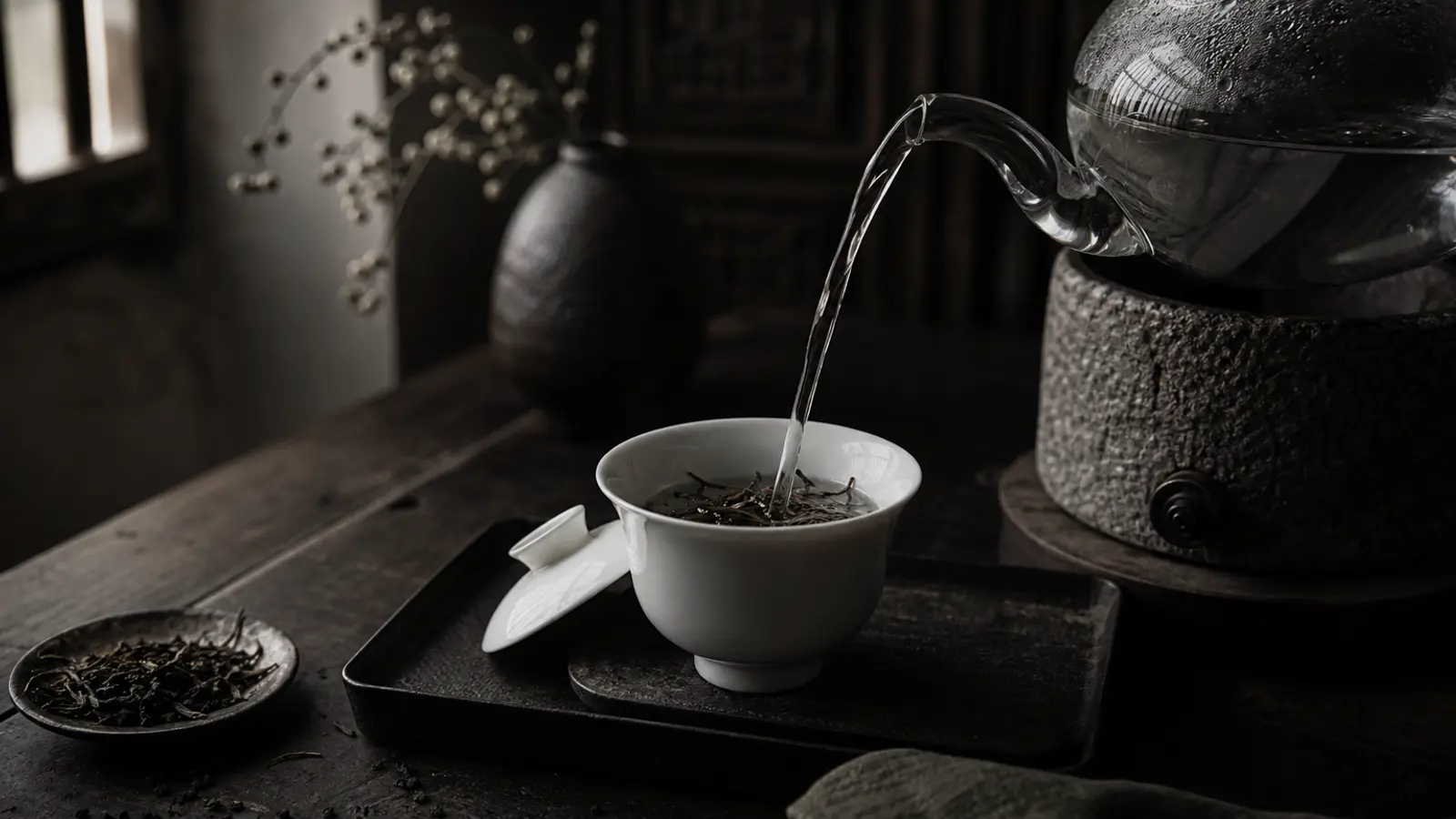
- Rinse your vessel. Pour hot water over your gaiwan (蓋碗) and cups to warm them, then discard.
- Measure your tea. Use 5–8g per 100–150ml of vessel volume. For a standard 100ml gaiwan, 7g is a reasonable starting point for most oolongs and pu-erhs.
- Rinse the leaves (optional but common). Pour hot water over the leaves, let it sit for 3–5 seconds, and discard. This isn’t for “washing” the tea — it’s for waking the leaves and preparing them to open. Some teas benefit from this; many high-quality greens do not need it.
- First steep: start short. 5–10 seconds for most oolongs and sheng pu-erh. 10–20 seconds for ripe pu-erh. The goal is subtlety — you’re not trying to extract everything at once.
- Pour completely into a serving pitcher. This ensures all infusions stay consistent and prevents over-steeping while you’re pouring individual cups.
- Distribute into cups and drink promptly. Small cups cool fast.
- Increase each subsequent steep by 5–15 seconds. The leaves are progressively more spent, so you need slightly more time per steep to maintain a consistent strength. By steep 6 or 7, you might be at 30–40 seconds. By steep 10–12, potentially a minute or longer.
- Continue until the flavor fades. A quality oolong or aged pu-erh should give you 8–15 usable steeps. When sweetness and aroma drop off without bitterness replacing them, the leaves are done.
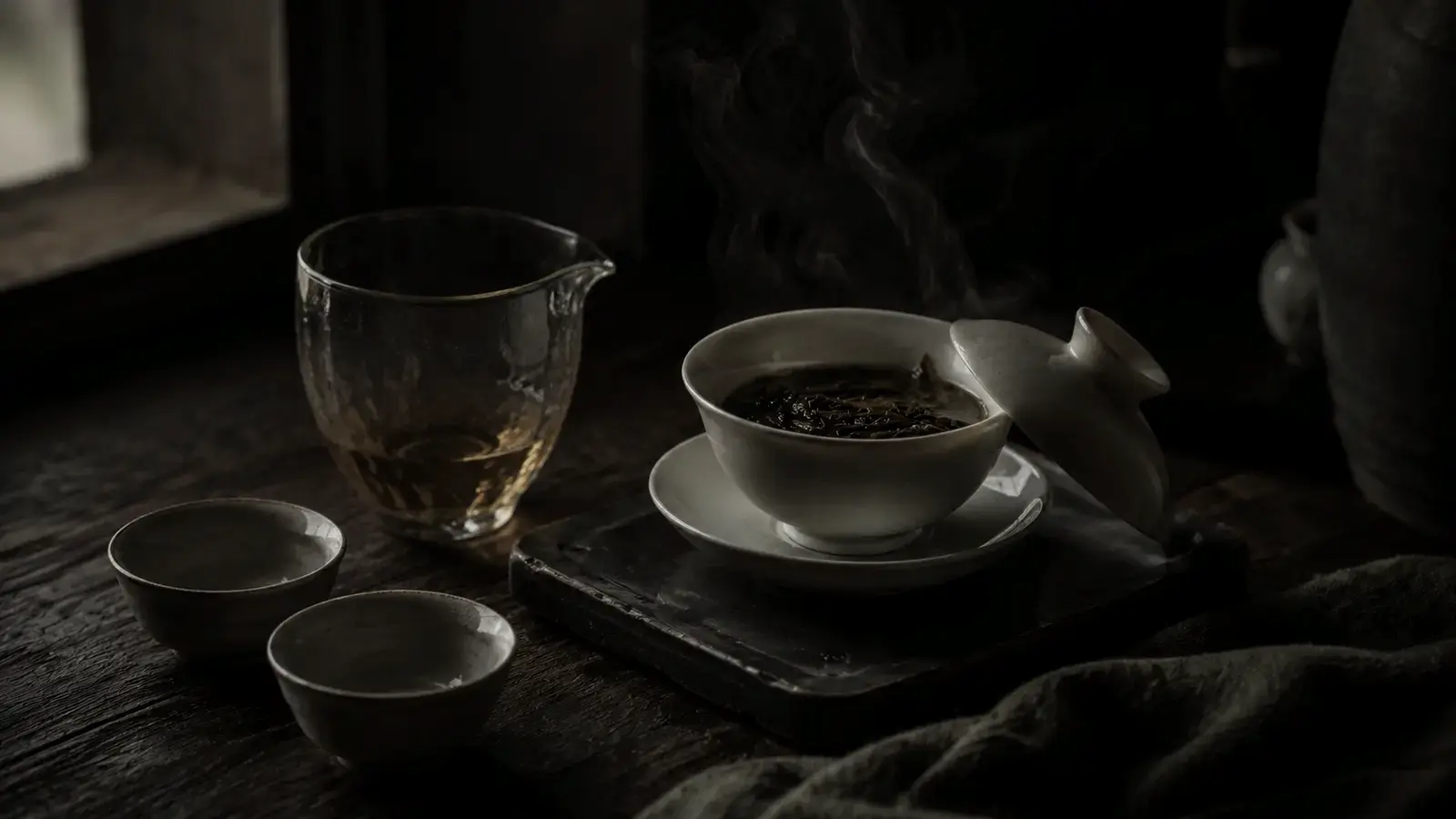
The gaiwan (蓋碗) is the most versatile vessel for gongfu brewing. It’s a lidded bowl with a saucer, made of porcelain, used by tilting the lid to create a gap and pouring through it. It has no flavor contribution, handles heat well, and lets you observe the leaves directly. If you want to go deeper on gongfu equipment, the gaiwan guide is the right next step.
Quick Reference: Temperature and Steep Times by Tea Type
| Tea Type | Temp (Western) | Western Steep Time | Temp (Gongfu) | Gongfu Steep Start |
|---|---|---|---|---|
| Black tea | 95–100°C (203–212°F) | 3–5 min | 90–95°C (194–203°F) | 10–20 sec |
| Green tea | 70–80°C (158–176°F) | 2–3 min | 75–80°C (167–176°F) | 8–15 sec |
| White tea | 75–85°C (167–185°F) | 3–5 min | 80–85°C (176–185°F) | 10–20 sec |
| Light oolong | 85–90°C (185–194°F) | 3–4 min | 90–95°C (194–203°F) | 5–10 sec |
| Roasted oolong | 90–95°C (194–203°F) | 3–5 min | 95–100°C (203–212°F) | 10–15 sec |
| Sheng pu-erh (生普) | 95–100°C (203–212°F) | 3–4 min | 95–100°C (203–212°F) | 5–10 sec |
| Shou pu-erh (熟普) | 95–100°C (203–212°F) | 3–5 min | 95–100°C (203–212°F) | 10–20 sec |
| Herbal/Rooibos | 95–100°C (203–212°F) | 5–7 min | Not typical | — |
| Yellow tea | 75–80°C (167–176°F) | 2–3 min | 80–85°C (176–185°F) | 10–15 sec |
These are starting points, not rules. Every tea is different, and the same cultivar from two different producers or harvest seasons may respond differently. Use this table to get in range, then adjust based on what you taste.
The Most Common Beginner Mistakes
Using Boiling Water for Everything
I’ve already covered this, but it bears repeating: boiling water destroys green and white tea. If your green tea has tasted harsh, bitter, or flat — and you’ve been using freshly boiled water — fix the temperature first before you blame the tea.
Steeping Too Long
The second most common mistake. Set a timer. Most teas turn unpleasantly bitter or astringent when left to steep past their recommended window. If you frequently forget your tea, use an infuser you can pull immediately, or switch to grandpa style where the continuously diluting ratio self-corrects over time.
Too Little Leaf
A weak cup is usually a ratio problem, not a quality problem. Most people under-leaf significantly. If your tea is tasting thin and watery, add more leaf rather than steeping longer — extended time extracts bitterness, while more leaf adds body and sweetness.
Not Tasting Critically
Brewing good tea is an iterative skill. If you drink a cup without paying attention, you can’t improve. After your first steep, note what you liked and what you’d change — more strength, less bitterness, longer finish. Adjust one variable at a time.
Choosing Your Starting Method
Start with Western brewing if: You want to drink tea casually without thinking about it. You’re working primarily with black tea, herbal blends, or flavored teas. You have five minutes and a mug.
Start with grandpa style if: You drink green tea at a desk or want zero-equipment brewing. You like the meditative quality of a slowly evolving glass over an hour or two.
Move to gongfu if: You’ve tasted something in a good oolong or pu-erh and want more of it. You’re curious about what “tea as a practice” actually means. You want to understand why serious tea drinkers care so much about this.
There’s no hierarchy here in terms of validity. Grandpa style and Western brewing produce excellent results in the right context. Gongfu isn’t better — it’s more revealing. For high-quality teas with complex flavor profiles, it extracts dimensions that other methods don’t reach.
What to Brew First
If you’re buying your first loose leaf tea to experiment with these methods:
- For Western or grandpa style: A Taiwanese high-mountain oolong (高山烏龍) or a simple Darjeeling first flush. Both are forgiving, clearly flavorful, and respond well to temperature adjustments.
- For gongfu: A dancong oolong (單叢) or a young sheng pu-erh. Both have enough structural complexity to reward the method and will taste noticeably different at different steeps.
If you want to understand the full landscape of tea types before buying anything, the types of tea guide covers the six categories — green, white, yellow, oolong, black, and pu-erh — with origin and flavor context for each.
Going Deeper
This guide gives you the framework to brew any tea competently today. But brewing is only one dimension of tea knowledge. Once you’ve practiced the three methods and developed a sense of what you prefer, these are the natural next steps:
Water temperature — The full guide to tea brewing water temperature goes into the chemistry of extraction, the role of altitude in boiling points, and how mineral content in your water affects taste independently of temperature.
Gongfu brewing — A dedicated deep-dive into the gongfu method: vessel choice, pouring technique, how to read leaves, and how to sequence steeps across a long session.
Types of tea — Understanding the six categories and how processing creates their differences. This context will sharpen your intuitions about temperature and steeping faster than any brewing guide alone.
Gaiwan guide — How to hold, pour from, and choose a gaiwan (蓋碗). The technique is not obvious, and the wrong grip will result in spilled tea or burned fingers.