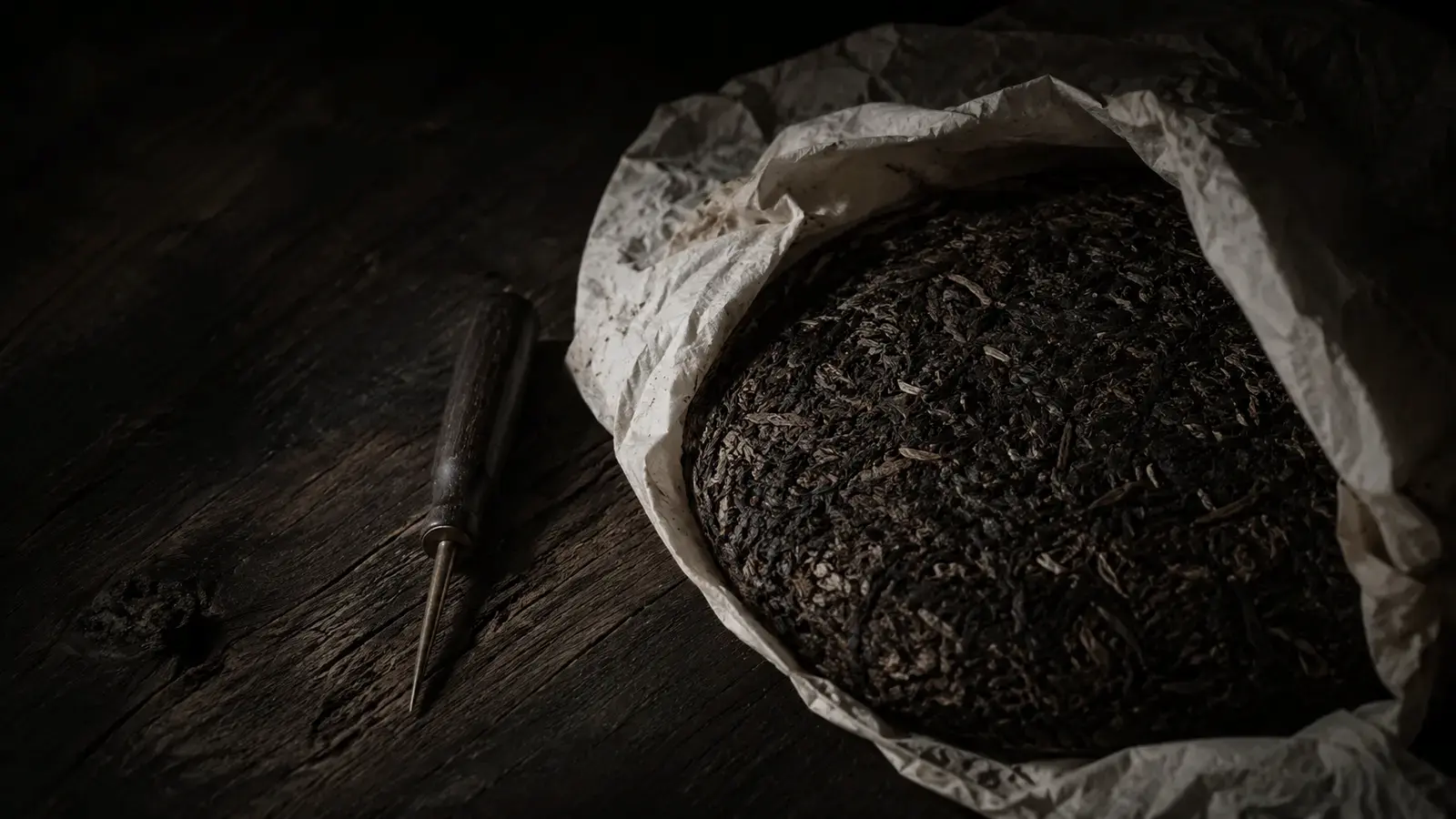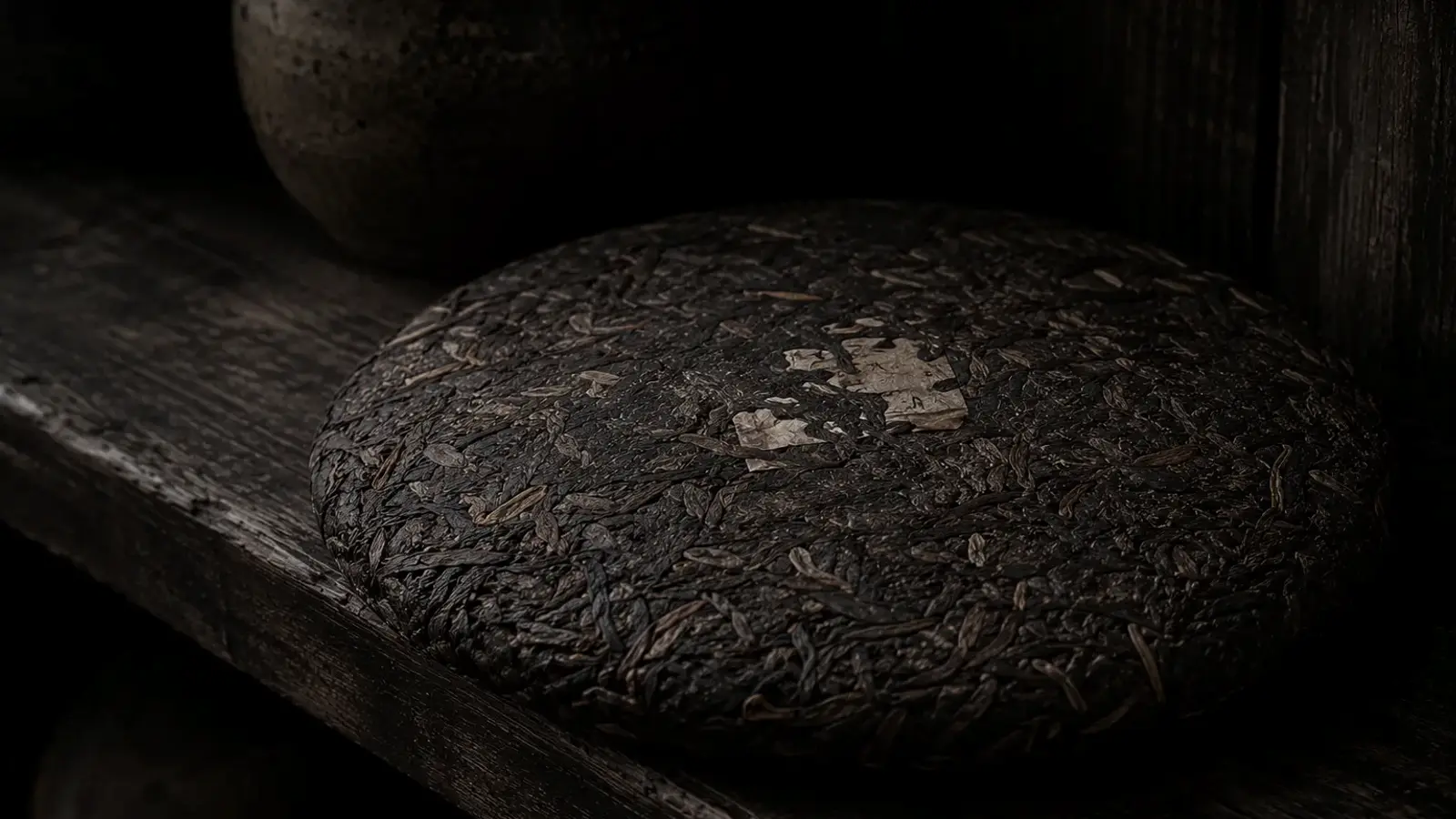
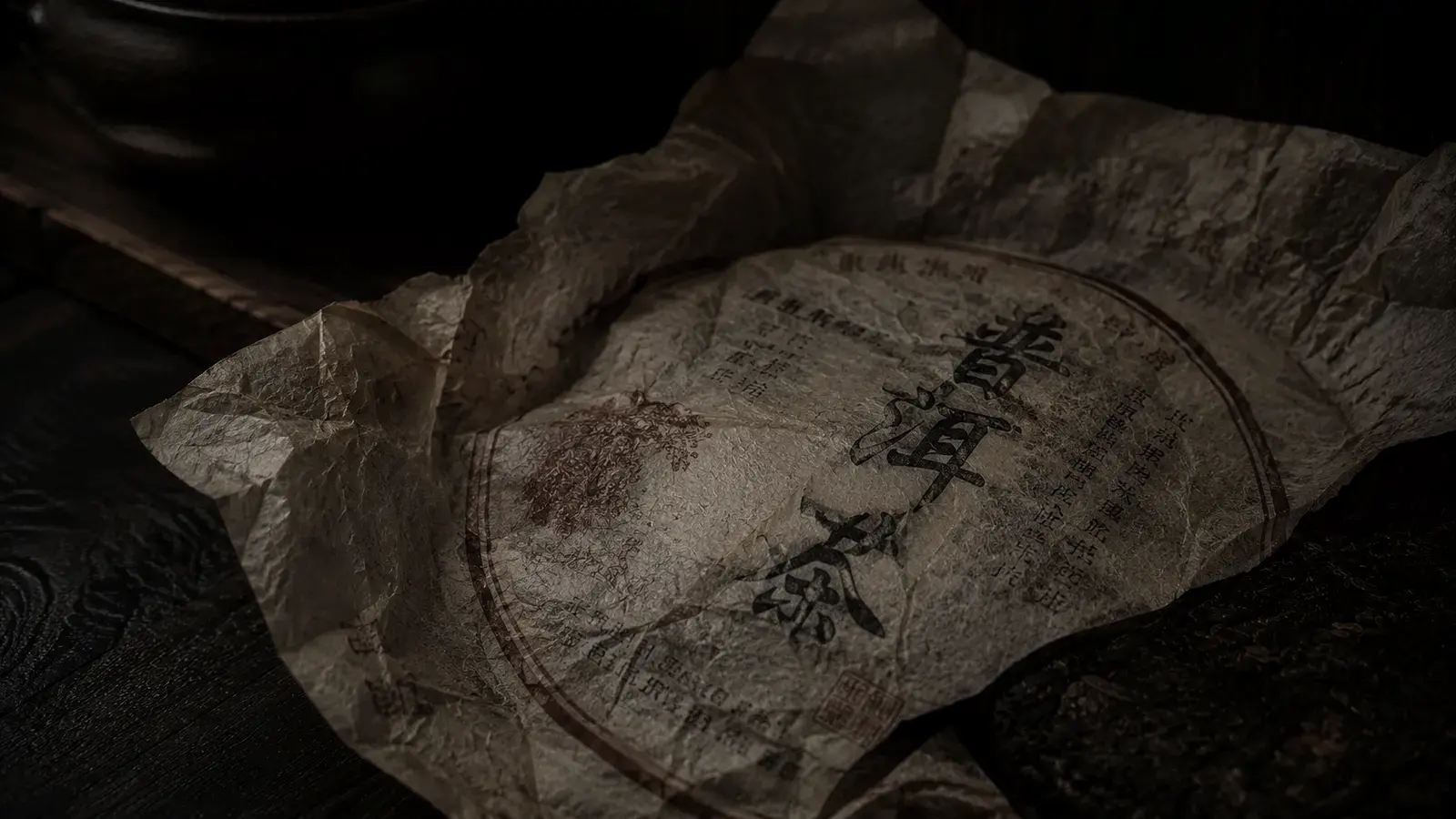
A pu-erh tea wrapper (包装纸) is not decoration. It is documentation. Every element — the outer paper, the loose ticket inside, and the small pressed tag embedded in the tea itself — carries production data if you know how to read it. Most resources either ignore this system entirely or explain one piece without the others.
This guide covers all three identification elements, the four-digit recipe number system, factory codes, Chinese date formats, and how to spot forgeries on supposedly aged cakes. Keep it open when you’re evaluating a new purchase or working through a collection.
The Three Identification Elements of a Pu-erh Cake
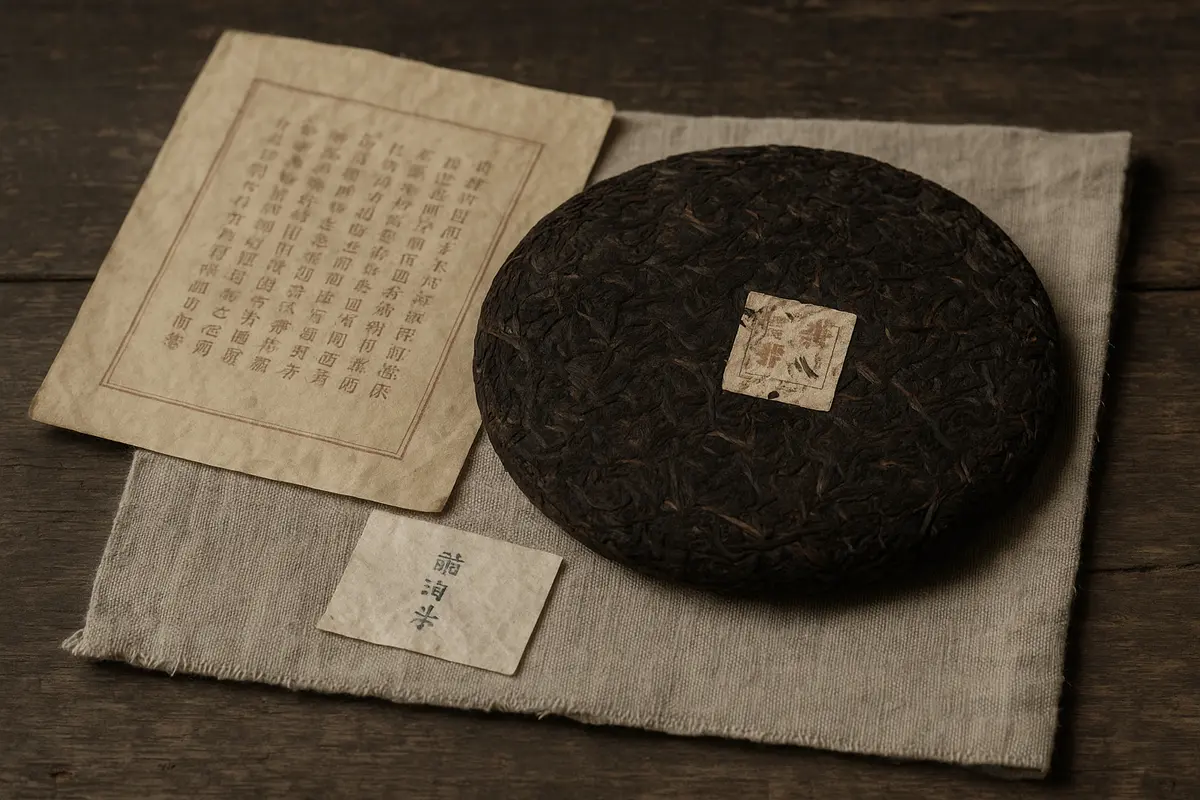
Before getting into specifics, understand that a complete pu-erh cake has three distinct information layers. Serious collectors cross-reference all three. Any single element in isolation can be faked; the three together tell a coherent story — or reveal contradictions.
1. The Outer Wrapper (包装纸, bāozhuāng zhǐ)
The outer wrapper is the large printed sheet of paper that wraps the cake. It’s the most visible and the most commonly faked element. For state-factory productions from the mid-20th century onward, the design is often standardized and well-documented — there are reference books (notably the various “pu-erh identification” volumes published in Chinese) with print-quality photographs of authentic wrappers by factory and era.
Key elements to read on the outer wrapper:
- Brand name (品牌, pǐnpái): Often stylized, e.g., “大益” (Dayi, the Menghai brand), “下关” (Xiaguan), “中茶” (CNNP / Zhongcha).
- Tea type designation: 普洱茶 (pǔ’ěr chá), or more specifically 普洱生茶 (shēng chá, raw) or 普洱熟茶 (shóu chá, ripe/cooked).
- Net weight (净含量, jìng hánliàng): Standard cake is 357g; some are 400g, 500g, or the older 375g Taiwanese-targeted weights.
- Recipe or product number (唛号, mài hào): The four-digit code discussed in depth below.
- Production date (生产日期, shēngchǎn rìqī): Year, sometimes month.
- Standard codes: Modern productions list GB/T standards (e.g., GB/T 22111 for geographic indication pu-erh from Yunnan).
- Factory or company name and address.
The paper itself matters. Pre-1990s wrappers were printed on coarser stock with hand-applied inks. The texture, ink absorption, and even the smell of the paper are reference points for experienced collectors. This is Tier 2 knowledge for me — I rely on documented reference photography and collector accounts rather than decades of personal handling.
2. The Neipiao (内票, nèi piào)
The neipiao is a larger printed sheet — roughly A5 or smaller — loose inside the wrapper, sitting against the surface of the cake. Think of it as the product insert. It often contains:
- Brand history and factory description
- More detailed production information
- Brewing instructions (sometimes)
- Lot or batch numbers on modern productions
- QR codes on post-2010 productions
The neipiao is the weakest of the three authenticity markers. It’s a loose piece of paper. Anyone can print a convincing neipiao on aged-looking paper. Use it for information, not verification.
3. The Neifei (内飞, nèi fēi)
The neifei is the element that sets pu-erh apart from virtually every other tea category. It’s a small paper ticket — typically 4–6 cm long — that is physically pressed into the compressed leaf during production. Part of the ticket is buried inside the cake; part is visible on the surface.
A genuine neifei from the compression date cannot be removed without disturbing the tea. This is why it’s the primary physical authentication tool for aged cakes.
On a neifei you typically find:
- Factory name: e.g., 勐海茶厂 (Měnghǎi Chá Chǎng, Menghai Tea Factory)
- Brand mark: e.g., 大益 or the older “八中茶” circular logo (八 = eight, used by CNNP)
- Sometimes a serial number or production code
- Occasionally a brief quality statement
Spotting a fake neifei: Authentic aged neifei paper oxidizes over time — it yellows, the ink fades unevenly, and the paper becomes slightly brittle at the edges. A neifei on a “1990s” cake that has bright white paper, sharp ink edges, and sits cleanly on top of the tea surface rather than partially embedded in it is an immediate red flag. More on this in the authenticity section.
Decoding the Four-Digit Recipe Number (唛号)
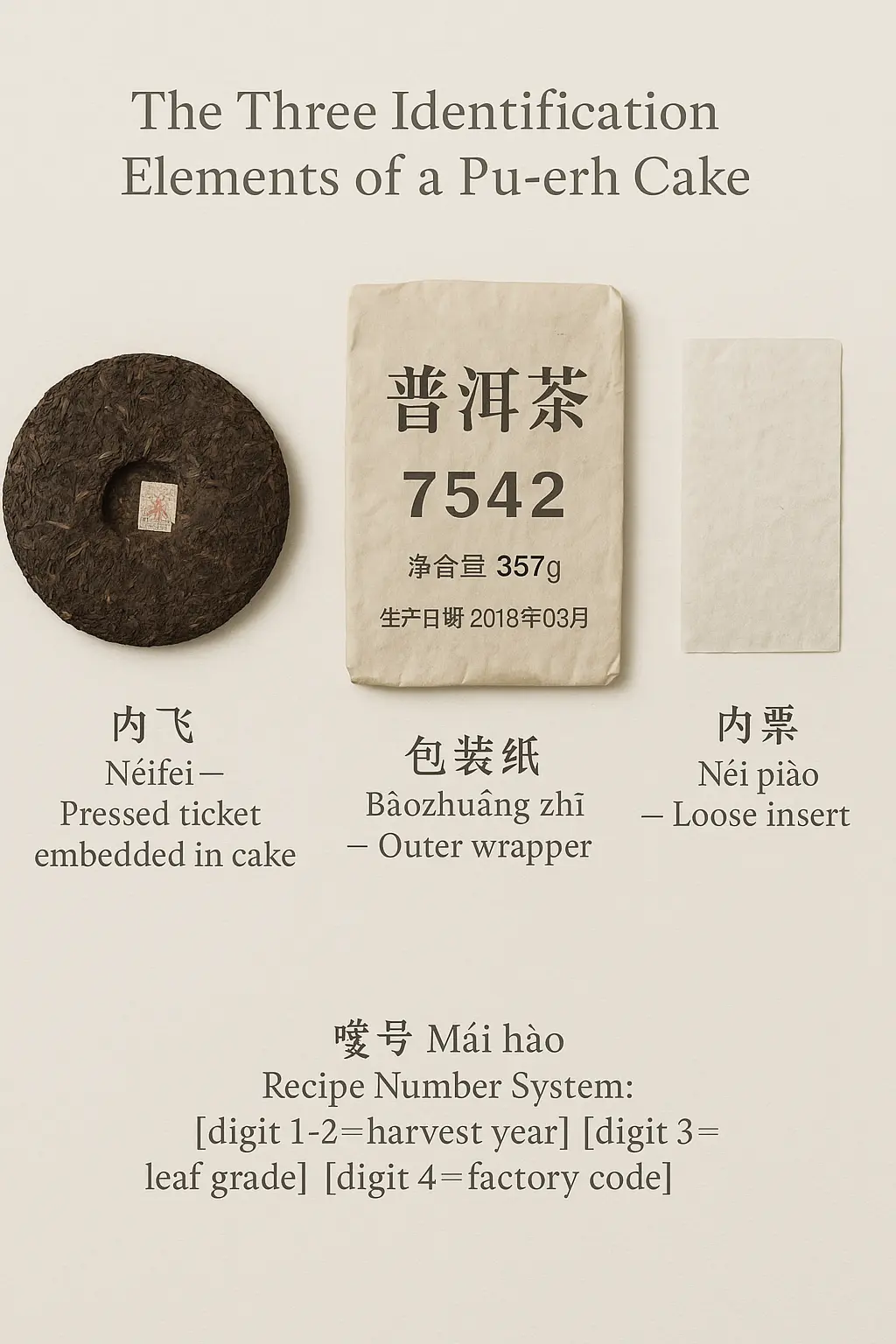
The four-digit recipe number system is one of the most useful tools for identifying pu-erh — and one of the most misunderstood. Here is the exact formula.
AABB C D
No, more precisely: A A B C
Let’s use 7542 as the reference example.
| Digit(s) | Position | Meaning | Example (7542) |
|---|---|---|---|
| 1st–2nd | AA | Year the recipe was standardized | 75 = 1975 |
| 3rd | B | Dominant leaf grade in the blend | 4 = Grade 4 |
| 4th | C | Factory code | 2 = Menghai |
So 7542 = recipe standardized 1975 / grade 4 leaf / Menghai Tea Factory.
And 8582 = recipe standardized 1985 / grade 8 leaf / Menghai Tea Factory.
This system was developed and standardized during the state-factory era of Chinese tea production, when Yunnan’s tea factories operated under central planning and needed a consistent coding method. It remains in use today, though modern private producers sometimes adopt the format loosely or invent their own recipe codes that mimic the structure without following the original rules.
Leaf Grade in Pu-erh
The grade digit (third position) refers to the size and processing classification of the leaf material, not quality in the wine sense. Lower numbers indicate smaller, more tender leaves; higher numbers indicate larger, more mature leaf. This is somewhat counterintuitive if you come from green tea or white tea thinking.
- Grade 1–3: Smaller, more tip-heavy material, often used for the facing/surface (撒面, sā miàn) of a cake to make it visually appealing
- Grade 4–6: Mid-range; the workhorses of most standard blends
- Grade 7–9: Larger, more mature leaf and stem material, often used for the interior (里茶, lǐ chá) or bottom (底茶, dǐ chá) of a cake
Many classic recipes blend grades deliberately — the 7542 uses grade 4 as the dominant material, but the actual blend is not uniform grade 4 throughout. The facing might use grade 3 or even grade 1-2 for aesthetics while the interior uses coarser material for structure and aging depth.
Factory Codes
The four main state factory codes established under the original system:
| Code | Factory | Chinese | Location |
|---|---|---|---|
| 1 | Kunming Tea Factory | 昆明茶厂 | Kunming, Yunnan |
| 2 | Menghai Tea Factory | 勐海茶厂 | Menghai, Xishuangbanna |
| 3 | Xiaguan Tea Factory | 下关茶厂 | Dali, Yunnan |
| 4 | Fengqing Tea Factory | 凤庆茶厂 | Lincang, Yunnan |
Factory code 2 (Menghai) dominates the collector market. The famous 7542 and 8582 sheng cakes, the 7572 shou (ripe), the 7562 — these are all Menghai productions and have been made continuously, with varying quality, from their recipe-standardization dates to the present.
Factory code 3 (Xiaguan) is best known for tuochas (沱茶, tuó chá) — the bird’s-nest-shaped compressed form — and for tightly compressed bings. Their T8653 tuo and FT (Fei Tai) productions are widely collected.
Factory code 1 (Kunming) produced the famous 7581 shou brick (砖, zhuān). Kunming closed as a state factory and has had various reinventions.
Factory code 4 (Fengqing) is less collected in the classic cake market but notable for their Dianhong black teas.
Reading Chinese Date Formats on Pu-erh Labels
Modern Chinese date formatting on tea labels follows the standard ISO-adjacent format: 年 (nián, year) / 月 (yuè, month) / 日 (rì, day).
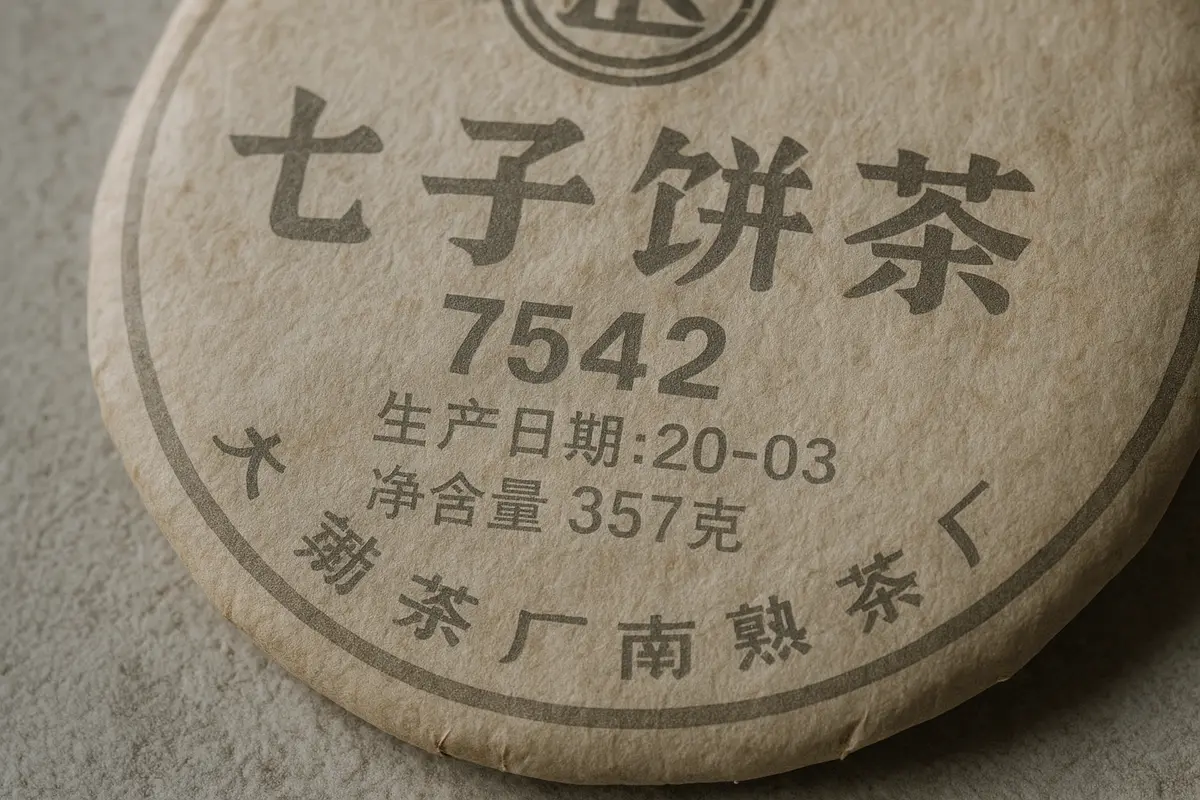
So 2018年03月 means March 2018.
Older labels from the state-factory era often give only the year, sometimes in the Chinese Republican calendar (民國, Mínguó) rather than the Gregorian calendar. The Republican calendar counts from 1912, so:
民國74年 = 1912 + 74 = 1986
This matters when authenticating older Taiwanese-stored pu-erh, where storage and transit documentation sometimes used the Republican calendar. A label reading 民國74年 is not 74 CE — it’s 1986.
Some very old factory productions use only a two-digit year without century designation, which creates ambiguity that forgers exploit. Context from other label elements, wrapper printing style, and neifei condition should resolve this.
Lot and Batch Numbers
Modern productions — particularly from Dayi (大益) post-2004, after the factory’s privatization — include batch numbers (批次, pīcì) on the neipiao or outer wrapper. A Dayi cake labeled 7542 801 means the 7542 recipe, batch 1 of 2008. Batch numbers matter because raw material quality and production conditions vary year to year; some batches are significantly more collected than others.
Common Classic Recipes and What Their Labels Tell You
Understanding a few canonical recipes gives you calibration for reading anything else.
7542 (七五四二)
- Recipe year: 1975
- Leaf grade: 4
- Factory: Menghai (2)
- Type: Sheng (raw)
- The benchmark sheng pu-erh blend. When collectors talk about “standard-wrapper 7542s” from the 1980s and 1990s, they mean specific print runs where the outer wrapper design, neifei style, and ink type are all documented reference points. A 7542 from the late 1990s trades at dramatically different prices than a current-production 7542.
8582 (八五八二)
- Recipe year: 1985
- Leaf grade: 8
- Factory: Menghai (2)
- Type: Sheng (raw)
- Uses coarser grade 8 material, which many collectors argue ages into more complex, earthy territory than grade 4 material. The 8582 is considered more rustic on young drinking but rewarding at 15–25+ years. To understand how pu-erh ages across these timescales, the transformation in coarser-leaf recipes like the 8582 is particularly instructive.
7572 (七五七二)
- Recipe year: 1975
- Leaf grade: 7
- Factory: Menghai (2)
- Type: Shou (ripe)
- The benchmark shou pu-erh blend. Used by Menghai as a reference standard for ripe pu-erh quality.
T8653 (Xiaguan)
- Recipe year: 1986
- Leaf grade: 5
- Factory: Xiaguan (3)
- Type: Sheng tuo
- The classic Xiaguan tuo. Note the T prefix indicating tuo shape. The 8653 tuo is the reference point for Xiaguan sheng aging.
Authenticity Markers and Forgery Red Flags
The market for aged pu-erh (陳年普洱, chénnián pǔ’ěr) is large enough that sophisticated forgeries exist. I’m not a forensic authenticator, and this section is Tier 2 knowledge — drawn from collector literature, documented cases, and dealer accounts rather than personal examination of every type mentioned. Use it as a starting framework, not a final word.
What Authentic Aging Looks Like
Paper oxidation: Wrapper paper and neipiao from genuine aged cakes yellows, darkens, and becomes slightly brittle over 15–30 years. The oxidation is uneven — edges and areas exposed to more air or humidity show more change. Uniformly yellowed paper (as if dipped in tea or aged in an oven) is a warning sign.
Ink aging: Printed ink on authentic aged labels fades and sometimes takes on a slight yellow or brown cast from oxidation. Digital printing didn’t exist in commercial applications in the early 1990s. Any pre-2000 cake with laser-sharp, uniformly colored text is suspicious.
Neifei embedding: A genuine neifei is pressed into the cake under hydraulic or stone pressure. The paper fibers at the embedded edge are disrupted and compressed into the leaf matrix. A neifei sitting cleanly on the surface, with a clean edge at the transition point, has been placed there after the fact.
Neifei paper quality: Pre-1990s neifei were printed on specific paper stocks — slightly rough, with visible fiber texture. Modern reprints often use smoother, whiter paper. Under magnification, the fiber structure differs.
Consistency across elements: This is the key test. All three elements — wrapper, neipiao, neifei — should show consistent and matching aging. A cake where the wrapper looks authentically aged but the neifei is bright white has mismatched elements.
Compression style and aging on the cake itself: Genuine aged sheng pu-erh has a characteristic patina — the surface leaves darken, the compression loosens slightly as fibers relax over time, and the aroma shifts from green/floral to earthy, woody, and sometimes camphor-tinged (樟香, zhāng xiāng). A cake sold as “30-year aged” that still smells predominantly green and grassy needs scrutiny.
Known Forgery Tactics
- Re-wrapping: Taking an authentic neifei from a lower-value production and wrapping it with a high-quality reproduction wrapper for a more valuable recipe.
- Wet storage acceleration: Briefly exposing young sheng to high humidity and temperature to simulate aging on the wrapper and outer leaves, without genuine long-term transformation of the internal leaf material. Understanding how to store pu-erh tea properly makes it easier to recognize when storage conditions have been manipulated for deceptive purposes.
- Neipiao substitution: The easiest swap. Authentic-aged cakes sometimes lose their neipiao in handling; re-sellers substitute reproduction neipiao.
- Decade mixing: Selling 10–15 year old cakes as 25–30 year old production.
The single most reliable protection against forgeries is buying from traceable sources with documented storage history and, ideally, physical samples verified against documented reference cakes. For very high-value aged productions, professional authentication services exist in Hong Kong and Taiwan.
Modern Wrapper Elements: QR Codes and Anti-Counterfeit Features
Post-2010 productions from major factories — particularly Dayi (大益) — incorporate digital anti-counterfeit systems.
QR codes (二维码, èr wéi mǎ): Link to manufacturer databases where you can verify the production batch, recipe, and sometimes the specific weight class of the cake. Scan it: if the URL goes nowhere, loads slowly, or the product data doesn’t match the physical cake, that’s a problem.
Holographic stickers: Applied to the neipiao or outer wrapper. Authentic holograms have depth and color-shift effects. Flat, single-color foil stickers are reproductions.
Serialized neifei: Some modern productions embed neifei with unique serial numbers tied to blockchain-backed provenance systems. This is still emerging technology in the tea space.
Branded string ties (笋壳, sǔn ké) for tong packaging: Authentic factory tong (seven-cake bamboo-wrapped bundles) use branded string and specific bamboo-leaf folding patterns. Fakes often get the wrapper right but miss the tong packaging details.
For everyday purchases of current productions, the QR verification step takes thirty seconds and should be habitual. For aged productions, digital verification doesn’t apply — you’re working entirely from physical evidence and provenance documentation.
A Practical Checklist When Buying a Pu-erh Cake
Use this when examining any pu-erh in person:
- Identify the type first. Is it sheng (生) or shou (熟)? The wrapper should state this clearly on modern productions.
- Read the recipe number. Decode all four digits: recipe year, leaf grade, factory.
- Locate the neifei. Is it partially embedded in the cake? Does the paper match the claimed age?
- Check the neipiao. Note the batch number if present. Cross-reference recipe number with neipiao information.
- Examine the wrapper printing. For modern cakes: check QR codes. For claimed aged cakes: assess ink aging, paper quality, printing method.
- Cross-reference the date. Wrapper date, neipiao date, and batch number should be internally consistent.
- Check consistency. All elements should show matching levels of aging and wear.
- Smell the cake. The aroma should be consistent with the claimed age and type. If you’re evaluating huigan and other sensory markers during a tasting, a structured approach helps — the Steep Atlas tasting protocol gives a repeatable framework for evaluation.
Key Chinese Characters Reference
A quick reference for the characters you’ll encounter most on pu-erh wrappers:
| Term | Characters | Meaning |
|---|---|---|
| Pu-erh tea | 普洱茶 | The category |
| Raw/sheng | 生茶 | Unfermented style |
| Ripe/shou | 熟茶 | Post-fermented style |
| Outer wrapper | 包装纸 | The wrapping paper |
| Neifei | 内飞 | Pressed-in ticket |
| Neipiao | 内票 | Inner loose ticket |
| Recipe number | 唛号 | 4-digit code |
| Production date | 生产日期 | Manufacturing date |
| Net weight | 净含量 | Weight printed on wrapper |
| Batch number | 批次 | Production batch |
| Factory | 茶厂 | Tea factory |
| Cake/bing | 饼茶 | Disc-shaped compression |
| Tuo | 沱茶 | Bowl-shaped compression |
| Brick | 砖茶 | Brick compression |
| Tong | 筒 | Seven-cake bamboo bundle |
| Aged | 陳年 | ”Aged year,” indicating age |
| Camphor aroma | 樟香 | A prized aged sheng note |
| Huigan | 回甘 | Returning sweetness |