Taiwan and China both produce oolong (烏龍) — but the traditions have diverged so far that Taiwanese high mountain oolong (高山烏龍) and Chinese Wuyi rock tea (武夷岩茶, yan cha) taste as different as Chablis and Barolo. Both are partially oxidized teas from Camellia sinensis. Both require extraordinary skill to produce. And yet, put a cup of Ali Shan high mountain oolong next to a cup of Rou Gui from the Zhengyan core, and you’d be forgiven for thinking they came from different plants entirely. Understanding the divergence between Taiwanese vs Chinese oolong illuminates what processing and terroir actually mean in practice — not as abstract concepts, but as flavors in your cup.
What Is the Difference Between Taiwanese and Chinese Oolong?
Taiwanese oolongs are predominantly high-elevation, lightly oxidized ball-rolled teas prized for floral delicacy and creamy texture. Chinese oolongs span a wider range — from the mineral, heavily roasted cliff teas of Wuyi to the aromatic dancong of Guangdong. Taiwan specializes within a narrower band; China covers the full spectrum.
The Comparison at a Glance
Before diving into the details, here’s how these traditions stack up across the dimensions that matter most.
| Dimension | Taiwanese High Mountain | Wuyi Yan Cha | Anxi Tieguanyin | Phoenix Dancong |
|---|---|---|---|---|
| Oxidation | 15–25% | 50–75% | 15–50% (style-dependent) | 50–70% |
| Rolling style | Ball-rolled (球形) | Strip-rolled (條形) | Ball-rolled | Strip-rolled |
| Key technique | High-elevation slow growth | Charcoal roasting (焙火) | Variable roast levels | Single-bush selection |
| Terroir signature | Elevation-driven concentration | Volcanic Danxia mineral (岩韻) | Subtropical granite hills | Fenghuang Mountain granite |
| Flavor profile | Floral, creamy, transparent | Mineral, roasted, deep | Floral to warm (style-dependent) | Aromatic, specific, perfumed |
| Roasting | Minimal to none | Heavy charcoal, multiple rounds | Light to heavy | Moderate to heavy |
| Price range (per 100g) | $15–$60+ | $8–$100+ | $5–$40 | $10–$80+ |
| Best for | Delicacy and floral seekers | Structure and mineral seekers | Exploring the middle ground | Aromatic complexity |
| Wine parallel | White Burgundy | Northern Rhône Syrah | Côtes du Rhône (bridging styles) | Alsatian Gewürztraminer |
This table tells you the shape of the comparison. The rest of this article tells you why.
The Historical Connection: One Root, Two Trees
Taiwanese oolong descends directly from Chinese oolong. This isn’t a metaphor — it’s botanical fact.
In 1855, a scholar named Lin Fengchi (林鳳池) brought oolong tea plants from the Wuyi Mountains (武夷山) to Lugu Township in Nantou County, Taiwan. Those plants became the foundation of Dong Ding oolong (凍頂烏龍), Taiwan’s oldest named oolong tradition. In the early twentieth century, Tieguanyin (鐵觀音) cultivars traveled from Anxi (安溪) in Fujian Province to Muzha (木柵) in what is now Taipei, establishing a second lineage.
The family tree is clear. But 150-plus years of separate development — in different terroir, under different market pressures, with different processing innovations — produced genuinely distinct traditions. Think of it like Pinot Noir: the grape is the same whether it’s in Burgundy or Oregon, but nobody confuses the two wines.
The Processing Fork
Processing is where the divergence becomes irreversible. Even if you planted the same cultivar in both regions, the processing traditions would push the finished tea in opposite directions.
Taiwanese High Mountain Oolong
The signature style of Taiwan’s high mountain (高山) oolongs — produced on Ali Shan (阿里山), Li Shan (梨山), Shan Lin Xi (杉林溪), and Da Yu Ling (大禹嶺) — targets light oxidation, typically 15–25%. After withering and a controlled bruising phase that develops floral aromatics, the leaves are kill-greened (殺青, shaqing) relatively early to arrest oxidation.
The leaves are then ball-rolled (揉捻), a labor-intensive process that wraps them into tight pellets. These pellets unfurl slowly during brewing, releasing flavor across many steeps. Roasting, if applied at all, is minimal — just enough to stabilize the tea for storage without masking its floral transparency.
The goal: a crystalline cup where you taste elevation itself. Orchid, lily, butter, sugarcane. Nothing between you and the mountain.
Chinese Wuyi Yan Cha
Wuyi rock tea follows a fundamentally different philosophy. Oxidation runs heavy — 50–75% — allowing the leaf to develop deep, complex chemistry before kill-green. The leaves are strip-rolled rather than ball-rolled, creating long, twisted shapes that brew differently in the cup.
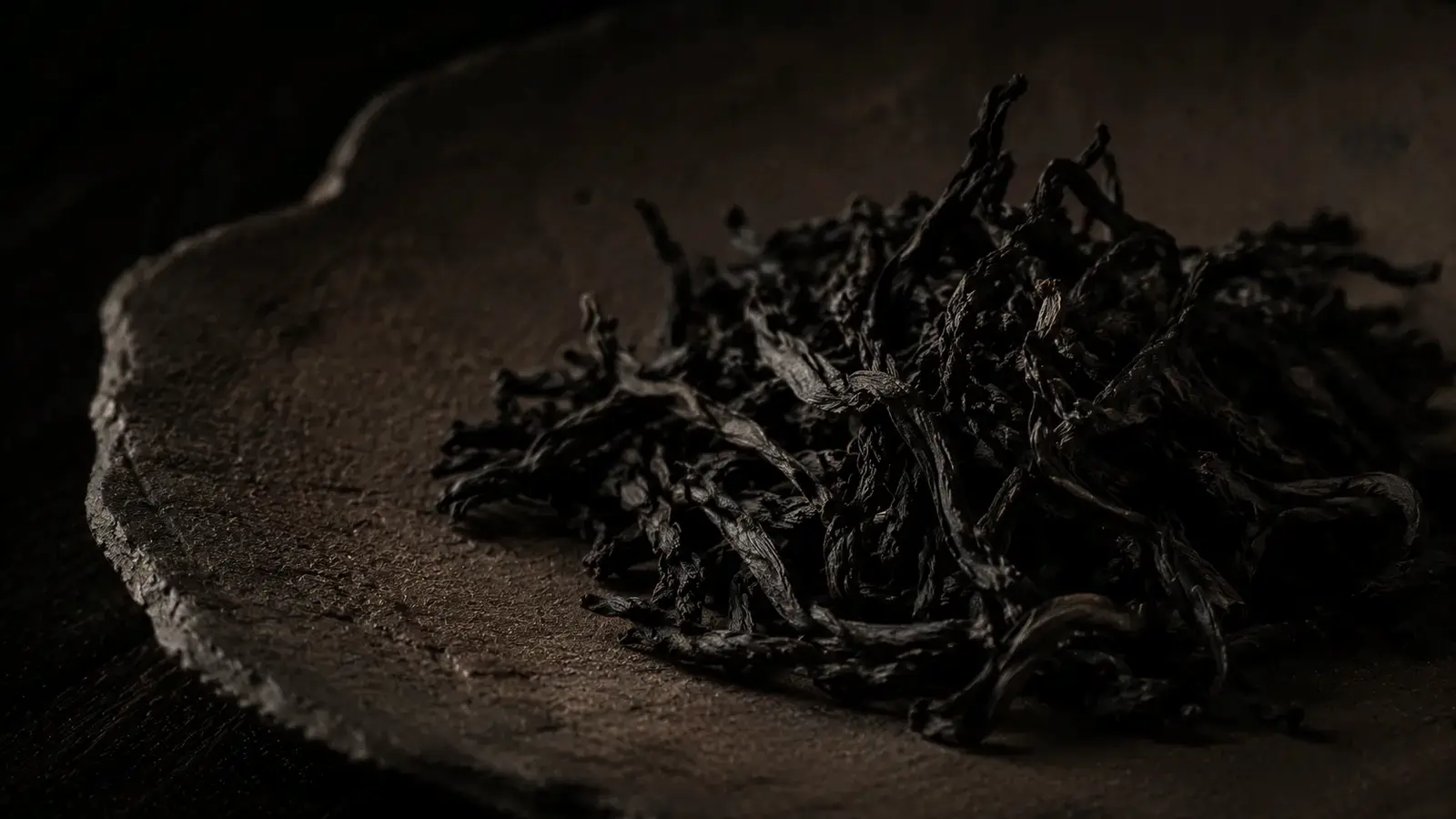
But the defining technique is charcoal roasting (焙火, beihuo). Premium yan cha undergoes multiple rounds of charcoal roasting over weeks or months. This transforms the tea’s flavor architecture from its raw green-floral state into something dark, mineral, and layered. A well-roasted Rou Gui (肉桂) or Shui Xian (水仙) from the Zhengyan (正岩) core carries what Chinese tea culture calls yan yun (岩韻) — rock rhyme — a mineral reverb that hums through the aftertaste.
The goal: depth, structure, persistence. Not transparency but resonance.
Chinese Anxi Tieguanyin
Anxi Tieguanyin sits in the space between these poles, which is part of why it causes so much confusion in the Taiwanese vs Chinese oolong conversation. Tieguanyin is ball-rolled, like Taiwanese oolong. Modern Anxi production often targets light oxidation (15–25%), producing a green, floral style that superficially resembles Taiwanese high mountain tea.
But traditional Anxi Tieguanyin (傳統鐵觀音) was — and in some workshops still is — oxidized to 40–50% and roasted substantially. This traditional style produces a warm, toasty, honeyed cup that has little in common with the modern green version. The cultivar itself, Tieguanyin, brings a specific minerality and what producers call guanyin yun (觀音韻) — the “Guanyin rhyme” — a subtle orchid-metallic character in the aftertaste.
Anxi sits at lower elevation (typically 300–800m) than Taiwan’s high mountain origins, and the terroir difference shows. Even when oxidation levels overlap, the cup character diverges.
Chinese Phoenix Dancong
Dancong (單叢) from the Fenghuang Mountains (鳳凰山) in Guangdong Province represents a third tradition entirely. Oxidation runs 50–70%, and the leaves are strip-rolled and moderately roasted. But dancong’s defining feature is its single-bush specificity — individual trees are selected and processed separately for their unique aromatic profiles.
The result is a gallery of specific perfumes: Mi Lan Xiang (蜜蘭香, honey orchid), Ya Shi Xiang (鴨屎香, duck shit aroma — the name is deliberately misleading), Zhi Lan Xiang (芝蘭香, orchid). Each bush offers a different aromatic signature. This specificity has no real parallel in Taiwanese or Wuyi production, where blending across trees is standard.
Terroir Divergence: Geology as Destiny
Processing choices don’t happen in a vacuum. They evolved in response to what the terroir provides.
Taiwan’s Elevation Advantage
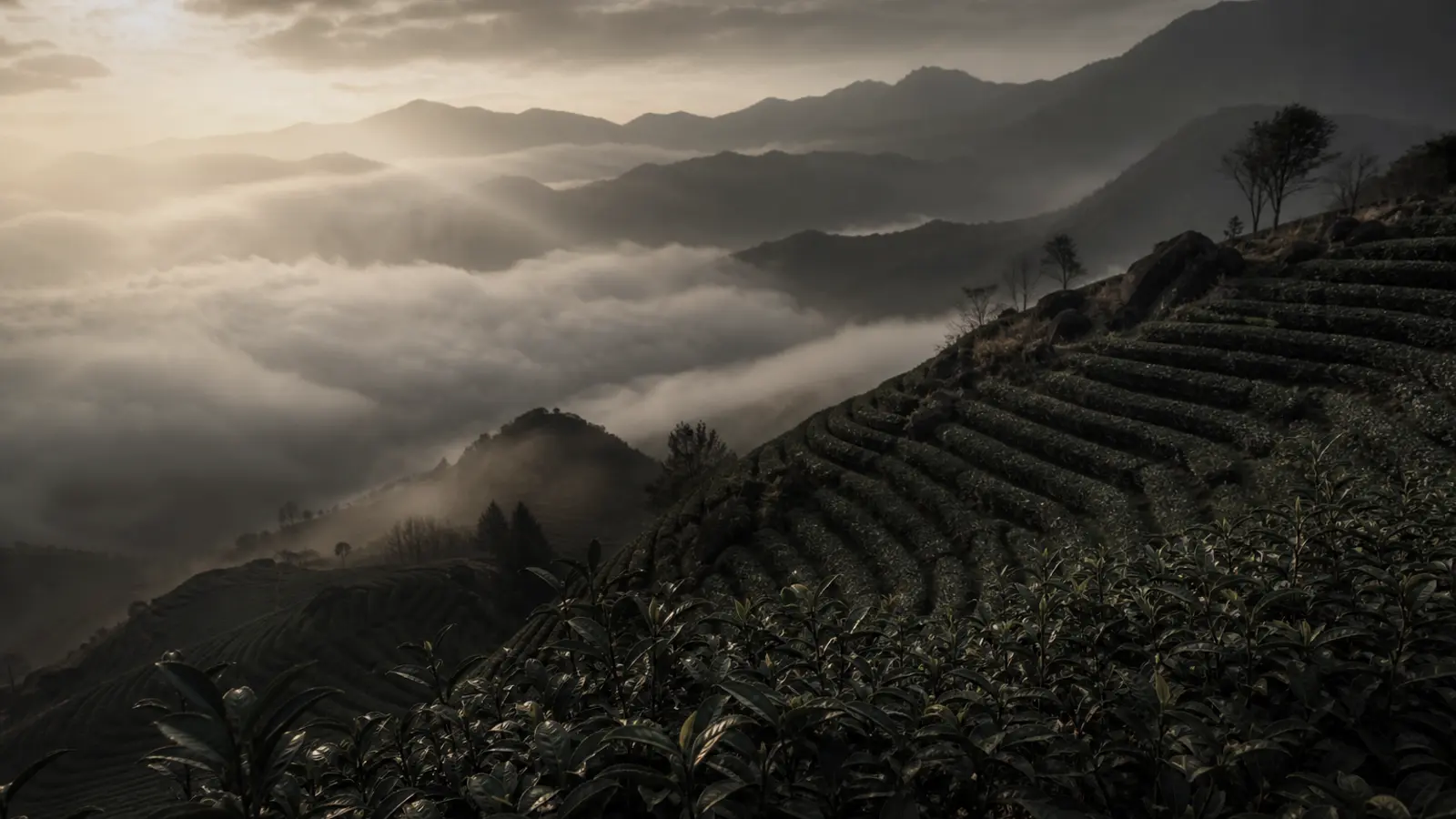
Taiwan’s premier oolong-growing areas sit at 1,200–2,400 meters above sea level. Da Yu Ling, the highest commercially harvested origin, reaches above 2,400m. At these altitudes, temperatures drop significantly at night, slowing leaf growth and concentrating flavor compounds — particularly L-theanine, the amino acid responsible for that characteristic umami sweetness and creamy body.
Cloud cover is persistent. UV exposure is moderated. The leaves grow slowly, developing thicker cell walls and denser flavor chemistry per gram of leaf. This is why Taiwanese high mountain oolong has that almost supernatural sweetness — it’s not sugar, it’s amino acid concentration driven by altitude and slow growth.
The parallel to wine is direct: this is the same dynamic that makes high-altitude Malbec from Mendoza taste different from valley-floor Malbec. Elevation equals concentration.
Wuyi’s Volcanic Signature
The Wuyi Mountains offer something Taiwan cannot: Danxia landform geology. These dramatic cliffs and narrow valleys are composed of volcanic sedimentary rock — a specific geological formation that produces mineral-rich, well-drained soil with a unique chemical profile.
Yan cha grown in the Zhengyan core — the narrow valleys and cliff faces within Wuyi Mountain National Park — absorbs this geology. The resulting mineral character, yan yun, is not a metaphor. Multiple sources describe it as a sensation more than a flavor — a persistent, vibrating quality in the aftertaste that lingers in the throat and palate, reminiscent of wet stone after rain.
This mineral signature is terroir-driven and cannot be replicated through processing alone. Yan cha from the broader Wuyi region (半岩, banyan — half-rock) lacks the intensity of Zhengyan material, even when processed identically. The rock matters.
Neither Is Superior
I want to be explicit about this: these terroirs are not better or worse. They are fundamentally different geological contexts producing fundamentally different teas. Comparing them on a single quality axis misses the point entirely. Taiwan’s elevation produces concentration and sweetness. Wuyi’s Danxia geology produces mineral resonance. You might prefer one, but declaring either objectively superior is like declaring that Burgundy’s limestone is better than the Rhône’s granite. It’s a category error.
Flavor in the Cup: Delicacy vs Depth
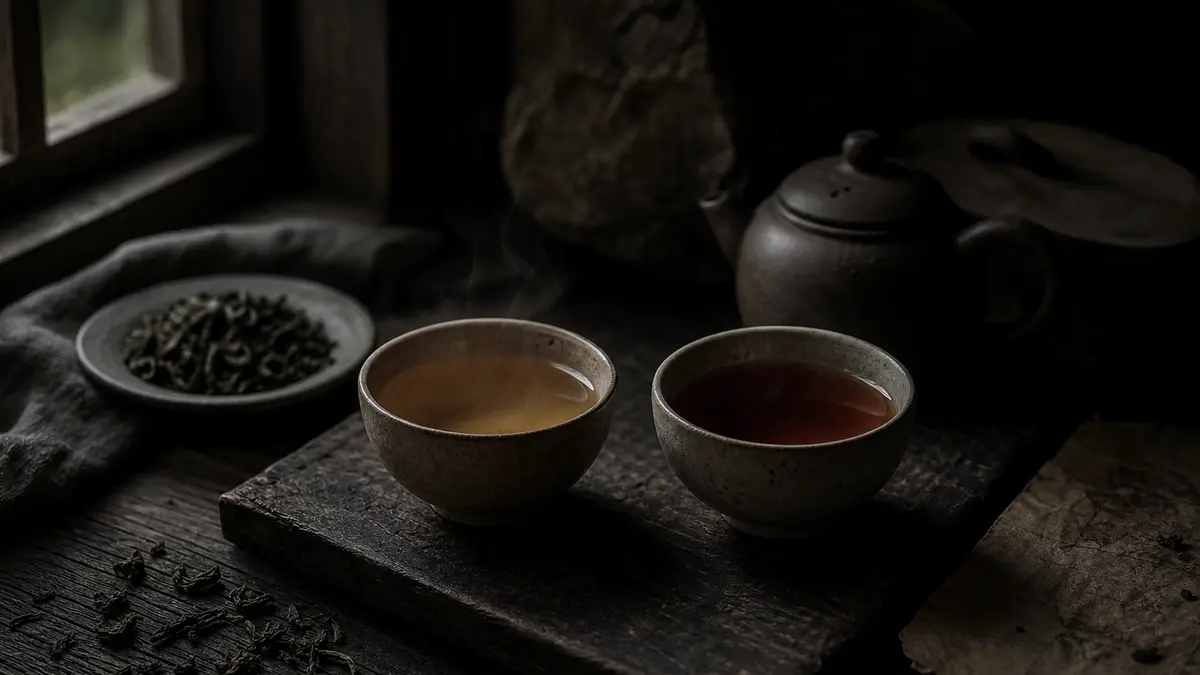
Here’s what you’ll actually taste, side by side.
Taiwanese High Mountain Oolong
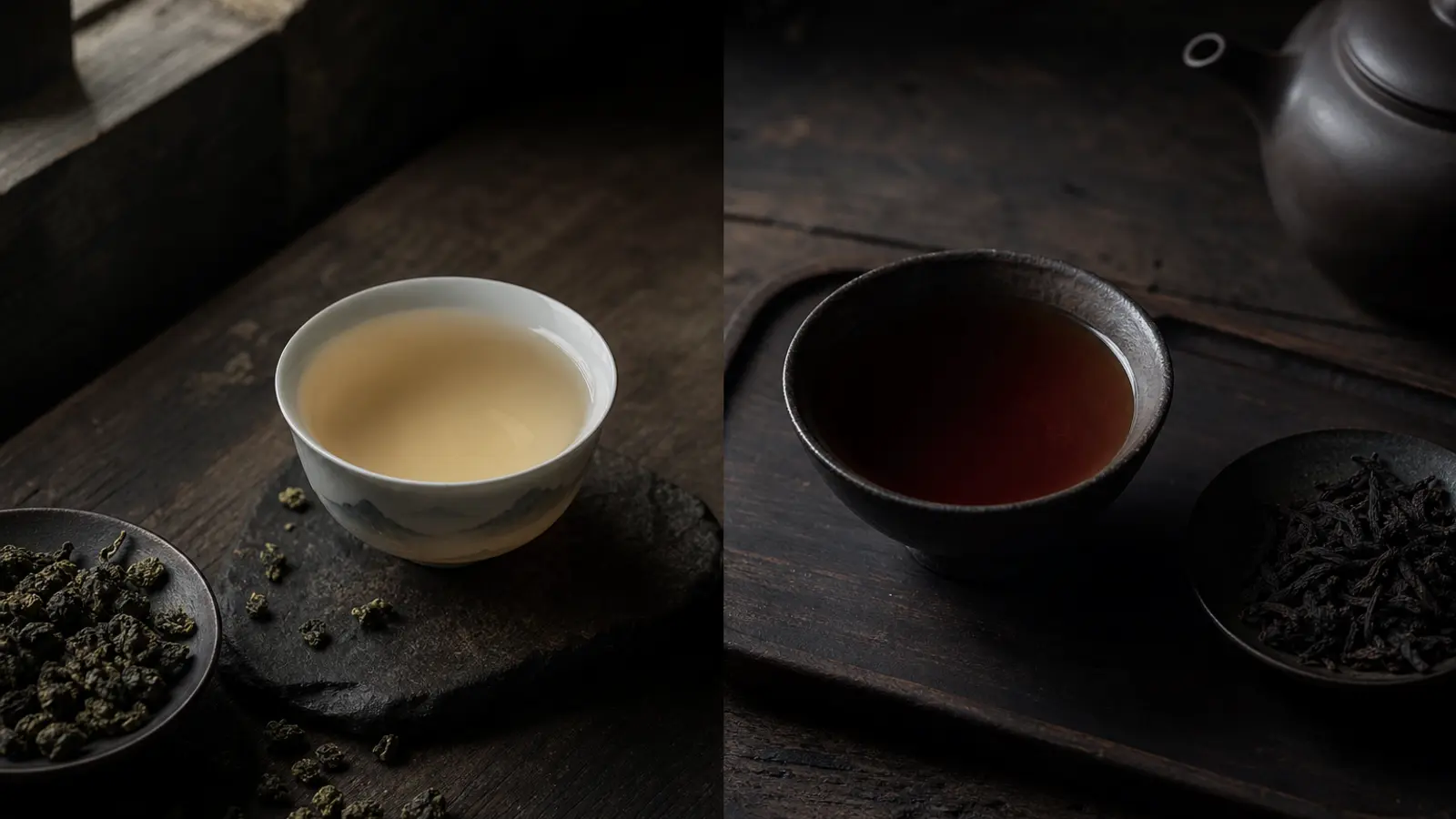
The liquor is pale gold to light green, often nearly transparent. The aroma rises immediately — gardenia, lily, sometimes a distinct butter or cream note. On the palate, sweetness arrives first. Not sugar sweetness but the round, savory-sweet quality of concentrated amino acids. The body is silky. Huigan (回甘, returning sweetness) builds gradually across steeps, and the best examples carry a cooling sensation in the throat.
The overall impression is one of crystalline clarity. You’re tasting the mountain through glass. Nothing obscures the view.
Wuyi Yan Cha
The liquor is deep amber to reddish-brown. The aroma is complex from the start — charcoal, dark stone fruit, cinnamon bark (in the case of Rou Gui), wet rock. On the palate, there’s immediate structure. Yan cha has tannin — not in the aggressive, astringent sense, but as architectural framework. The mineral character sits beneath the roast, and in the best examples, the roast integrates completely, serving as a vehicle for the terroir rather than masking it.
Huigan in good yan cha is deep and persistent — not the light, floral return of high mountain oolong but a resonant, bass-note sweetness that stays in the throat for minutes. Qi (氣), the full-body sensation some teas produce, is often pronounced. You feel this tea in your chest and limbs.
The Anxi Bridge
Good traditional Anxi Tieguanyin sits between these poles. It has the warmth and roast character of yan cha but with a lighter mineral profile and the ball-rolled structure that releases flavor differently in the gaiwan (蓋碗). Modern green-style Anxi Tieguanyin leans toward the Taiwanese profile — floral, light, immediate — but typically lacks the elevation-driven sweetness and body of genuine high mountain tea.
Dancong’s Own Lane
Dancong defies the binary comparison. A well-made Mi Lan Xiang has the oxidation level and structural depth of yan cha but the aromatic specificity of a single-vineyard wine. Each bush is its own terroir expression. If Taiwanese high mountain is Chablis and Wuyi yan cha is Côte-Rôtie, dancong is Alsatian Gewürztraminer — operating in a parallel dimension of aromatic intensity that doesn’t map neatly onto either tradition.
The Market Reality
Pricing reflects production economics, not just quality.
Taiwan is a small island. Its high-elevation growing area is severely limited — there are only so many mountain slopes between 1,200 and 2,400 meters. Labor costs are high by East Asian standards. Harvests are small. A spring Li Shan oolong might run $25–$60 per 100g at retail, and competition-grade Da Yu Ling can exceed $100.
Chinese oolong spans an enormously wider price band. Commodity-grade Anxi Tieguanyin sells for $3–$8 per 100g. Mid-range Wuyi yan cha from the banyan (half-rock) zone runs $10–$30. But premium Zhengyan yan cha — authentic Niu Lan Keng (牛欄坑) Rou Gui or old-tree Ma Tou Yan (馬頭岩) Shui Xian — reaches $60–$150 per 100g and beyond, rivaling or exceeding Taiwanese prices.
The generalization that “Taiwanese oolong is more expensive” holds at the mid-market level but breaks down at the top. Both traditions produce teas that command serious prices from serious collectors.
What differs is the floor. China’s massive production scale means entry-level Chinese oolong is significantly cheaper than entry-level Taiwanese oolong. If you’re exploring on a budget, Chinese oolong gives you more range for less money.
Brewing Considerations
Both traditions reward gongfu brewing, but the parameters diverge.
For Taiwanese high mountain oolong, I use 5–6g in a 100ml gaiwan, water at 90–95°C, with steeps starting around 30–45 seconds and extending gradually. The lower temperature protects the delicate floral aromatics that are this tea’s signature. Porcelain gaiwans work beautifully — they don’t absorb flavor, letting you taste exactly what the leaf offers.
For Wuyi yan cha, I push harder: 7–8g in a 100ml vessel, full boiling water at 100°C, with shorter initial steeps of 10–15 seconds. Yan cha can handle — and rewards — aggressive brewing. The roast and heavy oxidation create a flavor architecture that needs heat to fully express itself. Some yan cha drinkers prefer Yixing (宜興) clay pots, particularly those made from high-fired zhuni (朱泥) clay, arguing the clay rounds the roast and enhances mineral notes. I’ve found this to be true in my own sessions, though the effect is subtle.
Anxi Tieguanyin adapts to either approach depending on style. Dancong, despite its heavy oxidation, requires a lighter hand than yan cha — 5–6g, 95–100°C — because its aromatic compounds are volatile and can turn bitter quickly if overbrewed.
Which Should You Try First?
This depends entirely on your palate.
If you gravitate toward white wines, delicacy, and transparency — if you prefer Puligny-Montrachet to Châteauneuf-du-Pape — start with Taiwanese high mountain oolong. Ali Shan is the most accessible and widely available starting point. Look for spring harvest (春茶) for the richest amino acid content.
If you gravitate toward red wines, structure, and mineral complexity — if you’d choose Côte-Rôtie over Chablis — start with Wuyi yan cha. A mid-range Rou Gui from the broader Wuyi production area is a reliable entry point that demonstrates the roast-mineral profile without requiring a premium investment.
If you drink both wine styles — and most people who care enough to read this article probably do — you’ll drink both oolong styles. They are not competitors. They are complementary expressions of what Camellia sinensis can become under different hands, in different soil, at different altitudes.
The plants came from the same Chinese mountains 170 years ago. What happened next is one of tea’s great stories of divergence. Two islands of tradition, each pursuing its own definition of beauty, producing teas that taste nothing alike and are both extraordinary.
That’s not a problem to solve. That’s a gift.