Comparing Korean tea vs Chinese tea is a bit like comparing a single-vineyard Burgundy producer to the entire wine output of France. Both countries grow Camellia sinensis. Both have tea traditions stretching back centuries. But the scale difference alone reshapes everything — processing, price, cultural meaning, and what ends up in your cup.
China produces roughly 3 million tons of tea annually across all six recognized tea categories, from dozens of provinces, using thousands of cultivars. Korea produces approximately 4,000 tons — almost entirely green tea — from a narrow band of southern coastal land. Understanding that ratio, about 750:1, is the starting point for understanding everything else.
What Is the Difference Between Korean and Chinese Tea?
Korean tea production is small-scale, hand-processed, and concentrated in three southern regions, yielding pan-fired green teas with gentle savory character. Chinese tea spans six major categories across dozens of provinces, with industrial and artisanal production at global scale. Korea is depth in a narrow band; China is breadth across the entire spectrum.
Scale and Scope: A Continent vs. a Garden
Chinese tea culture is a continent. That’s not a metaphor — it’s a geographic reality. Tea grows from tropical Yunnan (云南) in the southwest, where ancient arbor trees produce pu-erh, to temperate Zhejiang (浙江) on the eastern coast, where Longjing (龙井) thrives in cool hillside microclimates. Between those extremes lie Fujian’s oolong mountains, Anhui’s yellow tea valleys, Guangdong’s dancong (单丛) peaks, and dozens more distinct origins. China produces green, white, yellow, oolong, red (commonly called black in the West), and dark/hei cha (黑茶) — every category the tea world recognizes.
Korean tea culture is a garden. That’s not dismissive — some of the world’s most profound wines come from tiny plots. Korean tea production concentrates in the southern provinces: Hadong (하동) in South Gyeongsang, Boseong (보성) in South Jeolla, and Jeju Island (제주도). The elevation range is narrow, roughly 50–700 meters. The primary output is green tea (녹차, nokcha), with emerging production of hwangcha (황차, Korean yellow/oxidized tea) and small quantities of tteok-cha (떡차, pressed fermented tea). Where China offers a library of tea types, Korea offers a focused, intimate collection.
This isn’t a limitation — it’s a defining characteristic. Korean tea’s narrow scope creates depth rather than breadth. The best Hadong yasaeng-cha (야생차, wild-grown tea) from old seed-propagated bushes produces a character that no Chinese origin replicates. That specificity is the point.
Korean Tea vs Chinese Tea: Comparison Table
| Category | Korean Tea | Chinese Tea |
|---|---|---|
| Annual production | ~4,000 tons | ~3,000,000 tons |
| Tea types produced | Primarily green; emerging hwangcha, tteok-cha | All six categories (green, white, yellow, oolong, red/black, dark) |
| Primary processing | Slow pan-firing in iron cauldron (가마솥); some steaming | Fast wok-fired (杀青 shā qīng); also steamed, baked, sun-dried |
| Terroir diversity | Narrow — southern coastal, 50–700m elevation | Vast — tropical to temperate, sea level to 2,400m+ |
| Price range (green tea, per 100g) | $40–$400+ (ujeon highest) | $5–$300+ (Mingqian Longjing highest) |
| Ceremony tradition | Darye (다례) — contemplative, minimal | Gongfu (工夫) — technical, multi-steep; also casual daily brewing |
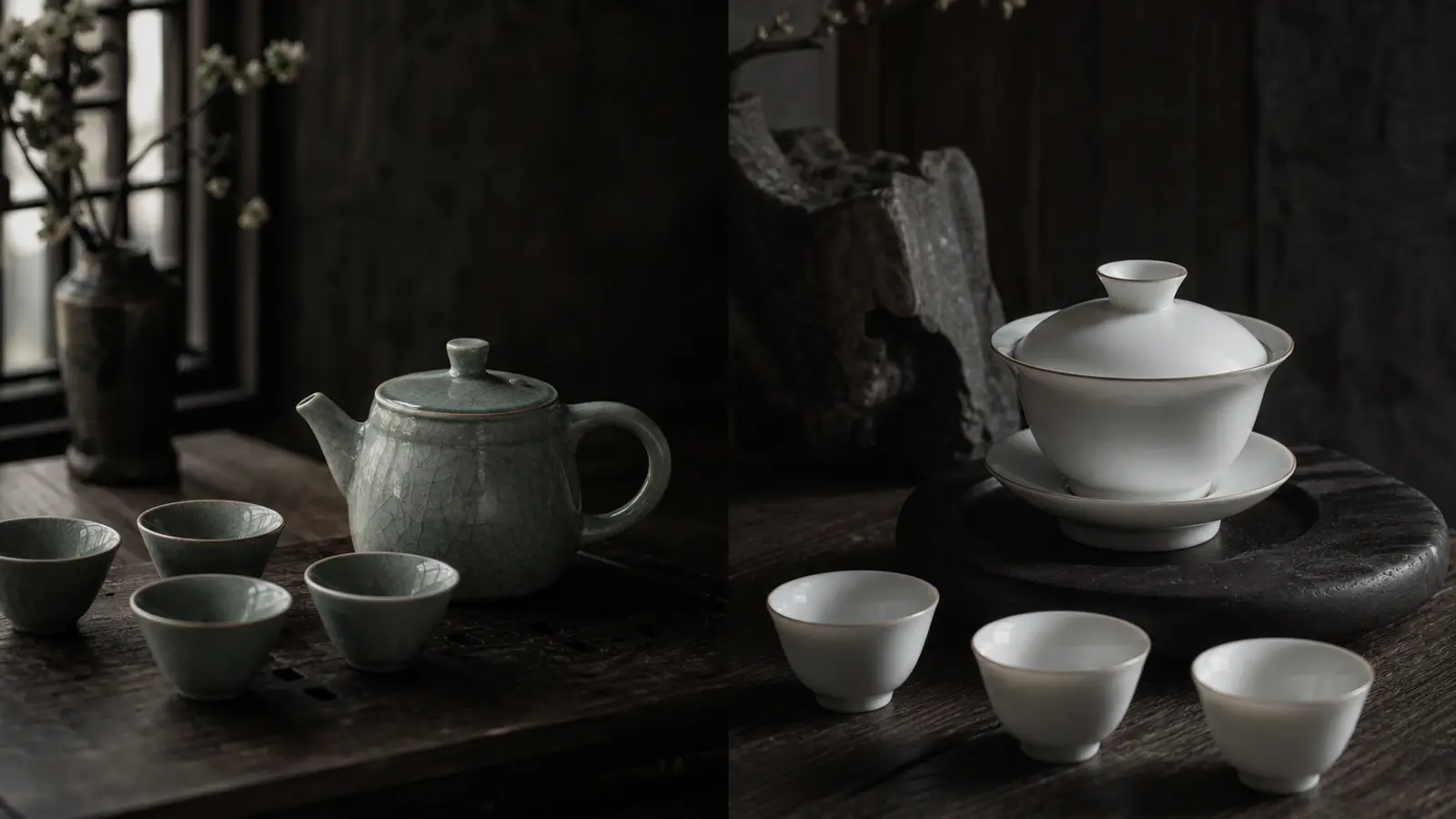
| Teaware tradition | Celadon (청자), buncheong (분청) | Yixing (宜兴) clay, porcelain gaiwan (蓋碗), glass |
| Cultural significance | Post-colonial reclamation; every cup preserves tradition | Embedded in daily life at every social level |
| Cultivar diversity | Limited; many wild seed-grown populations | Thousands of registered cultivars |
| Artisan identity | High — individual makers are traceable and named | Variable — ranges from factory-scale to single-farmer |
Processing: The Kill-Green Divide
Both Korean and Chinese green teas require a kill-green step — applying heat to halt oxidation and fix the leaf’s character. The shared principle obscures a real difference in technique.
Chinese Wok-Firing (杀青, Shā Qīng)
Chinese kill-green is typically fast and hot. A thin-walled steel wok reaches high temperatures. The tea maker tosses leaves rapidly, sometimes for just one to two minutes in the initial firing, before shaping. The goal is efficiency: arrest enzyme activity quickly, then move to rolling and drying. Chinese green tea processing also includes steamed varieties (influenced by historical Japanese exchange) and baked styles like Huangshan Maofeng (黄山毛峰). The breadth of technique matches the breadth of production.
Korean Cauldron-Firing (덖음, Deokkeum)
Korean pan-firing uses a thick cast-iron cauldron (가마솥, gamasot) that holds and distributes heat differently than a thin wok. The firing is slower, with more deliberate hand pressure applied to the leaves. A Korean tea maker may repeat the deokkeum-and-rolling cycle multiple times — fire, press, cool, fire again — building layers of toasted character incrementally. The result is a roast profile that reads differently in the cup: softer, rounder, with a grain-like sweetness that I associate more with toasted rice than with the sharp chestnut snap of a typical Longjing.
Korean steamed green tea (증제, jeungje) also exists, particularly from Boseong, and produces a brighter, more vegetal cup closer in spirit to Japanese sencha than to pan-fired Korean nokcha. But deokkeum defines the Korean green tea identity.
The processing difference matters most in the cup. Korean pan-fired green tea tends toward warmth — toasted grain, sweet nuttiness, a gentle body. Chinese wok-fired green tea tends toward brightness — crisp vegetal notes, sharper aromatics, a clean finish. Neither is superior. They’re different instruments playing in different registers.
Terroir: Uniform Intimacy vs. Continental Diversity
Chinese terroir diversity is unmatched globally. Yunnan alone contains subtropical valleys, high-altitude plateaus, and ancient forest ecosystems. A Darjeeling-adjacent high-mountain white tea from Fujian tastes nothing like a lowland Sichuan green tea, which tastes nothing like a Phoenix Mountain dancong. The variation in soil, altitude, latitude, rainfall, and microclimate across China’s tea-growing regions rivals the terroir complexity of all European wine appellations combined.
Korean terroir is narrower but not without its own distinctions. Hadong’s Hwagae Valley (화개면) sits along the Seomjin River, where wild-grown tea bushes cling to hillsides at 200–500 meters. The soil is granitic, the humidity high, and winter temperatures dip low enough to stress the plants into dormancy — a factor that concentrates flavor in the spring flush. Boseong sits at lower elevation with clay-heavy soil and more structured plantation cultivation. Jeju Island adds volcanic soil and maritime influence. These differences are real, even if the range is compressed compared to China.
The comparison parallels wine neatly. China is like tasting across France, Italy, Spain, Germany, and Portugal combined. Korea is like tasting across a single appellation — say, the Côte de Nuits — where the differences are subtle, site-specific, and reward close attention.
Cultural Weight: Daily Habit vs. Reclamation
In China, tea is woven into every level of daily life. A construction worker fills a thermos with rough green tea leaves and hot water each morning. A businessman conducts negotiations over a gongfu session with aged pu-erh. A grandmother in Chaozhou brews dancong in a tiny pot she’s used for forty years. Tea in China is not precious — it’s essential. This ubiquity is its own kind of beauty. Tea doesn’t need to justify itself in China. It simply is.
In Korea, the picture is profoundly different. The Joseon Dynasty’s (조선, 1392–1897) Neo-Confucian policies marginalized Buddhist monasteries where tea culture had thrived. The Japanese colonial period (1910–1945) further disrupted Korean tea traditions, replacing them with Japanese tea practices and infrastructure. Post-liberation, Korea underwent rapid industrialization, and coffee became the dominant hot beverage. Korean tea culture nearly vanished.
Its revival, driven by monks, scholars, and dedicated artisans since the mid-20th century, gives Korean tea a significance that Chinese tea doesn’t carry. Every cup of well-made Korean nokcha is a small act of cultural preservation. The darye (다례) ceremony — Korea’s contemplative tea practice — is less technically elaborate than Chinese gongfu but more intentionally meditative. Where gongfu is a conversation with the tea’s evolving character across multiple steeps, darye is closer to a quiet sit with one voice, listened to fully.
This cultural weight is not separable from the tea itself. It’s part of what you’re tasting.
Price: Why Korean Tea Costs More
Korean tea is generally more expensive than Chinese tea at equivalent quality levels, and the reasons are structural, not arbitrary.
Premium Korean ujeon (우전, “before the rain” — though the term refers to the earliest spring harvest, picked before Gogu, 곡우) costs $200–$400 per 100g from reputable artisan producers. Chinese Mingqian Longjing (明前龙井, “before Qingming”) at comparable quality runs $100–$300 per 100g. The gap widens at lower tiers: everyday Korean nokcha costs $40–$80 per 100g, while perfectly drinkable Chinese green tea is available at $5–$20 per 100g.
Three factors drive this:
- Production volume. Scarcity is real. Four thousand tons serves a domestic market that’s still small, leaving minimal surplus for export. Chinese tea’s massive output creates a broad price spectrum with accessible entry points.
- Labor costs. Korean wages are significantly higher than Chinese agricultural wages. Hand-picked, hand-fired Korean tea absorbs those costs directly.
- Artisan scale. Many Korean producers are individual makers or small family operations processing hundreds of kilograms per season, not tons. The economics of small-batch production don’t allow for low pricing.
Is the premium justified? That depends on what you value. If you want the best possible green tea for the least money, Chinese tea wins easily. If you want a specific flavor profile, cultural context, and artisan traceability that Korean tea uniquely offers, the price reflects a real cost of production — not marketing.
What Korean Tea Offers That Chinese Tea Does Not
This isn’t about superiority. It’s about specificity. Several elements of Korean tea have no direct Chinese equivalent:
Yasaeng-cha (야생차, wild-grown tea). While China has wild arbor trees, particularly in Yunnan, the Korean yasaeng-cha tradition focuses on seed-propagated bushes growing semi-wild on hillsides, often tended by a single maker who knows each plant. The traceability — this tea, from this hillside, made by this person — creates an intimacy that large-scale Chinese production rarely matches outside of niche single-farmer offerings.
Tteok-cha (떡차, pressed fermented tea). Korea’s traditional pressed tea, shaped into small discs or coins and naturally fermented, has no precise Chinese analogue. It’s not pu-erh. The processing, microbiology, and flavor profile are distinct — earthy, lactic, with a sweetness that develops over months or years.
Darye (다례) ceremony. Simpler than gongfu, less choreographed than Japanese chanoyu, darye emphasizes a quiet presence that lets the tea speak without performance. The aesthetic is rooted in Korean Buddhist practice and the wabi-sabi-adjacent concept of Korean beauty (소박한 아름다움) — unpretentious, warm, slightly irregular.
Korean teaware. Celadon (청자, cheongja) and buncheong (분청) ceramics serve Korean tea in ways that reflect the tea’s character. A buncheong cup — rough, warm, slightly asymmetrical — changes how you experience nokcha compared to drinking it from a thin porcelain gaiwan. Teaware is never neutral, and Korean ceramics are part of the tea’s meaning.
What Chinese Tea Offers That Korean Tea Does Not
Breadth. Sheer, overwhelming breadth.
Want a heavily roasted Wuyi yancha (武夷岩茶) that tastes like charcoal and stone fruit? China. A decades-aged shou pu-erh (熟普洱) with the texture of dark chocolate? China. A high-mountain Taiwanese-style oolong from Fujian with floral lift and no roast? China. A smoky Lapsang Souchong (正山小种) that smells like a campfire? China. A delicate silver needle white tea (白毫银针) that tastes like melon and hay? China.
Korean tea cannot offer this range. It doesn’t try to. Comparing the two on breadth is like criticizing a jeweler for not also being a department store. The comparison is structural, not qualitative.
For anyone building a tea practice, Chinese tea provides the foundation of category knowledge. You cannot understand what oolong is, what dark tea is, what the full spectrum of oxidation and fermentation produces, without engaging Chinese tea. Korean tea provides something different — depth within a narrow lane, and a cultural context that rewards sustained attention.
Which Chinese Tea Is Most Similar to Korean?
If you drink Korean pan-fired nokcha and want to find its closest Chinese relative, look toward Chinese green teas with a similar roast character. Longjing (龙井) shares the pan-fired method but tends crisper and more aggressively nutty. Some smaller-production Chinese green teas from Sichuan or Guizhou, pan-fired at moderate temperatures with less aggressive shaping, come closer to the soft, grain-sweet profile of Korean deokkeum-cha.
But “most similar” still means “noticeably different.” The thick-cauldron Korean firing technique, the cultivar genetics of Korean seed-grown plants, and the terroir of southern Korea combine to produce something that doesn’t perfectly map onto any Chinese category. That irreducibility is the interesting part.
The Honest Bottom Line
Neither Korean tea nor Chinese tea is “better.” The question itself misframes the comparison. Chinese tea is an entire world — arguably the most diverse and historically significant tea tradition on earth. Korean tea is a small, fierce, beautiful corner of the tea universe, carrying the weight of cultural survival in every leaf.
If you’re starting your tea practice, Chinese tea offers more entry points, more variety, and more affordable exploration. If you already have a foundation and want to understand what focused artisan-scale tea culture looks like — and you’re willing to pay for it — Korean tea offers something irreplaceable.
I keep both in regular rotation. They don’t compete with each other. They complete different parts of what tea can be.